






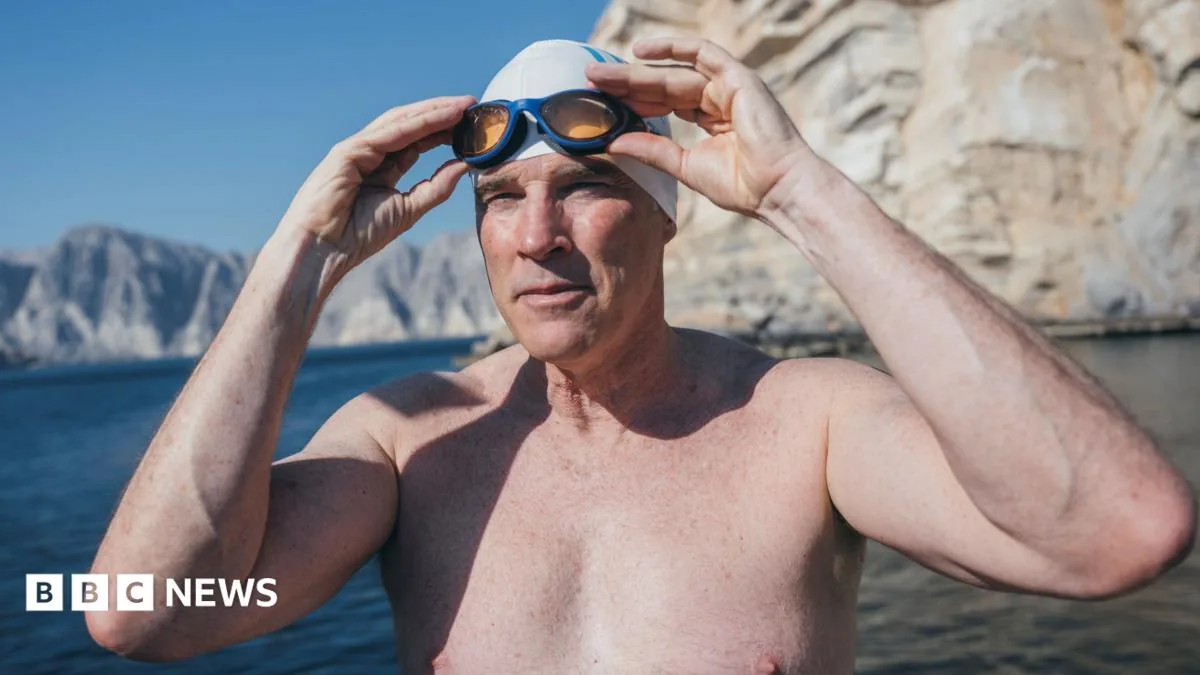
British endurance swimmer Lewis Pugh has completed a three-day journey through the strategic waterway to document environmental damage caused by conflict involving Iran. The 56-year-old athlete, who serves as a UN Patron of the Oceans, traveled about 15 kilometers (9.3 miles) through the Hormuz Strait as cargo tankers faced direct missile strikes nearby. Pugh finished the swim to show how armed conflict harms ocean habitats that receive far less attention than human losses during wartime in the Middle East [1].
Journey Across Hormuz Strait Waters
Born in Plymouth, Devon, Pugh is believed to be the first person to attempt a long-distance swim in the waterway since hostilities involving Iran began in March. He chose the route to bring global focus to neglected marine casualties in Middle Eastern seas. His three-day journey started from Musandam Island and finished at the Cape of Hormuz, located at the northern tip of Oman’s Musandam Peninsula [1].
Pugh faced difficult conditions along the route because the waterway functions as a main route for oil shipments leaving the Middle East, exposing vessels and swimmers to contested water. He completed the 15-kilometer distance against strong tidal currents without assistance between Musandam Island and the Cape of Hormuz. Observers from the Lewis Pugh Foundation tracked his progress as he swam through the Hormuz Strait past rocky headlands and shallow coastal reefs near Oman. Pugh entered a zone of military confrontation to document environmental destruction that conventional reports ignore. His swim linked geographic points across Oman and the Strait of Hormuz to show how battle damage enters fragile ocean habitats [1].
Attacks Near Commercial Tankers
Hostile fire broke out close to Pugh during the opening hours of the expedition near Oman. On the opening day, a projectile hit an oil tanker roughly 4km (2.5 miles) from Pugh’s swimming position, representatives from the Lewis Pugh Foundation reported [1]. The strike hit the carrier as Pugh swam in open water off the Musandam Peninsula. Heavy smoke rose above Omani waters shortly after the blast.
Danger escalated on the second day when Pugh observed massive columns of fire rising over a coastal headland that separated him from Tara Gas, a commercial carrier transporting liquefied petroleum gas. He later swam near Tara Gas while the damaged carrier continued burning in open water off the Musandam Peninsula. “My immediate thoughts were for the seafarers on board,” Pugh said. “The flames were enormous. These vessels carry highly flammable gases, and an attack on one can have catastrophic consequences – not just for crew members, but also on the surrounding marine environment.” Fires aboard transport vessels also create deep psychological pressure for civilian crews working under threat of attack, a concern reflected in studies of mental health at sea during the Hormuz Strait crisis.
Why Hormuz Is Important for Marine Life
Beyond its role as a busy oil channel for the Middle East, the waterway shelters diverse marine species that depend on clean coastal currents along the Musandam Peninsula. The shallow waters provide essential feeding grounds and migratory paths for dugongs, known scientifically as Dugong dugon, as well as sea turtles and whale sharks that inhabit the passage near Oman [1]. These animals rely on undisturbed coastal bays to survive.
These large marine species face grave hazards whenever fuel spills or burning petroleum wash through their feeding areas after attacks on passing ships. Dugongs graze on underwater plants, sea turtles feed along shallow banks, and whale sharks filter nutrients near the surface where oily films collect after maritime strikes. Because military operations prevent environmental response teams from deploying containment barriers, drifting residues spread over feeding grounds without cleanup. Pugh warned that toxic pollutants cause lasting damage beneath the surface of the Hormuz Strait, where wildlife cannot escape contaminated water [1]. Marine life in Oman suffers as water quality declines.


Strait of Hormuz Habitats at Risk
Toxic contamination from damaged cargo carriers creates hazards for plant and animal communities near the Cape of Hormuz and Oman. Pugh said oil spills and chemical leaks threaten coral reefs, seagrass meadows, and mangrove forests that stabilize Omani shorelines and sustain local fisheries [1]. These plant systems along the Musandam Peninsula form the foundation of nearshore food chains. Chemical residues settle into Omani sediments where they remain toxic for marine organisms.
When a damaged vessel leaks petroleum into the sea, thick slicks block sunlight and prevent underwater vegetation from producing oxygen through photosynthesis. Corals suffer smothering when heavy oil deposits sink onto reefs, and toxic compounds also poison seagrass beds where fish breed in shallow water near Oman. Mangrove forests along coastal margins trap floating chemicals within their root networks, killing juvenile marine life that relies on intertidal swamps for protection from open ocean predators. Pugh warned that contamination from military attacks can degrade marine ecosystems for decades, leaving coastal zones impaired long after armed conflict ends [1]. Natural recovery takes many years once oil penetrates coastal sediments.
Human Cost and Neglected Ecosystems
Pugh argued that international discussions of war focus almost exclusively on direct human trauma, but they regularly ignore environmental destruction in contested waters. “War causes immense human suffering. Lives are lost, families are torn apart, and homes, hospitals and schools can be destroyed in minutes,” he said. “But there is another casualty that receives far too little attention: nature itself. And the damage can last long after the fighting has stopped” [1].
News broadcasts routinely document missile strikes, vessel fires, and economic disruption, yet often overlook the silent degradation of Middle Eastern waterways. Pugh argued that although public debate tracks financial losses and military spending, discussions on the cost of war ignore environmental damage. Tanker fires release heavy smoke into the atmosphere, and ruptured fuel tanks discharge toxic petroleum compounds into the Hormuz Strait that poison benthic habitats. Because marine life cannot participate in diplomatic talks or file legal claims, coastal habitats suffer continued harm without emergency cleanup measures or remediation funding [1]. The ecological bill of military conflict remains unpaid by warring states.
Calls for Regional Conservation Action
Swift action by international authorities is necessary to prevent further ecological damage near the Musandam Peninsula and the Cape of Hormuz. Pugh appealed for an immediate ceasefire, urged authorities to ensure the reopening of the Strait of Hormuz, and demanded dedicated remediation efforts to heal wartime ecological harm [1]. He urged authorities in Oman and neighboring states to restore open navigation and halt missile strikes on merchant ships. His appeal demands that nature receive formal protection in peace talks involving Iran.
An end to missile attacks on tankers in the Middle East is the most direct way to prevent further chemical spills and protect mariners working in the waterway. As a UN Patron of the Oceans, Pugh advocates for scientific assessments to evaluate how much petroleum and toxic debris have settled into coastal waters of Oman since hostilities began in March. A diplomatic agreement to reopen the passage would permit marine conservationists to monitor damaged coral reefs, clean oil residues from mangroves, and protect endangered sea turtles in Oman. Pugh hopes his swim encourages leaders to recognize that environmental protection is essential for lasting peace [1]. Protecting the sea preserves life for future generations.
- ONLINE NEWS Wallace, J. (2026, November 21). Strait of Hormuz swim highlights environmental cost of war. BBC News. [Article Link]
APA 7: PerEXP Teamworks. (2026, November 22). Lewis Pugh Swims Hormuz Strait to Highlight Ecological Cost of War. PerEXP Teamworks. https://perexpteamworks.com/en/hormuz-strait-swim-environmental-cost/


