






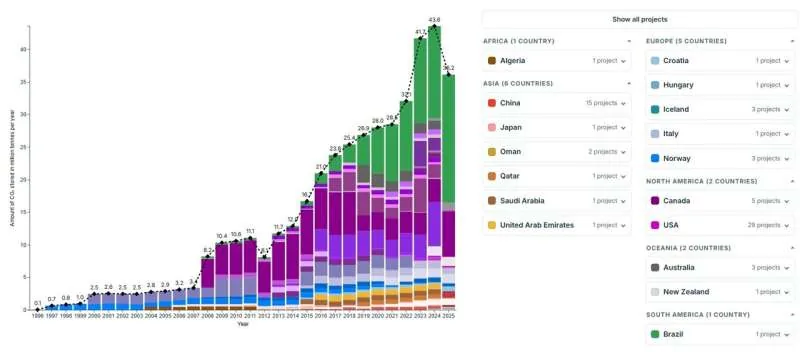
Annual underground CO2 storage reached a record 43.6 million metric tons in 2024, according to findings from the London Register of Subsurface CO2 Storage led by Imperial College London researchers [2]. The registry tracked 70 projects located in 17 countries, marking one of the broadest surveys of subterranean carbon disposal assembled to date [1]. Cumulative storage since 1996 now totals 421.7 million metric tons, or roughly 464.8 million US tons, showing steady industrial growth over nearly three decades [2].
Rising Volumes Since 2016
Annual volumes of injected carbon dioxide have more than doubled over the last eight years. Register figures show that global storage rose from 21.0 million metric tons in 2016 to 43.6 million metric tons in 2024, which equals an increase from 23.1 million to 48.1 million in US tons [1]. Professor Samuel Krevor, director of the Register from the Department of Earth Science and Engineering at Imperial College London, described this growth as evidence of maturing deployment. “Our latest report shows that geological CO₂ storage has become a global enterprise, with annual reported storage more than doubling between 2016 and 2024,” Krevor said, noting that new facilities join the ledger each year [2].
The database relies on an international research consortium instead of unverified corporate claims. More than 30 experts collaborate on compiling the annual figures, bringing together teams from Stanford University’s Department of Energy Science & Engineering, MIT Civil and Environmental Engineering, and Australia’s CSIRO. Non-academic contributors include the Global CCS Institute, the Carbon Capture & Storage Association, and the IEAGHG. Their shared work evaluates reported data against uniform standards so public agencies can assess decarbonization progress [2].
Geographic participation broadened during the 2024 reporting period. Two new countries, New Zealand and Italy, joined the global ledger during 2024 after launching localized injection trials. In Europe, the Norwegian Northern Lights joint venture began injection operations in August 2025, providing transport and reservoir access for industrial emitters [2]. It accepts liquefied gas delivered by specialized ships from coastal industrial hubs on the North Sea [1].
Top Performing Projects by Country
The United States maintained the highest total number of storage sites in 2024. American operators ran 23 active projects that collectively stored 20.2 million metric tons of carbon dioxide, which equals 22.3 million US tons [1]. Many of these facilities operate near energy infrastructure in Texas and Wyoming, including the Shute Creek plant and the North Burbank Unit [2]. US project counts lead the world, but individual injection volumes vary widely depending on nearby capture supply and reservoir permeability [1].
Brazil hosts the single largest carbon disposal venture anywhere on the planet. The Petrobras Santos Basin Pre-Salt Oil Field stored 14.2 million metric tons of carbon dioxide in 2024, or roughly 15.7 million US tons [2]. That single deepwater operation accounted for approximately one-third of the global total recorded by the register [1]. Offshore gas processing platforms separate the gas at sea and reinject it thousands of meters beneath the Atlantic seabed to minimize atmospheric venting [2].
Other nations logged notable contributions through major industrial projects. China stored 1.7 million metric tons, or 1.9 million US tons, drawing gas from the Shengli Oilfield and the newly included Daqing Aonan Oilfield [2]. Australia recorded an identical 1.7 million metric tons (1.9 million US tons) following the start of the onshore Moomba storage project [1]. These additions show that industrial hubs in Asia and the Pacific are building dedicated deep-rock isolation systems [2].
Data Audits and Baseline Revisions
Rigorous audit checks forced researchers to downgrade past baseline estimates. Cumulative storage through 2023 was revised downward from 351.4 million to 342.0 million metric tons, representing a 2.7 percent reduction in total permanently archived carbon [2]. In US short tons, that adjustment shifted the historical baseline from 387.4 million down to 377.0 million US tons [1]. The annual storage total for 2023 alone dropped from 45.2 million to 41.7 million metric tons, or from 49.8 million to 46.0 million US tons, after analysts corrected double-counting errors [2].
The corrections stemmed from three primary reporting flaws identified during data verification. Teams resolved overlap between company-level filings and project-level meters, corrected national inventory tallies for the historic Sleipner project in Norway, and reinterpreted recycling rates at the North Burbank Unit in Oklahoma [2]. Dr. Xiaowei Gao, executive director of the Register at Imperial College London, defended the adjustments [1]. “These revisions reflect the latest evidence, and we have been explicit in the report about where the accounting for reported storage remains uncertain,” Gao said [2]. “That transparency matters if geological CO₂ storage is to earn the confidence of policymakers and investors,” she added [1].

Preliminary submissions for 2025 illustrate how delayed reporting complicates tracking. At the time of publication, 29 projects in 12 countries had submitted early numbers showing 36.2 million metric tons (39.9 million US tons) of sequestered gas [2]. Brazil’s Petrobras Santos Basin project reported 21.6 million US tons (19.6 million metric tons) for 2025, climbing from 15.7 million US tons in 2024 [1]. However, prominent American reservoirs including Shute Creek, Hobbs Field, Denver Unit/Wasson San Andres Field, and Seminole San Andres Unit had not completed their 2025 filings when the report was issued [2].


How Geological CO2 Storage Works
Impermeable caprocks keep greenhouse gases sealed far beneath the earth’s surface. Industrial facilities extract gaseous emissions from cement kilns, chemical plants, and power generation units, purify the stream, and compress it into a dense supercritical fluid [1]. Underground CO2 storage relies on injection wells to propel this fluid into deep saline formations or depleted oil fields thousands of feet underground. Microscopic pore spaces in sandstone or carbonate rock absorb the fluid, while overlying shale formations prevent upward migration toward drinking water aquifers [2].
How do regulatory authorities verify that stored gas remains locked permanently underground? In the United States, project operators comply with Environmental Protection Agency rules governing Class VI subterranean injection wells [2]. These mandates prescribe continuous reservoir pressure monitoring, seismic surveillance, and surface soil sampling to identify any anomalous gas leaks [1]. Yet standards diverge across borders, because several emerging producer nations lack statutory frameworks for long-term reservoir stewardship [2].

Engineering priorities will shift as ambient removal systems reach commercial scale over coming decades. While nearly all current carbon comes from point-source industrial scrubbers, direct atmospheric extraction is expected to dominate disposal infrastructure by mid-century [1]. Samuel Krevor noted that direct air capture will need vast underground storage reservoirs capable of permanent containment. “Where the sources of CO₂ today are dominated by industrial capture, removals from the atmosphere are projected to emerge as the leading technology using geological storage by mid-century,” Krevor said [2].
Accounting Gaps in Oil Recovery Projects
A substantial fraction of reported subsurface carbon remains entangled with fossil fuel extraction. According to the London Register, 82.3 percent of all cumulative storage achieved since 1996 falls under the category of Geological Storage with Oil Recovery [2]. In these arrangements, operators inject pressurized gas into mature reservoirs to dislodge trapped crude oil, extending the working lifespan of legacy fields [1]. While a portion of the injected gas stays trapped in reservoir rocks, environmental advocates question whether subsidizing oil production yields true net climate gains [2].
Measurement discrepancies complicate net balance sheets across multiple oil recovery sites. Roughly one-third of the carbon reported under oil recovery projects—amounting to 112.5 million metric tons—is listed simply as injected volume without discounting gas that returns to the surface [2]. When extracted hydrocarbons reach the surface, associated gas is often captured and recycled back underground, creating risks of double counting [1]. The register consortium acknowledged this uncertainty in their formal assessment. “In this Register we endeavor to compile values of storage net of any losses and accounting for recycled and reinjected CO₂,” the authors wrote. “There are, however, uncertainties in the meaning of the reported values for those projects with ambiguous or unstated bases.” [2]
Auditing teams plan to publish deeper technical breakdowns to resolve these ambiguous filings. Upcoming editions of the register will apply standardized loss equations to separate net permanent storage from recirculating operational streams [2]. Resolving these accounting gaps is essential for carbon credit markets that price offset certificates based on certified permanence [1]. Without strict verification, commercial buyers cannot determine whether purchased credits represent real emissions reductions or routine reservoir operations [2].
Underground CO2 Storage Targets for 2050
Existing underground CO2 storage rates fall far short of international climate benchmarks. Under decarbonization pathways aligned with the Paris Agreement goal to cap warming at 1.5°C (2.7°F), geological storage must reach at least 1.0 billion metric tons per year by 2050 [2]. In US short tons, that target requires sequestering more than 1.1 billion US tons annually [1]. Meeting that goal means global capacity must expand more than twentyfold over the next quarter-century [2].
Can industrial developers construct the necessary transport and injection infrastructure in time? New pipeline networks and offshore pore space will need heavy capital investment from utilities and energy companies [1]. Geologists must conduct extensive seismic mapping to prove that candidate formations can hold injected volumes without inducing minor earthquakes or leakage [2]. Public support hinges on demonstrating that subsurface containment remains leak-free across multi-decade operational horizons [1].
Transparent scientific accounting will serve as the foundation for this rapid industrial expansion. Verifying each underground CO2 storage project protects public investments only when stated climate gains match real atmospheric outcomes. Krevor emphasized that precision remains crucial as facilities multiply across new continents. “The more precisely we can trace every metric ton of CO₂ from injection to permanent storage, the stronger the evidence base we can provide as the technology grows to the scale that climate targets demand,” Krevor concluded [2].
- ONLINE NEWS Mocerino, M. (2026, October 25). Underground carbon storage hits record high as US leads global charge. Interesting Engineering. [Article Link]
- ONLINE NEWS Imperial College London. (2026, October 25). Global underground CO₂ storage hit record 43.6 million metric tons in 2024 alone. Phys.org. [Article Link]
APA 7: PerEXP Teamworks. (2026, October 26). Imperial College Report Logs Record Underground CO2 Storage. PerEXP Teamworks. https://perexpteamworks.com/en/underground-co2-storage-record-2024/


