





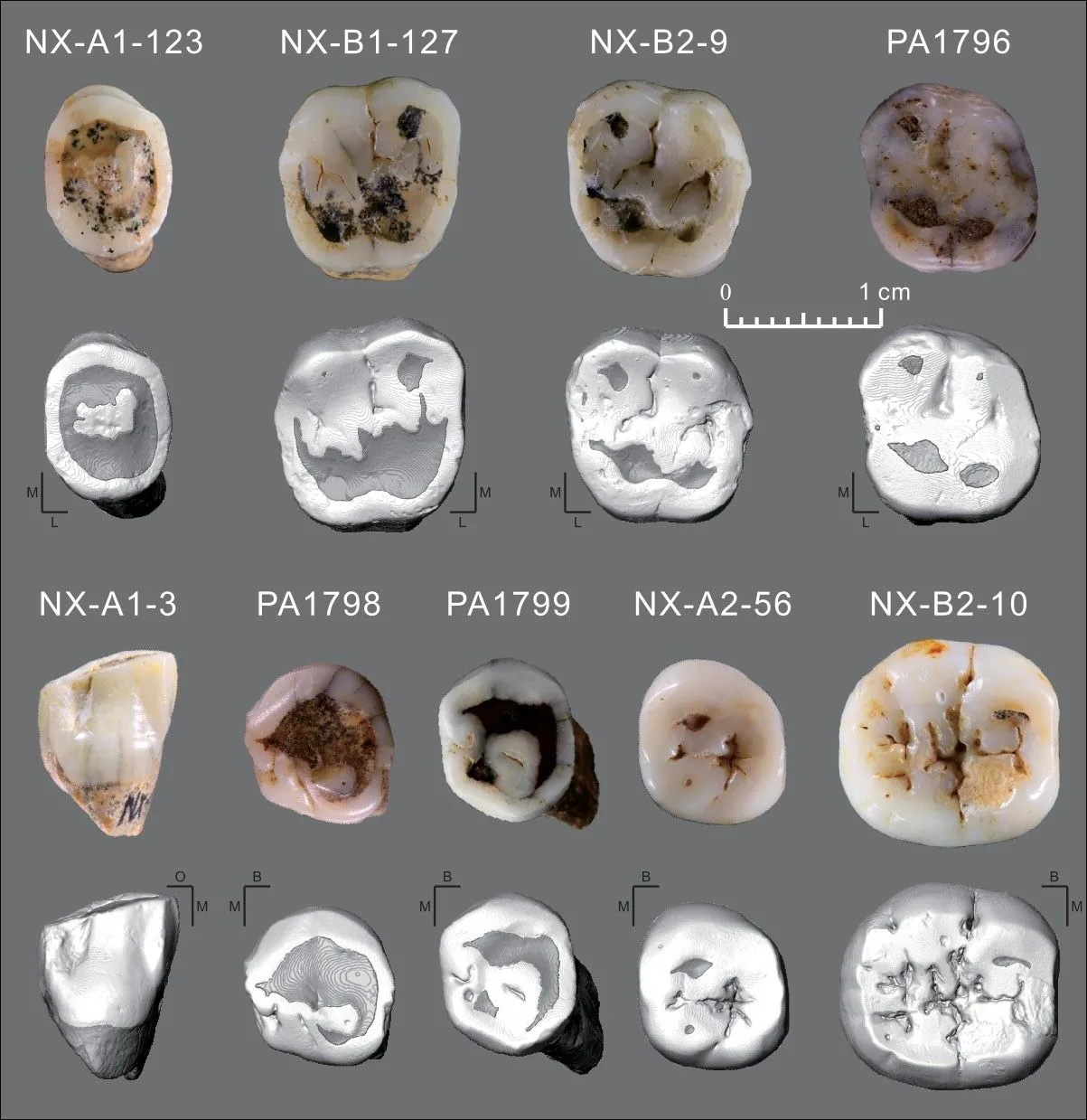
Nine fossil human teeth unearthed from two cave chambers in southern China show that late Homo erectus survived in closed tropical rainforests until 184,000 years ago. The discovery extends the confirmed presence of the species on the Asian mainland by more than two hundred thousand years [1]. Long regarded as open grassland specialists who vanished from the continent during the Middle Pleistocene, these ancient hominins thrived in wet forest canopies and traveled through rugged limestone corridors during the same era Denisovans occupied East Asia [2].
Fossil Teeth in Guangxi Caves
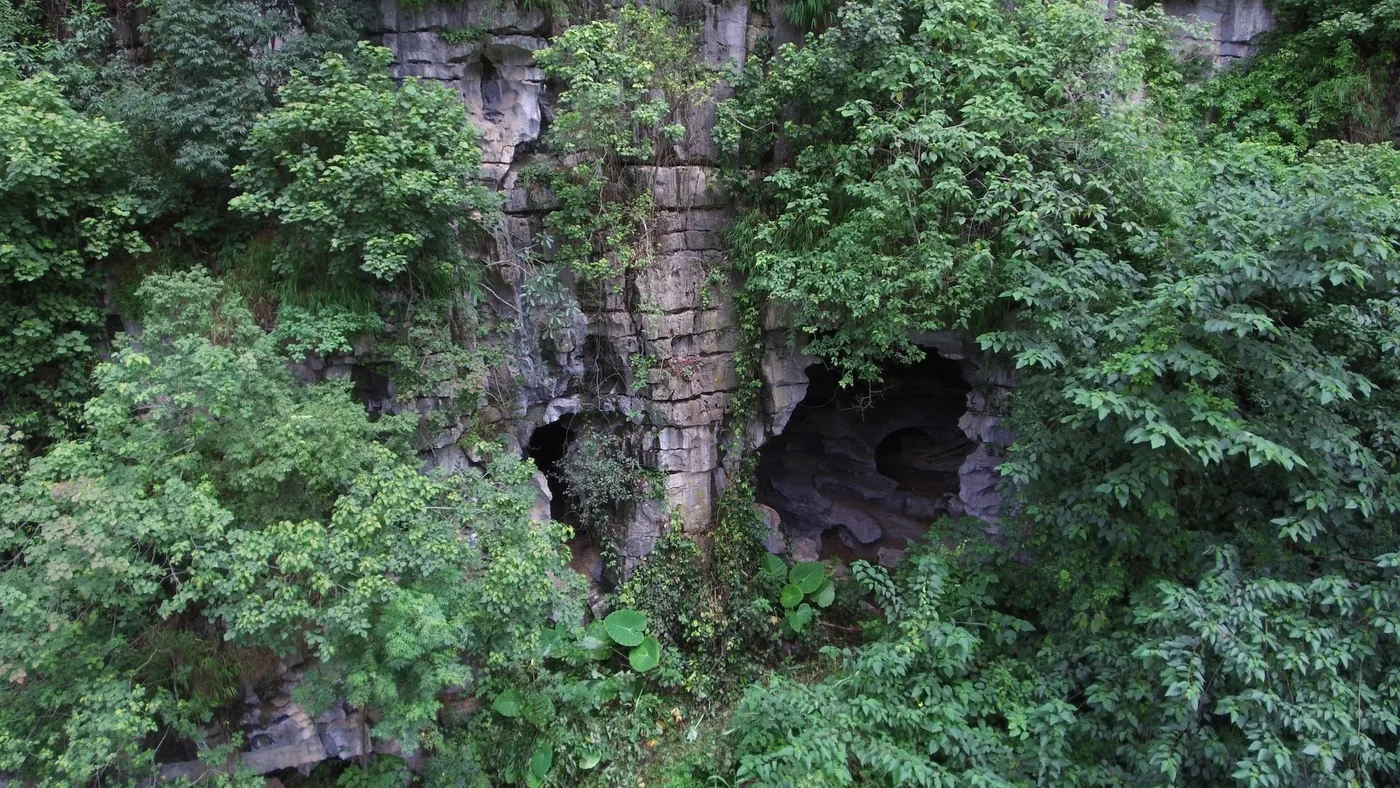
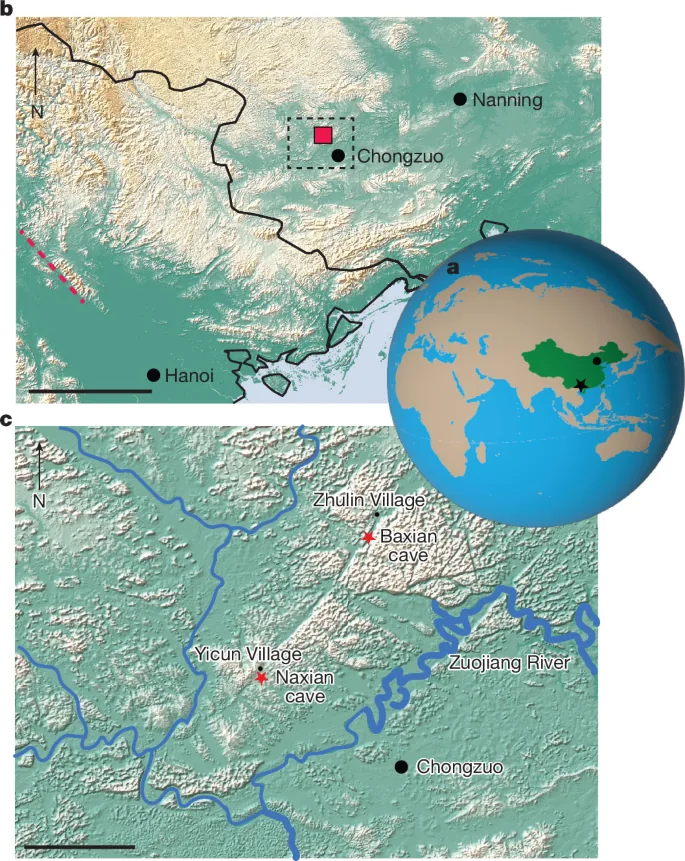
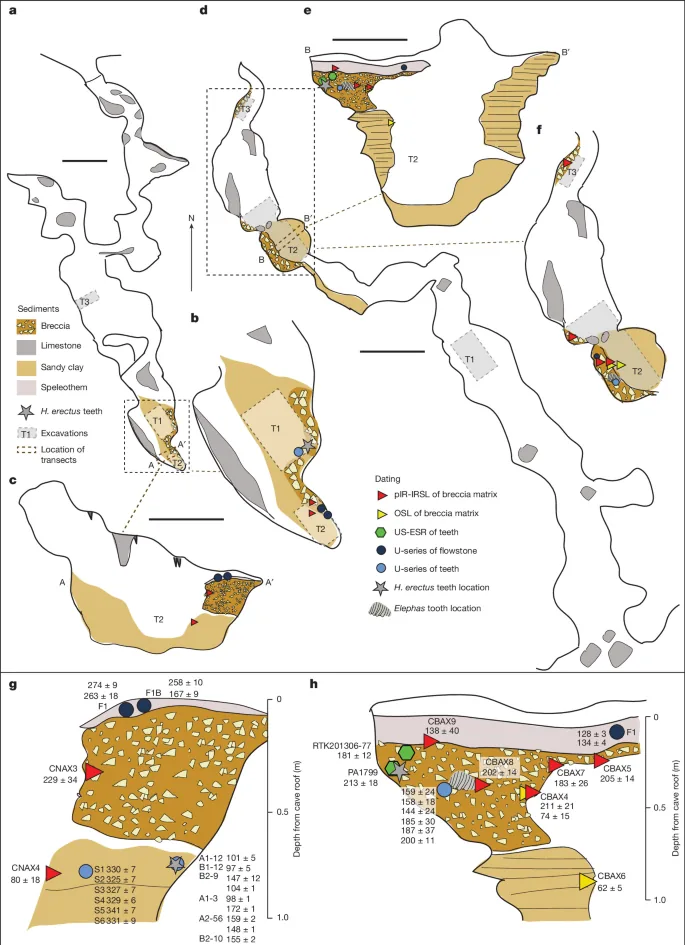
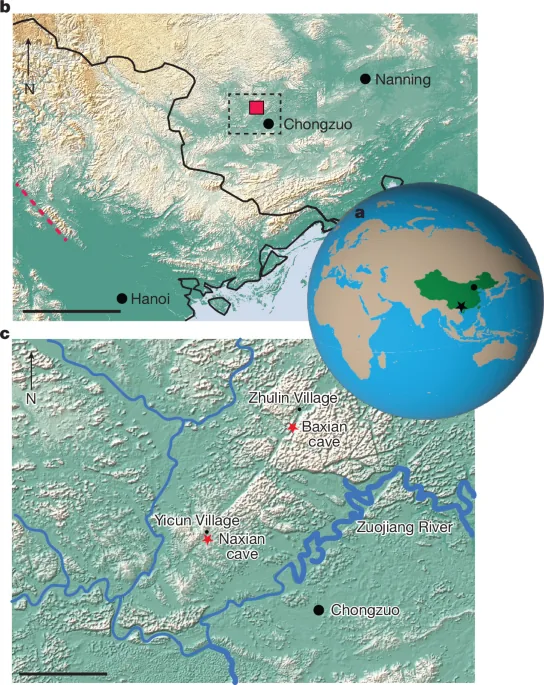
The fossil teeth came from Baxian Cave and Naxian Cave, two limestone chambers in Chongzuo City in Guangxi province separated by about 15 kilometers of karst terrain [2]. Field crews sorting through cemented cave breccias recovered nine human teeth among more than 18,000 mammalian bones collected by ancient porcupines [1]. Porcupines regularly dragged skeletons into deep crevices to gnaw on minerals, preserving dense caches of Middle Pleistocene wildlife [2].
Both sites sit between five and seven meters above the valley floor and open into fossil chambers sealed beneath thick calcite flowstone. Researchers examined the animal teeth from the breccia and identified forest creatures including Pongo, Stegodon, giant pandas in the genus Ailuropoda, Elephas, and Dicerorhinus rhinoceroses. Forest cover was dense. Earlier discoveries of Denisovan fossils revealing the physical appearance of ancient humans helped clarify how archaic lineages looked in eastern Eurasia. In Guangxi, the teeth lay sealed until recent excavations led by Wei Liao exposed the breccia blocks [2].
Proteomic analysis confirmed the taxonomic identity of the hominin teeth. Frido Welker, a molecular palaeoanthropologist at the University of Copenhagen, extracted dental enamel proteins to detect sex and species markers. Four teeth matched Homo erectus, with three showing amelogenin-Y proteins characteristic of males and one from a female. “The morphology is nicely confirmed by the proteomics,” Welker said. A ninth tooth lacked typical markers, pointing toward another hominin group [1].
Dating Late Homo Erectus in Southern China
Dating the Guangxi deposits required five independent radiometric methods applied in research laboratories in China and Australia. The research team tested quartz grains with optically stimulated luminescence and feldspar crystals with post-infrared luminescence. They also used uranium-series dating and coupled electron spin resonance on mammalian teeth, while uranium-series assays constrained the calcite flowstones that capped the fossil layers. Bayesian age modeling run in ChronoModel and OxCal combined 43 individual radiometric dates into a unified chronology. The analysis showed that Baxian Cave hominin fossils date between 324,000 and 184,000 years ago, indicating that hominins lived in this landscape during the late Middle Pleistocene [2].
Chronological modeling places late Homo erectus in southern China roughly 200,000 years later than previously confirmed mainland sites, where fossils disappeared at approximately 400,000 years ago. Earlier northern finds at Zhoukoudian ended around 400,000 years ago, while older fossils at Gongwangling and Yuanmou reached back more than 1.6 million years [2]. The Guangxi record bridges a long geographic gap [1].
Chris Stringer, a paleoanthropologist at the Natural History Museum in London, pointed out that the Guangxi timeline connects mainland fossils with Southeast Asian island records. “This brings the history of H. erectus in East Asia closer in age to the late Javanese examples, raising the possibility that these populations were connected through land bridges at times of lowered sea level,” Stringer said in an email. Ngandong fossils from Java date to roughly 108,000 years ago, following earlier occupations at Trinil and Sangiran [1, 2]. If sea levels dropped during glacial cycles, forest corridors would have enabled hominins to disperse between mainland China and Sundaland [2].
Chemical Clues to Rainforest Diet
Geochemists extracted carbon and oxygen isotopes from fossil enamel to reconstruct prehistoric vegetation and climate in Guangxi. Plant-equivalent carbon isotope values from Baxian Cave fauna averaged −27.6‰, while Naxian Cave fauna averaged −29.4‰. Both values fall well below the −27.5‰ threshold defining closed-canopy rainforests. The animals ate C3 rainforest plants instead of open savanna grasses [2].
Three fossil teeth from Naxian Cave designated NX-B1, NX-B2, and NX-A1 yielded hominin enamel carbon isotope values between −15.0‰ and −14.0‰, placing their daily diet firmly within closed-canopy tropical forest resources [2]. For decades anthropologists assumed that only Homo sapiens possessed the behavioral flexibility needed to forage inside dense tropical jungles, while archaic hominins depended on open grasslands or mosaic savannahs [1]. Clumped isotope thermometry on cave carbonates confirmed humid conditions with cooler temperatures and significantly heavier rainfall than Guangxi experiences today, exceeding canopy signals recorded in African forests [2, 6]. Cerling and colleagues had previously measured stable isotope ecology baselines in the Ituri Forest against which prehistoric canopy densities could be evaluated [6]. “Rather than being confined to open woodland and grassland environments, H. erectus was considerably more ecologically adaptable than many of us have assumed,” Stringer said [1].
Kira Westaway, a geochronologist at Macquarie University in Sydney who co-led the environmental study, stressed that textbook views of human evolution understated archaic versatility. “Being adaptable and being flexible are not traits that we associate with ancient human species — these are traits that we associate with H. sapiens,” Westaway said. The findings overturned long-held assumptions [1].


Strontium Ratios and Regional Mobility
Laser-ablation trace element mapping on the enamel of tooth PA1799 from Baxian Cave revealed how hominins moved through prehistoric landscapes. Researchers measured strontium isotope ratios that varied between 0.7110 and 0.7220 along growth bands. Strontium enters teeth through food and drinking water during enamel development between ages two and six. Because enamel does not remodel after childhood, these chemical layers preserve an indelible log of where an individual lived while growing up. The local geology surrounding Baxian and Naxian caves features uniform limestone formations with baseline strontium ratios between 0.710 and 0.715. The higher ratios detected in tooth PA1799 point toward volcanic or granitic mountain zones situated hundreds of kilometers away [2].
A strontium map built with machine learning linked those higher values to the Red River valley in northern Vietnam, roughly 320 kilometers to the southwest [1, 2]. These ancient groups traveled long distances across rugged terrain instead of staying inside a single valley [1].
Westaway said that the karst terrain demanded seasonal circuits through valleys and forested ridges. “It looks like H. erectus moved across large areas, traversing this karst landscape in the rainforests,” Westaway said [1]. Surviving in wet tropical forests required steady foraging circuits. The hominins tracked seasonal vegetation and followed game herds between river systems instead of remaining inside a single cave shelter. Dense canopy forests provided reliable shelter from extreme heat, but finding sufficient food required navigating complex topography and crossing multiple drainage basins throughout the year [2].
Coexistence of Late Homo Erectus and Denisovans
The ninth fossil tooth from Guangxi, cataloged as tooth PA1796, presented a taxonomic puzzle. Protein sequencing conducted by Welker’s team showed it came from a male, but the amino acid sequence lacked the diagnostic substitutions seen in late Homo erectus. Morphologically, the crown shape also diverged from standard erectus specimens and modern humans [1].
“Sequence-wise it doesn’t have this Homo erectus substitution and morphologically, it doesn’t look like an erectus tooth,” Welker said. Several researchers suspect that tooth PA1796 belonged to a Denisovan, an archaic human lineage closely linked to Homo longi in East Asia. Evolutionary studies exploring how Neanderthals adapted their circadian rhythms to northern latitudes show that different hominins faced distinct ecological pressures. In Asia, Denisovans ranged through Siberia, the Tibetan Plateau, and Laos. John Hawks, an anthropologist at the University of Wisconsin-Madison, said that the Guangxi timeline creates a clear temporal overlap between two hominin lineages in southern China [1].
Hawks had previously argued that Asian fossils younger than 400,000 years were Denisovans, not surviving erectus groups. The proteomic confirmation of erectus proteins in four teeth changed that assessment. Hawks said he would like to see further comparisons with Denisovan dental fossils. Direct contact between lineages is plausible [1].
Did Ancient Humans Share Forest Havens?
The confirmed presence of two hominin lineages in the same karst valley raises fundamental questions about ecological competition, resource sharing, and long-term coexistence. Did late Homo erectus compete with Denisovans, or did they partition forest niches across Guangxi? Both groups survived in dense rainforest conditions once believed uninhabitable for archaic species [1]. Tropical forests offer fruit, tubers, and game, but gathering those resources demands botanical knowledge and specialized foraging strategies [2]. The extended timeline also alters models of how Homo sapiens interacted with older lineages in East Asia. Modern humans reached China at least 45,000 years ago, encountering local populations whose ancestry persists in indigenous genomes today [1].
Hawks raised the question of whether modern humans could have met late erectus groups in southern refugia. “If H. erectus was enduring in the same area at the same time, might H. sapiens also have encountered late H. erectus in southern China?” Hawks asked. That possibility reshapes models of human dispersal [1].
Westaway rejected the common assumption that Homo erectus was an evolutionary dead end. “We think they were the first to leave Africa, the first to use fire,” Westaway said. “It blows my mind because they survived six times longer than H. sapiens has survived so far, so I don’t see them as unsuccessful.” The Guangxi teeth show that their ecological adaptability carried them into rainforests until the twilight of the Middle Pleistocene [1, 2]. Fossil evidence from Guangxi proves that early human survival strategies were far more flexible than earlier evolutionary models suggested [2].
- ONLINE NEWS Simms, C. (2026). 184,000-year-old teeth suggest Homo erectus and Denisovans lived side by side. Live Science. [Article Link]
- ACADEMIC JOURNAL Westaway, K. E., Joannes-Boyau, R., Liao, W., Shao, Q., Yu, W., Quinn, M., Bacon, A.-M., Liang, H., Bourgon, N., Zhao, J.-x., Roberts, P., Kono, R., Pan, Y., Yang, L., Wang, Y., Jin, C., Wu, Z., Murray, S., Zanolli, C.,. Wang, W. (2026). Rainforest adaptation in late Homo erectus from southern China. Nature. [Article Link]
- ACADEMIC JOURNAL Liao, W., Zanolli, C., Ásmundsdóttir, R. D., Wu, Z., Yi, Z., Villa-Islas, V., Fagernäs, Z., Troché, G., Zhou, K., Feng, X., Liu, F., Olsen, J. V., Shao, Q., Yu, W., Quinn, M., Bacon, A., Liang, H., Pan, Y., Yang, L.,. Jin, C. (2026). Evidence for late Middle Pleistocene Homo erectus in mainland East Asia. Nature. [Article Link]
- ACADEMIC JOURNAL Westaway, K. (2026). Raw data for Westaway et al Rainforest adaptation in late Homo erectus from southern China. Zenodo (CERN European Organization for Nuclear Research). [Article Link]
- ACADEMIC JOURNAL Westaway, K. (2026). Code for Westaway et al Rainforest adaptation in late Homo erectus from southern China. Zenodo (CERN European Organization for Nuclear Research). [Article Link]
- ACADEMIC JOURNAL Cerling, T. E., Hart, J. A., & Hart, T. B. (2004). Stable isotope ecology in the Ituri Forest. Oecologia, 138(1), 5-12. [Article Link]
APA 7: PerEXP Teamworks. (2026, November 19). Late Homo Erectus Fossils Reveal Rainforest Survival in China. PerEXP Teamworks. https://perexpteamworks.com/en/late-homo-erectus-rainforest-survival/


