





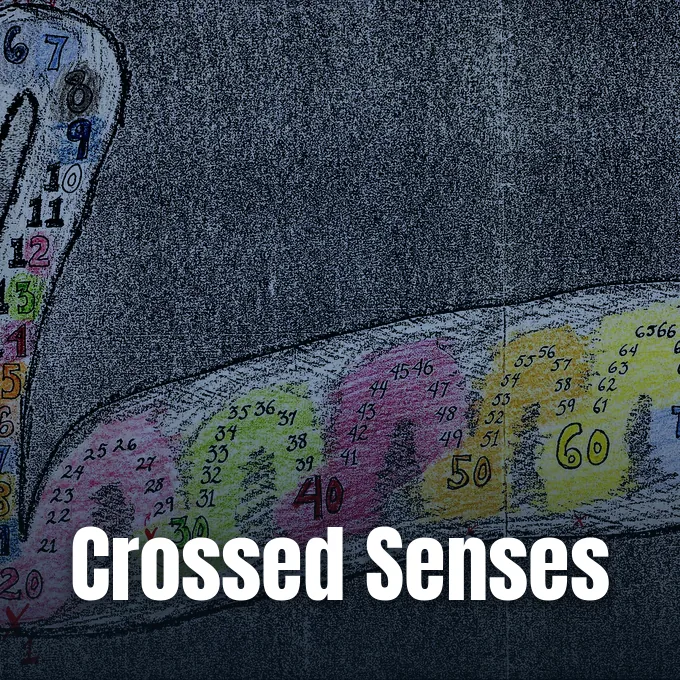
Synesthesia is a sensory trait where stimulating one sense triggers automatic reactions in another. Exploring what is synesthesia reveals how human minds can blend senses together, linking hearing with vision, taste with shape, or written symbols with vivid hues in daily life. Modern brain scans show that this sensory crossover reflects genuine neural firings rather than daydreams or poetic figures of speech [1, 2]. Demographic data from Cleveland Clinic and DaySyn indicates that about 3.7 to 4 percent of people worldwide share these traits [1, 4]. These perceptual crossings enrich daily thought without harming health [5].
What Is Synesthesia?
The name comes from Greek roots: syn translates to joining together, while aesthesis means sensory feeling [2, 6]. Typical sense organs send raw signals along isolated tracks to separate brain zones. For synesthetes, incoming cues spark two or more areas at once, so a musical tone might trigger a pale blue flash [1, 2].
Crossed senses do not point to illness or mental sickness [1, 5]. Medical manuals like the DSM-IV and ICD do not list the condition because it does not stop anyone from living a normal, healthy life [5]. Cleveland Clinic says that this trait is a form of neurodivergence, showing how brains develop unique wiring plans [1]. Most people with the trait grow up thinking everyone shares the same sensory overlap, only learning the truth when a friend looks puzzled during casual conversation [6, 7]. To many, it feels like an enriching gift that aids learning [1, 6].
The DaySyn registry, built on files from 1,297 individual synesthetes by researcher Day, catalogs at least 75 distinct varieties where specific triggers evoke paired sensations [4]. Cleveland Clinic suggests over 150 forms might exist if we count senses like heat, balance, and pain [1]. Sensation pairings stay durable across decades without fading or shifting. If someone sees the numeral four as forest green in early youth, they will report that exact shade when tested decades later. When spoken words or visual symbols stimulate secondary pathways, the resulting conscious experiences arise automatically without any deliberate effort [2, 6]. The pairing stays fixed for life [2].
Forms of Sensory Crossover
Scholars divide these events into projective and associative forms [1, 3]. Projective viewers see colors in open space [3, 6]. When a brass trumpet sounds, a projector might watch a glowing orange orb float in front of them until the tone fades. Neurologist Richard Cytowic said people easily tell these projections apart from real objects in the room [2, 6].
Associative thinkers feel cross-sensory links inside the mind’s eye rather than out in the room [1, 3]. When looking at the letter A printed in black ink, an associative viewer knows right away that the letter has a crimson soul, even while plainly reading the black print on the page [3, 7]. The feeling is prompt and sure. Scientist Mike Dixon showed that associative and projective groups use overlapping brain networks, even though their spoken reports sound quite different. Richard Cytowic and Mike Dixon both said that across large testing groups, associative synesthetes report stable colors that remain steady across years of repeated clinical tests. In both groups, incoming cues trigger involuntary sensory responses that cannot be suppressed [2].
Cleveland Clinic also groups the trait by origin, listing developmental, acquired, and drug-induced forms. Developmental cases are most common, blooming in early years as children learn speech, letters, and numbers. Acquired forms can start later in life after head trauma, stroke, or loss of sight, as the brain rewires damaged paths. Drug-induced cases occur after taking psychedelics like LSD or mescaline, though the sensory mixing stops once the body clears the drug [1, 2].
Graphemes and Chromesthesia
Grapheme-color mixing is the most widely studied form of sensory blending. In this type, letters and digits evoke fixed colors [7]. The DaySyn database notes that about 68 percent of synesthetes experience grapheme-color pairings, which equals roughly 1 in 44 people worldwide [2, 4]. Surveys by Day show common trends, like the letter A often turning red and B turning blue [2, 7].
Personal stories show how natural these pairings feel from youth. Author Patricia Lynne Duffy recalled telling her father that turning a letter P into an R by drawing a line made a yellow letter turn orange. Film director Stephanie Morgenstern said she memorized phone numbers by color, seeing five as blue, two as green, and three as red, while musical keys like C-sharp minor tasted like sharp yellow. Physicist Richard Feynman, who won the Nobel Prize in Physics, wrote that when he looked at math equations, he saw light-tan j letters, violet-blue n characters, and brown x variables flying across formulas from Jahnke and Emde’s text. Patricia Lynne Duffy and Stephanie Morgenstern said these colors never disrupted daily reading or math [7].

Chromesthesia links sounds to colors, causing noises like dog barks, clinking plates, or car horns to create brief flashes of light that shift in hue and vanish when the sound ends. Musician Deni Simon described hearing music as wavy bands moving across space like oscilloscope lines in metallic tones [6]. Star singers including Beyoncé, Duke Ellington, Billy Joel, and Mary J. Blige have all described seeing songs in glowing palettes. Richard Cytowic said chromesthesia resembles fireworks in the mind, helping musicians tune pitch and shape melodies with speed [1, 6].
Physical Mirroring and Rare Crossings
Mirror-touch causes a person to feel touch or pain on their own body when watching another person get touched [1, 8]. In a test at University College London and University of Sussex, researchers evaluated 567 undergraduate participants and found that about 1.5 percent felt mirror-touch traits. Later studies put the rate between 1.6 and 2.5 percent. Sensations can mirror the scene like a looking glass or match the exact anatomical side [8].
Skin sensations shift with the seen object. Watching a sharp knife point or finger tap someone elicits far stronger touch responses than observing a soft feather touch skin. Touching a dummy reduces this bodily reaction, showing the brain must view the target as an entity that can feel. Patient C, first studied in 2004, discovered her lifelong mirroring was unusual only after clinical interviews, and later found her female first cousin experienced matching tactile responses. Researchers also documented patient D.N., who developed tactile mirroring after sensory loss. Amputees face this too. Roughly 16 percent of people with limb loss report synesthetic pain in missing limbs upon seeing other people touch injured tissue [8].
Lexical-gustatory synesthesia affects roughly 0.2 percent of synesthetes, causing spoken words to trigger food tastes on the tongue. The film Derek Tastes of Earwax followed pub owner James Wannerton, who tastes earwax, stewed fruit, or waffles when hearing specific names. Ticker-tape viewers see spoken words stream across an imagined ribbon, while researcher Julia Simner showed how sequence-personality synesthetes give human traits and genders to numbers and weekdays [2, 6]. Julia Simner said ordinal linguistic personification often co-occurs with grapheme-color traits [6]. These rare cases show that brain crossovers can link high concepts as well as raw senses [2].


Why the Brain Blends Signals
Brain scans clarify how these crossed pathways operate. Author Edward Hubbard wrote in Current Psychiatry Reports that grapheme-color traits spring from cross-activation between neighboring brain zones, joined with hyperbinding in the parietal cortex [5]. High-resolution scans show extra grey matter in the right fusiform gyrus and Area V4a, which processes letters and hues [7].
One key theory looks at early brain growth and synaptic pruning. Newborn babies are born with a rich web of links between all sensory zones. During normal growth, natural pruning trims away surplus links to build separate sensory paths, but in synesthetes, genetic traits seem to pause this pruning, leaving cross-talk bridges open for life [1, 2]. Familial trends run deep: Francis Galton said in 1883 that synesthesia runs in families, and scholars like Julian Asher and Jamie Ward have tracked potential gene links. Julian Asher studied inheritance patterns, suggesting genetic markers influence early cortical pruning [2].
Another model highlights disinhibited feedback in brain hierarchies. In this view, cross links exist in every human brain, but top-down signals from sensory hubs normally keep them quiet. If chemical inhibitors fail to silence these paths, signals spill into neighboring sensory zones and trigger conscious photisms. Edward Hubbard showed that Area V4a lights up when grapheme synesthetes view plain black letters, explaining why psychedelics like LSD or mescaline can prompt swift sensory mixing in typical adults by muting normal brain filters [1, 2, 5, 7]. It also shows how head trauma or strokes can suddenly open dormant routes later in life [1].

Early Synaesthesia Case Studies
Early records hold vivid tales of blended senses. In 1690, Oxford University scholar John Locke told of a blind man who linked trumpet sounds to deep scarlet hues. Historians suspect Locke wrote about his Oxford classmate John Troughton (1637–1681), a blind cleric who preached on trumpets and scarlet cloth from Revelations. This tale stands as the oldest record of colored hearing [6].
The first formal medical paper on the trait came in 1812 from German physician Georg Tobias Ludwig Sachs. Sachs penned a detailed case study on his own albinism, noting how he and his sister saw letters, digits, and musical tones in distinct colors. In 1881, Francis Galton published his paper The Visions of Sane Persons, describing number forms. Francis Galton showed that healthy people map numbers and calendar dates into persistent 3D shapes in space, showing that unusual sensory layouts occur in sane minds [2, 6].
The most thorough early case was Russian journalist Solomon Shereshevsky, studied for thirty years by clinician Alexander Luria. Solomon Shereshevsky lived with sensory mixing across all five senses. Hearing a tone evoked a velvet strip of light, while tasting a word brought tactile feelings of cold glass. While Solomon Shereshevsky had vast memory power, his wild sensory associations made abstract thought tough, prompting clinician Alexander Luria to publish extensive clinical notes tracking Shereshevsky across three decades of cognitive tests. Richard Cytowic and later teams built on Luria’s work to study how sensory paths bridge together in human minds [2, 6].
Testing Perceptual Reality
For decades, psychology dismissed synesthesia as mere fancy. In 1987, Simon Baron-Cohen built consistency tests to see if sensory pairings were genuine. Retested without warning over a year later, synesthetes scored above 90 percent consistency, while control peers scored far lower when retested after brief intervals. Simon Baron-Cohen said genuine pairings stay remarkably stable across decades. This huge gap showed that synesthetic colors are fixed sensory bindings rather than made-up tales [2].
Grouping tests brought more solid proof of early visual processing. Vilayanur Ramachandran and Edward Hubbard showed synesthetes sheets of printed numbers, hiding a cluster of digit 2s in the shape of a triangle among random 5s. Normal viewers had trouble finding the hidden shape in the clutter. Projective grapheme-color viewers spotted the triangle right away because green photisms on the 2s jumped out against red photisms on the 5s in a clean pop-out effect. Vilayanur Ramachandran showed that this pop-out effect happens before conscious attention takes hold. Daniel Smilek showed that synesthetes take far longer to find numbers when printed on sheets matching their photism color. These tests show that synesthetic colors shape visual focus just like real ink [2].
In the 1990s, brain scanners using functional MRI and PET imaging provided objective confirmation [1, 3]. Scans showed that when grapheme-color viewers heard spoken words or saw plain black print, color zones in the visual cortex lit up along with speech zones [1, 5]. In non-synesthete control peers, visual zones stayed quiet during identical auditory tasks. Cleveland Clinic researchers said these brain scans ended decades of skepticism, showing that synesthesia is an authentic physiological process [1, 2].
Memory Advantages in Daily Life
Crossed senses bring clear mental perks, especially when storing and recalling facts. People with synesthesia score higher on memory tests using numbers, word lists, and dates [1, 2]. Because each fact carries twin sensory hooks, viewers have extra mental paths to find stored facts [1, 6]. Alexander Luria noted that these rich hooks turn plain data into vivid mental maps [2].
Most synesthetic events feel pleasant or neutral, but strong forms can bring sensory fatigue. In loud or crowded rooms, people with chromesthesia can feel bombarded by bright visual flashes, while mirror-touch viewers face tough tests when watching other people suffer cuts, bruises, or acute emotional pain [1, 3, 6, 8]. Counselors on platforms like BetterHelp say that grounding habits and quiet spaces help people soothe sensory overload and dodge burnout. BetterHelp therapists suggest simple coping routines for people feeling overwhelmed by empathy. Because synesthesia is a harmless neural trait, care focuses on peaceful habits rather than medical cures [1, 3].
Creative minds thrive on crossed senses. Surveys from Cleveland Clinic show that people with synesthesia often build careers in visual art, song craft, and creative prose. By linking musical chords to colors or letters to spatial shapes, these thinkers gain an innate well of metaphor that enriches artistic output [1, 2]. Spatial-sequence thinkers map calendars into vivid routes across space, allowing them to recall dates, names, and personal life markers with swift, reliable clarity. Cleveland Clinic clinicians say that synesthesia should be seen as a creative asset, and far from being a defect, the trait highlights natural brain diversity [1, 6].
- WEBSITE Cleveland Clinic. (2023, May 18). Sense and sense abilities: How synesthesia changes what people experience. [Article Link]
- WEBSITE Internet Encyclopedia of Philosophy. (2023, March 28). Synesthesia. [Article Link]
- WEBSITE BetterHelp. (2018, October 10). Synesthesia Definition: Grapheme-Color Synesthesia And Other Types. [Article Link]
- WEBSITE Day, S. A. (2016, January 1). Types-of-Syn. DaySyn. [Article Link]
- ACADEMIC JOURNAL Hubbard, E. M. (2007). Neurophysiology of synesthesia. Current Psychiatry Reports. [Article Link]
- WEBSITE Wikipedia contributors. (2026). Synesthesia. Wikipedia, The Free Encyclopedia. [Article Link]
- WEBSITE Wikipedia contributors. (2026). Grapheme–color synesthesia. Wikipedia, The Free Encyclopedia. [Article Link]
- WEBSITE Wikipedia contributors. (2026). Mirror-touch synesthesia. Wikipedia, The Free Encyclopedia. [Article Link]
Cover image: User:Cytowic in English Wikipedia / Wikimedia Commons, CC BY-SA 3.0


