






Anime News Network critic Rebecca Silverman published a comprehensive retrospective review reevaluating Tomoharu Katsumata’s 1975 feature, establishing how this foundational Little Mermaid anime preserved the somber emotional core of Hans Christian Andersen’s 1837 fairy tale [1]. Released fourteen years before Walt Disney Feature Animation popularized a sunny musical resolution, the Japanese production honored unrequited devotion over convenient happily-ever-afters. Does literary fidelity still captivate audiences accustomed to romantic rescues? The 68-minute landmark proved that animated cinema could embrace heartbreak, debuting on Japanese screens on March 21, 1975 [3].
- Why the Little Mermaid Anime Retained Andersen’s Tragic Conclusion
- Production Pioneers Under Tomonori Imada and Reiko Okuyama
- Vocal Performances Across Tokyo and Montreal Studios
- Physical Media Scarcity From Vintage VHS to Streaming Flaws
- How Does Hans Christian Andersen’s Little Mermaid End in Retrospect
Why the Little Mermaid Anime Retained Andersen’s Tragic Conclusion
Screenwriters Ikuko Ōyabu and Mieko Osanai rejected the softened conventions of mid-century children’s television to reconstruct Andersen’s original narrative architecture with unwavering fidelity [1]. Andersen, born in Odense in 1805 and deceased in Copenhagen in 1875, framed the ocean princess as an innocent soul seeking human immortality through selfless affection rather than mere conquest [4]. When Princess Marina saves Prince Fjord from a violent shipwreck conjured by the Sea Witch, she earns her coming-of-age pearl hairpin but surrenders her voice in exchange for human legs. The Sea Witch, designed with sweeping devil ray motifs, warns Marina that failing to win the prince’s hand will cause her physical form to dissolve into ocean foam at sunrise [1]. Instead of coercing the mermaid through deception, this aquatic sorceress candidly instructs Marina to speak with her expressive eyes [4].
Tragedy defines everything. Marina refuses to murder the sleeping prince, accepting death to preserve his newfound marital joy [2].
Rebecca Silverman observed that this 1975 animated adaptation predates nearly every major cinematic treatment of the Scandinavian fairy tale, surpassing the 1961 Shirley Temple’s Storybook broadcast and the 1976 Soviet live-action version. Disney chose matrimonial triumph. Toei Animation preserved Andersen’s spiritual ascension [1]. Marina dissolves into sea foam as dawn breaks over the prince’s wedding ship, yet her noble spirit ascends into the heavens [3]. Fjord discovers her discarded pearl hairpin and a solitary tail scale on deck, realizing in horror that Marina was his genuine ocean rescuer [2].
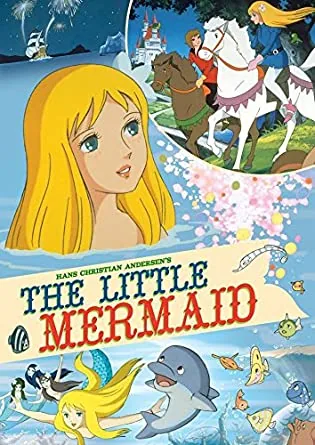
Production Pioneers Under Tomonori Imada and Reiko Okuyama
Toei Animation initiated the ambitious project to mark the centenary of Hans Christian Andersen’s 1875 passing, conceiving a prestige theatrical feature rather than another television serial. Although Toei had previously drawn upon Andersen’s lore in their March 1968 release, The World of Hans Christian Andersen, that earlier compilation lacked single-story narrative depth. In 1974, Toei Animation witnessed a major institutional transition as executive Tomonori Imada assumed the presidency from Junichi Toishi. Imada took his first screen credit as producer on this theatrical endeavor, initiating a decorated tenure that culminated in his appointment as company chairman in 1993 [3].
Artistic leadership fell to animator Reiko Okuyama, who made industry history as the first woman to serve as animation director on a Toei animated feature [3]. Okuyama supervised character movement and underwater kinetics, rendering delicate swimming sequences on traditional celluloid sheets. Director Tomoharu Katsumata—famed for high-octane anime such as Devilman, Cutey Honey, and Mazinger Z—steered the cinematic pacing across a concise 68-minute runtime [4, 5]. Art directors Mataji Urata and Mitsunari Makino crafted contrasting environments, balancing eerie deep-sea abysses against luminous Scandinavian coastal fortresses [5]. Okuyama subsequently departed Toei following the production, sealing the film’s standing as a landmark creative milestone [3].
Institutional recognition arrived swiftly across Japan. The Ministry of Education formally selected the picture, which also earned endorsements from the Governor of Tokyo and the Central Child Welfare Council. Furthermore, organizers designated the feature as a cooperating cultural work for Expo ’75 held in Okinawa [3]. Sound designers Isao Hatano and Katsumi Itō of Suwara Production synchronized delicate wave splashes and orchestral cues at Toei Audio Visual Art Center in Tokyo, anchoring technical execution at peak studio standards [5].


Vocal Performances Across Tokyo and Montreal Studios
The Japanese sound recording paired experienced theatrical veterans with celebrated musical recording artists to enrich dramatic pacing [5]. Fumie Kashiyama voiced Princess Marina during dramatic spoken passages, while recording artist Kumiko Ōsugi supplied vocal tracks for the insert compositions. Nippon Columbia released the film’s primary soundtrack record in March 1975, spotlighting the evocative opening theme ‘Akogare’ (Yearning) and the celebrated insert melody ‘Matteita Hito’ (The One I’ve Waited For), both composed and arranged by Takekuni Hirayoshi with lyrics penned by Tokiko Iwatani. Mariko Miyagi voiced Fritz the dolphin, marking her celebrated return to Toei theatrical animation after starring in The White Snake Enchantress (1958) seventeen years prior [3].
Supporting roles drew legendary talents from across the Japanese voice industry. Taro Shigaki voiced the conflicted Prince Fjord, and Haruko Kitahama played the formidable devil-ray Sea Witch [3]. Kōsei Tomita performed Duke the Whale, contributing to a monumental voice career spanning from 1956 until his passing in 2020 at age 84 [4]. Kazuko Sugiyama, who had previously headlined Toei’s 1970 magical girl television broadcast Mahō no Mako-chan (an anime series inspired by Andersen’s mermaid), voiced Marina’s loyal elder sister. Can modern international localizations match the emotional resonance established by such seasoned historical performers? International distributors soon sought to replicate this dramatic impact for English-speaking audiences [3].
In 1979, Montreal-based dubbing studio Cinélume produced an English translation directed by Tim Reid for theatrical distributor G.G. Communications and Prima Film [3, 5]. Canadian twin siblings Kirsten Bishopric and Thor Bishopric portrayed Marina and her dolphin companion Fritz [4, 5]. Their natural family chemistry generated warm camaraderie, grounding Marina’s tragic terrestrial isolation [2]. The production localized Marina’s melodic solo as ‘When a Mermaid Comes of Age,’ ensuring thematic continuity for North American viewers [5].

Physical Media Scarcity From Vintage VHS to Streaming Flaws
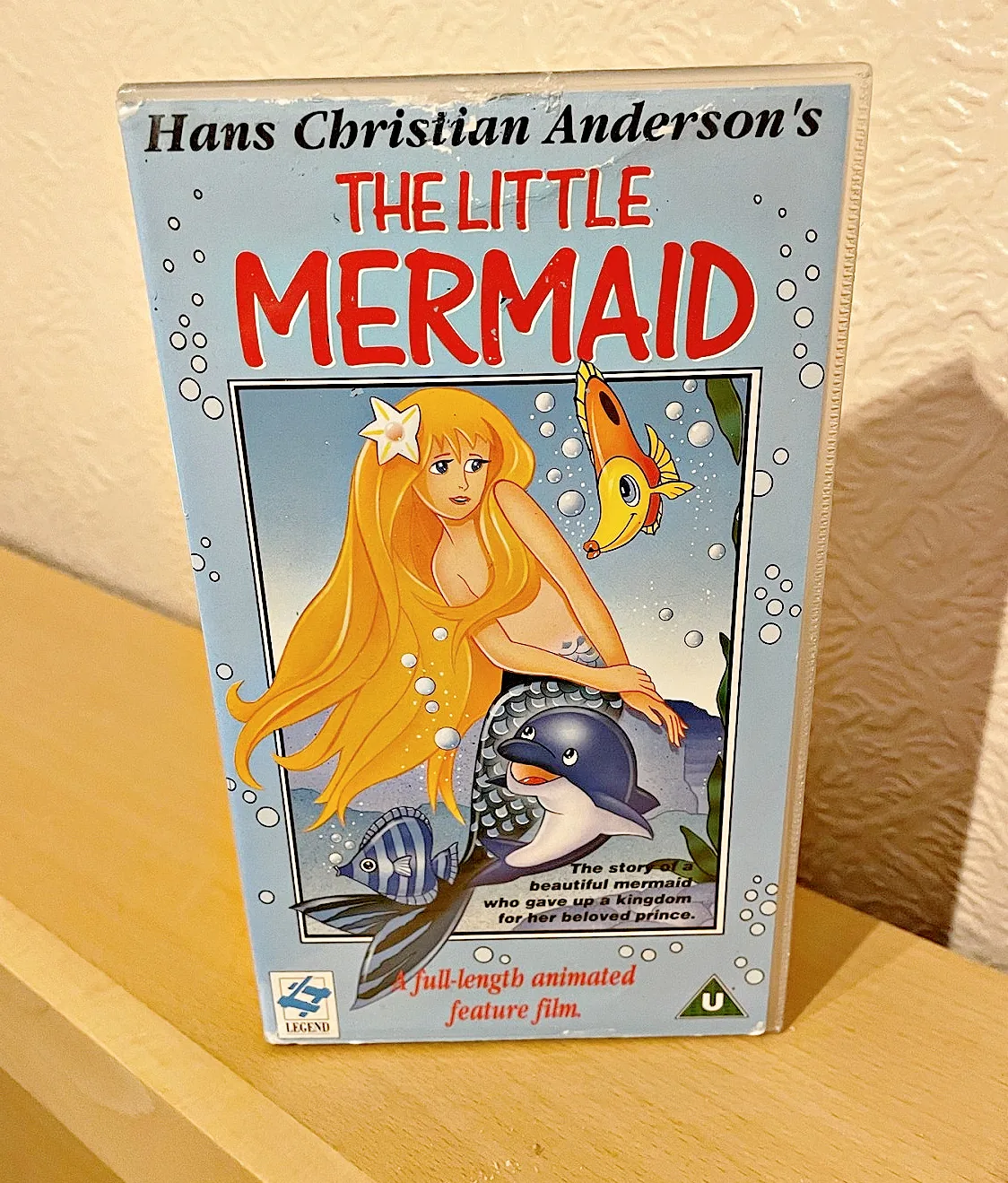
Western circulation for this foundational Little Mermaid anime has remained fraught with archival neglect and rights fragmentation across five decades [1, 4]. United Artists initially handled North American distribution during the late 1970s before commercial licensing passed to home video labels. Discotek Media subsequently rescued the title for an uncut bilingual North American DVD release, packaging both the original Japanese audio track and the Cinélume English dub [4]. However, that physical release slipped out of print, driving enthusiasts toward scarce second-hand VHS cassettes or Japanese catalog imports [1, 2].
Japanese physical preservation enjoyed dedicated commercial restoration. In November 2011, Toei Video reissued the feature on DVD under the retrospective collection Fukkoku! Toei Manga Matsuri 1975 Haru (catalog DSTD-03433), presenting the original 16:9 squeezed master with monaural audio [6]. American streaming availability, by contrast, presents notable technical compromises [1].
Rebecca Silverman highlighted severe transfer limitations on modern digital streaming platforms, noting that digital editions rely almost exclusively on dated English-dub masters. Viewers encounter noticeable video wavering and intrusive green artifacts shooting vertically across scenes, obscuring Okuyama’s delicate character animation and fluid underwater lighting [1]. Blogger Brin confirmed that while Amazon Prime made the picture accessible for digital rent or purchase, altered aspect ratios occasionally crop peripheral characters during palace encounters [2]. Enthusiasts inevitably balance digital convenience against visual fidelity when revisiting Toei’s historical milestone [1].
How Does Hans Christian Andersen’s Little Mermaid End in Retrospect
Audiences discovering this 1975 adaptation frequently ask how does Hans Christian Andersen’s Little Mermaid end when stripped of Disney’s celebratory alterations [1, 2]. Andersen intended the climax as a moral trial of spiritual transcendence through unconditional sacrifice [1]. Marina’s elder sisters shear their hair to purchase an enchanted dagger from the Sea Witch, begging Marina to pierce Fjord’s heart before dawn [2]. If the prince’s blood spills upon her feet, her human legs will reform into a mermaid tail, granting her three thousand years of undersea life. Marina enters the royal bedchamber where Fjord sleeps beside the Finnish princess of Suomi (the historical designation for Finland), raises the blade, yet chooses self-extinction over violence [2, 4].
Marina hurls the enchanted weapon into churning waves and leaps from the ship’s deck into the sea [2]. As morning sunlight touches the ocean, her mortal body dissolves into seafoam, while her luminous spirit ascends as an immortal daughter of the air [1, 3]. Dolphin companion Fritz trails the rising bubbles in helpless mourning [7]. The prince awakens to discover her abandoned pearl hairpin and a glistening tail scale, realizing too late that his true savior perished for his happiness. This tragic romance convention resonates deeply with classic character drama, reflecting how royal romance manga narratives develop lovestruck prince tropes across Japanese storytelling traditions [2].
Director Katsumata returns to live-action Copenhagen footage at the conclusion, framing Edvard Eriksen’s bronze harbour statue against quiet Scandinavian waters [2, 4]. The camera lingers. This final view cements Andersen’s enduring meditation on selflessness [2]. Fifty-one years after its theatrical debut, the classic Little Mermaid anime remains an unvarnished testament to animated tragedy [1].
- ONLINE NEWS Silverman, R. (2026, September 20). Hans Christian Andersen’s The Little Mermaid Anime Film Review. Anime News Network. [Article Link]
- WEBSITE Brin’s Book Blog. (2023, May 12). The Little Mermaid (1975): Film Review. Brin’s Book Blog. [Article Link]
- WEBSITE Wikimedia Foundation, Inc. (2007, February 17). Hans Christian Andersen’s The Little Mermaid (1975 film). Wikipedia. [Article Link]
- WEBSITE Ospreyshire. (2021, August 28). Hans Christian Andersen’s The Little Mermaid Review. Iridium Eye Reviews. [Article Link]
- WEBSITE Grokipedia. (2026, January 14). Hans Christian Andersen’s The Little Mermaid (1975 film). Grokipedia. [Article Link]
- WEBSITE Tower Records Japan. (2011, November 21). Fukkoku! Toei Manga Matsuri 1975 Haru [DVD]. Toei Video. [Article Link]
- WEBSITE MeenOnFilms. (2024, May 28). A review of Hans Christian Andersen’s The Little Mermaid (1975). Letterboxd. [Article Link]


