





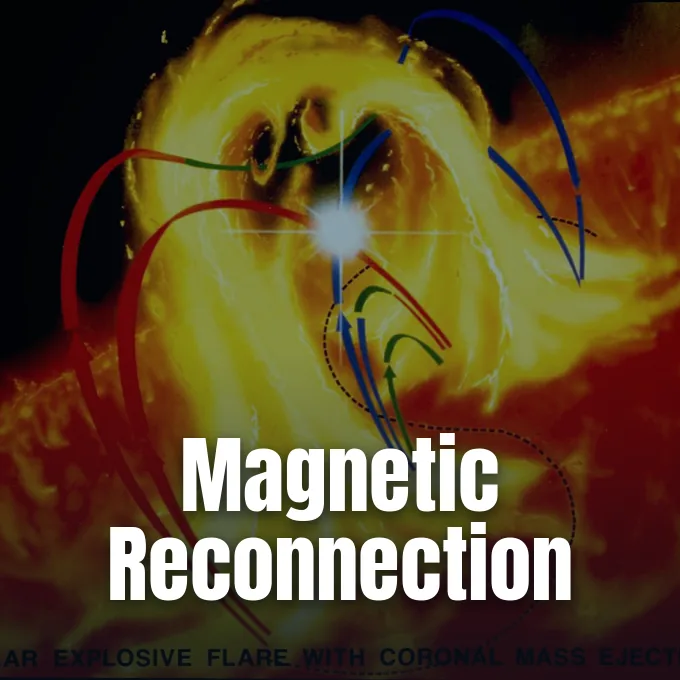
Magnetic reconnection is one of the most energetic events in space, breaking apart and reconnecting magnetic field lines to release stored energy in vast plasma environments. The phenomenon powers large solar flares and reshapes planetary magnetic fields, but laboratory researchers have long struggled to explain how it transfers so much energy into individual electrons. Now, a study led by Sonu Yadav at West Virginia University offers experimental evidence that ripples called lower-hybrid drift waves act as the main bridge for this transfer [2].
Understanding Magnetic Reconnection
Plasmas fill much of the visible cosmos, from solar atmospheres to the turbulent voids between planets. Within these charged gases, tangled magnetic fields store huge quantities of potential energy. When oppositely directed magnetic field lines come close together, they can break apart and splice into new arrangements [2]. This realignment, known as magnetic reconnection, converts magnetic energy into heat and particle motion. In solar flares, the process hurls huge streams of radiation toward neighboring worlds, while in near-Earth space it triggers vibrant auroral displays.
Scientists have observed the broad effects of reconnection for decades through space telescopes and orbital satellites, but tracking the exact behavior of particles inside the reaction zone has remained difficult. Spacecraft can fly through reconnection zones only briefly, gathering snapshot readings that do not capture the entire sequence from start to finish. In those fleeting orbital encounters, instruments measure sudden spikes in electron temperature and energetic particle streams, yet researchers cannot easily isolate which underlying mechanism drives the heating. Because these space regions span thousands of kilometers and shift continuously, satellites cannot stay stationed in one spot to observe the microscopic handover of energy. Similar questions about cosmic particles appear in separate research into cosmic ray electrons traced back to nearby sources [2].
Because space missions cannot control solar eruptions or change surrounding plasma density, physicists have turned to terrestrial laboratories. Recreating the phenomenon on Earth lets researchers alter magnetic fields, test different gases, and repeat identical runs to see how particles react under clean conditions [2].
The Search for Electron Energy Boosts
For years, plasma physicists debated how electrons absorb energy during magnetic reconnection events. While ions carry most of the mass in a plasma, lightweight electrons gain speed far more quickly, absorbing a large share of the released magnetic power. Earlier models suggested two main routes for this energization. In the first scenario, electric fields created inside the reconnection zone pull electrons forward, speeding them up along magnetic field lines [2].
The second proposed mechanism involved magnetic loops that shrink and snap back during reconnection. As these magnetic lines contract, electrons bounce between the converging ends, gaining kinetic energy with every reflection. While both mechanisms explain some heating, numerical simulations and space observations hinted that a third process was also at work. Researchers suspected that lower-hybrid drift waves, which form where plasma density drops sharply, could also transfer energy to electrons [2].
Why did this wave mechanism remain unconfirmed for so long? Detecting how electrons interact with these waves requires watching both wave ripples and electron velocities at the same time. Satellites in space rarely sit in the right spot long enough to record that fleeting interaction [2].
Inside the PHASMA Facility
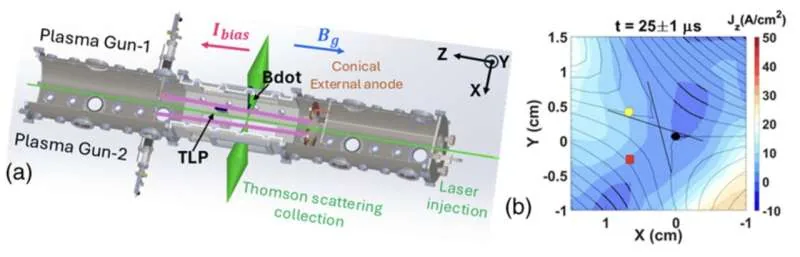
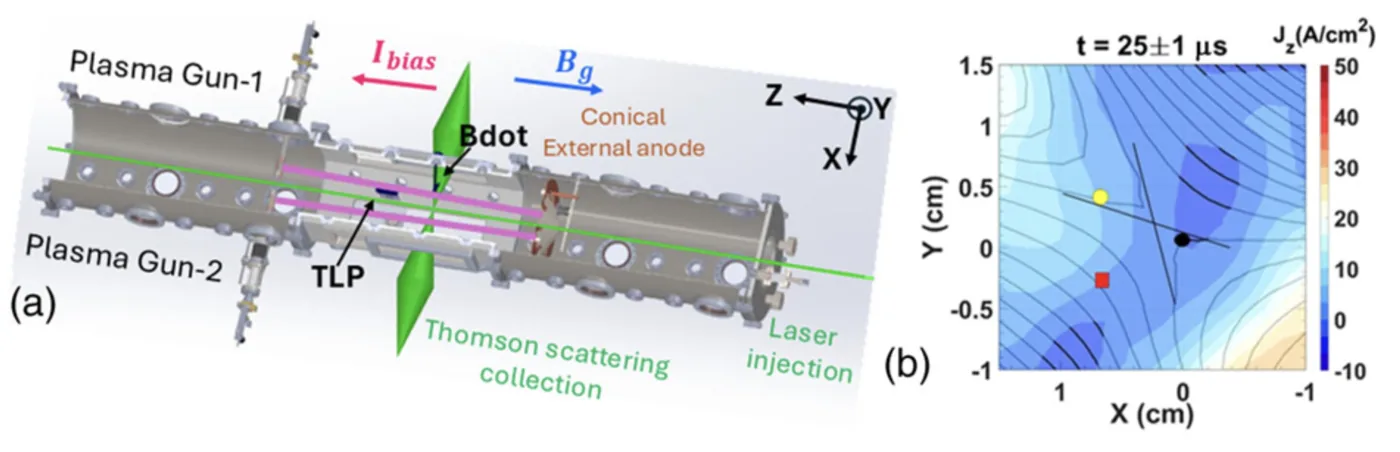
To overcome these experimental limits, Sonu Yadav and his colleagues conducted their work at the PHAse Space MApping facility, known as PHASMA, located at West Virginia University [1]. The centerpiece of the facility is an elongated vacuum chamber measuring almost 5 meters (16 feet) in length. Inside this controlled chamber, the research team created two twisted columns of magnetized helium plasma, aligning them so that pushing them together would trigger a clean reconnection event [2].
The main advantage of the PHASMA design is its exceptional reproducibility. In many earlier plasma devices, each electrical discharge produced slightly different turbulent patterns, which prevented scientists from compiling reliable statistics across multiple trials. At the West Virginia University laboratory, however, the plasma columns merged in almost exactly the same way during every run. Because each reconnection discharge played out predictably, the team could test theories that earlier machines could never verify. Yadav and co-authors T. Rood, E. Scime, P. Shi, J. Yoo, and G. G. Howes repeated the experiment dozens of times, gathering complementary data with different sensor systems under identical starting conditions to build a complete picture of electron heating [1].
This repeatability allowed the team to map out microscopic plasma features that had previously escaped detection. By running the chamber through predictable discharge cycles, the researchers positioned sensitive diagnostic instruments at specific locations along the boundary without facing random fluctuations that could distort the results [2].

Tracking Lower-Hybrid Drift Waves
The experimental team relied on two separate measurement methods to monitor the merging helium plasma. In some discharges, the researchers placed small electrical probes into the chamber to measure wave frequencies and electric field fluctuations at the reconnection separatrix. In other runs, they fired laser beams into the plasma and recorded the scattering of laser light to determine the speeds of passing electrons [2].
These measurements confirmed that coherent lower-hybrid drift waves formed right along the sharp boundary of the magnetic reconnection zone. In this narrow boundary layer, the plasma density drops steeply over a short distance, creating ideal conditions for wave growth. The electrical probes revealed that these waves moved along the magnetic field with a well-defined parallel phase velocity, setting the stage for energy exchange with particles moving at similar speeds [1].
Importantly, the signatures of these waves were not confined to a single isolated pocket. The research team detected identical wave activity at two separate points along the reconnection boundary, proving that the phenomenon was an integral part of the reconnection layer rather than a local defect of the chamber walls [2]. Related plasma structures and field changes also feature in studies of magnetic switchbacks from Solar Orbiter.
How Waves Transfer Energy to Electrons
When the researchers matched the wave data with the electron measurements, the kinetic energy transfer became obvious. As the lower-hybrid drift waves grew stronger, extra clusters of electrons appeared at velocities that matched the phase speed of the waves along the magnetic field [1]. This velocity matching is the hallmark of a resonant interaction, where particles ride the electric potential of a wave much like a surfer catching an ocean swell [2].
The measurements showed that these resonant interactions altered the electron velocity distribution functions (EVDFs) within the thermal electron population. Initially, the electrons formed discrete peaks in velocity space at speeds corresponding to the measured phase velocity of the wave. Over a brief timescale of around 2 microseconds, wave activity reached saturation and decayed, causing these sharp velocity peaks to flatten out into broad plateaus. This observed timeline matched theoretical calculations for quasilinear relaxation, which predicted how quickly wave turbulence should redistribute energy among particles in a magnetized plasma. By comparing these decay times with wave amplitudes and plateau widths, the physicists confirmed that the relaxation followed theoretical predictions with high quantitative precision [1].
The quantitative agreement between measured plateau widths, wave amplitudes, and coherence times confirmed that waves acted as true go-betweens. Rather than relying solely on large electric fields, the plasma used these microscopic ripples to channel stored magnetic energy into thermal electrons, establishing a verified kinetic pathway for energy conversion [1].
Implications for Space and Magnetic Reconnection
The confirmation of wave-driven electron heating gives astrophysicists a reliable benchmark for studying high-energy phenomena across the solar system. In the solar corona, magnetic reconnection powers flares that blast energetic particles through interplanetary space. Understanding how much energy goes into electrons helps researchers calculate the radiation output of these solar storms and anticipate space weather impacts, such as radiation belt disruptions near Earth.
Spacecraft exploring planetary magnetospheres, including orbital probes studying near-Earth space, often encounter magnetic reconnection boundaries where instruments detect heated electron populations. Until now, scientists analyzing those satellite readings had to infer the underlying acceleration mechanisms from indirect clues. The findings published in Physical Review Letters provide direct experimental proof that lower-hybrid drift waves can produce the observed electron plateaus, giving space scientists concrete formulas to calibrate their observational models [1].
By resolving how electrons gain energy inside laboratory plasma columns, the West Virginia University team closed a persistent gap between theoretical plasma physics and real-world observations. The reproducible experiments at PHASMA show that microscopic wave dynamics govern large-scale energy release in reconnecting magnetic fields. Future numerical models and space missions can now incorporate this kinetic pathway to predict how plasma systems evolve, from stellar atmospheres to distant cosmic shocks [1], [2].
- ACADEMIC JOURNAL Yadav, S., Rood, T., Scime, E., Shi, P., Yoo, J., & Howes, G. G. (2026). Kinetic Pathway for Electron Energization during Strong Guide-Field Magnetic Reconnection. Physical Review Letters, 137(22). [Article Link]
- ONLINE NEWS Jarman, S. (2026). Lab experiment shows how electrons gain energy during magnetic reconnection. Phys.org. [Article Link]
Cover image: NASA/Marshall Space Flight Center. / Wikimedia Commons, Public domain
APA 7: PerEXP Teamworks. (2026, November 29). PHASMA Facility Reveals Magnetic Reconnection Electron Heating. PerEXP Teamworks. https://perexpteamworks.com/en/magnetic-reconnection-electron-energy/


