





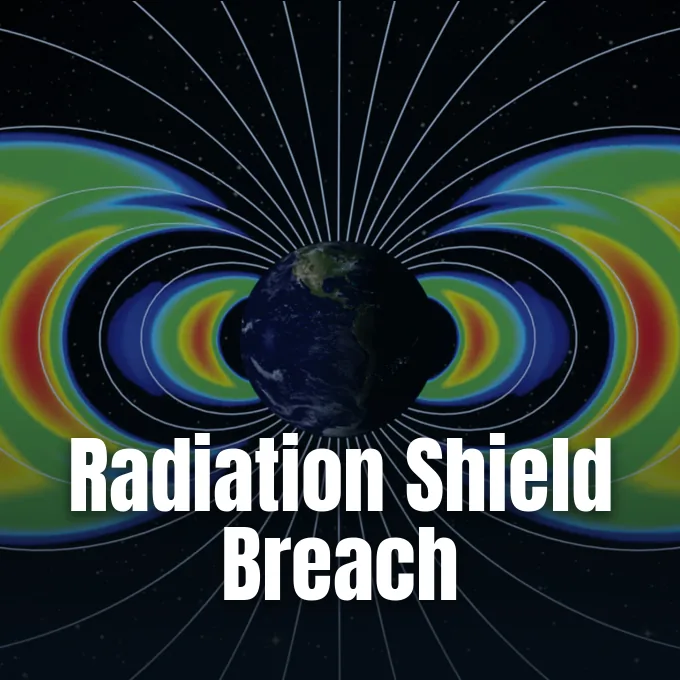
The Van Allen belts wrap our planet in concentric zones of trapped charged particles, keeping deep space radiation away from lower orbits [2]. For more than a decade, space physicists believed an impenetrable barrier at the inner edge of this shield kept ultra-relativistic killer electrons from reaching near-Earth space [4]. The protective wall failed during the extreme space weather of May 2024. Spacecraft observations confirmed that solar activity pushed energetic particles deep inside the barrier, energizing dangerous electrons inside the protected zone during recovery [1].
Particle Traps in the Van Allen Belts System
Explorer 1 discovered the belts during early Space Age exploration by NASA. Instruments aboard Explorer 1 discovered the Van Allen belts encircling the planet, revealing concentric rings of trapped energetic particles held in place by magnetic fields that shield Planet Earth from interplanetary radiation. The Van Allen belts divide into two primary zones [3]. While the outer zone contains energetic electrons driven by activity from the Sun, researchers found that the inner zone maintains a separate population of high-energy protons [2].
In contrast, the inner belt holds energetic protons created when incoming cosmic rays collide with neutral atmospheric atoms, producing secondary particle cascades that remain trapped along planetary magnetic field lines. Outer electrons often reach velocities near the speed of light during disturbances, earning the name killer electrons among researchers. Fast particles carry enough kinetic energy to penetrate the metal shielding of orbiting spacecraft, degrading sensitive silicon microchips and causing sudden electrical discharges that shorten satellite lifespans. High-energy radiation also threatens astronauts working in low orbit [2]. Spacecraft operators track particle fluxes to avoid system failures during storms [3]. Michelle Starr reported for ScienceAlert that researchers tracking Van Allen radiation belts wanted to locate the boundary where killer electrons stop [2].
Geological research examines remnants of the celestial body that impacted Earth to reconstruct mantle formation, while space physics teams at NASA study dynamic shields surrounding Earth. Understanding planetary interiors and particle fields helps scientists assess environmental stability. The Van Allen belts form the outer shield, where planetary magnetic lines continually trap and guide solar particles [3].
Discovery of an Impenetrable Shield
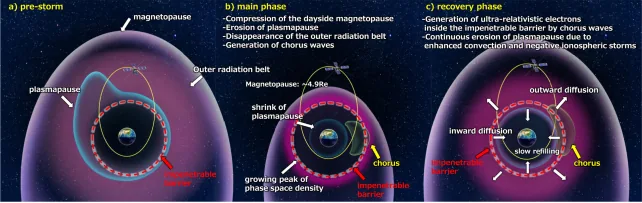
NASA launched the Van Allen Probes to study radiation boundaries [4]. In 2014, instruments identified a sharp barrier roughly 11,500 kilometers above Earth’s surface, corresponding to three planetary radii from the center [3]. Researchers led by Baker, Jaynes, and Hoxie described the feature as an impenetrable barrier in a study published in Nature [4].
Cold plasma within the surrounding plasmasphere was thought to scatter incoming killer electrons safely down into the upper atmosphere, knocking them out of trapped orbits before particles could venture near Earth [2]. However, a 2018 study in Nature Communications by Ozeke, Mann, and Murphy showed that ultra-low frequency wave radial diffusion naturally creates steep particle gradients without requiring sudden loss mechanisms at a rigid boundary. Ozeke showed that penetration occurs across days rather than years, limited mainly by how quickly individual solar storms subside [5].
Satellite measurements gathered between 1996 and 2006 provided additional evidence. Records showed that electromagnetic waves generated by terrestrial lightning could knock trapped electrons out of the inner belt. High-energy particles already inhabited the inner zone under specific conditions. Fiona MacDonald edited reports on satellite measurements recorded during that interval, showing doubts about whether the barrier was truly unbreakable [2].
Solar Storm Impacts in May 2024
The Sun released coronal mass ejections into space in May 2024 [2]. Solar wind gusts reached speeds topping 1,200 kilometers per second, severely compressing Earth’s magnetic envelope during the most intense space weather disturbance since the Halloween storm of 2003. A fast cannibal coronal mass ejection merged with an earlier ejection to amplify the impact [3].
Magnetized plasma triggered a level G5 geomagnetic storm that generated vibrant auroras visible in Florida and Mexico while ocean floor sensors near Japan registered magnetic fluctuations. The solar event matched the historical intensity of the 2003 Halloween storm [3]. Above the atmosphere, the storm crushed the cold plasmasphere closer to Earth, while a concurrent negative ionospheric storm depleted local plasma densities to leave an empty magnetic void [1]. Andy Tomaswick reported for Universe Today that the retreat of this protective sheath exposed the inner magnetosphere to unprecedented particle dynamics [3].
Japan deployed the ERG mission satellite, named Arase, with instruments developed by teams including Shinohara and Takashima to monitor Earth’s magnetosphere [1]. Launched in 2017, Arase had watched the radiation barrier remain stable for years [3]. Instruments on Arase detected a sudden surge of multi-MeV electrons deep inside the forbidden zone during the May 2024 event [1]. ScienceAlert reported that the study was fact-checked by Fiona MacDonald, detailing the satellite observations [2].


How Arase Tracked Accelerated Particles
During the recovery phase of the May 2024 solar superstorm, Japan’s Arase satellite detected ultra-relativistic electron counts climbing more than 5,000 times above normal background levels near 3 megaelectronvolts [3]. How could particles accelerate so deep inside the inner magnetosphere [1]? Instruments aboard Arase recorded the surge deep inside the zone previously considered an impenetrable barrier, capturing how particle counts shifted through separate energy channels as the storm evolved [2].
The timeline of the particle surge revealed how electrons gained energy. Lower-energy particles multiplied first, followed half a day later by higher-energy electrons. Roughly one day after the first jump, electrons carrying more than 3 megaelectronvolts surged past the inner boundary [2]. To determine where these particles originated, space physicist Yoshizumi Miyoshi of Nagoya University and co-authors S. Kurita, A. Shinbori, K. Yamamoto, C. Jun, and S. Matsuda examined electron phase space density profiles in Geophysical Research Letters [1]. If incoming particles had simply migrated inward from the outer belt, the phase space density profile would have displayed a clear downward slope closer to Earth [3]. Instead, Arase recorded a sharp local maximum at L* ∼ 3, right at the original location of the radiation barrier [1].
Nagoya University co-authors S. Saito and R. Kataoka confirmed that in situ acceleration established an electron source inside the barrier. Energized particles then diffused both inward and outward into higher orbits. Space physicists describe this particle profile as a clear signature of local wave-particle interactions rather than inward radial transport from the outer magnetosphere. The data proved that particles accelerated on site [1].
Van Allen Belts Experience Wave Acceleration
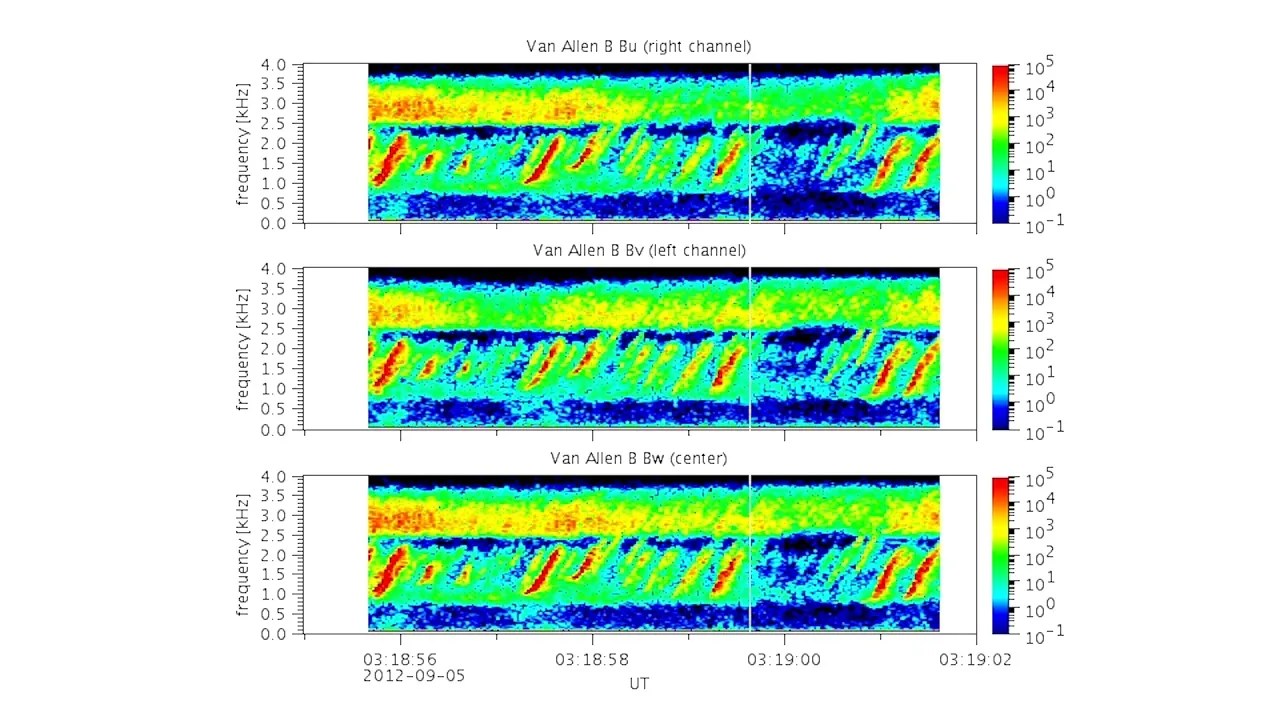
The main driver of this local acceleration was a natural phenomenon called chorus waves [1]. Lower-energy electrons generate these low-frequency plasma waves during geomagnetic storms [3]. When translated into audio signals, chorus waves sound like chirping birds or rising whistles [2]. In quiet periods, chorus waves stay restricted to the outer regions of the Van Allen belts because dense plasma closer to Earth suppresses their growth [3].
In the depleted environment created by the storm, chorus waves thrived throughout the void, transferring energy to low-energy electrons within hours. Dense plasma normally absorbs wave energy and prevents waves from accelerating particles to relativistic speeds [3]. “When converted into audio, it sounds like a bird song,” Miyoshi said when describing the acoustic translation of the wave data recorded by Arase. Instead of scattering particles down into the atmosphere as other waves typically do, these chorus emissions acted as an orbital particle accelerator deep inside the barrier [2].
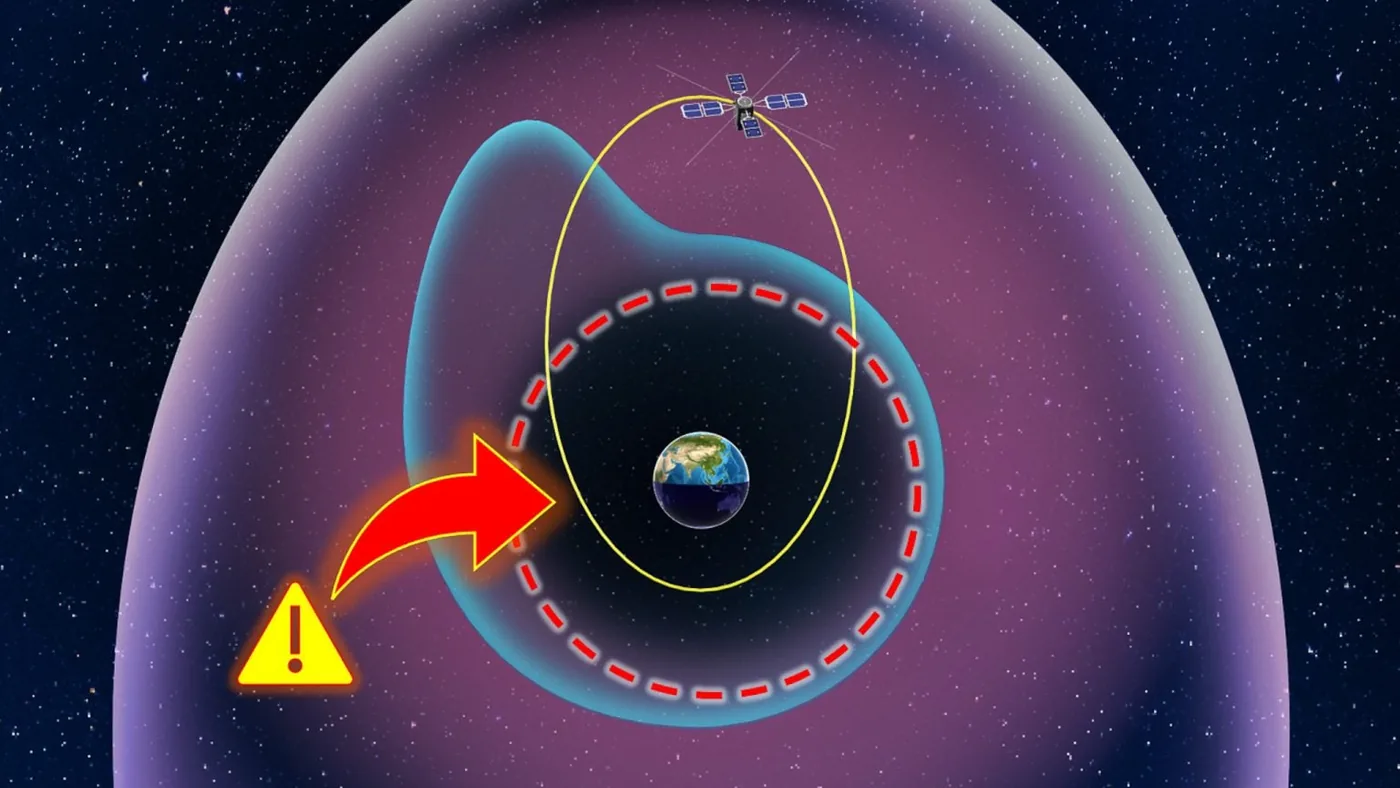
Enhanced radiation inside the barrier persisted long after the storm subsided. Arase observed high flux levels decaying slowly over several months [2]. The particles lingered until October 2024, when a subsequent solar storm disturbed near-Earth space again. Observations confirmed that an internal barrier breach leaves long-lasting radiation trapped close to the planet [3].
What the Radiation Hazard Threatens
Generating killer electrons inside the barrier alters risk assessments for orbital hardware [2]. Satellites in orbit rely on the Van Allen belts barrier to shield sensitive electronics from radiation damage. If intense storms generate multi-MeV electrons within this zone, spacecraft will require thicker shielding or improved circuit redundancy [3]. Astronauts on orbital missions could also face increased radiation exposure during extreme space weather [2].
Forecasting space weather has become an urgent priority for satellite operators and researchers [2]. Scientists need to predict not only how solar ejections travel through interplanetary space, but also how Earth’s protective plasmasphere retreats during extreme space weather events [3]. “This discovery highlights the need to understand and predict how energetic electrons behave under extreme space weather conditions,” Miyoshi said regarding the findings [2]. Understanding chorus wave interactions will help satellite operators prepare for future solar cycles and protect vulnerable communications hardware [1]. The observational findings confirm that near-Earth space is far more dynamic than earlier models assumed, requiring continuous monitoring as satellite constellations expand into vulnerable orbital zones [2].
- ACADEMIC JOURNAL Miyoshi, Y., Kurita, S., Shinbori, A., Yamamoto, K., Jun, C., Matsuda, S., Saito, S., Kataoka, R., Wang, D., Shinohara, I., Takashima, T., Mitani, T., Higashio, N., Matsuoka, A., Kasahara, Y., Tsuchiya, F., Kumamoto, A., Hori, T., Kitamura, N., & Teramoto, M. (2026). Local Acceleration of Multi‐MeV Electrons Inside Earth’s Impenetrable Barrier During the May 2024 Superstorm. Geophysical Research Letters, 53(20). [Article Link]
- ONLINE NEWS Starr, M. (2026). Earth’s Supposedly Impenetrable Radiation Barrier Has Been Breached. ScienceAlert. [Article Link]
- ONLINE NEWS Tomaswick, A. (2026). Earth’s “Impenetrable” Space Radiation Shield Was Just Breached From Within. Universe Today. [Article Link]
- ACADEMIC JOURNAL Baker, D. N., Jaynes, A. N., Hoxie, V. C., Thorne, R. M., Foster, J. C., Li, X., Fennell, J. F., Wygant, J. R., Kanekal, S. G., Erickson, P. J., Kurth, W., Li, W., Ma, Q., Schiller, Q., Blum, L., Malaspina, D. M., Gerrard, A., & Lanzerotti, L. J. (2014). An impenetrable barrier to ultrarelativistic electrons in the Van Allen radiation belts. Nature, 515(7528), 531-534. [Article Link]
- ACADEMIC JOURNAL Ozeke, L. G., Mann, I. R., Murphy, K. R., Degeling, A. W., Claudepierre, S. G., & Spence, H. E. (2018). Explaining the apparent impenetrable barrier to ultra-relativistic electrons in the outer Van Allen belt. Nature Communications, 9(1). [Article Link]
APA 7: PerEXP Teamworks. (2026, November 1). Van Allen Belts Radiation Shield Breached by Solar Storm. PerEXP Teamworks. https://perexpteamworks.com/en/van-allen-belts-radiation-barrier-breached/


