





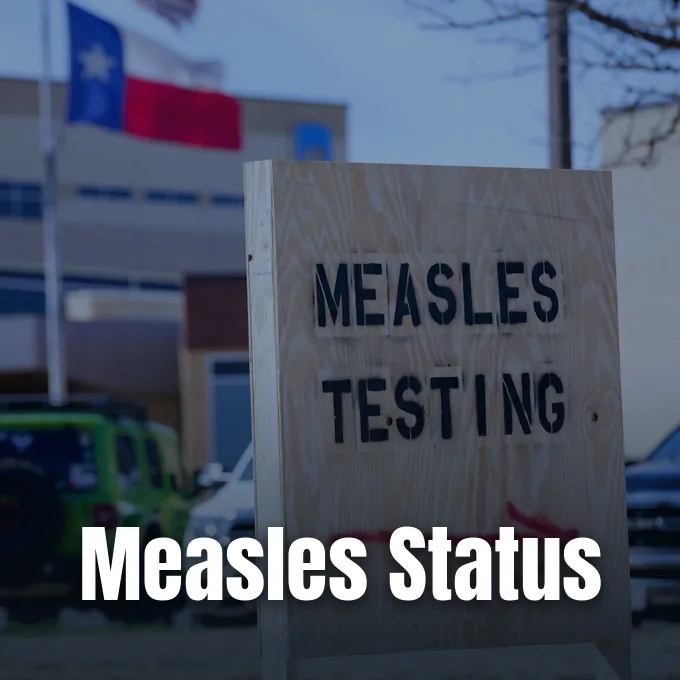
Public health officials at the Pan American Health Organization are meeting this week to determine whether the United States has retained its measles elimination status after two years of expanding viral outbreaks. The Americas branch of the World Health Organization is reviewing epidemiological records following a steep rise in infections that reached 5,182 confirmed cases in 2026 [2]. Although losing the designation carries no direct legal sanctions, medical researchers warn that an official revocation would bring a major setback for national immunization efforts [1].
Assessing Measles Elimination Status
The evaluation takes place during the sixth annual meeting of the Measles and Rubella Elimination Regional Monitoring and Re-Verification Commission, which convenes from November 10 to 13. At the gathering, an international team of specialists in epidemiology, virology, and medical policy assesses whether endemic transmission has resumed, placing measles elimination status in immediate jeopardy. The United States was first declared to have eliminated the virus in 2000, which meant that sustained domestic transmission had stopped for an entire year [2].
Longstanding community protection has fractured under persistent viral spread in multiple regions. In STAT‘s health newsletter Morning Rounds, reporter Theresa Gaffney reported that all indicators point toward a formal loss of elimination as case numbers mount. In January, former CDC official Ralph Abraham told the late journalist Helen Branswell that losing status would simply be “the cost of doing business”. Health specialists with Defend Public Health rejected Abraham’s framing, arguing that federal agencies must actively safeguard community immunity [1].
Scientific advisers have voiced alarm over that institutional stance. Elizabeth Jacobs, a professor emeritus at the University of Arizona and member of the Coordinating Committee of Defend Public Health, expressed dismay at the national trajectory of the outbreaks. “It’s astounding to me,” Jacobs said in comments to Scientific American regarding the epidemiological evidence. “I’m just beside myself about all of this. I literally can’t believe this is happening in the United States.” Michael Osterholm, who directs the Center for Infectious Disease Research and Policy at the University of Minnesota, said an official ruling merely confirms reality on the ground. “When a semi hits your car at 60 miles an hour at an intersection, you don’t need more assessments showing you’ve had an accident,” Osterholm said [2].

Surging Cases by State
Surveillance figures show that measles infections have multiplied quickly over the past three years. According to data compiled by the Centers for Disease Control and Prevention, the nation has recorded 5,182 confirmed cases so far in 2026. By comparison, health agencies documented 2,289 cases in 2025 and only 285 cases in 2024. The virus has now appeared in nearly every state, showing that localized importations are turning into ongoing transmission chains that local clinics struggle to interrupt [2].
Fatalities have also climbed as outbreaks expanded into new communities. Local health departments have reported eight deaths linked to recent infections, including fatal complications seen during a New York measles outbreak that caused the state’s first death in 30 years. Official CDC records list four confirmed deaths nationwide, illustrating differences in how quickly state registries verify fatal viral cases. Because measles is one of the most infectious respiratory pathogens known to medicine, small clusters can quickly spark dozens of secondary transmissions within unimmunized populations [2].
Falling Rates of Childhood Immunization
The primary driver of the resurgence is a sustained slide in childhood immunization coverage. Maintaining herd immunity against measles needs at least a 95 percent vaccination rate with the measles, mumps, and rubella (MMR) shot. Federal records reveal that coverage among American kindergartners fell to 92.4 percent in 2026, dropping steadily from the 95.2 percent recorded in 2020. National averages conceal local deficits, as eighteen states now report kindergarten MMR rates below 90 percent, with Idaho recording a coverage level of just 75.2 percent [2].
County-level disparities leave entire school districts exposed to explosive viral outbreaks. A study published in Nature Health in January identified multiple counties where MMR coverage dropped below 60 percent. Osterholm said broad state summaries often mask high-risk environments where the virus finds fertile ground. “There’s an old line that describes this well: When your head’s in the freezer and your feet are in the oven, you’re, on average, very comfortable,” Osterholm said. He said that even in Minnesota, known for strong public health programs, some schools maintain 80 percent coverage while several nearby school districts drop to 40 percent [2].


Technical Standards of Disease Elimination
In global public health, elimination has a precise technical definition that differs from outright eradication. When the Pan American Health Organization (PAHO) verified elimination for the United States in 2000, it certified that local transmission chains had been broken for an entire year. Under that standard, travelers can still import cases from abroad, but prompt contact tracing and high population immunity help imported infections extinguish without establishing endemic circulation [2].
Community immunity weakened as adult vulnerability compounded the drop in pediatric vaccination. Epidemiological tracking shows that more than 40 percent of all measles cases recorded in 2026 occurred in adults aged 20 or older. Furthermore, 96 percent of all infected individuals in the country had never received a vaccine or had an unverified vaccination history. Because protection relies on consistent community uptake, growing pockets of unprotected adults allow the pathogen to circulate unimpeded between households, schools, and workplaces [2].
Federal Debates Over Measles Elimination Status
Debate over returning infections centers on policies at the Department of Health and Human Services (HHS). Jacobs described the agency as an “epidemiological crime scene” under Secretary Robert F. Kennedy, Jr.. Although Kennedy occasionally urged measles shots, he spent years questioning vaccine safety and suggesting remedies that physicians consider ineffective. When contacted by reporters, HHS did not comment on the ongoing PAHO proceedings [2].
Kennedy has argued that the current surge stems from pandemic-era disruptions when families missed routine pediatric appointments. Jacobs challenged that explanation, noting that federal leadership has had ample opportunity to rebuild protective programs. “He has been in office for 18 months,” Jacobs said. “He has had ample time to go and form a really rigorous and thorough vaccination program, and he can barely say that MMR vaccination is the only way to prevent measles effectively”. Beyond agency disputes, she said online misinformation has accelerated parental hesitancy: “This whole thing blew up right around the same time Facebook did, and I could see it happening, and there’s no way to stop it” [2].

Debates over clinical guidance also surfaced at the American Medical Association interim meeting in Orlando, Florida, following earlier coverage of CDC leadership departures. Reporting by Chelsea Cirruzzo in STAT revealed that federal officials granted ethical waivers to every member of an influential panel reviewing preventive medical care, despite financial ties to affected industries. In August, the chair of the American committee that compiles surveillance data for PAHO detailed the review benchmarks in a First Opinion essay. Specialists await the commission’s final determination on American measles elimination status amid heightened scrutiny [1].
Outbreak Precedents in Canada
Precedents in neighboring countries offer a clear picture of what losing verification entails. Last year, PAHO revoked Canada’s elimination status after that country confirmed more than 5,000 cases in a single year. Osterholm said Canada contained that crisis within a population of 40 million, whereas a proportional outbreak in the United States, with 350 million residents, would translate into more than 50,000 annual infections. Canadian authorities mounted an active response and declared their outbreak over last month, proving that losing elimination doesn’t make viral circulation permanent [2].
Regaining control calls for swift action from health agencies before other pathogens exploit the same gaps. Jacobs cautioned that measles often serves as an early indicator of wider systemic vulnerabilities in community immunization. “As vaccination rates decrease, measles pops up first because it’s so contagious,” Jacobs said. “But the other vaccine-preventable diseases are simmering in the background, and as we have learned, it really doesn’t take much for things to start tearing through a population.” Without coordinated efforts to reverse falling MMR coverage, researchers warn that losing U.S. measles elimination status may herald future disease challenges [2].
- ONLINE NEWS Gaffney, T. (2026, November 11). The U.S. may soon lose measles elimination status. STAT. [Article Link]
- ONLINE NEWS Kovac, A. (2026, November 10). The U.S. may be on the cusp of losing its measles elimination status. Scientific American. [Article Link]
APA 7: PerEXP Teamworks. (2026, November 12). United States Faces Loss of Measles Elimination Status. PerEXP Teamworks. https://perexpteamworks.com/en/measles-elimination-status-united-states/


