






A monolith vs microservices evaluation centers on how engineering organizations choose between packaging software into a single unified binary or distributing functionality between loosely coupled network services. While a monolithic application executes all business logic within a single operating system process and writes to a shared relational database, a microservice architecture decomposes capabilities into autonomous services that run independently and manage their own persistent data stores [6]. Deciding between these two styles shapes deployment velocity, failure resilience, and team communication in expanding software organizations.
- Monolith vs Microservices Core Concepts
- Historical Shift From Single Binaries
- Conway’s Law and Team Boundaries
- Why Monolith vs Microservices Changes Operations
- Data Consistency in Distributed Databases
- Failure Modes in Production Systems
- Real-World Scale and Industry Migration
- Evaluating Monolith vs Microservices by Team Size
Monolith vs Microservices Core Concepts
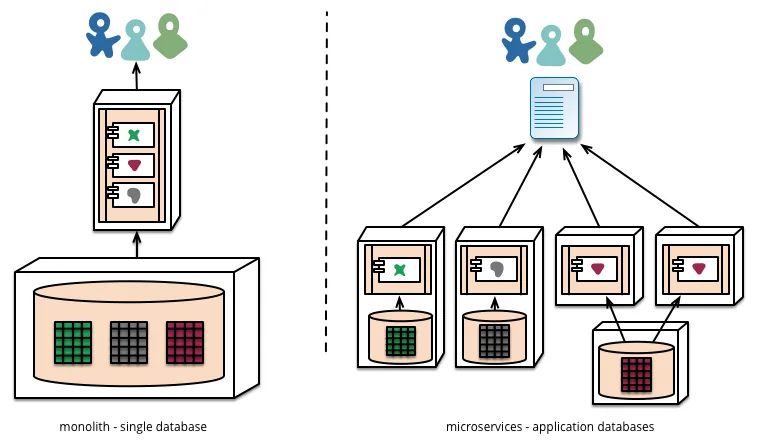
A monolithic application packages its user interface, server-side domain logic, and relational database operations into a single logical executable binary that runs inside one operating system process without requiring network boundaries. Code modules share memory. Developers rely on standard language tools like classes, namespaces, and functions to keep boundaries clean without network penalties. Relational tables enforce ACID consistency through local database commits [6].
By contrast, microservices split a software system into small, autonomous units built around discrete business subdomains. Each service executes in its own operating system process, maintains its own private data store, and talks to peer services through lightweight protocols such as HTTP resource APIs or asynchronous messaging queues. Martin Fowler and James Lewis defined this style clearly: “the microservice architectural style is an approach to developing a single application as a suite of small services, each running in its own process and communicating with lightweight mechanisms”. When teams evaluate monolith vs microservices, the central distinction lies between low-latency in-memory method invocations and distributed network hops that introduce serialization latency, packet loss, and partial system failures. Teams can test, deploy, and scale one service without rebuilding the entire system [6].
Chris Richardson frames these architectural trade-offs using dark energy and dark matter forces in his Assemblage design method. Dark energy pushes systems toward smaller services to foster team autonomy, speed up delivery pipelines, and support multiple programming languages. Dark matter pulls components back together into fewer units to preserve simple in-memory interactions, cut network latency, and keep ACID database transactions simple without requiring complex saga coordination patterns. Richardson explains that balancing these forces determines whether a system thrives as a monolith or as distributed services [4].
Historical Shift From Single Binaries
The ideas behind microservices stem from Unix design traditions that prize small tools doing one job well. The term monolith grew out of the Unix community, appearing in The Art of Unix Programming to describe software packages that became too unwieldy and tightly coupled to modify safely. In 1999, software developer Peter Rodgers joined the Dexter project at Hewlett Packard Labs to explore resource-oriented computing and make complex enterprise systems more durable under changing business conditions [9].
At the 2005 Web Services Edge conference, Rodgers explained that software components could act as micro-web-services connected through Unix-like pipelines. Alistair Cockburn introduced hexagonal architecture that same year to isolate domain logic from external transport layers and databases [9]. Software architects met near Venice in May 2011 to examine these distributed practices, formally adopting the label microservices in May 2012 to describe applications built from small, independently deployable software components. James Lewis presented Microservices – Java, the Unix Way at the 33rd Degree conference in Krakow, while Adrian Cockcroft helped Netflix migrate toward fine-grained service-oriented architecture in the cloud. Fred George explored similar patterns. In an excerpt from Software Engineering Radio, Johannes Thönes and Tobias Kaatz discussed how consumer-driven contracts help engineering teams manage service boundaries as their application ecosystems expand [6].
Architects Joe Walnes, Daniel Terhorst-North, Evan Botcher, and Graham Tackley also refined these modular deployment patterns across commercial enterprise projects. Monolithic release cycles became a painful bottleneck as cloud hosting spread. Teams needed faster paths to production. Frustrations with lengthy deployment queues pushed developers away from single binaries to independently deployable services that could scale on demand without risking whole-system regressions [6].
Conway’s Law and Team Boundaries
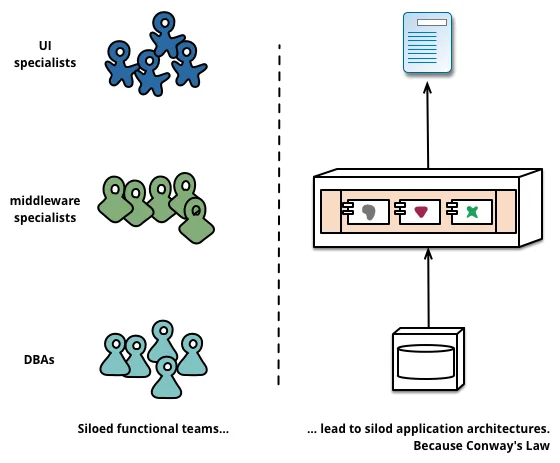
Organizational communication patterns shape software systems, an insight formulated by Melvin Conway in 1968. Conway’s law states that organizations produce system designs that copy their own internal communication lines. Monoliths frequently mirror technical silos: user interface specialists work in one group, backend engineers in a second, and database administrators in a third. Because simple feature requests touch all three technical tiers, shipping an update needs cross-department coordination meetings, management budget approvals, and delayed delivery dates that frustrate product managers [6].
Microservices reorganize engineering departments into small, cross-functional teams that own discrete business subdomains from user interfaces down to database storage, enabling rapid iterative releases without organizational gridlock. Each unit includes developers, testers, and operations specialists who build and run their own software independently. At comparethemarket.com, cross-functional product teams build and run discrete services that coordinate through a message bus. When managing independent services, engineering teams often evaluate monorepo versus multirepo repository layouts to balance independent code versioning against shared build tooling and unified dependency management. Autonomous teams move faster when code boundaries match product boundaries. By giving each team a self-contained code repository and an independent build pipeline, companies prevent separate groups from blocking each other during daily production releases [6].
Splitting systems without team discipline creates new friction. Richard Clayton, Chief Software Engineer at Berico Technologies, said that his team ran into serious trouble after dividing a backend into 8 distinct services assigned to individual programmers. Developers felt blocked by tasks on other services and refused to assist, losing sight of the broader system goals. Clayton said that sharing utility code created unexpected coupling that forced a major refactoring [5].
Why Monolith vs Microservices Changes Operations
A comparison between monolith vs microservices highlights how day-to-day software work shifts from writing core business logic to maintaining networked infrastructure, container orchestrators, and automated deployment pipelines. A monolith needs one build job, one server process, and one database connection pool. Distributed services run dozens of separate processes on distinct virtual machines or containers [3].
Martin Fowler formulated four baseline operational prerequisites with ThoughtWorks colleagues Evan Bottcher, Thiyagu Palanisamy, Sam Newman, and James Lewis. First, teams must possess rapid server provisioning to launch new virtual instances in hours through cloud automation rather than waiting weeks for manual hardware setup. Second, basic monitoring must catch runtime errors and business drops quickly to allow rollbacks. Third, deployment pipelines must ship builds to test and production environments in under two hours. Fourth, developers and operations staff must maintain an active DevOps collaboration culture to resolve incidents together. Colleagues Chris Ford, Kief Morris, Premanand Chandrasekaran, Rebecca Parsons, Sarah Taraporewalla, and Ian Cartwright helped refine these baseline operational standards across multiple enterprise client engagements. Teams that skip these operational fundamentals spend more time fighting broken infrastructure than writing software [3].
In Microservices: A Practical Guide, Eberhard Wolff said that operating distributed software requires specialized infrastructure tools. Production setups rely on Consul for service discovery, Prometheus for metric collection, Zipkin for distributed tracing, and Kafka for asynchronous event queues to monitor system health. Wolff also highlighted service meshes like Istio for managing inter-service communication policies. Without automated platform tooling, microservices burden operators with unmanageable complexity [8].



Data Consistency in Distributed Databases
The core monolith vs microservices tension appears most clearly in database design. A monolith relies on a single relational database where ACID transactions guarantee data integrity between related tables. In microservices, loose coupling requires the Database per Service pattern, ensuring that one service never reads or writes another service’s private tables straight through database queries [4].
Because distributed two-phase commit transactions cause heavy lock contention and network latency, microservice architectures embrace eventual consistency. Teams coordinate business actions using saga patterns, executing distributed commands as sequences of local database updates linked by asynchronous messages that update state step by step. When services need to query data from multiple domain datastores, developers implement API composition or Command Query Responsibility Segregation (CQRS) patterns with read-only query tables to avoid distributed joins. Chris Richardson said that outbox tables allow services to update local entities and publish domain events in a single atomic transaction. This approach ensures that downstream services stay synchronized without requiring tight distributed locking across the network [4].
Mark Richards warned against the data-driven migration antipattern, advising teams not to split databases before decoupling application code. Decoupling databases first leads to failed migrations because domain lines are still blurry. Software architect Neal Ford said that integrator factors like shared transactions favor keeping services combined, while disintegrator factors like independent scaling justify splitting them into separate deployable units. Ford suggested using architectural fitness functions to measure coupling over time [9].

Failure Modes in Production Systems
Network boundaries introduce partial failures that do not exist within a single in-memory monolith. In-process calls run instantly or throw immediate local exceptions. Network calls face packet loss, latency spikes, and remote server crashes. When one service stalls, calling services can exhaust worker threads while waiting, causing cascading outages throughout the entire platform unless circuit breakers halt incoming traffic [4].
Distributed systems protect themselves by deploying circuit breakers and cell-based architecture. Cell-based architecture groups services into self-contained cells that process customer traffic independently. If one cell suffers an outage, traffic shifts to healthy cells while internal circuit breakers isolate failing components to prevent cascading downtime from affecting the wider user base [9]. To manage service-to-service routing, encryption, and telemetry without cluttering business logic, engineering groups adopt service mesh routing and security mechanisms that handle traffic policies transparently. Tools like Istio handle network retries and mTLS authentication transparently. By decoupling networking concerns from application code, a service mesh provides consistent traffic management across diverse microservices [8].
Design flaws can ruin a distributed system. In an IEEE Software study, researchers Taibi and Lenarduzzi interviewed 72 developers to classify 11 bad smells that hurt microservice maintainability [9]. In an unreviewed arXiv preprint on self-adaptive systems, Nabor Mendonca, Pooyan Jamshidi, David Garlan, and Claus Pahl studied how distributed video surveillance services can adapt their behaviors under uncertain network conditions. Their work highlights that dynamic monitoring remains essential for self-healing distributed topologies [1].
Real-World Scale and Industry Migration
Web traffic spikes originally drove the industry shift toward microservice architectures. Netflix transitioned away from its monolithic data centers to an AWS cloud architecture to support international video streaming. Today, Netflix processes more than one billion API calls daily from over 800 device types, generating up to 30% of peak Internet traffic during busy streaming hours [4].
A single client request to Netflix fans out to an average of six backend microservices to assemble metadata, user viewing history, and algorithmic recommendations before rendering the screen. Retail leader Amazon made a similar transition, moving from an early two-tier monolith to hundreds of backend services. The Amazon.com website calls 100 to 150 independent services to build a single shopping page. Online marketplace eBay partitioned its application into functional areas like buying and selling, using Z-axis splits and multi-axis scaling across application and database tiers to handle heavy bidding loads. These high-scale organizations proved that independent services solve immense concurrency demands when single monolithic databases reach physical hardware limits under heavy customer loads [4].

At the SpringOne 2GX conference, Fred Melo and Matt Stine presented patterns for running microservices on Cloud Foundry using Spring Boot to simplify deploying and orchestrating stateless backend services. They focused on stateless services, dynamic configuration, and backing service consumption. Their presentation showed that microservice architectures shine at massive scale but require mature platform automation. Without automated platform tooling, microservices burden operators with unmanageable complexity [7].
Evaluating Monolith vs Microservices by Team Size
Teams evaluating monolith vs microservices must match system design to organizational maturity and team size. Early-stage startups and small teams benefit from building a clean monolith first. In an unreviewed arXiv preprint, Nicola Dragoni, Ivan Lanese, Manuel Mazzara, Ruslan Mustafin, and Larisa Safina noted that microservices deliver independent scaling but introduce heavy operational friction for smaller engineering organizations [2]. Monoliths let small teams refactor domain models rapidly without negotiating network APIs, versioning remote schemas, or coordinating deployment schedules across multiple software repositories [6].
Keeping code in one binary simplifies local testing on developer laptops without requiring container orchestration [6]. As companies grow and distinct subdomains stabilize, monolithic builds can choke deployment pipelines. When separate product teams step on each other’s code, extracting high-throughput services solves deployment gridlock. Engineering teams evaluating microservices scaling trade-offs must balance developer cognitive load against operational flexibility to avoid introducing distributed complexity before organizational growth demands it. Incremental decomposition lets teams carve out bounded contexts without halting product delivery [9].
A modular monolith keeps software design clean while preserving the option to split services later as business needs expand and traffic patterns become better understood [9]. Microservices succeed when an organization has already mastered automated testing, continuous delivery pipelines, and reliable system monitoring to support independent service deployments. Without those prerequisite skills, monoliths remain the safer choice for sustainable product engineering [3].
- PREPRINT Mendonca, N. C., Jamshidi, P., Garlan, D., & Pahl, C. (2019). Developing Self-Adaptive Microservice Systems: Challenges and Directions. [Article Link]
- PREPRINT Dragoni, N., Lanese, I., Larsen, S. T., Mazzara, M., Mustafin, R., & Safina, L. (2017). Microservices: How To Make Your Application Scale. [Article Link]
- WEBSITE Fowler, M. (2014). Microservice Prerequisites. [Article Link]
- WEBSITE Richardson, C. (2026). Microservice Architecture Pattern. [Article Link]
- ONLINE NEWS Stenberg, J. (2014). Experiences from Failing with Microservices. [Article Link]
- WEBSITE Fowler, M., & Lewis, J. (2014). Microservices: A Definition of This New Architectural Term. [Article Link]
- ONLINE NEWS Melo, F., & Stine, M. (2014). Developing Microservices for PaaS with Spring and Cloud Foundry. [Article Link]
- WEBSITE Wolff, E. (2026). Microservices: A Practical Guide. [Article Link]
- WEBSITE Wikipedia Contributors. (2026). Microservices. [Article Link]


