






A microservices architecture organizes a software app into small, autonomous units that run in separate processes and communicate through lightweight network APIs [3]. Instead of packaging all business features into a single executable file, teams build each unit around a distinct business capability. This design lets individual parts scale on demand, deploy on separate schedules, and use different programming languages [6]. While the pattern speeds up feature delivery in growing software firms, it moves new complexity into network management, distributed data handling, and automated infrastructure [3].
- What Is Microservices Architecture?
- Monolithic Limits on Application Growth
- Conway’s Law and Team Organization
- How Microservices Architecture Handles Data
- Operational Prerequisites for Independent Services
- Why Microservices Architecture Projects Fail
- Architectural Smells in Cloud Systems
- How Teams Evaluate Migration Strategies
What Is Microservices Architecture?
The concept of microservices architecture gained rapid traction between 2011 and 2014 as web firms searched for better ways to build cloud systems. In May 2011, software architects met near Venice to discuss practical ways to break large applications into small, independently deployable units. A year later, in May 2012, that same group selected the name microservices. Consultant James Lewis of ThoughtWorks presented these ideas in March 2012 at the 33rd Degree event in Krakow under the title Microservices – Java, the Unix Way, while Fred George shared similar principles around the same time [3].
Breaking code into small parts has deep roots. In 1999, Peter Rodgers worked on the Dexter project at Hewlett Packard Labs to make large systems less brittle, pioneering resource-oriented computing and later proposing Unix-like pipelines for web services at a 2005 conference. Alistair Cockburn introduced hexagonal architecture that same year, isolating core logic from auxiliary adapters [6]. Later, researchers X. Larrucea and C. Ebert observed in IEEE Software that microservices represent small applications with single responsibilities that teams deploy, scale, and test independently without centralized bottlenecks [2].
At Netflix, Adrian Cockcroft called this design fine-grained service-oriented architecture (fine-grained SOA) while expanding video streaming to millions of homes. Early pioneers Joe Walnes and Evan Bottcher helped test the pattern in production systems [3]. In an unreviewed preprint, N. Dragoni and fellow researchers showed that microservices offer teams practical paths to scale apps through decoupled units [1].
Monolithic Limits on Application Growth
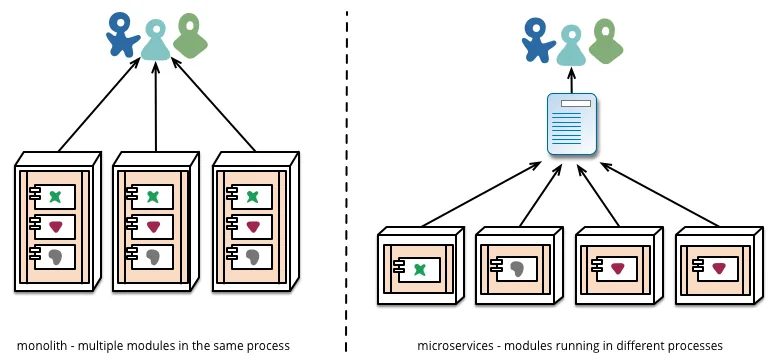
Most enterprise software begins as a monolith, bundling client screens, domain code, and database tables into one file. The word monolith appears in The Art of Unix Programming to describe software that has grown too large to manage cleanly. In a microservices architecture, teams reject this single-process model. In a standard monolith, all request processing runs inside a single process where developers use basic language tools like classes and namespaces for modular structure. Teams can run the entire program on a laptop and deploy it through a simple pipeline [3].
Monoliths work well early on. But as codebases grow, small edits to a single helper function force teams to rebuild and test the whole codebase [3]. Scaling also wastes cloud resources when one busy task (such as checkout or search) forces engineers to clone the entire monolith rather than adding power only to the constrained code [6].
Streaming platforms demonstrate why monoliths hit hard limits. Netflix, which accounts for up to 30% of internet traffic, migrated to fine-grained services to handle over one billion daily calls to its video streaming API from more than 800 different device types. Each incoming API request fans out to an average of six backend services. Similarly, Amazon replaced its early two-tier setup with hundreds of backend services, where rendering a single page on Amazon.com calls between 100 and 150 separate service endpoints. The auction site eBay adopted similar functional splits to scale its database tier [4].
Conway’s Law and Team Organization
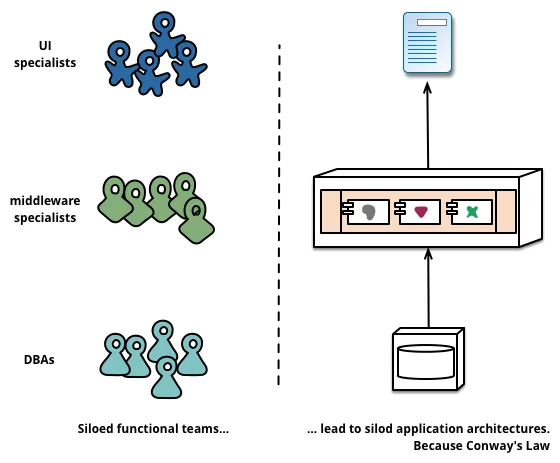
System designs often copy human communication paths, an effect discovered by programmer Melvin Conway in 1968. Conway’s law states that any group that builds a system will create a design that matches the group’s communication lines. When a software firm splits staff into separate user interface, backend, and database teams, even small feature changes need multiple handoffs, cross-team approvals, and delayed release schedules. Code logic ends up scattered wherever coders have write access instead of where it naturally fits [3].
Cross-functional teams solve these handoff delays by taking full ownership of a single business area. In a microservices architecture, each team builds, tests, and runs its own service stack, covering user screens, business logic, and databases [3, 4]. Authors of Team Topologies describe how these autonomous units push frequent updates through automated delivery pipelines [4]. For instance, Comparethemarket.com organized staff around distinct products, letting small groups run separate services that talk over a message bus. ThoughtWorks consultant Sam Newman noted that matching service boundaries to team boundaries gives teams real autonomy [3]. Ownership stays clear from code commit to production monitoring.

Domain-driven design concepts, particularly bounded contexts, give teams clear structural lines. A bounded context defines an area where a domain model stays valid and consistent. Mapping each service to one bounded context keeps coupling low and lets teams ship updates without waiting for company-wide release windows or coordinated code freezes across different departments [3, 6].
How Microservices Architecture Handles Data
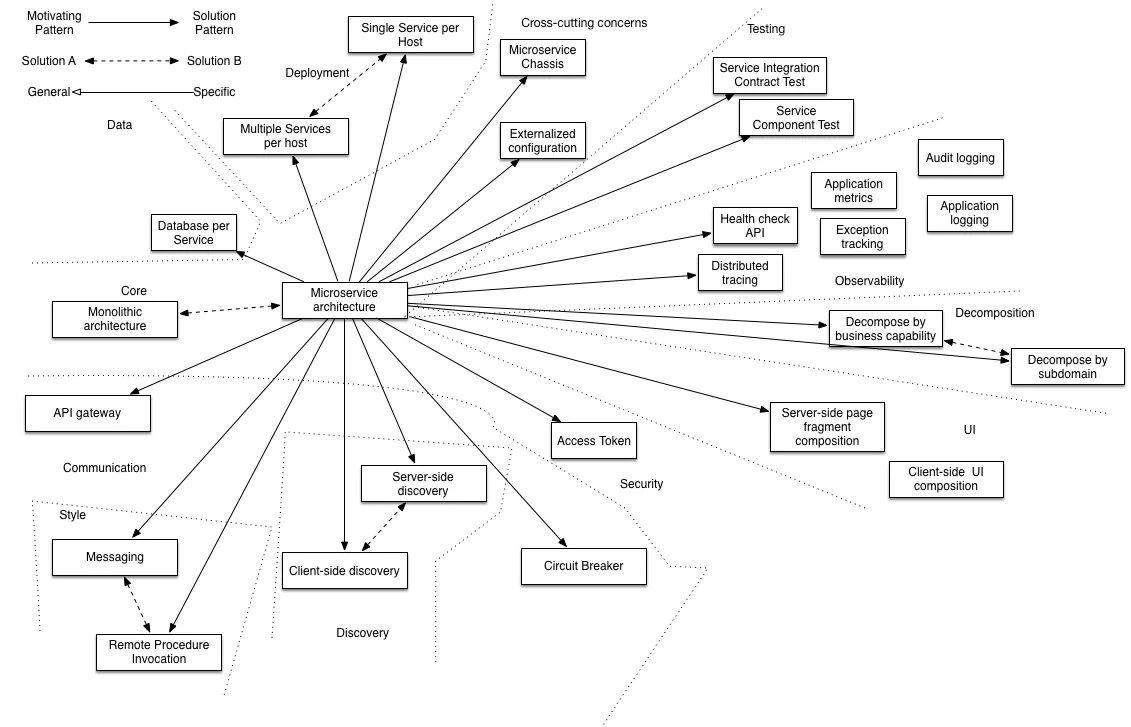
The hardest part of a microservices architecture is abandoning a shared central database. In a monolith, developers use relational tables, foreign keys, and direct ACID transactions to keep records clean. True service autonomy needs the database per service pattern, where every individual service holds its private data store and blocks outside components from querying its internal tables directly. Other services must request data through published APIs or event feeds, removing hidden database ties that stop independent releases [3, 4]. Shared databases create invisible coupling that breaks team independence.
Decoupled data means teams must swap immediate ACID safety for eventual consistency under BASE principles (basically available, soft state, eventual consistency). When an operation spans several services—such as taking an order, holding stock, and charging a credit card—a single database commit cannot work. Chris Richardson details several collaboration patterns to coordinate these distributed operations without using slow distributed locks. The Saga pattern splits a multi-service task into local transactions, where each step emits an event that prompts the next service to act. If any step fails, the saga runs undo transactions to roll back earlier changes and keep data balanced [4]. This approach avoids distributed deadlocks.
Reading data across services presents another hurdle because teams cannot run join queries on separate databases. Coders use API composition or event streams to feed read views [4]. Architecture expert Mark Richards coined the data-driven migration antipattern, warning that moving data stores before shifting application code often wrecks modernization plans [6].


Operational Prerequisites for Independent Services
Running dozens of separate services brings operational burdens that can crush unprepared engineering teams. In an essay on martinfowler.com, Martin Fowler warned that teams without basic operational competencies should avoid microservices architecture until they build proper foundations. Fowler outlined four core needs: fast server setup in hours, broad monitoring for system errors and business drops, deployment pipelines that run in under two hours, and close DevOps collaboration. Without these baseline skills, managing many moving parts becomes an operational trap [5]. Automation must precede service growth.
Resource tuning is a major cloud challenge. In research for the ACM, A. F. Baarzi and G. Kesidis built SHOWAR to solve service sizing and container scheduling (vertical and horizontal resource tuning). Their tests showed that fixed allocations waste costly memory and CPU limits, while undersized services fail during demand surges. SHOWAR uses historical usage data to set vertical resource bounds and applies control theory to adjust horizontal replica counts dynamically, sending smart placement hints to the cluster scheduler [9]. Right-sizing microservices reduces cloud bills while preserving response speeds.
Modern platforms use tools to handle these tasks. Consultant Eberhard Wolff explained in Microservices – A Practical Guide that teams deploy Kafka for message streams, Consul for service registries, and Kubernetes for containers. Tracing tools like Zipkin and monitoring systems like Prometheus let engineers track requests across multiple service hops [12].
Why Microservices Architecture Projects Fail
Adopting a microservices architecture without proper preparation often ends in expensive failure. At Berico Technologies, Chief Software Engineer Richard Clayton wrote an open post on InfoQ detailing why his team stumbled while building a microservice system. Clayton explained that the primary root causes were not flaws in programming tools, but team frictions, misjudged service splits, and poor ownership lines between developers [7]. Technology choices rarely cause failure on their own.
Clayton identified five main problems that damaged the project. First, ongoing debates over monoliths versus microservices created emotional friction that slowed work. Second, dividing the backend into eight separate services and assigning one person per service created walls; coders felt blocked by other tasks and refused to help on other services. Third, launching eight services right away was too big a leap for the team, where starting with two or three services would have prevented failure [7]. When engineers focus only on their own slice, overall system health suffers.
Code sharing and API design also tripped up the Berico team. Trying to balance shared libraries against clean service autonomy led to a painful rewrite. Loose API specs also caused constant bugs for frontend coders [7]. In IEEE Software, Pooyan Jamshidi and Claus Pahl confirmed that finding the right balance between shared code and team autonomy is a common difficulty across the software industry [11].
Architectural Smells in Cloud Systems
As a microservices architecture matures in production, hidden design flaws can degrade performance and slow down feature work. In IEEE Software, researchers D. Taibi and V. Lenarduzzi spoke with 72 experienced microservice developers to build a catalog of 11 harmful design smells. Their findings showed that teams regularly stumble into cyclic dependencies between services, leak database fields through public APIs, and stretch simple user actions across too many service calls [8]. Catching bad smells early preserves codebase health.
Distributed systems face network penalties that never occur inside a monolith. Remote procedure calls and HTTP requests introduce serialization delays, connection drops, and network round trips. When multiple services call one another in long chains, a slowdown in one downstream node can ripple through the entire platform. To limit these risks, teams build cell-based designs where services sit in autonomous cells protected by circuit breakers that stop cascading outages [6]. Cells confine damage so that a failure in one region does not bring down the entire global product.

Software architect Neal Ford recommended using fitness functions and balancing integrator and disintegrator factors to judge service size. Integrator factors like shared transactions suggest combining services, while disintegrator factors like independent scaling point toward splitting them. Watching these forces keeps architectures clean and stops wasteful service sprawl across growing cloud platforms [6].
How Teams Evaluate Migration Strategies
Choosing a microservices architecture requires an honest assessment of system scale and organizational maturity. Writing in ACM SIGAPP Applied Computing Review, researchers T. Černý, M. J. Donahoo, and M. Trnka analyzed how enterprise systems move from traditional service-oriented architecture (SOA) to microservices. They showed that while microservices remove clumsy enterprise service buses, they introduce fresh difficulties in service governance, configuration drift, and distributed request tracking across cloud environments [10]. New patterns solve old problems but create fresh trade-offs.
Migrating legacy software needs proven patterns. In Software Practice and Experience, A. Balalaie and colleagues documented migration and rearchitecting patterns from industrial cloud projects, showing how incremental adoption prevents catastrophic failures during enterprise software modernizations [6, 11]. Teams extract business capabilities behind an API gateway instead of attempting risky complete rewrites [4, 6]. This evolutionary approach lets organizations run newly developed services alongside legacy monoliths until all critical business capabilities transition safely into independent production environments [6]. Step-by-step extraction keeps risk manageable while delivering early business value.
Microservices are not an automatic fix for every engineering challenge. Martin Fowler and other software architects point out that a clean modular monolith is often the fastest, lowest-cost option for early products and smaller teams [3, 5]. Only when system scale and diverging feature demands create severe bottlenecks does the operational overhead of microservices pay off [3, 4]. Simplicity should remain the default starting point.
- PREPRINT Dragoni, N., Lanese, I., Larsen, S. T., Mazzara, M., Mustafin, R., & Safina, L. (2017). Microservices: How To Make Your Application Scale. arXiv. [Article Link]
- ACADEMIC JOURNAL Larrucea, X., Santamaría, I., Colomo-Palacios, R., & Ebert, C. (2018). Microservices. IEEE Software, 35(3), 96-100. [Article Link]
- WEBSITE Lewis, J., & Fowler, M. (2014). Microservices. martinfowler.com. [Article Link]
- WEBSITE Richardson, C. (2026). Microservice Architecture pattern. microservices.io. [Article Link]
- WEBSITE Fowler, M. (2014). Microservice Prerequisites. martinfowler.com. [Article Link]
- WEBSITE Wikipedia contributors. (n.d.). Microservices. Wikipedia, The Free Encyclopedia. [Article Link]
- ONLINE NEWS Stenberg, J. (2014). Experiences from Failing with Microservices. InfoQ. [Article Link]
- ACADEMIC JOURNAL Taibi, D., & Lenarduzzi, V. (2018). On the Definition of Microservice Bad Smells. IEEE Software, 35(3), 56-62. [Article Link]
- CONFERENCE PAPER Baarzi, A. F., & Kesidis, G. (2021). SHOWAR. Proceedings of the ACM Symposium on Cloud Computing, 427-441. [Article Link]
- ACADEMIC JOURNAL Černý, T., Donahoo, M. J., & Trnka, M. (2018). Contextual understanding of microservice architecture. ACM SIGAPP Applied Computing Review, 17(4), 29-45. [Article Link]
- ACADEMIC JOURNAL Jamshidi, P., Pahl, C., Mendonça, N. C., Lewis, J., & Tilkov, S. (2018). Microservices: The Journey So Far and Challenges Ahead. IEEE Software, 35(3), 24-35. [Article Link]
- WEBSITE Wolff, E. (n.d.). Microservices – A Practical Guide. practical-microservices.com. [Article Link]


