




A service mesh provides a software layer that manages network traffic between microservices through lightweight proxies. In cloud architectures, complex web platforms split into independent services that exchange calls over private networks. As cloud deployments expand, managing traffic policies, encryption certificates, and failure recovery inside individual code repositories creates friction for software developers. Running sidecar proxies next to each application instance lets teams enforce routing rules and gather diagnostics without altering underlying business code [1].
What a Service Mesh Does
Software teams once built monolithic programs where code components talked through in-memory function calls. When companies transitioned to microservices, those components became separate network services communicating over protocols like HTTP, gRPC, and TCP. Developers imported libraries into each code repository to handle retries and security certificates. That approach broke down in polyglot setups [2]. The mesh fixes this [1].
A service mesh pulls networking tasks completely out of application codebases. Instead of forcing engineers to maintain networking libraries in Go, Java, and Python services, it inserts an external layer that governs how data moves through the cluster. The mesh provides service discovery, Layer 7 traffic routing, cryptographic identity checks, and metrics collection for each running service. Because these capabilities operate as an independent layer outside the app runtime, developers focus on writing business code while operations teams configure communication policies uniformly in Kubernetes clusters [1]. Nicolas-Plata, Gonzalez-Compean, and Sosa-Sosa showed how integrating processing patterns directly into mesh frameworks reduces coupling between components. Their research in Cluster Computing confirms that delegating discovery and workload management to mesh components frees developers from handling complex communication pipelines by hand [10].
Many engineers wonder how this capability differs from standard container orchestration. While tools like Kubernetes schedule workloads and manage basic container lifecycles, they do not inspect Layer 7 traffic or enforce mutual authentication between individual pods. A mesh runs with container workloads managed by Kubernetes, extending native service abstractions with request-level routing and automated circuit breaking [5]. It turns a basic network into an observable communication fabric.

Data Plane and Control Plane Architecture
The architecture of every service mesh divides cleanly into two functional parts: the data plane and the control plane. This division separates the fast path moving raw application packets from the central management path defining configuration rules. The data plane consists of lightweight network proxies that sit in the network path between services, intercepting inbound and outbound calls. In contrast, the control plane stays outside the path of individual requests, acting as a central coordinator that translates operator commands into dynamic routing policies and distributes them to every active proxy. This strict separation ensures that temporary control plane outages never disrupt existing data plane traffic flowing between running services [1].
Data plane proxies run through the sidecar pattern. In a Kubernetes pod, an auxiliary proxy container executes alongside the main application container. Both share the same network namespace and IP address. Traffic hits the proxy first [1],. Envoy and Linkerd2-proxy serve as prominent examples [2].
The control plane provides APIs for administrators to manage routing policies without modifying running pods [1]. When an operator updates traffic split ratios or adds an authorization rule, the control plane translates that instruction and pushes updated tables to thousands of distributed proxies. Most modern systems use the standardized xDS discovery API created by the Envoy project to stream configuration updates in real time [7]. Proxies apply new routing tables on the fly without dropping active network connections or requiring container reboots.
Traffic Routing and Resilience
Routing traffic between microservices requires more control than standard round-robin DNS lookups can offer. A service mesh provides Layer 7 routing based on HTTP headers, URL paths, and query parameters. Operations teams use traffic splits to conduct canary releases, routing a tiny fraction of live production traffic to a newly deployed build while sending the rest to an established version [2]. If error rates climb on the candidate release, proxies reroute traffic back without requiring redeployments.
Resilience features protect distributed systems from cascading failures. If a downstream service slows down, calling services can exhaust connection pools and crash. Proxies enforce request timeouts, bounded retries with backoff, and automated circuit breaking [1], [2]. This stops cascading crashes [1]. The struggling service gets time to recover.
Configuring resilience attributes across hundreds of interacting services presents difficulty for cloud engineering teams. Researchers Meng, Jagadeesan, and Thottan analyzed this challenge by developing a model-based reinforcement learning workflow that predicts fault resilience behaviors across complex multi-service web applications. Their investigation demonstrated that testing every possible attribute combination in pre-production staging environments is impossible due to distributed state complexity, making automated learning agents valuable for identifying configurations that maintain request stability during unexpected service degradation [12]. Aldas and Babakian similarly showed in IEEE Access that cloud-native mesh architectures require enhanced programmability to handle heavy signaling influxes in 5G Service-Based Architecture environments without introducing unbounded latency spikes [10].
Mutual TLS Security
Zero-trust security models assume that internal network boundaries offer no inherent safety. Perimeter firewalls guard external ingress points, but internal service communication travels over unencrypted channels. If attackers breach one low-privilege container, they can sniff internal packets. A mesh eliminates this risk by enforcing cryptographic authentication cluster-wide [1],. The proxies decrypt packets [2].
The foundation of service mesh security is automatic mutual Transport Layer Security (mTLS) [1]. When two services initiate a network connection, their paired sidecar proxies execute a mutual cryptographic handshake before forwarding any application payload. The proxies verify digital identities using X.509 certificates and encrypt all data in transit using modern ciphers [2]. The mesh control plane acts as an automated certificate authority, generating short-lived identities for each workload and rotating cryptographic keys continuously without requiring human intervention or service interruptions. This design keeps every inter-service call authenticated, encrypted, and protected against unauthorized eavesdropping in the shared infrastructure [1],. Systems like Istio and Open Service Mesh implement this automated key rotation natively [2], [7].
Beyond automated encryption, meshes enforce declarative authorization policies that define which services can communicate. Academic researchers Alboqmi and Gamble expanded on this capability in Sensors by designing a vulnerability-driven trust mechanism that evaluates third-party software supply chain risks directly within the mesh. Their framework calculates dynamic runtime trust scores for microservices based on discovered dependencies, showing how data planes can actively isolate compromised modules before security flaws propagate through production environments [11].



Observability Across Distributed Services
Diagnosing latency problems across fifty microservices is difficult without centralized instrumentation. Because sidecar proxies intercept every network request, a service mesh generates telemetry without requiring developers to embed custom monitoring libraries into application code. The mesh automatically captures golden signals: request count, error rates, latency percentiles, and connection saturation metrics. Teams get instant clarity [2].
In addition to metrics, modern meshes produce access logs and distributed tracing spans. Proxies inject unique tracing headers, such as W3C Trace Context or B3 propagation headers, into every forwarded request. These spans feed directly into backend visualization tools including Jaeger, Zipkin, and OpenTelemetry collectors, allowing engineers to trace the complete path of a single transaction as it travels through multiple internal microservices. Visual dashboards like Kiali for Istio or Hubble for Cilium render dynamic network topology maps that display real-time traffic volume and error rates between services. Prometheus gathers metrics across nodes, while Grafana visualizes latency graphs for operations engineers during live incidents [2].
As enterprise infrastructure scales up, real-time diagnostic pipelines must process enormous data volumes. High-density cloud environments frequently combine general application pods with specialized hardware accelerators for cloud workloads, making low-overhead diagnostic collection helpful for cluster stability. Researchers Samani and Stadler evaluated dynamic management frameworks on Istio and Kubernetes, using reinforcement learning agents to reallocate resources periodically so services consistently meet end-to-end delay bounds under heavy traffic loads [12].

Comparing Major Service Mesh Options
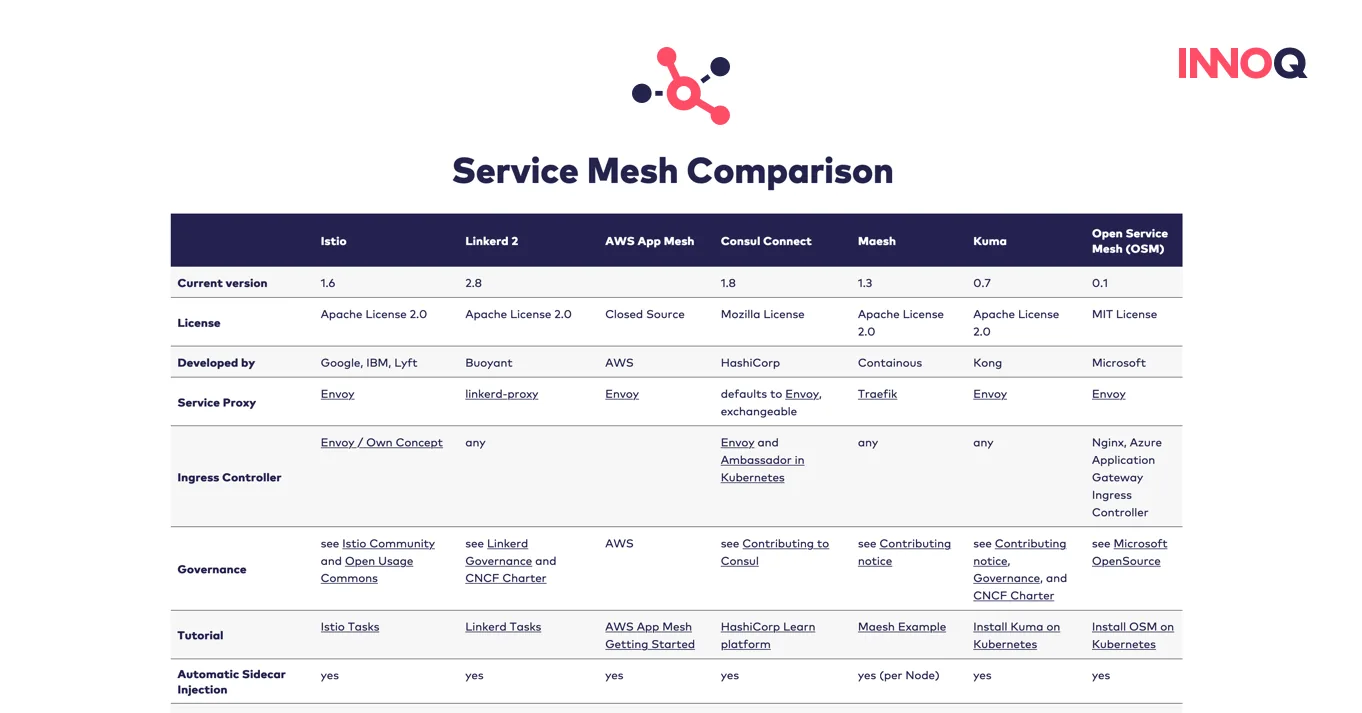
The cloud-native ecosystem offers several competing service mesh implementations, each optimized for distinct operational trade-offs [2], [9]. Istio, originally created through a collaboration between Google, IBM, and Lyft, has become the most widely adopted platform in enterprise environments. It uses the Envoy proxy on the data plane and provides extensive support for complex routing, policy enforcement, and multi-cluster topologies. However, Istio’s vast feature set brings noticeable configuration complexity that can overwhelm smaller engineering teams [2], [9]. Istio runs on Google Cloud, Microsoft Azure, Amazon AWS, and Red Hat OpenShift [2].
In contrast, Linkerd, developed by Buoyant, prioritizes operational simplicity and raw runtime performance [2], [9]. Linkerd uses an ultralight proxy written in Rust called linkerd2-proxy. It installs quickly, delivers automated mTLS out of the box, and consumes minimal memory. Buoyant donated Linkerd to the CNCF, where it achieved graduated status [2].
Other implementations address specialized architectural needs in hybrid enterprise infrastructure. HashiCorp’s Consul excels at connecting traditional bare-metal virtual machines with containerized clusters, making it popular in hybrid enterprise migrations. Kong’s Kuma offers multi-zone routing across both Kubernetes and standalone virtual machines. Meanwhile, Cilium takes an innovative architectural approach by leveraging eBPF inside the Linux kernel to handle Layer 3 and Layer 4 routing directly in kernel space while dynamically injecting Envoy proxies only when Layer 7 inspection is needed [2]. Palavesam, Krishnamoorthy, and M evaluated multi-cluster management across Istio, Linkerd, Kuma, and Consul, finding that Istio excels in multi-cluster scaling while Linkerd leads in operational simplicity [9].
The Open Service Mesh Project
In August 2020, Microsoft launched Open Service Mesh (OSM) based on Envoy [3], [4]. Microsoft designed OSM as a reference implementation of the Service Mesh Interface (SMI) specification for Kubernetes. Gabe Monroy, who managed Azure Compute partner programs at Microsoft and served as a CNCF board member, said that customer friction drove the project. “What our customers have been telling us is that solutions that are out there today, Istio being a good example, are extremely complex,” Monroy said [3]. “We see the data in the AKS support queue of customers who are trying to use this stuff — and they’re struggling right here.”
Microsoft donated OSM to the CNCF to ensure community-led open governance [3],. That decision contrasted with Google, which had sparked industry controversy by keeping Istio under the Open Usage Commons [4], [5]. Analyst Holger Mueller of Constellation Research said that Microsoft built OSM to avoid leaving the mesh layer to Google. “There is room for competition in a new area like service mesh,” Mueller said [4]. Oliver Gould, cofounder of Buoyant, also said that OSM shared strong design traits with Linkerd [5].

On May 4, 2023, maintainers announced that Open Service Mesh would be archived within the CNCF [7], [8]. The decision followed Google’s donation of Istio to the CNCF, which unified community governance. Maintainers redirected efforts toward contributing to Istio, standardizing the Kubernetes Gateway API through the GAMMA initiative, and collaborating on Ambient Mesh patterns [7].
Operational Trade-Offs Before Adoption
Should every engineering team adopt a service mesh? The honest answer is no. While meshes solve intricate networking headaches for large architectures, they introduce technical overhead. Running a dedicated sidecar proxy inside every application pod consumes extra CPU cycles and memory across the cluster. Each proxy hop also introduces incremental network latency, typically adding one to three milliseconds to each inter-service call [2]. For smaller organizations with only a handful of microservices, this resource footprint can outweigh the operational benefits.
Before adopting any service mesh in production, engineering teams should conduct rigorous performance benchmarking. Infrastructure teams should set up identical staging clusters — one running the candidate service mesh and another running bare container workloads without a mesh. Running automated load generation tools like Locust or Fortio lets operators measure throughput, memory consumption, and percentile latency under realistic production traffic patterns [2]. Benchmarking helps teams discover whether the added latency fits within their service level objectives before committing to long-term architectural migration, helping infrastructure changes deliver measurable improvements rather than unexpected system slowdowns.
A service mesh delivers genuine value when architectural complexity justifies its operational cost [1], [2]. Polyglot environments benefit from centralized mTLS certificate rotation, uniform access control, and standardized telemetry pipelines. When compliance demands zero-trust encryption or canary releases require traffic splits, delegating network policies to proxies frees developers to focus on core features [1].
- WEBSITE Wikipedia. (n.d.). Service mesh. Wikipedia. [Article Link]
- WEBSITE INNOQ. (2024, September 12). Service Mesh Comparison. servicemesh.es. [Article Link]
- ONLINE NEWS Lardinois, F. (2020, August 5). Microsoft launches Open Service Mesh based on Envoy. TechCrunch. [Article Link]
- ONLINE NEWS Wheatley, M. (2020, August 5). Taking on Google’s Istio, Microsoft debuts Open Service Mesh. SiliconANGLE. [Article Link]
- ONLINE NEWS Carey, S. (2020, August 7). Microsoft breaks ranks with its own service mesh. InfoWorld. [Article Link]
- WEBSITE Open Service Mesh. (2019, December 13). Open Service Mesh (OSM). GitHub. [Article Link]
- WEBSITE OSM Maintainers. (2023, May 4). OSM Project Update. openservicemesh.io. [Article Link]
- WEBSITE Wikipedia. (n.d.). Open Service Mesh. Wikipedia. [Article Link]
- ACADEMIC JOURNAL Palavesam, K. V., Krishnamoorthy, M. V., & M, A. S. (2025). A Comparative Study of Service Mesh Implementations in Kubernetes for Multi-cluster Management. Journal of Advances in Mathematics and Computer Science, 40(1), 1-16. [Article Link]
- ACADEMIC JOURNAL Nicolas-Plata, A., Gonzalez-Compean, J. L., & Sosa-Sosa, V. J. (2024). A service mesh approach to integrate processing patterns into microservices applications. Cluster Computing, 27(6), 7417-7438. [Article Link]
- ACADEMIC JOURNAL Alboqmi, R., & Gamble, R. (2025). Enhancing Microservice Security Through Vulnerability-Driven Trust in the Service Mesh Architecture. Sensors, 25(3), 914-914. [Article Link]
- ACADEMIC JOURNAL Samani, F. S., & Stadler, R. (2024). A Framework for Dynamically Meeting Performance Objectives on a Service Mesh. IEEE Transactions on Network and Service Management, 21(6), 5992-6007. [Article Link]


