






Can an elementary quantum material violate the temporal symmetry of physics while repelling magnetic fields? Physicists investigating single crystals of ytterbium diantimonide have discovered the first type I superconductor that spontaneously breaks time-reversal symmetry under ultracold laboratory conditions [3]. Synthesized by lead researcher Anshu Kataria and colleagues at the Indian Institute of Science Education and Research Bhopal, the material enters an unconventional superconducting state at -272 degrees Celsius [4].
What Defines a Type I Superconductor?
Superconductors are categorized primarily by how their internal electronic structure responds to external magnetic fields and temperature thresholds. In conventional materials, electrons bind into entangled tandems termed Cooper pairs, allowing electric currents to traverse crystalline lattices without encountering electrical resistance or energy dissipation [4]. Type I superconductors expel external magnetic flux completely via the Meissner effect until a sharp critical field abruptly collapses their superconducting state [3]. Physicists at the Indian Institute of Science Education and Research Bhopal historically categorized them as simpler systems compared to complex type II materials [4].
While type II superconductors allow magnetic flux lines to penetrate through microscopic vortices—enabling the magnetic fields harnessed in magnetic resonance imaging—type I varieties enforce total magnetic exclusion across their bulk. ScienceAlert writer Ivan Farkas noted that researchers often view type II varieties as the high-performance Lamborghinis of the field because they demand intricate engineering [4]. By contrast, type I materials were long perceived as uniform conductors incapable of supporting exotic quantum states [3]. Recent breakthroughs in condensed matter physics, distinct from sensationalized claims seen in ongoing research into revolutionary superconductor materials, demonstrate that fundamental classifications can still harbor genuine surprises [1]. Senior editor Robert Egan reviewed these classification boundaries [3].
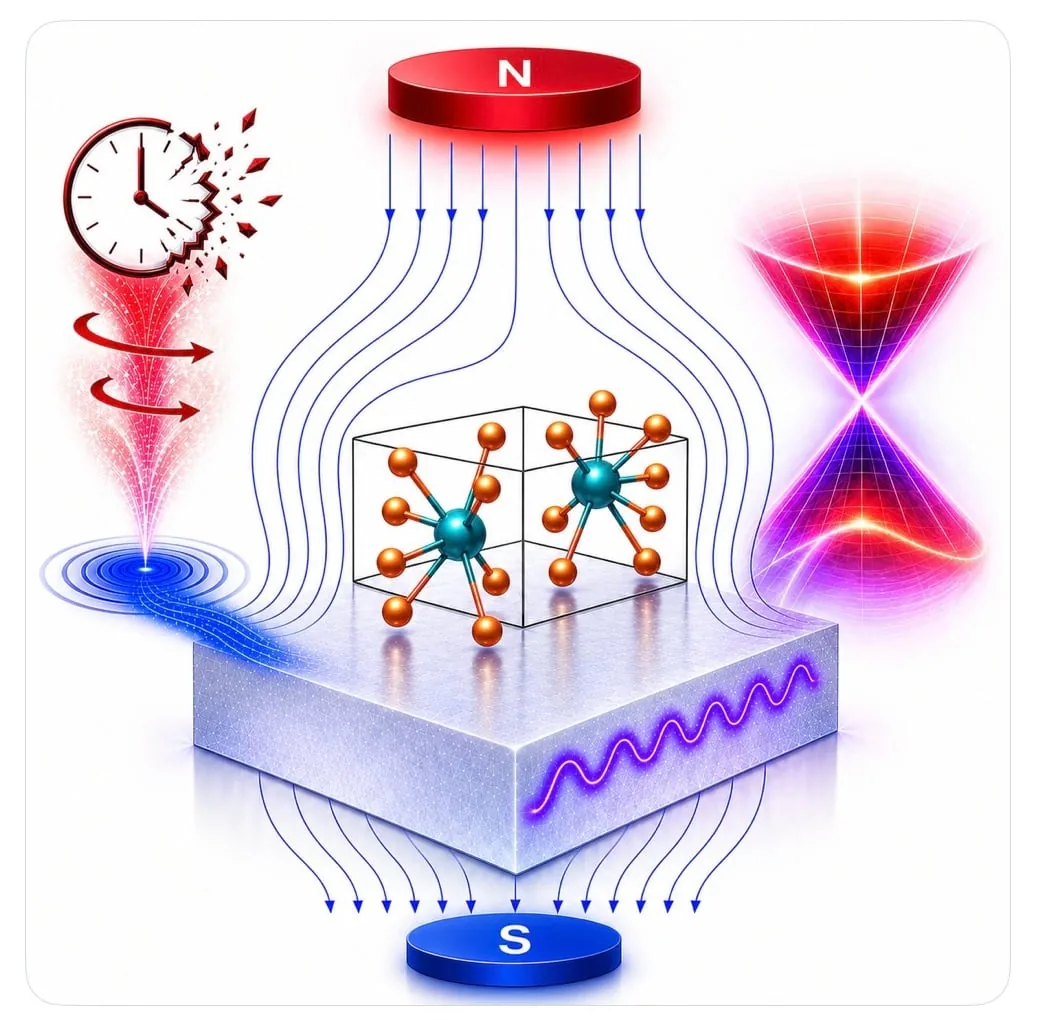
Time-reversal symmetry represents a foundational principle of classical and quantum mechanics stating that physical laws remain invariant whether time mathematically flows forward or backward. When a material breaks this symmetry, internal magnetic moments align spontaneously without the influence of any external field [3]. Until this discovery, every verified superconductor displaying spontaneous time-reversal symmetry breaking belonged exclusively to type II classifications [1]. Science author Paul Arnold and physicist Anshu Kataria documented this historical exclusivity [3].
How Muon Spin Probes Detect Internal Magnetic Fields
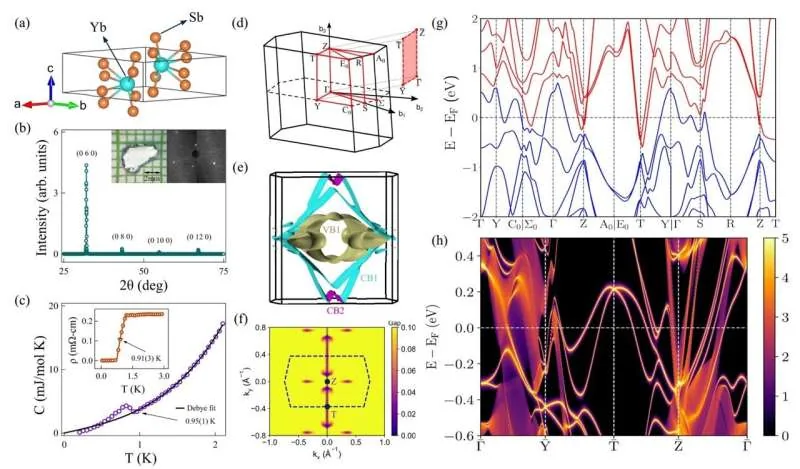
Anshu Kataria and a collaborative team of physicists at the Indian Institute of Science Education and Research Bhopal synthesized single crystals of ytterbium diantimonide, chemically designated as YbSb2 [3]. The team utilized rigorous X-ray diffraction techniques to confirm both the chemical purity and the stoichiometric integrity of the crystal lattice [4]. This specific structural geometry appears in both conventional and unconventional superconducting compounds, providing an ideal matrix to examine emergent quantum behaviors near absolute zero. Lead author Anshu Kataria synthesized the single crystals [3].
Muons act like miniature bar magnets. Implanted into the crystal, their spin precession reveals minuscule internal magnetic fields without disturbing electrons [1].
To probe the material’s magnetic response, Anshu Kataria and colleagues cooled the YbSb2 crystals to ultracold temperatures just above absolute zero and conducted zero-field muon spin spectroscopy [4]. In the absence of any applied external magnetic field, tiny internal magnetic fields spontaneously emerged the moment the compound transitioned into its superconducting phase. If the crystal had preserved time-reversal symmetry, no such spontaneous magnetic signatures would have appeared [3]. Lead author Anshu Kataria and co-authors reported that this observation serves as definitive evidence of time-reversal symmetry breaking within a type I superconductor [1]. Editor Gaby Clark confirmed the spectroscopic analysis [3].
Why Does YbSb2 Break Time-Reversal Symmetry?
YbSb2 breaks time-reversal symmetry because its paired electrons generate a collective intrinsic magnetic moment that changes direction under mathematical time reversal. Reversing the time parameter leaves electrical quantities unchanged, but magnetic moments—generated by moving charges and spin angular momentum—must invert their vector orientation [4]. Because internal magnetic fields in YbSb2 arise spontaneously at the transition temperature without an external field driving them, the forward-time and backward-time quantum states are no longer identical [3]. ScienceAlert writer Ivan Farkas and author Paul Arnold documented this magnetic inversion [4].
Experimental electrical measurements confirmed that the resistivity of the synthesized crystals dropped abruptly to zero at approximately -272 degrees Celsius (-457.6 degrees Fahrenheit), merely 1.15 degrees above absolute zero (-273.15 degrees Celsius). Specific heat measurements conducted by the research group established that the material is fully gapped. This thermodynamic property demonstrates the existence of a finite energy barrier across the entire Fermi surface, indicating that thermal fluctuations cannot easily disentangle the electron pairs or knock the crystal out of its superconducting ground state. Absolute zero is -273.15 °C [4].
Before formal publication in Physical Review Letters, Anshu Kataria and the research team uploaded the manuscript as preprint arXiv:2601.07460. Science writer Paul Arnold noted that preprints lack independent peer review prior to journal evaluation [2].


Unconventional Spin Triplets in the INT State
The microscopic origin of this spontaneous magnetic behavior lies in an unconventional pairing mechanism between conducting electrons across the atomic matrix. In conventional superconductors, paired electrons possess opposite spins that cancel each other out into a spin singlet. In YbSb2, Anshu Kataria and the physics team reported in Physical Review Letters that conducting electrons align into an unconventional spin triplet, where the combined spin quantum number equals one [4]. This configuration generates an uncompensated net magnetic moment across the crystal lattice, explaining how internal magnetic fields arise spontaneously without external magnetic stimulation. Furthermore, theoretical modeling indicates that this pairing corresponds directly to an internally antisymmetric nonunitary triplet (INT) state [1].
In their published paper in Physical Review Letters, lead author Anshu Kataria and colleagues explained: “Here, we report evidence of time-reversal symmetry breaking in the type I superconductor YbSb₂” [1]. The nonunitary nature of the triplet state means that Cooper pairs possess a net magnetic orientation because paired electrons originate from distinct orbital energy bands [4]. This orbital asymmetry enables the material to break time-reversal symmetry inherently [1]. Pairing occurs across separate orbital bands [4].

This orbital-dependent pairing reflects broader developments in condensed matter physics, where non-reciprocal and broken-symmetry phenomena unlock new quantum mechanics. Similar unconventional quantum interactions are currently investigated in non-reciprocal quantum fluid systems, where traditional symmetry principles yield to novel fluid dynamics [4]. In YbSb2, complete Meissner field expulsion combines with an internally active spin-triplet order parameter [1]. Paul Arnold documented the theoretical modeling [3].
Can a Type-I Superconductor Host Majorana Modes?
Theoretical calculations confirm that a type-I superconductor exhibiting this nonunitary triplet state can indeed host gapless Majorana surface modes. Low-energy effective models derived by the authors indicate that while the interior bulk of YbSb2 functions as a fully gapped superconductor, its two-dimensional boundaries support exotic boundary excitations [1]. Could such surface phenomena unlock topological superconductivity within elementary conductor classes? The mathematical models point toward that possibility, bridging mundane type I materials and protected quantum phases. Paul Arnold, scientific author at the Science X Network, reported that finding these states in a type I material reveals unforeseen quantum richness across condensed matter physics [3].
Majorana modes represent elusive quantum quasiparticles that act as their own antiparticles, predicted decades ago by theoretical physics. ScienceAlert writer Ivan Farkas described YbSb2 using a Red Vine analogy: while transmitting bulk superconducting current through its interior, its outer boundaries host Majorana excitations. Fact-checker Fiona MacDonald reviewed the published Red Vine comparison [4].

Study authors concluded: “Calculations based on an effective low-energy model further suggest that this INT state may host gapless Majorana surface modes” [1]. Visualization data provided by Oak Ridge National Laboratory illustrated the magnetic probes used to examine condensed matter systems [4].
Topological Protection for Quantum Computing Architectures
The discovery of time-reversal symmetry breaking in YbSb2 holds concrete implications for the development of fault-tolerant quantum computing architectures. Standard quantum bits (qubits) remain vulnerable to decoherence, where environmental disturbances destroy delicate quantum superpositions. By contrast, ScienceAlert writer Ivan Farkas noted that topological quantum materials offer hardware-level protection against such environmental interference because their encoded quantum information is distributed non-locally across topological surface states. This non-local topological encoding prevents localized thermal or electromagnetic noise from corrupting stored computational states [4].
By combining complete Meissner shielding with robust spin-triplet pairing, this type I superconductor presents a distinct material platform for condensed matter experimentalists [3]. Unlike fragile systems that require complex multi-layer fabrication, single crystals of YbSb2 offer a monolithic substrate to investigate Majorana surface dynamics [1]. These unique topological characteristics could inform ongoing investigations into novel quantum mechanics driving state transitions and energy coherence in next-generation physical devices. Science editor Fiona MacDonald fact-checked the reported article [4].
Future experimental work must focus on directly detecting the predicted Majorana surface excitations using high-resolution tunneling spectroscopy and phase-sensitive measurements [1]. Physicists led by Anshu Kataria at the Indian Institute of Science Education and Research Bhopal must also verify whether chemical substitution or epitaxial strain can elevate the superconducting critical temperature above -272 degrees Celsius while preserving the nonunitary triplet state [4]. As researchers synthesize related antimonide compounds, YbSb2 stands as the foundational archetype of broken time-reversal symmetry in type I superconductivity [3].
- ACADEMIC JOURNAL Kataria, A., Srivastava, S., Samanta, D., Yadav, P., Manna, P., Sharma, S., Mishra, P., Barker, J., Hillier, A. D., Agarwal, A., Ghosh, S. K., & Singh, R. P. (2026). Observation of Time-Reversal Symmetry Breaking in the Type-I Superconductor YbSb 2. Physical Review Letters, 137(13). [Article Link]
- PREPRINT Kataria, A., Srivastava, S., Samanta, D., Yadav, P., Manna, P., Sharma, S., Mishra, P., Barker, J., Hillier, A. D., Agarwal, A., Ghosh, S. K., & Singh, R. P. (2026). Observation of Time-Reversal Symmetry Breaking in the Type-I Superconductor YbSb2. arXiv:2601.07460. [Article Link]
- ONLINE NEWS Arnold, P. (2026). Scientists discover first type I superconductor that breaks time-reversal symmetry. Phys.org. [Article Link]
- ONLINE NEWS Farkas, I. (2026). Physicists Find a Superconductor That ‘Breaks’ The Symmetry of Time – A First For Its Kind. ScienceAlert. [Article Link]
APA 7: TWs Editor. (2026). Can a Type I Superconductor Break Time-Reversal Symmetry? PerEXP Teamworks.


