






Can a simple typographical error distort the historical timeline of geomagnetic science for over a century? A historical space weather mystery regarding the earliest recorded impact of solar activity on human technology was recently unraveled by an international research team. For decades, historians believed that an intense geomagnetic storm (a temporary disturbance of Earth’s magnetosphere caused by solar eruptions) disrupted railway telegraphs in Devon as early as October 1841. Archival investigations confirmed that this widely cited incident actually occurred during a major auroral disturbance on October 18, 1848 [1].
How a Typo Sparked a Space Weather Mystery
The confusion began with an anonymous dispatch published in the scientific journal Nature in 1871, three decades after the purported event took place in southwest England. According to that nineteenth-century narrative, a ferocious magnetic disturbance swept across Devon on the evening of October 18, 1841, interfering with delicate railway signalling instruments. The electrical surge reportedly immobilized the signalling needles of the railway telegraph at Exeter Station, preventing operators from confirming whether oncoming tracks were clear of traffic. Consequently, the scheduled 10:05 p.m. express train suffered a sixteen-minute departure delay while bewildered technicians attempted to decipher erratic instruments [2]. Exeter operators noted anomalous currents [1].
Scholars rediscovered the obscure 1871 account in 2013, promptly designating it as the earliest documented instance of solar activity interfering with human machinery. Because early electrical communication relied on ground-return circuits, fluctuating magnetic fields easily induced spontaneous currents along telegraph lines. Yet when modern astrophysicists examined the historical engineering records of Devon, the chronology unraveled immediately. The railway did not exist [6].
Associate Professor Brett Carter of RMIT University investigated the railway archives alongside researchers from Baylor University to verify operational history. Carter discovered that the South Devon Railway Company had not even received parliamentary approval to build tracks between Exeter Station and Plymouth until July 1844. Parliament approved track construction in 1844. Furthermore, the specific Exeter-to-Starcross railway segment of South Devon Railway did not open for passenger service until May 30, 1846. A South Devon Railway locomotive could not possibly suffer an operational delay on a line that was still five years away from existing [6].
What Major Mysteries Have Scientists Solved?
Scientists have recently solved one of the oldest mysteries in space weather history by proving that human technology first collided with space weather years later than long assumed. For generations, textbook chronologies placed the dawn of technological solar vulnerability squarely in 1841. However, the peer-reviewed investigation led by Professor Jim Wild from Lancaster University School of Physics and Astronomy confirmed that this benchmark was entirely illusory. The Exeter Station train delay was genuine, but a clerical misprint in Nature had shifted the calendar back by seven years. The 1841 date was false [1].
Before this correction, historians treated the 1841 Exeter incident as a precursor to the legendary Carrington Event of September 1859. During that massive Carrington Event solar eruption, powerful coronal mass ejections triggered worldwide auroras that stretched across Central America and Hawaii, glowing so brightly that gold miners prepared meals at midnight. Wires sparked across Victorian stations. Telegraph systems worldwide failed as intense currents surged across wires, allowing some operators to transmit messages purely on auroral energy while disconnected from battery power [4].
Exeter preceded Carrington [4]. Midland Railway suffered disruptions first. In March 1847, spontaneous currents jammed telegraph needles beneath brilliant Scottish auroras, establishing the true initial technological impact [1].

Uncovering Truth in 1840s Space Weather Records
Reconstructing the actual circumstances of the 1840s space weather anomaly required researchers to track down the identity of the anonymous Victorian author. While examining the publisher’s original copy of Nature from 1871, the investigative team located a crucial handwritten notation in the margin reading ‘N. [J.] Holmes.’ This marginal clue pointed directly to Nathaniel John Holmes, a prominent electrical engineer renowned for deploying undersea telegraph cables across the North Sea [5].
Holmes maintained close professional ties with Sir Norman Lockyer, the founding editor of Nature who famously studied solar spectra. Lockyer edited Nature in 1871. Holmes lived just one mile away from Lockyer in Hampstead in 1871, and contemporary Scottish newspapers recorded Holmes lecturing on the chemical effects of the solar spectrum. Furthermore, an 1877 letter confirmed that Holmes frequently corresponded with Lockyer regarding solar phenomena. Holmes understood solar physics. His familiarity with solar science explains why he documented the Exeter disruption for Sir Norman Lockyer in London [5].
To pinpoint the true date of the Exeter delay, Wild and co-author Dr. David Boteler from Natural Resources Canada systematically combed through surviving Victorian railway timetables preserved in regional archives. In contemporary editions of Trewman Exeter Flying Post, the team discovered that a 10:05 p.m. express train operated out of Exeter Station only between March 11, 1848, and July 26, 1849. An 1841 timetable contained no such departure. The documentation aligned seamlessly with an autumn night in 1848 rather than 1841, solving the 178-year-old discrepancy on the Exeter-to-Starcross route [6]. The true date was 1848 [1].


How Do Scientists Solve Problems?
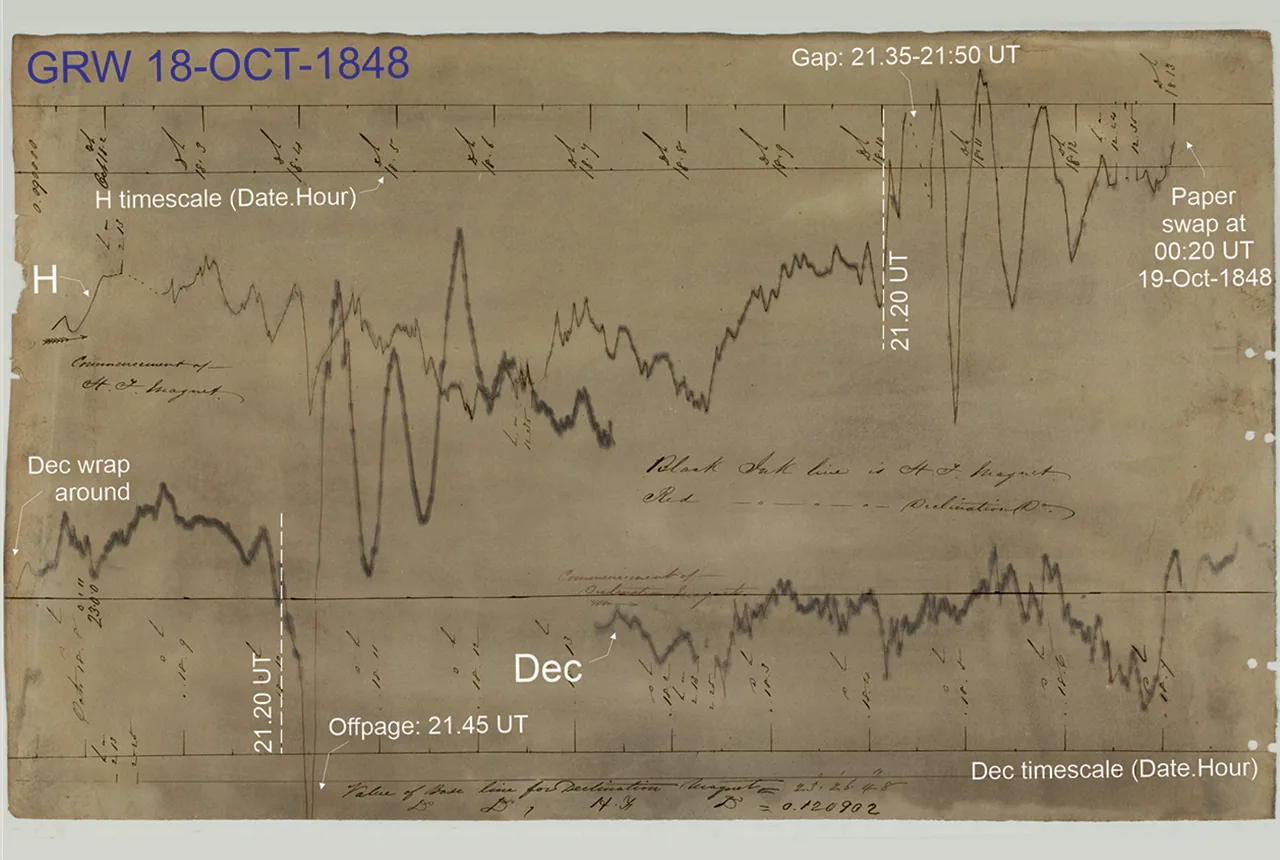
Scientists solve complex historical problems by cross-referencing disjointed physical measurements with municipal documentation across multiple disciplines. When written testimonies conflict, geophysicists turn to physical instruments that recorded planetary conditions in real time. Dr. Ciarán Beggan, a geophysicist at the British Geological Survey (BGS), accessed the historic magnetogram archive recorded at the Greenwich Observatory in London. Greenwich Observatory maintained continuous magnetograms. Magnetograms (photographic traces of magnetized needles measuring variations in Earth’s magnetic intensity) provided continuous records dating back to 1840, offering an objective baseline for geomagnetic activity [3].
The Greenwich Observatory magnetograms for October 18, 1841, revealed entirely tranquil magnetic conditions, with no auroral activity reported anywhere across the British Isles. In contrast, the Greenwich Observatory traces for October 18, 1848, recorded violent deflections indicative of a severe geomagnetic storm. Corroborating astronomical records sealed the verdict. British astronomer Temple Chevallier had documented massive sunspot clusters on October 19, 1848, confirming that an active solar region faced Earth during that exact week. Temple Chevallier recorded major sunspots [5].

Long-term environmental monitoring parallels geomagnetic archives, much like evaluating whether arctic sea ice melt season stabilizes across historical recording baselines. Historic signalling instruments, such as London and Blackwall Railway equipment preserved by the Science Museum in London, illustrate how early rail transport depended on vulnerable electromagnetic hardware [6]. Archival preservation at British Geological Survey transforms fragile nineteenth-century paper logs into empirical baselines for modern geophysical models [3].
Historic Space Weather and Modern Power Grids
The resolution of this Victorian mystery demonstrates that historic space weather is not a recent hazard born of the satellite era, but an enduring feature of the planetary environment. In 1848, the Exeter Station telegraph equipment failed because geomagnetically induced currents entered the wires, overpowering the low-voltage galvanic signals that governed track clearance. Modern networks face identical risks. Today, geomagnetically induced currents can saturate high-voltage power transformers across national grids, triggering cascading blackouts and melting multimillion-dollar substation equipment during intense solar storms [1].
While nineteenth-century operators contended with localized telegraph hiccups, contemporary civilization relies entirely on space-based satellite constellations that lack atmospheric shielding. While orbital missions test biological resilience—such as ongoing inquiry into astronaut ageing research in space environments—ground-based infrastructure faces direct electromagnetic induction during severe coronal mass ejections. A solar storm equivalent to the 1859 Carrington Event today would disrupt Global Positioning System navigation, halt international aviation, and compromise transoceanic communication pipelines [1].
Ars Technica noted that telegraph operators in 1848 believed someone was playing practical jokes on their instruments when currents flowed through unpowered wires [7]. That bewildered Victorian reaction underscores how rapidly technological expansion can outpace our grasp of natural space hazards. Collaborative research involving RMIT University and Lancaster University allows modern electrical engineers to anticipate how extreme geomagnetic disturbances propagate through interconnected networks [1].
Preparing Critical Infrastructure for the 2030s Solar Cycle
Interpreting past space weather events provides the essential empirical foundation for engineering resilient power grids before the Sun enters its next major activity cycle. Solar cycles span eleven years. Dr. Mike Hapgood, a senior space weather scientist at RAL Space, warned that the approaching solar cycle in the 2030s will coincide with an unprecedented surge in orbital space infrastructure, commercial satellite megaconstellations, and electrified transportation corridors. Hapgood emphasized evaluating historical disturbances to refine predictive forecasting models [2].
Investigating archival records functions much like forensic detective work, turning handwritten Victorian registers into crucial data points for space weather forecasting algorithms. By establishing that the Exeter disruption occurred under the magnetic parameters of October 1848 rather than 1841, space physicists publishing in the American Geophysical Union journal Space Weather can accurately calibrate the frequency and intensity thresholds of extreme space weather events. Society cannot prevent coronal mass ejections, but robust historical benchmarks allow electrical engineers to harden power grids, reroute railway signalling, and safeguard critical satellites before the next major solar storm strikes [4].
- ACADEMIC JOURNAL Wild, J. A., Beggan, C. D., Boteler, D. H., Cade, W. B., Carter, B. A., & Hapgood, M. (2026). Did Space Weather Delay the 10:05 p.m. Train Departure From Exeter on 18 October 1841?. Space Weather, 24(9). [Article Link]
- ONLINE NEWS Whalen, R. (2026, September 22). Scientists Just Solved a 178-Year-Old Space Weather Mystery. The Debrief. [Article Link]
- PRESS RELEASE British Geological Survey. (2026, September 17). Mystery of one of the earliest recorded space weather impacts solved. BGS Press. [Article Link]
- ONLINE NEWS BrightSurf Science News. (2026, September 16). 1840s space weather mystery finally solved. BrightSurf. [Article Link]
- WEBSITE Karlston. (2026, September 28). Scientists solve 1840s space weather mystery. Nsane Forums. [Article Link]
- PRESS RELEASE RMIT University. (2026, September 17). Space weather mystery finally solved in new study. RMIT News. [Article Link]
- ONLINE NEWS Ars Technica. (2026, September). Scientists solve 1840s space weather mystery. Ars Technica. [Article Link]
APA 7: PerEXP Teamworks. (2026, September 29). How Researchers Solved an 1840s Space Weather Mystery. PerEXP Teamworks.


