






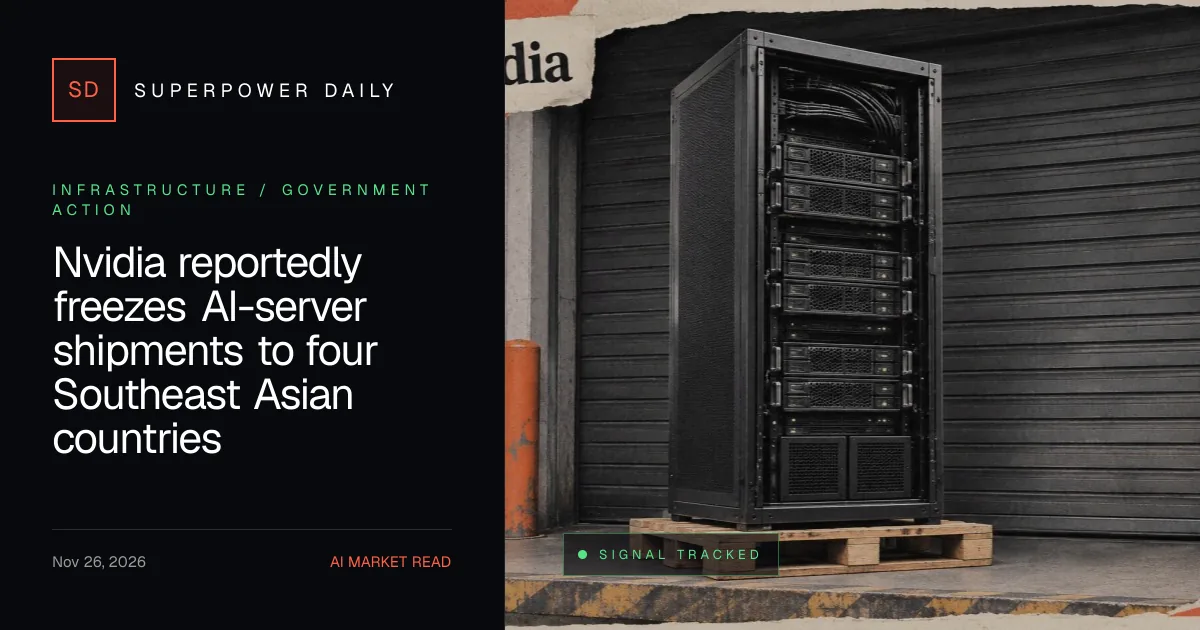
Nvidia told its manufacturing partners to stop delivering advanced AI hardware to Malaysia, Singapore, Thailand, and Indonesia following updated export curbs from Washington [1]. The directive pauses Nvidia server shipments containing high-end graphics chips assembled by Dell Technologies and Super Micro Computer [2]. Federal regulators introduced the policy to prevent Chinese tech firms from renting computing capacity in third countries [3]. Regional buyers in Southeast Asia now face unexpected delays. The freeze hits one of the world’s fastest growing data center hubs [4].
Why Nvidia Server Shipments Stopped at Factory Gates
The pause on Nvidia server shipments surfaced after the Financial Times reported that Nvidia instructed assembly partners to hold pending hardware orders destined for clients in Malaysia, Singapore, Thailand, and Indonesia [1]. Dell Technologies (NYSE: DELL) and Super Micro Computer (NASDAQ: SMCI) assemble graphics processors into server racks for enterprise customers across Southeast Asia [4]. Both builders notified buyers that finished systems cannot leave factory floors [2]. The hold stops finished hardware at the gate [4].
Nvidia and its manufacturing partners are studying how to comply with Washington’s new export controls, sources told the Financial Times [1]. Nvidia declined to comment. Dell Technologies, Super Micro Computer, ByteDance, and Singapore-based Aolani did not answer inquiries seeking comment. The shipping hold comes shortly after Nvidia halted GeForce RTX 5090 production to shift chip supplies toward enterprise data centers. Because large data centers run complete server cabinets filled with dozens of linked GPUs, power units, and switches, Dell and Supermicro cannot release finished customer orders until trade officials approve each buyer’s compliance paperwork [4].
Holding completed systems halts gear at the final assembly phase. While individual chips move through regular parts dealers, cloud hubs buy pre-built server racks that arrive ready to run. Completed systems assembled by Dell and Supermicro are now stranded in factory holding areas while legal teams audit shipping forms [4].

Closing Cloud Loopholes Under New Federal Rules
On November 19, the Bureau of Industry and Security at the US Commerce Department introduced updated export rules focusing on foreign computing hubs that supply high-end processing power to organizations in restricted jurisdictions like China [2]. Previous trade rules blocked direct semiconductor sales to Chinese buyers, but developers bypassed those limits by renting remote capacity in third countries [3]. Chinese AI teams trained large models while the physical chips stayed abroad [4].
US Trade Representative Jamieson Greer told CNBC that Washington aimed to block indirect access, including chip smuggling through Southeast Asia and remote server rentals in third countries. Under the updated export controls issued by the Bureau of Industry and Security, cloud hosts operating in Malaysia, Singapore, Thailand, Indonesia, and Brazil have 90 days to verify that Chinese entities do not access American hardware [1, 2]. Data center operators must prove that restricted Chinese entities or military groups are not among their end users [1]. However, qualifying US-based firms and American subsidiaries can stay exempt from some rules if they meet reporting duties [2]. The Commerce Department has expanded oversight over third-party channels, taking action after the Commerce Department placed Megaspeed on the Entity List amid ongoing supply chain investigations.
The 90-day deadline has caused confusion among regional cloud hosts. Operators in Singapore and Malaysia must audit customer accounts, but federal agencies offered little practical advice. One cloud executive told the Financial Times that “There’s this new rule but no guidance on execution.” [3]. The lack of clear standards leaves pending contracts in doubt [1].



Secondary Markets and Unsold Processor Racks
The shipping pause on Nvidia server shipments quickly shook secondary hardware markets. Following Washington’s announcement, dealers listed an unusually large volume of high-end Nvidia GPUs for sale on secondary trading platforms, CNBC reported. Jack Duhamel, president of AI infrastructure marketplace GPU Mart, and two other market insiders confirmed that the jump in listings was a direct result of the new rule. Brokers at GPU Mart are now seeking buyers who can legally take delivery of thousands of advanced B300 processors, one of Nvidia’s top AI models initially slated for server clusters serving Chinese tenants through remote leases [1].
Those B300 processors were built for server clusters intended to serve Chinese cloud clients. Because those rental deals now face regulatory barriers or cancellations, sellers are trying to find new buyers before hardware prices drop. Finding quick buyers for multi-million-dollar server cabinets is difficult [1].
The market scramble shows China’s ongoing appetite for Nvidia computing power. Even as Chinese state programs push for homegrown silicon, machine learning research labs in China still count on Nvidia hardware to train foundation models. Nvidia Chief Executive Jensen Huang had earlier argued that Washington should let American tech firms continue selling processors to Chinese clients so that foreign developers remain tied to US software tools and hardware platforms. Instead, federal policies have closed off third-country cloud routes that Chinese developers used to bypass direct export bans [3]. Data center hosts are left with costly server racks they cannot lease to their intended clients [1].
Impact on Nvidia Server Shipments and Hardware Partners
The delivery freeze creates financial risks for server makers that built large order backlogs around Nvidia chips. Just two days before the freeze hit, Dell Technologies reported record demand for AI infrastructure in its third fiscal quarter, securing $60.2 billion in new AI server orders that lifted its total order backlog to $132.3 billion. Stalled shipments could slow how fast Dell converts pending orders into recognized revenue [2].
Super Micro Computer faces similar risks due to its heavy focus on GPU-based systems. Supermicro previously projected net sales of $19.5 billion to $21.5 billion for its fiscal quarter that wraps up at the end of December. Neither Dell nor Supermicro has publicly quantified the financial hit from the shipping pause. Unresolved delays could complicate data center financing and hardware delivery targets for enterprise buyers [2].
For Nvidia (NASDAQ: NVDA), Southeast Asia is a major sales hub. Nvidia booked $104 billion in sales through its Singapore division in 2025, climbing 72% over the previous annual period. That accounting total includes some revenue from Taiwan and China, but it shows the importance of regional distribution networks for Nvidia [3]. With US stock exchanges closed for Thanksgiving on Thursday, Friday’s shortened trading session gives investors their first chance to react to the halt in Nvidia server shipments. Market watchers are assessing whether the pause is a temporary compliance review or a prolonged obstacle to regional growth [2].
Lenders Pull Credit From Regional Cloud Deals
Beyond hardware makers, the policy shift is disrupting financing for major infrastructure projects across Southeast Asia. Both Malaysia and Indonesia drew massive data center investments totaling billions of dollars, spurred by cloud demand from Chinese technology groups. Regional operators bought Nvidia hardware assuming they could freely rent computing time to international clients [3]. That assumption fell apart under the new US export controls [1].
The financing fallout has already hit specific commercial partnerships. Singapore-based cloud firm Aolani had arranged cloud agreements to deliver AI processing power to ByteDance, the Chinese parent company of TikTok. Following the release of the updated export rules, commercial banks withheld approximately $500 million in credit facilities that were intended to fund Aolani’s server purchases for ByteDance projects [1, 3, 4]. ByteDance may now withdraw from the arrangement [1, 3]. Banks halted funding before the hardware left factory floors [1].
The withdrawal of bank financing shows how export rules can freeze capital before systems ship. Cloud hosts in Singapore, Malaysia, Thailand, and Indonesia must decide whether to buy hardware they might not be licensed to run. If providers cannot prove their facilities are free of restricted Chinese users within the 90-day window, lenders may withhold more funding from regional projects [1, 3]. For now, pending hardware orders remain parked in factories while suppliers wait for Washington to clarify the rules [4].
- ONLINE NEWS Schreiner, M. (2026, November 26). Nvidia halts server shipments to Malaysia, Singapore, Thailand, and Indonesia after tighter US export controls. The Decoder. [Article Link]
- ONLINE NEWS Mercer, E. (2026, November 26). Nvidia, Dell & SMCI Halt AI Server Shipments Amid New US Chip Export Controls. Coinpaper. [Article Link]
- ONLINE NEWS Gupta, S. (2026, November 26). NVIDIA Halts AI Server Shipments to 4 Southeast Asian Countries: Report. AIM Media House. [Article Link]
- ONLINE NEWS Superpower Daily Editorial Desk. (2026, November 26). Nvidia reportedly freezes AI-server shipments to four Southeast Asian countries. Superpower Daily. [Article Link]
- ONLINE NEWS Ray, S. (2026, November 26). Nvidia Reportedly Halts AI Chip Shipments To Southeast Asia. Forbes Middle East. [Article Link]


