





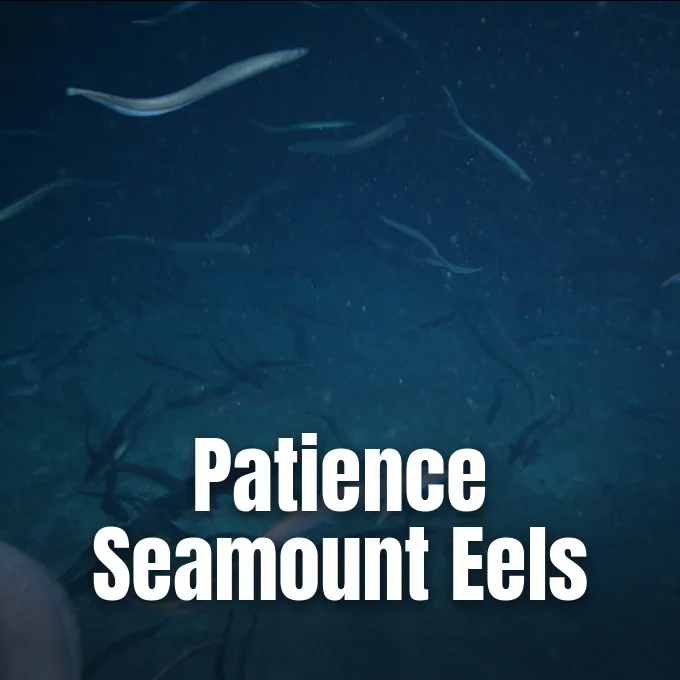
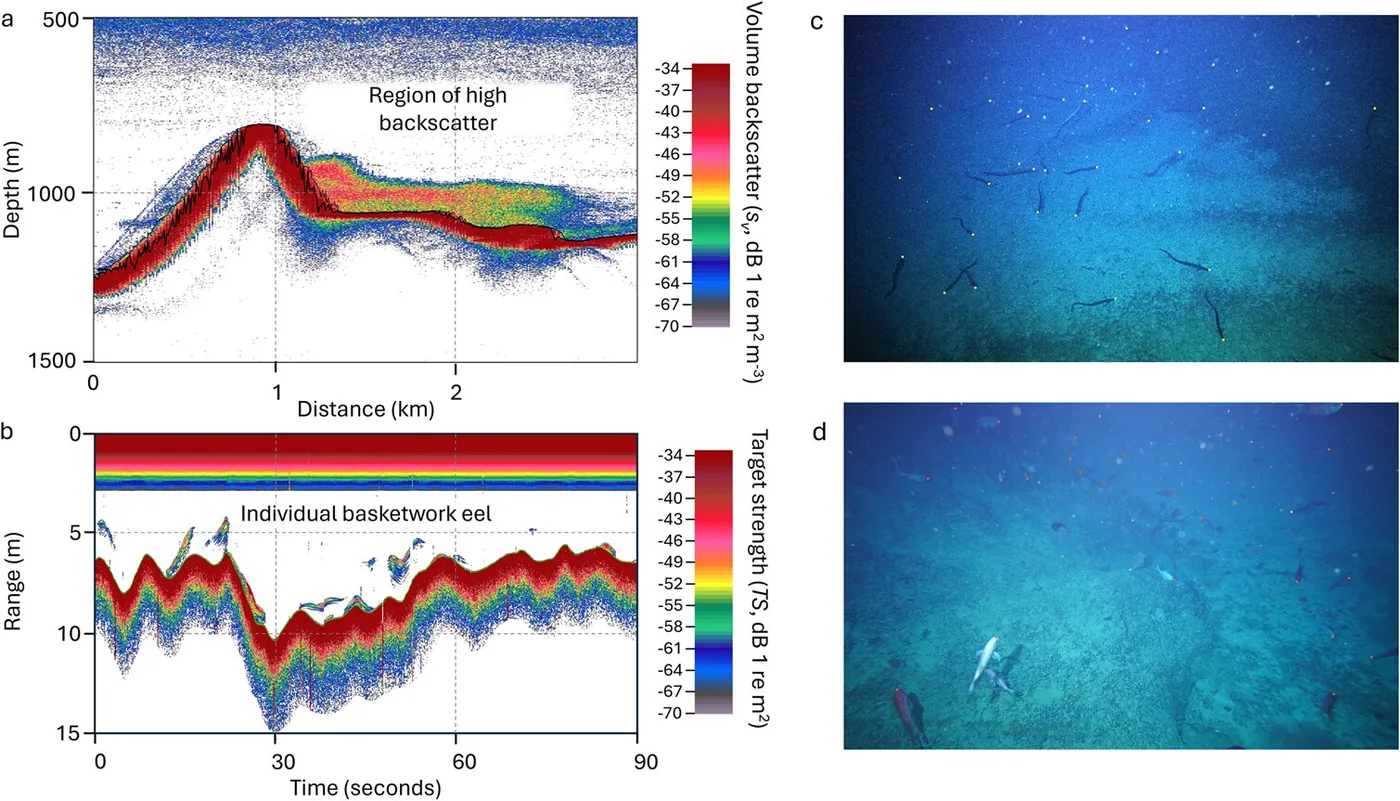
Marine scientists surveying an extinct underwater volcano south of Tasmania have documented one of the largest fish aggregations known in the deep ocean. Deep-water acoustic and visual surveys led by Ben Scoulding of Australia’s Commonwealth Scientific and Industrial Research Organisation, known as CSIRO, revealed that up to 2.8 million basketwork eels (Diastobranchus capensis) assemble around Patience Seamount during the southern autumn. The dense aggregation spans roughly three kilometers in length and rises 150 meters into the water column above the sea floor [2]. At peak abundance in May, the total biomass of these schooling eels reaches roughly 3,550 metric tons, equivalent to about 3,900 U.S. tons, turning a small patch of deep seabed into one of the most concentrated biological centers in the Southern Ocean [1].
Surveys Reveal Millions of Basketwork Eels
Commercial trawlers operating off Tasmania first reported unusually dense schools of eels during the 1980s and 1990s. Those early encounters hinted at an unusual phenomenon, but scientific teams had no visual proof until decades later. In 2007, researchers aboard a CSIRO survey vessel towed a deep-sea camera over the summit and through the dark water column. The camera feed showed thousands of writhing eels swimming together in the gloom [2]. It was the first video evidence of the swarm.
Earlier efforts had struggled to establish the true scale of the aggregation. A 2021 study by Williams and colleagues analyzed camera transects and acoustic signals from an April 2015 voyage, estimating that tens of thousands of eels gathered along a stretch of roughly one kilometer [4]. That was an underestimate. To get a definitive count, Scoulding and his team conducted nine separate acoustic surveys between 2023 and 2025 on the research vessel RV Investigator [1]. They paired shipboard sonar with deep-towed cameras and physical netting to track how eel numbers shifted across seasons [3].

The new data showed that the eel population was far larger than earlier research indicated. While eels inhabit the mountain through most of the year, their numbers surge between March and May. By May, the eel biomass reaches between 3,547 and 3,557 metric tons, accounting for approximately 2.8 million individual fish [3]. “Seeing so much biomass concentrated on such a small deep-sea feature is rare,” Scoulding said [2].
Distinguishing Species in Sonar Data
Calculating the eel population required solving a difficult technical puzzle beneath the waves. Sound waves beamed into the ocean from shipboard sonar produce echograms that map where marine life clusters in the water, but acoustic pings alone cannot distinguish one fish species from another. This limitation created an obstacle at Patience Seamount because another schooling fish, the orange roughy (Hoplostethus atlanticus), also gathers there in large numbers [1]. Sonar cannot separate them.
To separate the two species, researchers designed a two-phase modeling approach. They first examined deep-towed camera imagery to map the spatial distribution of each fish species across the slopes. Next, the scientists ran biomass-constrained sensitivity analyses that applied conservative limits of 200 to 850 metric tons for orange roughy, drawing on historical fisheries assessments [3]. “Even with calibrated multi-frequency acoustics, camera imagery and physical sampling remain essential for species identification, size estimation and bioinformatics analysis,” the research team wrote in Royal Society Open Science [1].
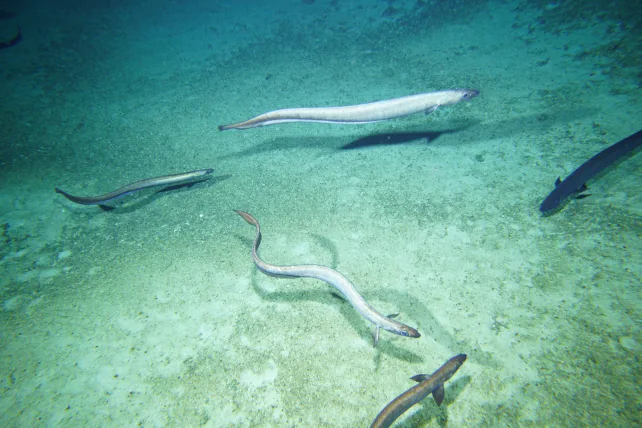
Camera transects confirmed that basketwork eels and orange roughy occupy different zones of the mountain. Orange roughy gather along the steeper upper slopes near the summit, while eels mass over deeper, flatter terrain around the flanks and base [2]. Eels dominated the base. This clear spatial separation allowed the team to allocate acoustic backscatter accurately and produce species-specific biomass estimates [3].
Spawning Indicators in Sampled Females
Physical specimens collected from the site offered direct clues about why the animals congregate. When biologists examined female eels hauled up from the deep water, they found that most carried eggs in an advanced stage of development [1]. An earlier sample of 20 Diastobranchus capensis specimens taken in April 2015, consisting of 14 females and 6 males, also showed mature reproductive status across every individual [4]. Every captured female was ready to spawn. These findings confirmed that the autumn gathering serves as an active reproductive event.
Dissections also revealed an intriguing dietary detail: all examined eels had empty stomachs [1]. The fish stop feeding as they prepare to spawn, relying on stored bodily energy. This feeding pause created a practical hurdle for the scientific crew. Because the fish were not feeding, they refused to take baited hooks, and researchers managed to catch only seven eels during the 2023–2025 sampling voyages [2].
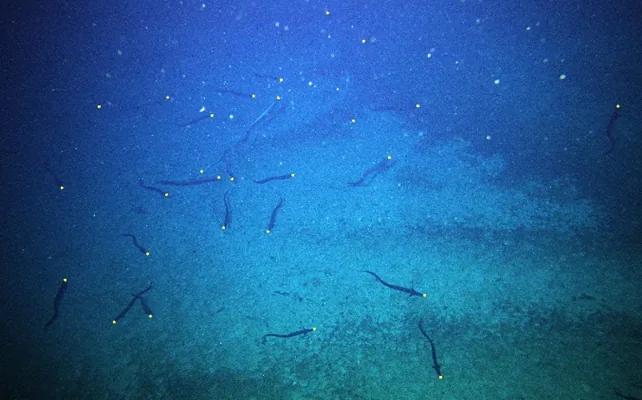
Despite capturing few physical specimens, the team gathered extensive visual evidence through non-invasive camera systems. Towed cameras recorded eels swimming steadily through bottom currents just above the sea floor [2]. No eggs were found. Yet the exact timing and location of egg release remain unobserved in the deep water.


Why Basketwork Eels Choose Patience Seamount
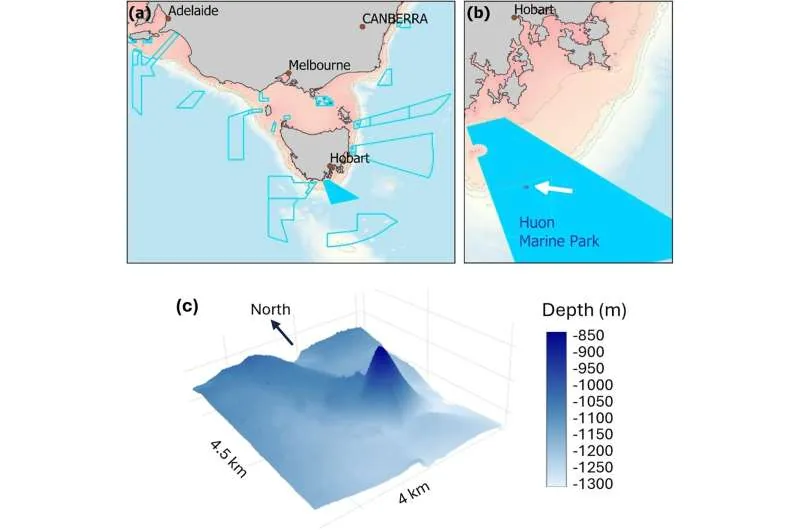
Researchers do not yet have a definitive answer for why eels single out this peak, but proximity to the continental shelf and local current patterns stand as leading explanations. Why do millions of eels converge on this isolated peak while ignoring nearby seamounts? Patience Seamount is one of approximately 120 underwater mountains scattered across the Huon and Tasman Fracture marine parks south of Tasmania. Many of these neighbouring peaks share similar summit depths, water temperatures, and broad seafloor characteristics, yet none of them appear to host comparable gatherings of basketwork eels. “That’s one of the biggest unanswered questions,” Scoulding said in an interview with ScienceAlert [2]. “Patience is one of around 120 seamounts in the Huon and Tasman Fracture marine parks south of Tasmania, and although nearby seamounts have similar depths and broad environmental characteristics, they don’t support the same aggregation of eels.”
The unique location of the peak may turn it into a regional navigational landmark for migrating ocean life. Rising 150 meters above the surrounding seafloor, the small seamount covers only about 2 square kilometers (about 0.8 square miles) [2]. The underwater mountain is small. With no other spawning grounds identified across southern Australian waters, the seamount appears to serve as a regional spatial anchor that draws mature eels from hundreds of kilometers away [4].
Depth Preferences across the Seafloor
Within the boundaries of Patience Seamount, the eels do not distribute themselves evenly across the underwater slopes. Acoustic mapping and camera runs showed that the fish pack into dense schools along the western flank of the mountain at a specific depth range [1]. Swarms hang in the water column between the seabed and about 150 meters above the bottom, stretching across three kilometers of open ocean [2]. These formations create a thick acoustic layer that registers clearly on multi-frequency echo sounders [3].
The seasonal expansion of the school follows a clear temporal rhythm. Acoustic surveys conducted between December and August showed that basketwork eels inhabit the seamount year-round, but their total biomass shifts throughout the calendar. In March, researchers measured approximately 750 metric tons of eel biomass around the base. By May, that figure rose to more than 3,500 metric tons, indicating that millions of additional eels arrive from surrounding waters as the spawning season peaks [2].
As autumn transitions to winter, the school begins to disperse back into the deeper Southern Ocean. By late winter, acoustic backscatter over the flatter slopes thins out, leaving only a resident population near the peak [2]. Researchers still do not know where the spent adults travel after reproduction or where larval eels develop before reaching maturity.
Marine Park Protection and Population Recovery
The discovery of such a massive fish gathering is particularly notable given the site’s troubled industrial history. During the late twentieth century, commercial trawlers targeted Patience Seamount and nearby ridges, dragging heavy bottom gear that damaged deep-sea coral reefs and depleted local fish stocks [4]. In 1999, the Australian government established a marine reserve around the seamounts to halt further damage, later expanding the zone in 2007 into the formal Huon Marine Park (within the South-east Marine Park Network) [2]. Bottom trawling ceased in 2007. This legal protection banned destructive fishing gear and gave deep-water ecosystems space to rebuild.
Two decades of protection have yielded tangible signs of ecological recovery across the seafloor. Recent camera surveys revealed that delicate cold-water corals are growing back on previously trawled areas, while orange roughy numbers continue to rebuild around the summit. Because Patience Seamount sits within a protected zone, scientists can track these deep-sea populations without interference from industrial fishing. “Because the aggregation occurs within a protected marine park, it provides a rare opportunity to revisit the site every few years and see how the population changes through time,” Scoulding said [2]. “If the ecosystem continues to recover from historical fishing impacts, we may see further increases in the size of the aggregation.”
- ONLINE NEWS Arnold, P. (2026, October 28). Scientists count more than 2 million eels on one underwater mountain. Phys.org. [Article Link]
- ONLINE NEWS Starr, M. (2026, October 28). Millions of Mysterious Deep-Sea Eels Caught Gathering Off The Coast of Tasmania. ScienceAlert. [Article Link]
- ACADEMIC JOURNAL Scoulding, B., Gastauer, S., Devine, C., Althaus, F., Hobday, A., Farley, J., Deagle, B., Pogonoski, J., Gorton, R., Downie, R., & Williams, A. (2026). A unique ecological phenomenon quantified by hydroacoustics: the deep-sea eel spawning aggregation at Patience Seamount. Royal Society Open Science, 13(10). [Article Link]
- ACADEMIC JOURNAL Williams, A., Osterhage, D., Althaus, F., Ryan, T., Green, M., & Pogonoski, J. (2021). A Very Large Spawning Aggregation of a Deep-Sea Eel: Magnitude and Status. Journal of Marine Science and Engineering, 9(7), 723. [Article Link]
APA 7: PerEXP Teamworks. (2026, October 29). Patience Seamount Hosts Millions of Basketwork Eels. PerEXP Teamworks. https://perexpteamworks.com/en/basketwork-eels-patience-seamount-survey/


