






Anime News Network reviewer Georgie Boysaxe published a detailed Crymelight game review on November 14, 2026, awarding FuRyu Corporation’s new action RPG an overall D- grade. FuRyu launched it on three platforms (PlayStation 5, Nintendo Switch 2, and PC) as a story-focused release. While Boysaxe praised the hand-drawn art, the assessment found that repetitive levels and dull combat loops dragged the journey down [1].
Wonderland Setting in the Crymelight Game Review
The narrative opens in an afterlife purgatory inspired by Lewis Carroll’s Alice’s Adventures in Wonderland and Through the Looking-Glass, and What Alice Found There. Five young girls with severe memory loss wake up without any clear recollection of what they did in their former lives, leaving them confused about why they were condemned to this strange realm. A figure named the White Rabbit welcomes them to a tea party and explains their predicament. To earn an Easter-Day resurrection and walk among the living once more, each girl must murder the Queen of Hearts while surviving clashes with one another in a deadly contest [1].
Alice serves as the quiet lead. The other contestants take on the names of Mary, Cheshire Cat, March Hare, and Mad Hatter. Each girl carries heavy guilt that threatens to consume her mind during the trials. FuRyu framed the story around its familiar “trauma drama” ideas as the sinners confront their pasts [1].
Boysaxe pointed out that despite using a Lolita art style, the story avoided the crude tropes seen in games like Mugen Souls or Seven Pirates H. The writing kept its focus on the personal grief of the five girls instead of relying on cheap fan service to grab attention. The reviewer said the evocative voice acting helped ground the cast during emotional scenes, singling out a harrowing performance near the end of the campaign as the single narrative highlight that stayed memorable after finishing the game [1].
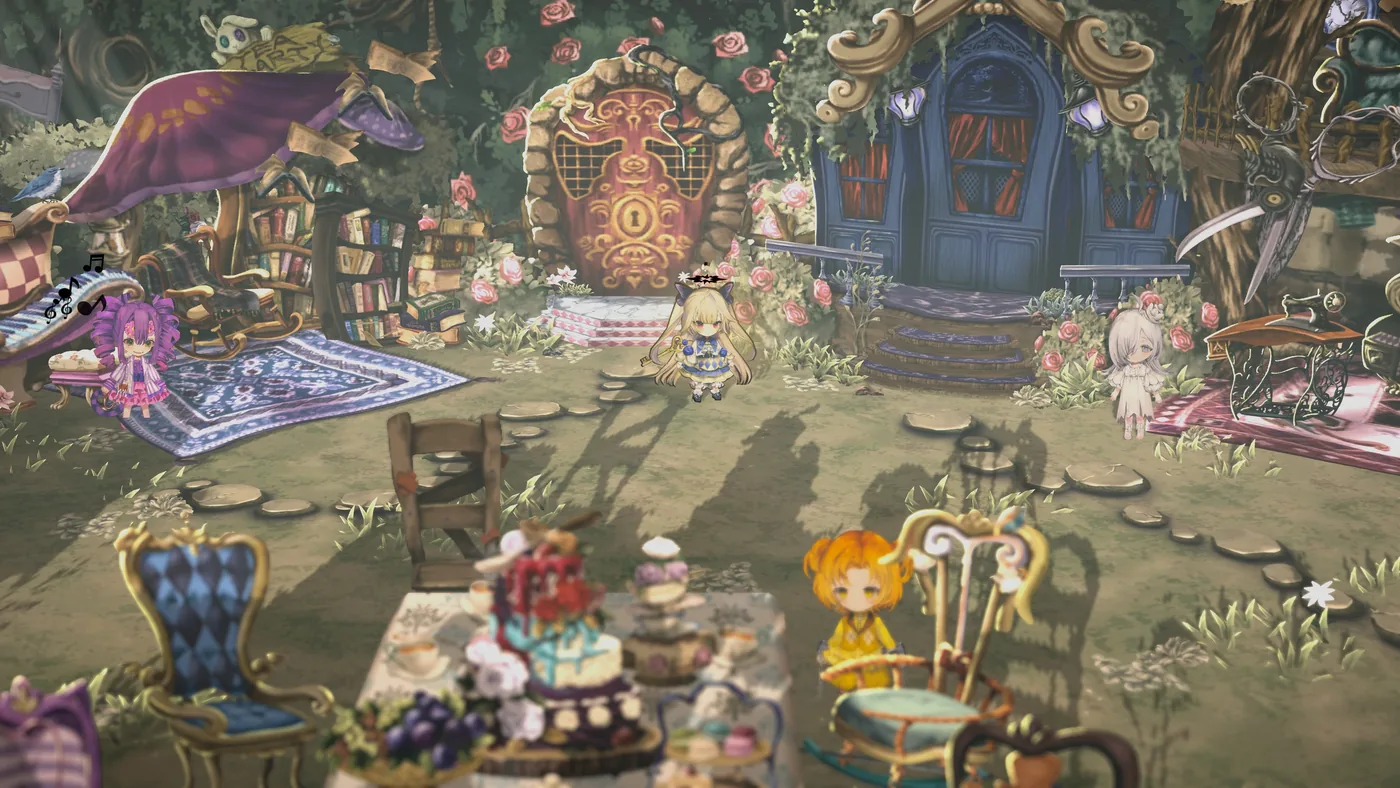
Combat Actions and Level Navigation
The action plays out as a top-down action RPG with light bullet-hell patterns inspired by Touhou titles. Runs begin on an Amidakuji ladder map where players pick routes through different nodes. Each path branches before converging toward the biome boss. Surviving rooms involves clearing enemy waves while dodging incoming projectile fire [1].
Alice possesses a modest combat toolset to fight off Wonderland’s host of hostile creatures in every room. Her basic moves include a light strike, a heavy strike, and a dash attack with weak and strong options. A grapple maneuver lets her fling enemy soldiers into one another or straight into arena hazards. Boysaxe said that her evasive dodge offered only about two invulnerability frames, which made early defensive timing feel stiff, unforgiving, and awkward during crowded skirmishes where projectiles filled the screen [1].
Combat encounters quickly become predictable. Enemy mobs follow simple behavioral scripts without introducing fresh surprises as the map opens up. While dodging bullet curtains provides brief tension, the shallow move pool keeps battles from developing meaningful tactical depth. The reviewer explained that players spend hours repeating identical attack sequences against the same small group of enemies [1].
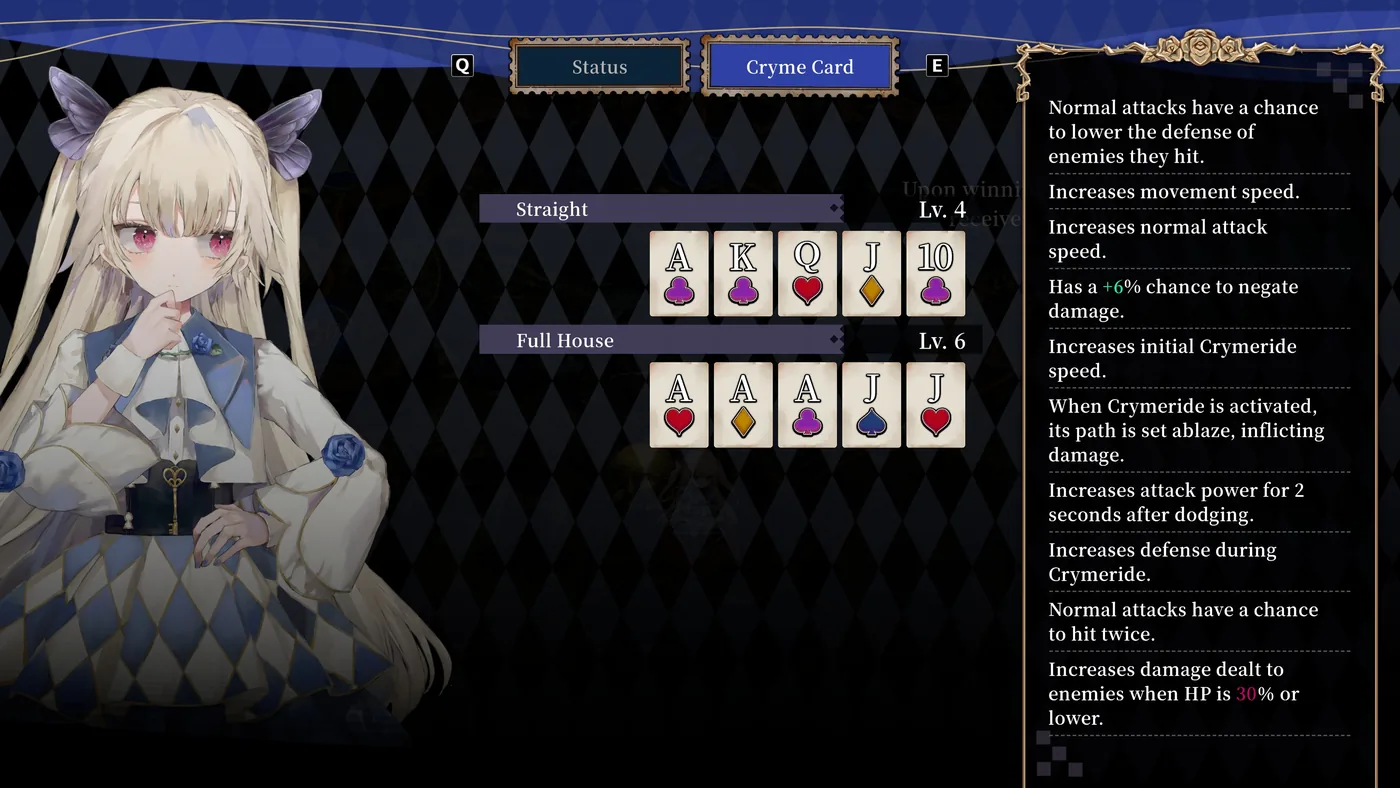


Crymecard Deck Building System
The most inventive concept in the release centers on the Crymecard power-up system, which replaces conventional skill trees with poker card hands. When players clear an encounter, the game awards a random card drawn from a standard 52-card playing deck or a specific card suit shown on the overworld map. Alice can hold up to five cards in her active loadout at any time. Assembling recognized combinations such as a Full House, Straight, Four of a Kind, Straight Flush, or Royal Flush upgrades the potency of her enhancements from standard efficacy up to level seven and beyond during subsequent dungeon stages. Once a winning hand is scored, the loadout resets to let players build another panel of stacking perks for attack range, movement speed, and enemy knockback [1].
Each individual card provides specific stat boosts to aid Alice in battle. Some cards widen her weapon strike range, while others boost sprint speed or push foes farther away upon contact. Boysaxe wrote that hunting for matching suits to complete a Royal Flush was the only time the game provided genuine excitement [1].
Unfortunately, the poker card setup can’t overcome the weak impact of ordinary stage rewards. Minor perks outside completed poker hands rarely help during grueling boss fights. Players rarely feel that an isolated card reward can rescue a struggling run from failure. Because base enhancements feel negligible on their own, the satisfaction of drafting cards steadily fades as the campaign drags on and the same weak upgrades reappear in every route [1].

Run Fatigue in the Crymelight Game Review
The central failure examined in this Crymelight game review is an utter lack of procedural variety during repeated dungeon runs. Successful roguelikes thrive on unpredictable room layouts and unexpected enemy spawns that keep players alert. FuRyu kept chamber layouts and monster placements identical on every attempt, altering only the card reward at the end of each room [1].
Progress grinds to a halt early on because of the first major checkpoint. The first biome boss is Dum, a gothic girl reimagining of Tweedle Dum from the children’s storybook. Defeating Dum needs hours of grinding in-game currency during failed runs just to buff Alice’s base attributes to a functional level. Boysaxe described spending hours fighting identical monster packs in identical rooms, sitting through the same story scenes repeatedly until Alice accumulated enough raw power to survive the encounter and unlock the next biome [1].
The review compared the design to Supergiant Games’ Hades, stating that the developers took the wrong lessons from that title. Instead of generating tension through shifting challenges and surprises, the entire journey felt like an exhausting chore of dull memorization. Boysaxe summarized the experience with the blunt words “poop from a butt” to capture the frustration of playing it [1].

Review Scores Across Categories
When tallying up the results, Anime News Network awarded CRYMELIGHT an overall mark of D-. The scorecard showed huge differences between visual craft and gameplay mechanics (B for Graphics, C for Presentation, and F for both Gameplay and Sound). Boysaxe pointed out that while the art team delivered expressive characters, the sound design and core combat loops fell completely flat, making prolonged play sessions feel tedious and unrewarding for anyone looking for engaging action [1].
Graphics earned a B. Hand-drawn sprite animations and pastel backgrounds recalled the visual charm of Vanillaware titles created by George Kamitani and Yoshio Nishimura. Conversations displayed fluid character motion on an appealing storybook surface. But beautiful art couldn’t save the repetitive combat that dominated every run [1].
Boysaxe concluded his Crymelight game review by writing that even loyal fans of FuRyu’s CRY series will struggle with the title’s tedious pacing. Players seeking dark anime action would find better value in games like BlazBlue: Entropy Effect or Chrono Ark. Those drawn to Carroll’s wonderland fantasy can revisit American McGee’s Alice for a far more atmospheric interpretation. With so many polished roguelikes competing for attention in 2026, CRYMELIGHT simply doesn’t offer enough variety to warrant a recommendation [1].
- ONLINE NEWS Boysaxe, G. (2026, November 14). CRYMELIGHT Game Review. Anime News Network. [Article Link]


