






Nginx architecture relies on an asynchronous event loop rather than creating a new OS thread or process for each incoming web request. Russian software engineer Igor Sysoev began developing the engine in 2002 under the 2-clause BSD license to eliminate heavy concurrency bottlenecks on busy websites. Instead of tying memory to client sockets, it processes multiple open sockets within non-blocking worker routines. A setup can hold 10,000 inactive HTTP keep-alive sockets and consumes roughly 2.5 MB of memory [1].
Core Principles of Nginx Architecture
Understanding Nginx architecture begins with recognizing how it departs from the thread-per-request model used by earlier Unix daemons. Early web servers followed process-driven designs that allocated an entire operating system process or separate execution thread to each connected browser session. When web traffic expanded in the late 1990s, this approach meant that thousands of open sockets exhausted kernel memory through large thread stacks and constant context switching. Nginx changed this foundation by treating sockets as lightweight state machines monitored through operating system event notifications. In a benchmark published in Linux Journal, author Will Reese tested Nginx version 0.5.22 against Apache version 2.2.8 on Ubuntu 8.04 using the ab benchmarking tool at a concurrency level of 100. Apache required four worker processes, 30% CPU utilization, and 17 MB of memory to deliver 6,500 requests per second [6].
Under that same workload, Nginx needed only one worker process, 15% CPU utilization, and 1 MB of memory to serve 11,500 requests per second. Netcraft and W3Techs surveys later showed Nginx rapidly overtaking legacy servers on high-traffic properties. Recent academic benchmarks on Debian by Wicoksono and colleagues confirmed that Nginx maintains the highest transfer rate among competing servers under concurrent stress [15].
This efficiency stems from eliminating per-socket threads. A standard web daemon spends processor cycles saving registers and swapping memory maps as threads yield, but each socket in Nginx consumes a compact state block instead of allocating a separate stack space that often spans several megabytes [1]. That compactness keeps memory buffers predictable and preserves CPU cache locality across successive network events.

The Master and Worker Roles
At runtime, Nginx divides operational duties between two tiers of processes, combining a single privileged master process that reads config files and binds ports 80 and 443 with unprivileged worker processes that run under the www-data system account. The master oversees the health of its child processes and coordinates runtime signals without handling client requests directly [1]. If a worker exits unexpectedly, the master detects the event and spawns a replacement worker to keep capacity full.
Engineers configure worker processes in the main config file using the worker_processes setting, matching physical CPU core counts to prevent thread contention between physical cores. In Nginx architecture, the worker_connections setting defines how many simultaneous sockets a single worker can manage, with a standard default of 1024 sockets per child process [6].
The separation of master and worker roles enables non-disruptive administrative updates as traffic flows without interruption. When an operator runs the reload command, the master checks config syntax, opens new sockets if required, and launches new workers running the updated rules. Older workers stop accepting incoming traffic and exit gracefully after finishing active requests, but system operators can also replace the running Nginx binary on disk to initiate a live upgrade without terminating live sockets [1].
How the Event Loop Manages Connections
Each Nginx worker executes an autonomous event-driven loop that processes network notifications sequentially without blocking, reading incoming request data into buffers and parsing HTTP headers as soon as the kernel signals that a socket is ready for reading. It never blocks. If reading from a socket would stall because network packets haven’t arrived yet, the worker promptly suspends that socket state machine and serves another ready socket. This approach allows a single thread to juggle thousands of concurrent sockets smoothly, switching between reading client requests, sending static files, handling SSI inclusions, and relaying backend responses without thread context penalties [1].
By default, Nginx architecture enables proxy_buffering to protect upstream app clusters from slow client links. When buffering is enabled, Nginx reads an upstream app’s entire response into memory buffers as quickly as the backend generates it. The backend app server can then return to its worker pool promptly as Nginx slowly streams the buffered bytes to the end user [8].
Many internet platforms deploy edge networks in front of their origin pools, as described in an analysis of how Cloudflare manages and protects web traffic across global points of presence. In these architectures, front-end edge proxies terminate external TLS and protocol handshakes before dispatching streamlined requests to origin workers, absorbing slow client handshakes and stream resets so origin Nginx servers experience far less connection churn. That isolation prevents connection pool exhaustion during heavy traffic spikes [12].
Dan Kegel and the C10K Milestone
Dan Kegel outlined the C10K problem in 1999 to describe the challenge of designing web servers capable of handling 10,000 concurrent client connections on standard hardware. At the time, operating systems possessed sufficient network bandwidth to carry that traffic, but server software architectures collapsed under process and thread overhead. Each socket demanded its own execution thread, which consumed large amounts of memory and overwhelmed kernel schedulers. By designing an asynchronous engine that processed network I/O through non-blocking system calls and kernel event queues rather than spawning thousands of competing operating system threads, Igor Sysoev showed that commodity servers could sustain massive connection counts without crashing [5].
Rambler was Russia’s second-largest web portal, facing rapid user growth and escalating static media demands. Sysoev deployed Nginx into production at Rambler in summer 2004, where it offloaded static assets, SSL termination, and persistent connections. By September 2008, Rambler’s deployment was serving roughly 500 million requests per day with proven reliability [6].
The open-source release of Nginx under the 2-clause BSD license in autumn 2004 allowed web administrators worldwide to adopt the same high-concurrency architecture. W3Techs recorded that Nginx grew to power more than 50 million websites by 2012, and later surveys ranked it as the most widely used web server globally, reaching 33.8% market share by April 2025. DataDog metrics also documented that Nginx became the most commonly deployed base image in Docker container environments. Its steady footprint established it as standard infrastructure [7].



Reverse Proxy Upstream Routing
Beyond serving static files from local storage and handling methods like PUT, FLV media streaming, and SSI inclusions, Nginx functions extensively as an intermediate reverse proxy. In this role, the server accepts client requests and dispatches them to designated backend app clusters using the proxy_pass setting inside location blocks. When routing these requests, Nginx automatically manages HTTP protocol conversions and strips out empty header fields. Administrators frequently configure the proxy_set_header setting to pass crucial client metadata, such as passing the client’s actual remote address through the X-Real-IP header. Nginx also resets the upstream Host header to match backend expectations, so internal microservices receive properly formatted routing information regardless of front-end domain variations [8].
Nginx architecture supports diverse upstream protocols through specific pass rules, including FastCGI via fastcgi_pass for PHP engines, SCGI via scgi_pass, and uwsgi via uwsgi_pass for Python deployments. In addition, memcached caching instances can receive queries through memcached_pass rules, but mail proxy blocks route IMAP, POP3, and SMTP sessions with STARTTLS encryption [1]. Research on LNMP server architectures by Hu, Wen, and Lu showed that using Nginx as a reverse proxy maintains consistent data delivery and external request isolation [9].
Edge networks frequently combine reverse proxy termination with newer privacy protocols, which parallels the deployment of the Cloudflare OHTTP Gateway privacy add-on for upstream privacy protection. In complex network topologies, Nginx can also bind outgoing upstream connections to specific local network interfaces using the proxy_bind rule. This capability allows administrators to route traffic through selected internal interfaces or specific IP addresses when connecting to restricted backend databases and isolated app environments [8].
Load Balancing for Upstream Clusters
Distributing incoming web traffic across backend server pools is fundamental to Nginx architecture, which defines server pools with the upstream rule in the http context. By default, Nginx distributes requests across upstream nodes using a weighted Round Robin algorithm. Server weights determine traffic share. When an operator assigns higher weight to a backend node, Nginx routes proportionally more requests to that target, but nodes marked with the backup parameter receive traffic only when primary servers fail, and the fail_timeout parameter suspends faulty upstream servers automatically [9].
Beyond basic Round Robin, open-source Nginx provides four additional balancing algorithms. The least_conn rule routes requests to the server with the fewest active connections, which works well for long-running transactions. The ip_hash method calculates a hash from the client’s IPv4 address or IPv6 subnet, directing returning clients to the same backend to preserve session data [9].
Academic research has evaluated these balancing algorithms under heavy production stress. In an empirical study published in IEEE Access, researchers Ma and Chi tested Nginx load balancing algorithms and demonstrated that standard IP_HASH can suffer from hash collisions on high-concurrency clusters. They developed an optimized algorithm called NEW_HASH, which reduced backend search latency and increased overall system throughput [14]. Commercial Nginx Plus extends these options further with a random two least-time algorithm and session persistence cookies [9].
How Nginx Architecture Leverages Kernel Primitives
The real power of Nginx architecture comes from its tight integration with platform-specific kernel polling mechanisms. Rather than relying on older POSIX abstractions like select or poll that scale poorly as connection counts climb, Nginx uses advanced event notification subsystems. Epoll handles Linux events. On Linux 2.6 and newer kernels, workers utilize epoll, taking advantage of features like EPOLLRDHUP in Linux 2.6.17 and EPOLLEXCLUSIVE in Linux 4.5. On FreeBSD 4.1 and newer distributions, Nginx relies on kqueue, and Solaris environments leverage event ports and dev poll. Because these advanced kernel primitives notify the app only about sockets that actually have pending data rather than scanning through thousands of idle descriptors on every event loop iteration, event processing overhead remains constant regardless of total connection scale [1].
To maximize throughput when serving static media, Nginx bypasses user-space buffer copies using zero-copy file transfer system calls. Enabling the sendfile setting instructs the operating system kernel to copy data straight from disk cache pages to the network interface socket buffer. Nginx supports sendfile on FreeBSD 3.1+, Linux 2.2+, and macOS 10.5+, and DIRECTIO on Linux 2.4+ and FreeBSD 4.4+ [1].
These deep Unix kernel dependencies explain why Nginx behaves differently on Microsoft Windows operating systems. The official Windows port distribution 1.31.10 uses the native Win32 API rather than Cygwin, but it relies exclusively on standard select and poll methods without I/O completion ports. Consequently, Windows builds lack the XSLT filter, image filter, GeoIP module, embedded Perl language, and UDP proxying present in Unix releases [2]. Official documentation confirms that multiple worker processes can start on Windows, but only one worker actually processes network traffic.
Nginx Architecture Evolution Toward Unit
Static compilation defined early releases before version 1.9.11 introduced dynamic module loading in February 2016, enabling operators to add modules without recompiling the core executable binary. Newer network protocols arrived soon after. Version 1.9.5 introduced HTTP/2 support, version 1.25.0 added experimental HTTP/3 over QUIC, and an August 2025 update added native ACME support via the ngx_http_acme module implemented in memory-safe Rust for automated Let’s Encrypt certificate renewals [13]. This native TLS automation eliminates external renewal scripts, keeping encryption valid without manual operator intervention.
To expand beyond basic reverse proxying, Nginx announced the NGINX Application Platform in September 2017, introducing NGINX Unit and NGINX Controller. Unit targets microservices. As Nginx product lead Owen Garrett and co-founder Igor Sysoev explained at the Portland launch conference, Unit runs application code in languages such as Python, PHP, Go, and WebAssembly, reconfiguring applications dynamically through a RESTful JSON API without restarting worker processes [4].
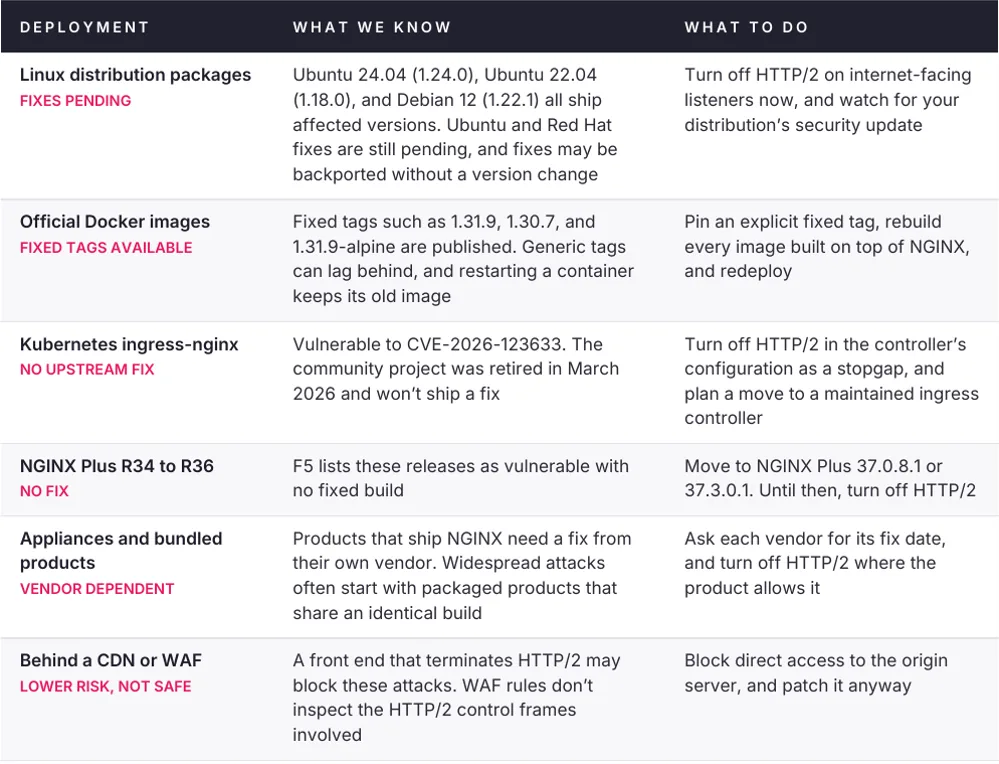
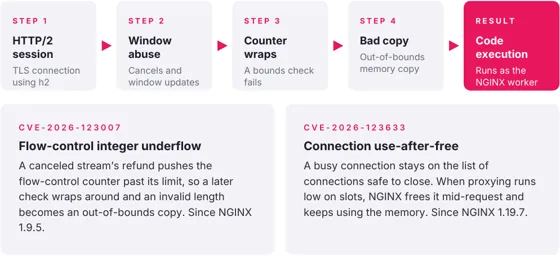
The commercial trajectory of Nginx culminated in March 2019 when application security provider F5 acquired Nginx, Inc. for 670 million dollars. F5 chief executive François Locoh-Donou stated that the acquisition bridged the gap between NetOps and DevOps teams by aligning enterprise cloud security with open-source delivery. Keeping web servers updated remains necessary because edge architectures remain exposed to software security vulnerabilities across network edge services, where protocol bugs like CVE-2026-123007 in HTTP/2 flow control can compromise unpatched hosts [10]. Today, understanding Nginx architecture allows developers to build scalable, resilient infrastructure that handles massive web workloads efficiently [3].
- WEBSITE Sysoev, I., & NGINX Team. (2003). Architecture and scalability: Tested operating systems and connection methods. Nginx.org. [Article Link]
- WEBSITE Sysoev, I., & NGINX Team. (2026). Nginx for Windows. Nginx.org. [Article Link]
- ONLINE NEWS Lunden, I. (2019). F5 acquires NGINX for $670M to move into open-source, multi-cloud services. TechCrunch. [Article Link]
- ONLINE NEWS Lardinois, F. (2017). Nginx goes beyond its server roots and launches its application platform. TechCrunch. [Article Link]
- ONLINE NEWS Moody, G. (2012). Interview with Igor Sysoev, author of Apache’s competitor NGINX. Free Software Magazine. [Article Link]
- ONLINE NEWS Reese, W. (2008). Nginx: The high-performance Web server and reverse proxy. Linux Journal. [Article Link]
- WEBSITE Wikipedia Contributors. (2026). Nginx. Wikipedia, The Free Encyclopedia. [Article Link]
- WEBSITE F5 Networks. (2026). NGINX reverse proxy. F5 NGINX Documentation. [Article Link]
- WEBSITE F5 Networks. (2026). HTTP load balancing. F5 NGINX Documentation. [Article Link]
- ONLINE NEWS Bleih, A. (2026). Two critical NGINX HTTP/2 flaws: What to patch first. Check Point Blog. [Article Link]
- ONLINE NEWS The Hacker News. (2026). 10-year-old NGINX HTTP/2 flaw lets unauthenticated attackers execute code on servers. The Hacker News. [Article Link]
- ONLINE NEWS Cloudflare Security Team. (2026). nginx2root: Five new nginx vulnerabilities, and how Cloudflare protects origins from the worst of them. Cloudflare Blog. [Article Link]
- WEBSITE Let’s Encrypt. (2025). Native ACME support comes to NGINX. Let’s Encrypt. [Article Link]
- ACADEMIC JOURNAL Ma, C., & Chi, Y. (2022). Evaluation test and improvement of load balancing algorithms of Nginx. IEEE Access, 10, 14311-14324. [Article Link]
- ACADEMIC JOURNAL Wicoksono, W., Mustaqhim, H. A., Panchadria, P. A., & Badratul, L. N. L. (2025). Performance comparison of NGINX, Apache, and Lighttpd using WRK on a Debian. bit-Tech, 8(1), 670-680. [Article Link]


