



In 2022, Sahrawi prospectors scouring a salt plain near Teghaza in Mali found an unusual rose-colored rock (weighing roughly 800 grams). Laboratory analyses funded by NASA confirmed that the rock, designated Teghaza 001, is the oldest Martian meteorite recovered on Earth, having formed more than 4.1 billion years ago during the Noachian epoch. Most known Martian meteorites are young volcanic stones that crystallized in the past several hundred million years, which left early planetary evolution largely unrecorded. This specimen provides a direct geochemical record of how the crust and mantle formed on ancient Mars [3].
Why the Oldest Martian Meteorite Matters
More than 435 meteorites from Mars are cataloged in global collections, but nearly all belong to the shergottite group that crystallized within the last 600 million years [5]. Ancient crustal samples from Mars remain exceptionally scarce on Earth, making each recovery significant for planetary science. Initial oxygen isotope tests at the University of New Mexico grouped Teghaza 001 alongside common shergottite meteorites, but microscopic inspection revealed coarse-grained igneous textures from deep magma reservoirs. Lead author Yang Liu of NASA’s Jet Propulsion Laboratory in Pasadena, California, reported that a peer reviewer for the journal Science called the stone a “Rosetta Stone for Mars” because of the long history preserved in its crystals [3].
Before this discovery, planetary scientists possessed only two other Martian meteorites older than four billion years: Allan Hills 84001 and NWA 7034. Allan Hills 84001 was discovered in Antarctica in the 1980s and consists almost entirely of orthopyroxene. The other rock, cataloged as NWA 7034 and nicknamed Black Beauty, is a volcanic breccia assembled roughly 2.1 billion years ago from ancient rock fragments. Teghaza 001 offers a far broader assemblage of pristine igneous minerals from the primordial Noachian crust. Planetary scientist Lydia Hallis from the University of Glasgow in Scotland said, “We’ve doubled our old meteorites. There will be a lot of people, including me, who want to get a piece of this” [4].
Unusual Minerals in Ancient Crust
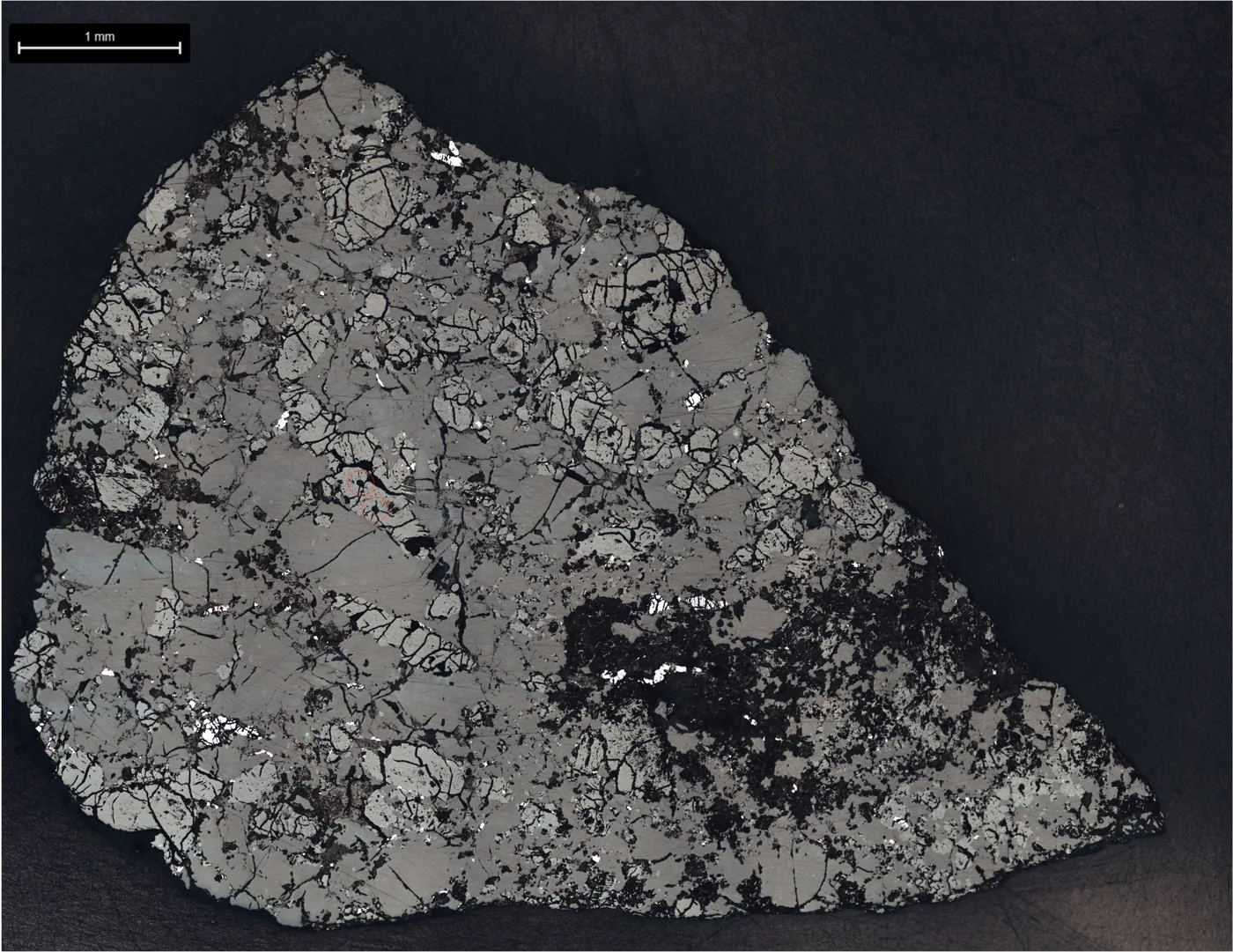
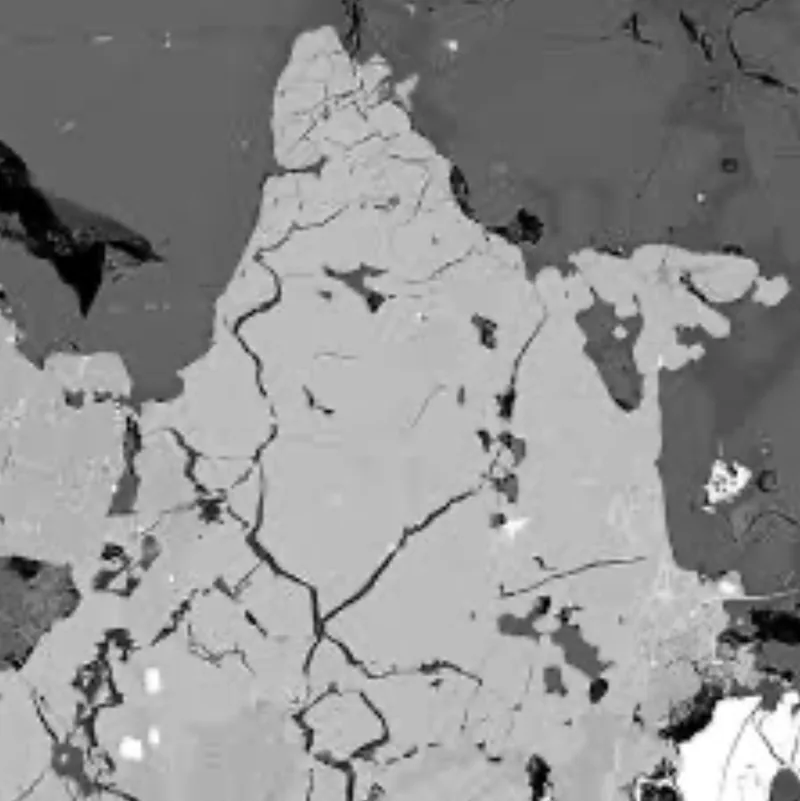
Geochemical evaluations published in the journal Science formally classified Teghaza 001 as a slowly cooled gabbroic diorite that sampled ancient crustal and mantle reservoirs [1]. The composition differs from the basaltic lavas that blanket most Martian volcanic provinces because this specimen holds high concentrations of silicon and abundant zircon crystals. Zircons trap minute quantities of uranium during crystallization from cooling magma. Because radioactive uranium decays into lead at an immutable physical rate over eons, these resilient crystals function as reliable clocks that allow geochemists to calculate exact crystallization ages. If thermal events or hydrothermal fluids alter the crystal lattice, the isotopic clock resets, which means the parent rock could have formed even earlier than 4.1 billion years ago [4].
The high silicon content in Teghaza 001 surprised geochemists because granite-like rocks on Earth typically require tectonic subduction zones to generate silica-rich magmas. Mars lacks active plate tectonics, leading researchers to expect that granitic materials would be virtually absent on the planet. Stanford University planetary scientist Eva Scheller said, “It’s very strange; we don’t expect that”. Orbital data and robotic surface explorers have encountered comparable rocks. In Perseverance rover explorations of Jezero Crater, science teams identified quartz-bearing outcrops like Plankeholmane alongside speckled boulders like Atoko Point that contain pyroxene and feldspar minerals. Geologist Christopher Herd at the University of Alberta in Canada said, “There’s more of a story to this rock than most other Martian meteorites” [4].
Laser Ablation of Feldspar
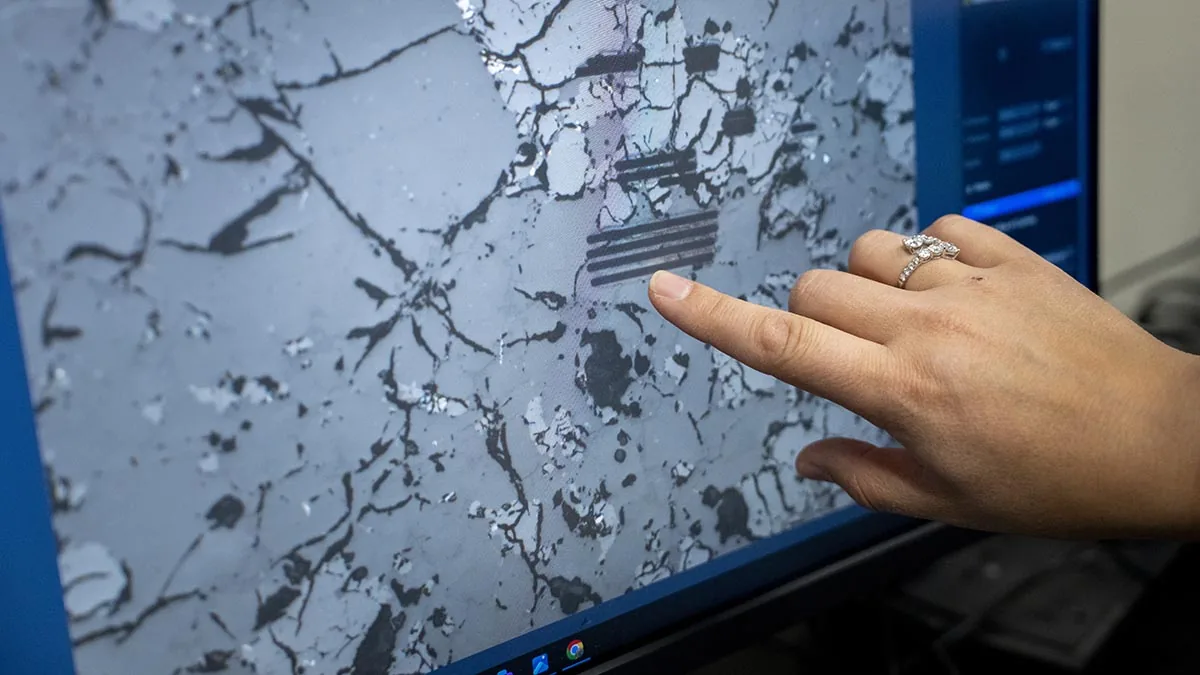
Measuring the crystallization age of Teghaza 001 without destroying irreplaceable planetary material required an adapted isotopic technique. Professor Alicia Cruz-Uribe, who serves as the Edward Sturgis Grew Professor of Petrology and Mineralogy at the University of Maine, collaborated with geochemist François Tissot at Caltech to adapt rubidium-strontium dating. Conventional methods require weeks of chemical digestion in acids that consume whole rock chips. Instead, Cruz-Uribe directed an ultraviolet laser beam measuring one-sixth the width of a human hair directly onto individual feldspar grains. Helium carrier gas swept the ablated mineral vapor into a high-precision mass spectrometer at Caltech, where chemical separation took place inside the instrument in less than a minute [6].
The laser ablation technique preserved the delicate sample while delivering rapid isotopic measurements from targets smaller than a fingernail. The primary mass of Teghaza 001, weighing 442 grams, is curated at the Maine Mineral & Gem Museum in Bethel, Maine, while 22 grams are held at the Institute of Meteoritics at the University of New Mexico. Cruz-Uribe and her students also analyzed loaned material in the MicroAnalytical Geochemistry and Isotope Characterization Laboratory (known as the MAGIC Lab) at UMaine. The rubidium-strontium dates from feldspar matched the uranium-lead ages from zircons, confirming that the meteorite crystallized 4.1 billion years ago. Cruz-Uribe said, “When you add a third sample, and its geochemistry is really unique compared to the other samples that we have, it lets us see a different part of Mars’s ancient history in terms of what the mantle looked like and what the different mantle sources were on Mars” [6].


How the Oldest Martian Meteorite Trapped Water
Beyond establishing crystallization ages, researchers investigated how hydrothermal fluids migrated through the crust of early Mars. A companion study published in Science Advances examined hydrous components trapped within igneous calcium-phosphate minerals. The analysis revealed that minerals in Teghaza 001 underwent hydrothermal alteration from fluids enriched in heavy oxygen-18 before an impact blasted the rock into space. Researchers identified isotopic mixing between dry primordial mantle magmas and a deuterium-rich fluid reservoir from the ancient Martian hydrosphere [2].
The deuterium-to-hydrogen ratio measured in the calcium-phosphate minerals indicates that the ancient Martian hydrosphere had an isotopic ratio roughly twice that of modern Earth seawater. Coauthor Lee Saper, a former JPL postdoctoral researcher now based at the NASA Ames Research Center in Silicon Valley, discussed the findings at the Goldschmidt geochemistry conference in Montreal [4]. Saper said that ascending magmas assimilated deuterium-rich surface water as they moved through altered crustal rocks. Because Mars lacked a sustained magnetic dynamo, solar winds stripped light hydrogen atoms from the upper atmosphere while heavier deuterium remained trapped in crustal reservoirs. “It records interactions of water and rock and maybe even an imprint of the Martian atmosphere as it was losing water,” Saper said [3]. These measurements indicate that the loss of Martian surface water began during the planet’s infancy [5].
Identification of Martian Rocks
How do planetary geochemists distinguish a stray meteorite found in the desert from ordinary terrestrial rocks? Thousands of meteorites strike Earth each year, but identifying Martian specimens requires measuring distinct chemical and isotopic signatures. When a large asteroid impacts Mars, the collision can accelerate crustal fragments past the planetary escape velocity of five kilometers per second. After drifting through interplanetary space for millions of years, some fragments eventually intercept Earth’s orbit and survive atmospheric entry as meteorites [3].
Laboratories verify Martian origin by comparing the chemical composition of candidate rocks against geochemical benchmarks established by robotic spacecraft. Oxygen isotopes provide an unambiguous planetary signature because the relative ratios of oxygen-16, oxygen-17, and oxygen-18 differ uniquely between Earth, the Moon, Mars, and various asteroid bodies. Geochemists at the University of New Mexico first confirmed Teghaza 001 by matching its oxygen isotopes to known Martian meteorites. In addition, trapped gases inside glassy melt pockets are compared directly to Martian atmospheric data collected by the Viking 1 and Viking 2 landers in 1976. Modern surface instruments operating on Curiosity rover missions studying ancient Martian rivers and the Perseverance rover continue to supply comprehensive chemical libraries that ground-truth these laboratory comparisons [3].
Candidate Impact Sites in Southern Highlands
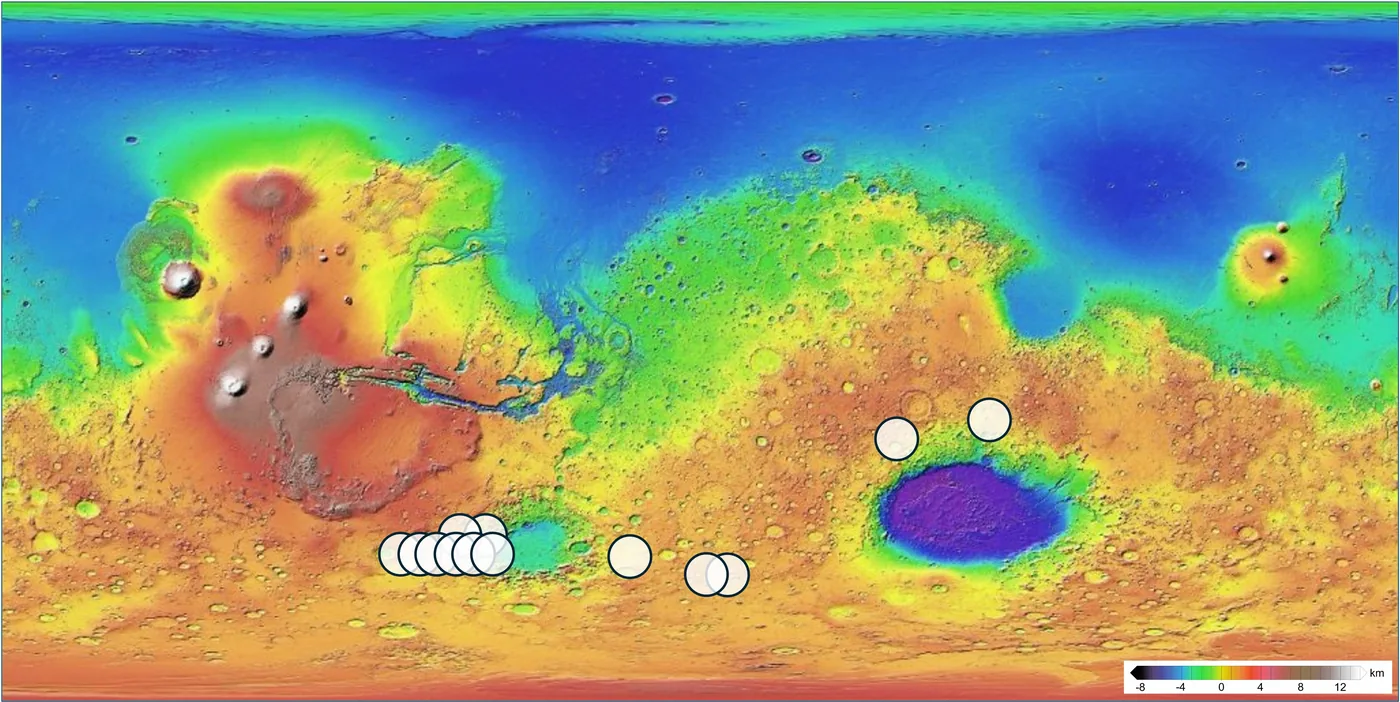
Pinpointing the specific impact crater that ejected Teghaza 001 remains challenging, but researchers identified potential source regions using orbital spectrometry. Orbital data gathered by NASA’s Mars Reconnaissance Orbiter show that the heavily cratered southern highlands preserve the closest chemical and mineralogical matches to the composition of Teghaza 001. The research team identified 13 potential locations across the southern hemisphere that share the rock’s unique gabbroic diorite signature. These cratered terrains represent ancient crust that crystallized during the Noachian period over four billion years ago [3].
While meteorites provide valuable material for laboratory study, scientists emphasize that returned samples from Mars remain necessary for ground-truth exploration. Planetary scientist Anya Udry of the University of Nevada, Las Vegas, said: “Mars is a complex planet, and this meteorite is really cool, but we don’t know exactly where it came from, so this is really another example of why we need to bring back samples” [5]. Studying Teghaza 001 allows researchers to calibrate orbital remote sensing while identifying priority sampling regions for future surface missions. Lead author Yang Liu said that current findings are preliminary, noting that researchers have “only scratched the surface” of the history preserved inside Teghaza 001 [3].
- ACADEMIC JOURNAL Liu, Y., Saper, L. M., Bell, E. A., Ma, C., Li, H., Hu, J., Guan, Y., Melton, H., Cruz-Uribe, A. M., Yap, T. E., Tissot, F. L., Bucholz, C. E., Ziegler, K., & Agee, C. B. (2026). A Martian meteorite that formed ≳4.1 billion years ago samples Mars’ early crust and mantle. Science. [Article Link]
- ACADEMIC JOURNAL Saper, L., Liu, Y., Guan, Y., Ma, C., Bell, E. A., & Agee, C. B. (2026). A Noachian hydrosphere component in the 4.1-Ga Martian meteorite Teghaza 001. Science Advances, 12(24). [Article Link]
- PRESS RELEASE Jet Propulsion Laboratory. (2026). NASA-funded study details one of oldest Mars meteorites ever found. NASA. [Article Link]
- ONLINE NEWS Anderson, P. S. (2026). Oldest Mars meteorite reveals Mars lost its water early. EarthSky. [Article Link]
- ONLINE NEWS Randolph, M. (2026). The oldest known piece of Mars may help solve mysteries of life on Earth. Scientific American. [Article Link]
- PRESS RELEASE Lozier, A. (2026). UMaine scientist helps identify one of the oldest Martian meteorites on Earth. UMaine News. [Article Link]
- ONLINE NEWS Mirage News. (2026). NASA study details one of Mars’ oldest meteorites. Mirage News. [Article Link]
- ONLINE NEWS The Good News Brief. (2026). NASA-funded study identifies one of the oldest known Martian meteorites at over 4.1 billion years. The Good News Brief. [Article Link]
- WEBSITE Tran, L. (2023). Mars: News & features. NASA Science. [Article Link]
APA 7: PerEXP Teamworks. (2026, October 30). Teghaza 001 is the Oldest Martian Meteorite Found on Earth. PerEXP Teamworks. https://perexpteamworks.com/en/oldest-martian-meteorite-teghaza-discovery/


