



A circadian rhythm is an innate body cycle that recurs roughly every 24 hours, steering sleep, hormone release, and cell metabolism across living things [6]. Governed by a master clock in the brain and paired gene loops inside single cells, these cycles ready the body for daily shifts in sun and warmth [1]. Rather than passively answering environmental changes, the body predicts regular transitions between day and night through self-sustaining biochemical timing [6].
- What Is a Circadian Rhythm?
- Historical Roots and the Period Gene
- Molecular Feedback Loops in Single Cells
- How Light Signals Reach the Hypothalamus
- Autonomous Daily Clocks in Peripheral Tissues
- Why Circadian Rhythm Changes with Age
- Primary Circadian Rhythm Sleep Disorders
- Diagnostic Tools and Phase Resetting Strategies
What Is a Circadian Rhythm?
To rank as circadian, a body cycle must satisfy three clear rules set in chronobiology. First, the cycle must run on an innate period of about 24 hours in constant darkness, an unprompted cycle length named tau. Solar cues reset this period through entrainment. Day length sets the pace [6].
The third rule temperature compensation means cellular chemical speeds stay steady across normal physiological heat without quickening as warmth climbs. Circadian rhythms differ fundamentally from simple diurnal responses that depend directly on outside daylight. In 1959, chronobiologist Franz Halberg created the word circadian from the Latin roots for about (circa) and day (dies) to describe body rhythms lasting roughly twenty-four hours. The International Committee on Nomenclature of the International Society for Chronobiology formally adopted this definition in 1977. They specified that circadian cycles encompass biological oscillations near 24 hours whether they remain synchronized with local time or run free in the absence of external signals [6].
These biochemical timekeeping systems arose early on Earth to help cells survive sunlight and chemical stress. Cyanobacteria such as Synechococcus elongatus carry the simplest known clock, which scientists rebuilt in test tubes using only three oscillator proteins named KaiA, KaiB, and KaiC fueled by ATP. Because cyanobacteria divide in daylight, researchers conclude that clock networks developed with redox proteins roughly 2.3 billion years ago after the Great Oxidation Event to counter reactive oxygen species [6].

Historical Roots and the Period Gene
Early naturalists tracked rhythmic acts long before uncovering their gene roots [6]. In 1729, French astronomer Jean-Jacques d’Ortous de Mairan noticed that Mimosa pudica plants folded their leaves at dusk and reopened them at dawn. When he placed the plants in dark cupboards cut off from sunlight, the leaves still folded and opened on a daily schedule [1]. Later tests by Patrick and Gilbert in 1896, J. S. Szymanski in 1918, and Colin Pittendrigh in 1954 showed that sleepiness, animal locomotion, and fruit fly pupal emergence followed innate daily cycles. Pittendrigh proved that Drosophila pseudoobscura adult emergence delayed when temperature cooled, yet the underlying biological clock kept ticking on schedule [6].
Gene inquiry into body clocks started in 1971 when Seymour Benzer and Ronald Konopka bred mutant Drosophila melanogaster flies with disrupted rest cycles. They mapped this flaw to a single gene named period. In 1984, teams isolated this gene sequence. Flawed genes stop normal cycles [1].
Working in close partnership, Jeffrey C. Hall and Michael Rosbash at Brandeis University in Boston, with Michael W. Young at Rockefeller University in New York, cloned the period locus [1]. The gene covered a 7.1-kilobase span on the X chromosome [6]. Hall and Rosbash showed that the PER protein accumulated during the night and degraded during daytime hours before entering the cell nucleus to block its own genetic transcription in a continuous cycle. The loop sustains itself. For this breakthrough, Hall, Rosbash, and Young received the 2017 Nobel Prize in Physiology or Medicine from the Nobel Assembly at Karolinska Institutet [1].
Molecular Feedback Loops in Single Cells
The core engine of cellular timekeeping relies on an inhibitory gene feedback loop that completes one turn roughly every 24 hours. When the period gene is active inside the cell nucleus, it synthesizes messenger RNA that moves out into the cytoplasm to assemble PER protein chains. To shut off its own production, PER must travel back into the nucleus, but it cannot enter alone. In 1994, Michael W. Young identified a second clock gene called timeless that codes for the TIM protein. Young showed that TIM binds with PER in the cytoplasm, forming a molecular pair capable of crossing into the nucleus to block transcription. This binding closes the inhibitory feedback loop [1].
A living clock needs a delay step so that it does not run through its cycle too fast. Young found a third clock gene named doubletime, which makes the DBT protein to add phosphate tags to PER. This tagging prompts early PER breakdown, slowing down protein buildup [1].
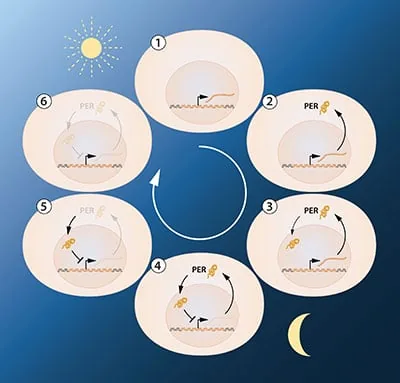
In mammal cells, transcription factors BMAL1 and CLOCK form positive regulators that activate PER1 and CRY genes, whose proteins return to the nucleus to halt their own synthesis [7]. These feedback loops operate within single cells. In 1993, researchers Gene Block, Michel, Geusz, and Zaritsky studied isolated basal retinal neurons from the sea mollusk Bulla gouldiana. Isolated neurons kept up daily shifts in membrane conductance across several cycles in culture dishes. Membrane conductance peaked in late subjective night and dropped twofold near dawn, proving single neurons function as pacemakers. Cells tick on their own [9].
How Light Signals Reach the Hypothalamus
In mammals, cellular oscillators coordinate through a master control hub known as the suprachiasmatic nucleus (SCN). Located in the anterior hypothalamus, this paired structure gets photic signals from eyes cells. Retinal ganglion cells express melanopsin, sending axonal fibers through the retinohypothalamic tract to the SCN [7, 8]. Eyes guide the clock [8].
Melanopsin absorbs light in the blue part of the spectrum around 480 nanometers, allowing daylight to reset body timing without conscious vision [7, 8]. Once lit by dawn, the SCN transmits daily timing cues throughout the nervous system and endocrine glands. In morning daylight, neural signals from the hypothalamus prompt the release of cortisol and raise core body heat to boost alertness. As daylight fades at dusk, the SCN stops suppressing the pineal gland, letting melatonin secretion climb and body heat drop. High nighttime melatonin promotes sleep readiness, while morning light quickly shuts down melatonin output to renew wakefulness [3]. Light functions as the primary zeitgeber for human entrainment [6].
Screen light late in the evening scrambles this photic pathway and delays sleep cues. In a study published in Chronobiology International, Green, Cohen-Zion, Haim, and Dagan tested nineteen people exposed to computer screens between 21:00 and 23:00. They found that short-wavelength blue light curtailed nighttime melatonin levels, disrupted sleep patterns, and weakened morning attention [11]. Reviewing light pathways in Frontiers in Neurology, Fisk, Tam, Brown, Vyazovskiy, Bannerman, and Peirson observed that non-image-forming retinal signals modulate sleep and alertness as well as central circadian alignment [12].


Autonomous Daily Clocks in Peripheral Tissues
Although the SCN sets overall synchrony, almost all human organs possess autonomous daily clocks inside their own cells [2]. In the liver, local transcription loops regulate enzymes that handle glucose breakdown and lipid processing in response to daily feeding habits [7]. Similar peripheral timers operate inside kidney, muscle, and vascular tissue [2].
At the MRC Laboratory of Molecular Biology in Cambridge, researchers investigated the autonomous circadian rhythm operating inside heart muscle cells. Study co-author Dr John O’Neill said: “It allows the heart to anticipate demand rather than simply react to it.”. The Cambridge team found that between 6% and 20% of proteins in heart cells fluctuate across a 24-hour cycle, directed by the mTORC protein complex. To balance osmotic pressure as protein amounts change, cardiac cells adjust potassium and chloride transport through KCC and NKCC transporter proteins controlled by WNK kinases and OXSR1/SPAK enzymes. This shifting ion balance alters membrane electrical potential, accelerating cell depolarization to support higher heart rates during wakeful hours [2].
Tests on isolated mouse hearts confirmed that beating frequency varied systematically according to the time of day even without nerve inputs from the brain. When scientists applied the drug torin1 to block mTORC activity, daily variations in electrical firing stopped, but normal rhythmicity resumed once the drug washed out. Research by Hayter and Stangherlin in 2021 showed that night shift schedules temporarily disrupt electrical coordination across heart tissue, illustrating the cardiovascular strain created when peripheral tissue clocks decouple from central sleep patterns [2].

Why Circadian Rhythm Changes with Age
An individual’s daily sleep drive and circadian rhythm timing evolve continuously across different life stages. Newborn infants lack a functional circadian clock at birth and sleep up to 18 hours across brief spells. Between four and six months of age, infant sleep patterns begin consolidating. Sleep settles into nocturnal blocks [3].
During puberty, biological clocks shift toward evening preference, creating a circadian delay in roughly 16% of teenagers. Because adolescent melatonin levels do not rise until late in the evening, teens often struggle to fall asleep before 23:00. When secondary schools require early morning attendance, adolescents accumulate chronic sleep deficits that hinder daytime alertness, emotional control, and classroom learning. Sleep pressure climbs through the day, but delayed circadian timing prevents earlier sleep onset [3].
As adults enter older age, the internal sleep clock loses robustness, causing earlier evening sleepiness and fragmented early morning awakenings while deep slow-wave sleep cycles alternate with REM sleep where dreams occur with temporary muscle immobility. Older adults wake early. Circadian disruption interacts with autonomic arousal pathways, connecting neural stress circuits with poor sleep in laboratory mice studied under irregular conditions. Degenerative brain conditions like Alzheimer disease further degrade the SCN, exacerbating nighttime wakefulness and daytime confusion among seniors. Studies show that circadian breakdown often surfaces before overt memory loss appears, pointing toward mutual links between neurodegenerative pathology and biological clock decay [3].
Primary Circadian Rhythm Sleep Disorders
Circadian rhythm sleep disorders emerge when internal timing mechanisms fail or fall out of alignment with societal demands. The International Classification of Sleep Disorders recognizes six major subtypes, including delayed sleep-wake phase disorder, advanced sleep-wake phase disorder, shift work disorder, and jet lag [4, 7]. Unlike primary insomnia, these conditions alter the timing of sleep propensity rather than the biological capacity to generate sleep. Delayed sleep-wake phase disorder typically forces sleep onset past 02:00, making conventional work or school schedules difficult to sustain [4, 5].
In non-24-hour sleep-wake rhythm disorder, the biological clock runs on an intrinsic cycle longer than a solar day, drifting progressively forward by minutes each morning. This condition affects an estimated 50% to 70% of totally blind individuals who lack light perception to reset their SCN pacemakers. In sighted individuals, Hayakawa and colleagues reported in a clinical series of 57 patients that 63% developed the disorder during adolescence, and psychiatric conditions had preceded onset in 28% of cases. Sighted patients cycle through weeks of normal sleep followed by weeks of severe insomnia and daytime exhaustion [8]. Familial forms also occur: Chris Jones, Ying-Hui Fu, and Louis Ptacek characterized an extended Utah family where a single mutation (S662G) in the PER2 gene causes familial advanced sleep phase syndrome [6].
Patient survey data gathered by the Circadian Sleep Disorders Network reveals the daily toll of chronic phase misalignment [5]. Reporting on 479 clinically diagnosed patients in Sleep Medicine: X, Peter Mansbach, Alexandra Wharton, and colleagues found that over half experienced persistent tiredness even on their preferred schedules. Sleep timing defects frequently preceded depressive symptoms [5, 10].
Diagnostic Tools and Phase Resetting Strategies
Accurate diagnosis of circadian disorders requires specialized clinical tracking to differentiate phase delays from primary insomnia [4]. Patients maintain comprehensive sleep diaries and wear actigraphy accelerometers on their wrists for at least 14 consecutive days to record movement and rest patterns. In clinical laboratories, doctors measure dim light melatonin onset by collecting repeated saliva or plasma samples in low illumination, pinpointing the exact hour when nocturnal melatonin production begins [7, 8].
Phototherapy serves as the primary drug-free method to realign circadian timing with the 24-hour day. Exposing patients to bright light boxes shortly after waking suppresses lingering melatonin and advances the circadian phase earlier for delayed sleep disorder [4, 7]. Conversely, applying light exposure in the late afternoon or early evening delays sleep onset, which benefits patients managing advanced sleep phase disorder. Consistent wake times and timed outdoor daylight reinforce daily entrainment [3, 4]. Behavioral adjustments work with phototherapy to stabilize the biological clock [3]. Circadian entrainment needs consistent timing across work days and weekends alike. When light cues align with regular meal times, peripheral organ clocks synchronize more rapidly with hypothalamic pacemakers [2, 4].
When behavioral interventions prove insufficient, clinicians combine light therapy with targeted pharmacotherapy. Taking low-dose melatonin several hours before bedtime shifts sleep propensity earlier in delayed phase disorders, whereas for totally blind individuals with non-24-hour sleep-wake rhythm disorder, the melatonin receptor agonist tasimelteon provides pharmacological entrainment approved by the United States Food and Drug Administration in 2014 and the European Union in 2015 [4, 8]. Tasimelteon resets the clock [8].
- PRESS RELEASE Nobel Assembly at Karolinska Institutet. (2017). The 2017 Nobel Prize in Physiology or Medicine: Discoveries of Molecular Mechanisms Controlling the Circadian Rhythm. [Article Link]
- ONLINE NEWS Jourdan, A. (2026). Heart Cells Have Their Own 24 Hour Clock. The Hippocratic Post. [Article Link]
- WEBSITE Suni, E., & Rehman, A. (2021). Sleep Drive and Your Body Clock. Sleep Foundation. [Article Link]
- WEBSITE Lecturio. (2025). Circadian Rhythm Sleep–Wake Disorder. Concise Medical Knowledge. [Article Link]
- WEBSITE Circadian Sleep Disorders Network. (2025). Circadian Rhythm Sleep Disorders Overview and Registry. [Article Link]
- WEBSITE Wikipedia contributors. (2026). Circadian Rhythm. Wikipedia, The Free Encyclopedia. [Article Link]
- WEBSITE Wikipedia contributors. (2026). Circadian Rhythm Sleep Disorder. Wikipedia, The Free Encyclopedia. [Article Link]
- WEBSITE Wikipedia contributors. (2026). Non-24-Hour Sleep-Wake Rhythm Disorder. Wikipedia, The Free Encyclopedia. [Article Link]
- ACADEMIC JOURNAL Michel, S., Geusz, M. E., Zaritsky, J. J., & Block, G. D. (1993). Circadian Rhythm in Membrane Conductance Expressed in Isolated Neurons. Science, 259(5092), 239-241. [Article Link]
- ACADEMIC JOURNAL Mansbach, P., Fadden, J. S., & McGovern, L. (2024). Registry and Survey of Circadian Rhythm Sleep-Wake Disorder Patients. Sleep Medicine: X, 7, 100100. [Article Link]
- ACADEMIC JOURNAL Green, A., Cohen-Zion, M., Haim, A., & Dagan, Y. (2017). Evening Light Exposure to Computer Screens Disrupts Human Sleep, Biological Rhythms, and Attention Abilities. Chronobiology International, 34(7), 855-865. [Article Link]
- ACADEMIC JOURNAL Fisk, A. S., Tam, S. K. E., Brown, L. A., Vyazovskiy, V. V., Bannerman, D. M., & Peirson, S. N. (2018). Light and Cognition: Roles for Circadian Rhythms, Sleep, and Arousal. Frontiers in Neurology, 9, 56. [Article Link]


