






The two small natural satellites of Mars, Phobos and Deimos, present planetary scientists with one of the most persistent mysteries in the solar system [8]. Discovered late in the nineteenth century, both bodies have irregular shapes and dark surfaces that look strikingly like carbonaceous asteroids drifting through the main belt [10]. Yet their circular equatorial paths around Mars contradict simple capture scenarios, prompting long debates over whether they formed from ancient impact debris or catastrophic disruptions [8].
What Are Phobos and Deimos?
Phobos and Deimos are tiny, nonspherical moons that circle Mars at strikingly different distances from its red surface [8]. Phobos measures roughly 26 by 23 by 18 kilometers, making it the larger natural satellite [10]. Deimos measures 16.1 by 11.8 by 10.2 kilometers [9]. Neither body has enough mass for gravity to create a sphere [1].
The orbital path of the inner companion sets it apart from every other natural satellite in the solar system [5]. Circling just 5,989 kilometers above Mars’ surface, Phobos completes a full revolution around the planet in 7 hours and 39 minutes [1], [5]. Because its orbital speed is three times faster than Mars’ rotation, an observer on the Martian equator would watch Phobos rise in the west and set in the east [1]. Deimos travels much farther out at an orbital distance of 23,457.50 kilometers [9]. Taking roughly 30.3 hours to finish one Martian orbit, Deimos rises in the east and lingers in the sky for over two days before setting [8], [9].
Both worlds are airless. Because weak surface gravity allows escaping gases to disperse into space, neither moon retains an atmosphere to insulate its rocky crust [10]. Sunlight reflects poorly off the Mars-facing terrains of Phobos, where the albedo measures a dim 0.071 [1], [8],. Surface temperatures reach −4 degrees Celsius in sunlight, but plunge to −112 degrees Celsius across shadowed ground [10].
Discovery by Asaph Hall in 1877
American astronomer Asaph Hall discovered both natural satellites during a telescopic survey conducted at the United States Naval Observatory in Washington, D.C. [8]. Hall nearly halted the exhausting search during hazy midnight observations in August 1877, but his wife Angelina Stickney Hall encouraged him to persist [5],. Hall detected Deimos on August 12, 1877, using the observatory’s 26-inch refractor [8].
Hall detected Phobos six nights later on August 18 [5],. He showed his observational measurements to Professor Simon Newcomb while Newcomb was eating lunch in the observatory on August 17, and Admiral Rodgers announced the discovery shortly afterward. Assistant George Anderson helped confirm the findings. Henry Madan, a science master at Eton College, drew upon Book XV of Homer’s Iliad to suggest naming the moons after the mythical companions of Ares, the Greek counterpart of the war god Mars [8]. Phobos means fear, while Deimos represents dread [5], [8].
Long before Hall detected the moons, European authors had already imagined two satellites around Mars. Johannes Kepler had misinterpreted a Latin anagram sent by Galileo Galilei about Saturn’s rings, erroneously assuming Galileo had found twin Martian companions. Jonathan Swift incorporated that idea into his 1726 satire Gulliver’s Travels, describing Laputan astronomers who tracked two satellites orbiting close to the planet. Swift made remarkably accurate estimates for their orbital distances and periods, possibly assisted by the mathematician John Arbuthnot. Voltaire repeated the speculation in his 1752 philosophical short story Micromégas. In honor of these literary references, craters on Deimos were later named Swift and Voltaire, while features on Phobos commemorate Laputa Regio and Lagado Planitia [8], [9].
Surface Features of the Martian Moons
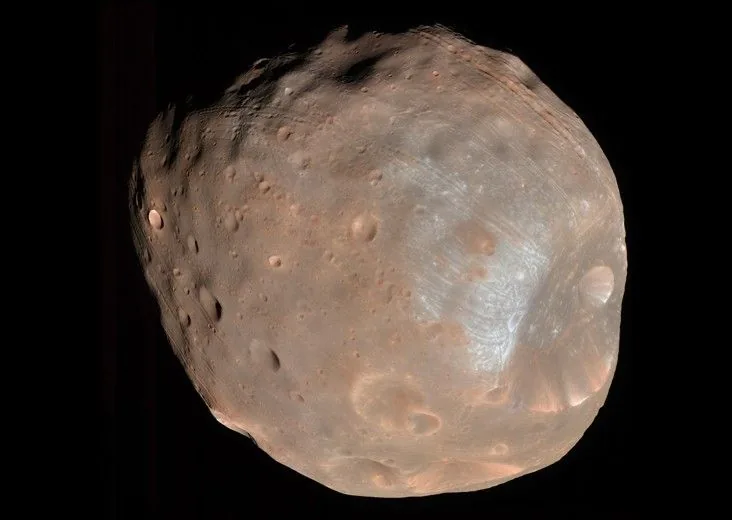
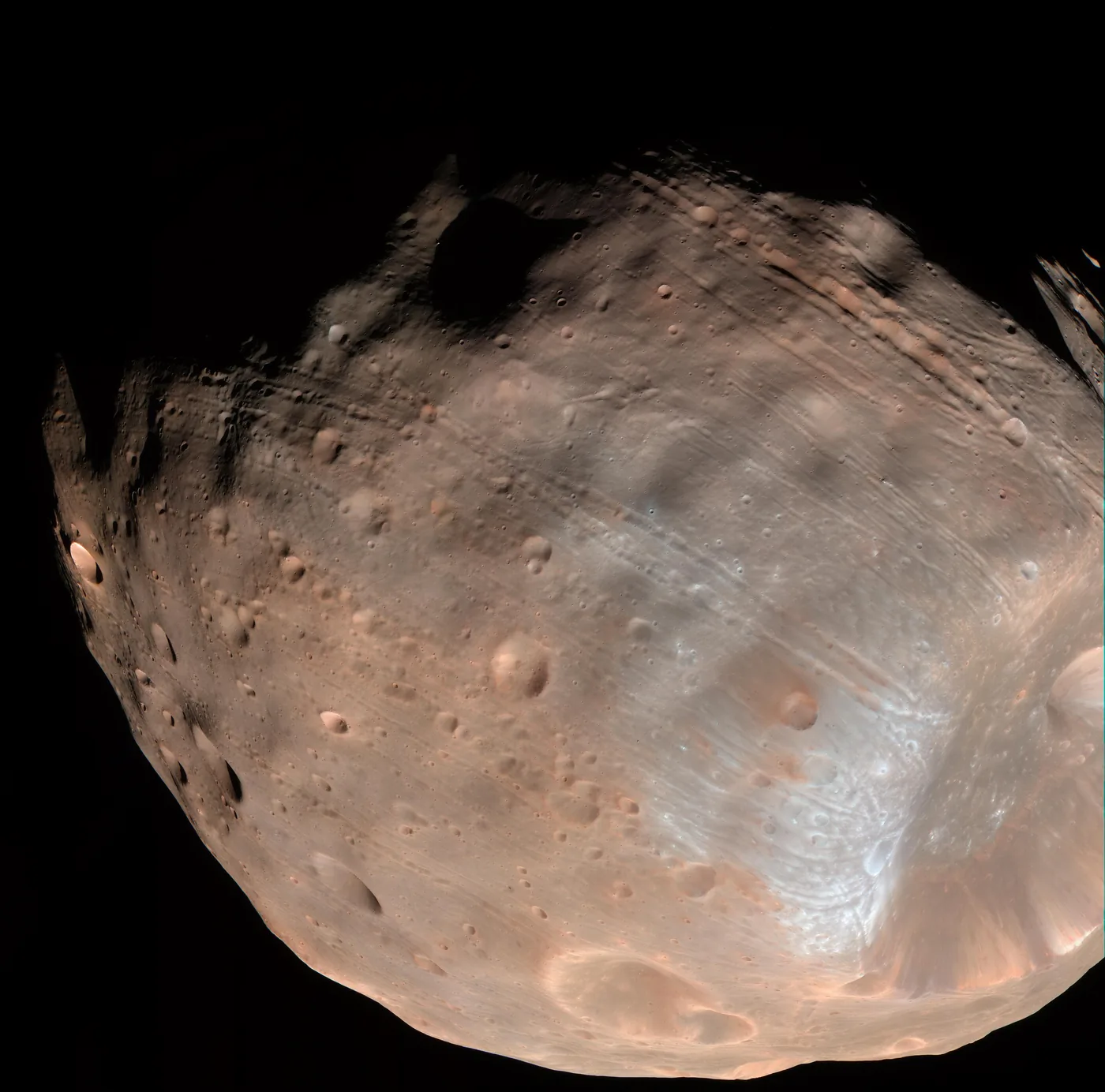
Impact scars dominate the surfaces of both satellites, recording billions of years of bombardment [1], [9]. The most prominent feature on Phobos is Stickney crater, a giant impact depression measuring roughly 9.5 kilometers across [1], [5]. Named after Angelina Stickney, the crater was created by an impact so powerful that it nearly shattered Phobos [1], [5], [7].
Observations from the Mars Global Surveyor spacecraft revealed that a blanket of fine dust covers Phobos [1], [5]. This powdery regolith measures at least one meter deep across broad plains, generated by continuous micrometeoroid bombardments that pulverize surface rock [1]. Surface gravity on Phobos is merely 1/1,000th of Earth’s gravitational pull, meaning a 68-kilogram person would weigh only 68 grams on its surface. Even within such a weak gravitational field, orbiters have captured unmistakable evidence of landslides, where displaced boulders and dust rolled down steep crater walls [5]. Close-up images acquired on 28 July 2008 by the Mars Express orbiter confirmed these complex surface details [1].
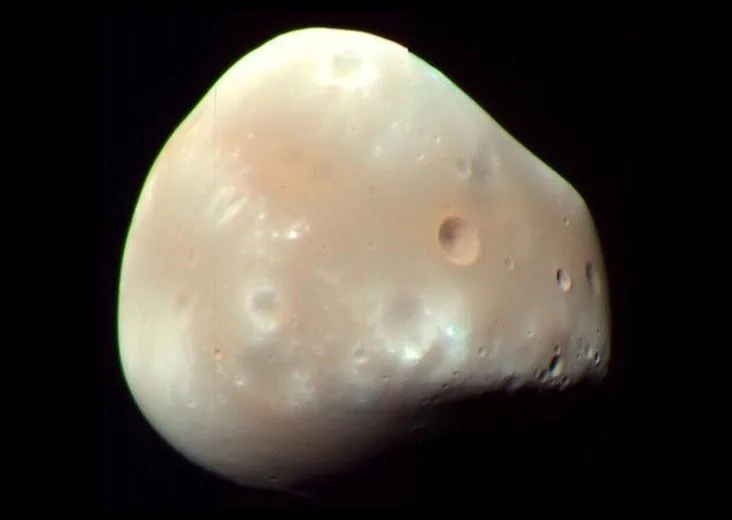
Deimos appears remarkably smooth. Although ancient impacts heavily scarred its companion, a deep mantle of porous regolith blankets Deimos and fills its older craters, muting the sharp topographical relief visible across Phobos. Radar studies indicate that this fine regolith has a low bulk density of roughly 1.471 grams per cubic centimeter. With an escape velocity of merely 5.6 meters per second, energetic meteorite collisions easily eject pulverized rock into space, though substantial dust drifts back to soften the landscape [9].
Could Phobos and Deimos Be Captured Asteroids?
For decades, planetary geologists suspected that Phobos and Deimos were stray asteroids captured from interplanetary space [8]. Both satellites share several spectral qualities with carbonaceous C-type and D-type asteroids [1],. Their dark surfaces and low bulk densities match primitive carbonaceous chondrite meteorites [8], [9]. These compositional similarities prompted early researchers to propose that Mars’ gravity captured two roaming asteroids from the main belt [1], [8].
Orbital dynamics poses a serious challenge to the capture hypothesis [4], [8]. Both moons follow nearly circular orbits that align closely with the equatorial plane of Mars [1], [8]. Gravitational capture normally leaves incoming objects on elongated, highly eccentric trajectories with random orbital inclinations [4], [8]. To circularize such orbits, Mars would need an exceptionally dense ancient atmosphere to provide aerodynamic braking. However, atmospheric drag strong enough to slow a Phobos-sized body would also shed so much orbital energy that the satellite would spiral down and crash into the Martian crust [3].
To overcome this difficulty, planetary scientist Geoffrey A. Landis proposed a tidal capture mechanism in a 2009 preprint that has not undergone peer review. Landis observed that many small asteroids, such as Ida and its companion Dactyl, travel through space as binary pairs. When a binary asteroid makes a close flyby of a planet, tidal forces can split the pair, stripping one companion away while allowing the other to be captured into a stable orbit around Mars [3].

Formation Through Ancient Giant Impacts
Because asteroid capture struggles to explain circular equatorial orbits, planetary scientists increasingly focus on giant impact models [6], [8]. In this scenario, a massive impactor struck early Mars, blasting crustal rock into orbit. That ejected material flattened into a circumplanetary debris disk from which new moons could accrete over time [6], [8].
In a 2015 preprint study that has not undergone peer review, researchers Robert Citron, Hidenori Genda, and Shigeru Ida examined this impact hypothesis using Smoothed Particle Hydrodynamics simulations. Their work modeled a Borealis-scale impact with an energy of approximately 3×10²⁹ joules, which could account for the formation of the vast Borealis basin in the Martian northern hemisphere. The numerical simulations demonstrated that such an impact could eject a debris disk with a mass of roughly 5×10²⁰ kilograms, representing between 1 and 4 percent of the impactor mass. That volume of material provides enough orbital mass to assemble at least one Martian moon [6].
Flyby data gathered by planetary orbiters provide strong physical evidence that Phobos re-accumulated from impact debris. Radio science tracking from Mars Express revealed that Phobos has an average bulk density of about 1.887 grams per cubic centimeter and a mass of roughly 10.6×10¹⁵ kilograms [1],. Porosity calculations indicate that internal voids account for 25 to 35 percent of the moon’s volume [10]. In 1988, the Soviet spacecraft Phobos 2 detected outgassing from the satellite before suffering an unexpected equipment malfunction. These observations confirm that Phobos is a porous rubble pile [1], [10].
Evidence for a Disrupted Common Progenitor
In 2021, an alternative formation model published in Nature Astronomy proposed that Phobos and Deimos evolved from a single parent body. Amirhossein Bagheri and Amir Khan at ETH Zurich, Michael Efroimsky at the United States Naval Observatory, Mikhail Kruglyakov, and Domenico Giardini combined orbital models with seismic data from the Mars InSight mission [4], [9].
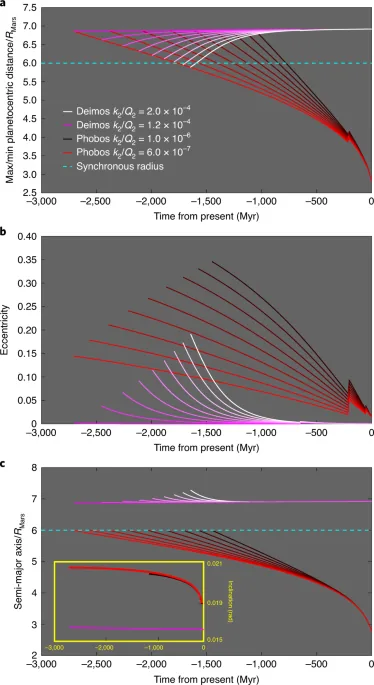
By running numerical simulations of satellite libration and tidal dissipation backward through time, the researchers discovered that the orbital paths of Phobos and Deimos intersected between 1.0 and 2.7 billion years ago [4],. They proposed that an ancient Martian moon suffered a catastrophic impact from an asteroid, shattering the progenitor into multiple rocky fragments [9]. Tidal dissipation within Mars and the resulting debris cloud circularized the eccentric orbits in less than 2.7 billion years. Phobos and Deimos emerged as the surviving remnants of that ancient disruption event. Subsequent studies continue to test this common progenitor model against spacecraft observations [4].
This disruption model neatly explains why the two moons now orbit on opposite sides of Mars’ synchronous radius line. After the collision, Deimos remained outside the synchronous boundary, where tidal forces transfer planetary spin energy to the moon and push it outward. Phobos fell inside the synchronous line, where tidal friction steadily drains its orbital momentum. This dynamic separation prevented Deimos from suffering inward orbital decay while setting Phobos on a course toward destruction [4].
Why Phobos Is Moving Toward Mars
Tidal friction drives the slow inward spiral of Phobos [2], [7]. Because Phobos orbits Mars in only 7 hours and 39 minutes, it travels faster than the planet rotates [1], [8]. The gravitational tidal bulge that Phobos raises on Mars lags behind the speeding satellite [7]. This lagging bulge exerts a continuous backward drag that lowers the moon’s altitude by about 1.8 to 2.0 meters each century [1], [5], [7].
Visible fractures running across Phobos offer direct structural evidence of these destructive tidal stresses [7]. Astronomers previously thought that these long, shallow grooves were fracture lines created by the Stickney impact or troughs carved by flying ejecta from Mars [1],. However, numerical modeling by Terry Hurford of NASA Goddard Space Flight Center and Erik Asphaug of Arizona State University revealed that the grooves act like structural stretch marks. “We think that Phobos has already started to fail, and the first sign of this failure is the production of these grooves,” said Terry Hurford. As Mars’ gravity pulls the moon inward, tidal forces distort its weak rubble-pile interior and tear its mildly cohesive regolith outer fabric [7].

Destruction awaits Phobos [2], [7]. Within 30 to 50 million years, or perhaps 100 million years at the latest, inward orbital decay will pull the moon past the Martian Roche limit [1], [2], [5], [7]. Once the satellite crosses that threshold, tidal stresses will shatter the fragile rubble pile into billions of fragments [2], [7]. This debris will form a dense planetary ring around Mars before falling to the surface [1], [2], [5]. Meanwhile, Deimos recedes slowly into space [4], [8].
Future Exploration of the Martian Moons
The unresolved origins and contrasting fates of Phobos and Deimos make both satellites prime destinations for space exploration [5], [8]. Mission architects have evaluated using Phobos as an orbital staging base for human expeditions to Mars. Thick layers of natural rock could shield astronaut habitats from solar radiation and galactic cosmic rays for nearly two-thirds of every orbit around the planet [5].
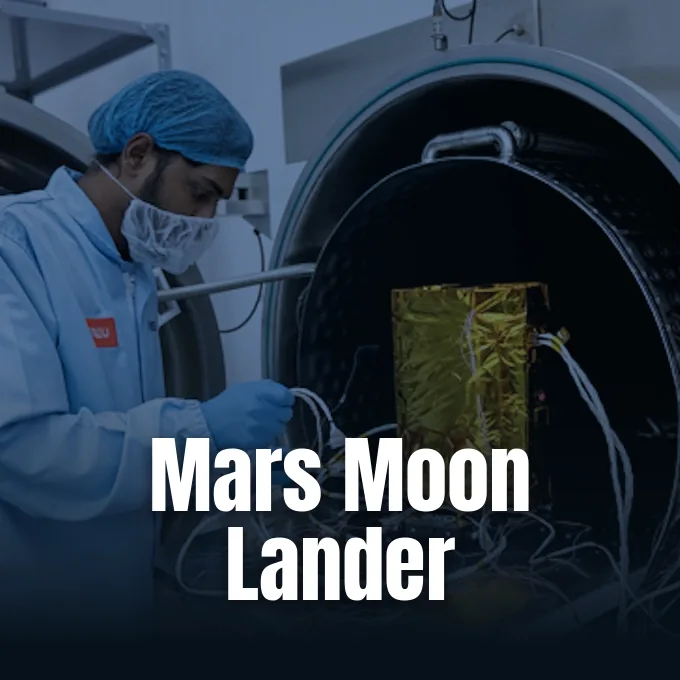
Returning physical samples from the Martian moons will provide the decisive evidence needed to resolve the debate between asteroid capture and impact accretion [8]. The Japan Aerospace Exploration Agency is preparing the Martian Moons Exploration mission to collect surface regolith from Phobos and conduct detailed flybys of Deimos. Robotic systems such as the Mars Moon Lander are designed to touch down on Phobos and gather samples from its loose regolith blanket. Earlier exploration suffered a setback when the Russian Phobos-Soil sample return mission failed to leave Earth orbit following launch in 2011, underscoring the technical challenges of exploring these small bodies [1].
Surface investigations by the Perseverance rover on the surface of Mars complement these orbital efforts by characterizing ancient crustal rocks and impact history. Measurements from Phobos will establish whether its isotopic ratios match Martian mantle rocks or primitive asteroid material [8]. By analyzing grains returned from Phobos and Deimos, planetary scientists will finally discover whether Mars captured two wandering asteroids, coalesced its moons from a giant impact disk, or shattered an ancient ancestral satellite [4], [6], [8].
- WEBSITE European Space Agency. (2019). Martian moons: Phobos. [Article Link]
- WEBSITE Nemiroff, R., & Bonnell, J. (2008). Phobos: Doomed Moon of Mars. NASA Science. [Article Link]
- PREPRINT Landis, G. A. (2009). Origin of Martian Moons from Binary Asteroid Dissociation. arXiv. [Article Link]
- ACADEMIC JOURNAL Bagheri, A., Khan, A., Efroimsky, M., Kruglyakov, M., & Giardini, D. (2021). Dynamical evidence for Phobos and Deimos as remnants of a disrupted common progenitor. Nature Astronomy, 5, 539-543. [Article Link]
- WEBSITE Cermak, A., & NASA Science Editorial Team. (2017). Mars Moons: Facts. NASA Science. [Article Link]
- PREPRINT Citron, R. I., Genda, H., & Ida, S. (2015). Formation of Phobos and Deimos via a Giant Impact. arXiv. [Article Link]
- ONLINE NEWS Hille, K. B. (2015). Mars’ Moon Phobos is Slowly Falling Apart. NASA. [Article Link]
- WEBSITE Wikipedia contributors. (n.d.). Moons of Mars. In Wikipedia, The Free Encyclopedia. [Article Link]
- WEBSITE Wikipedia contributors. (n.d.). Deimos (moon). In Wikipedia, The Free Encyclopedia. [Article Link]
- WEBSITE Wikipedia contributors. (n.d.). Phobos (moon). In Wikipedia, The Free Encyclopedia. [Article Link]


