





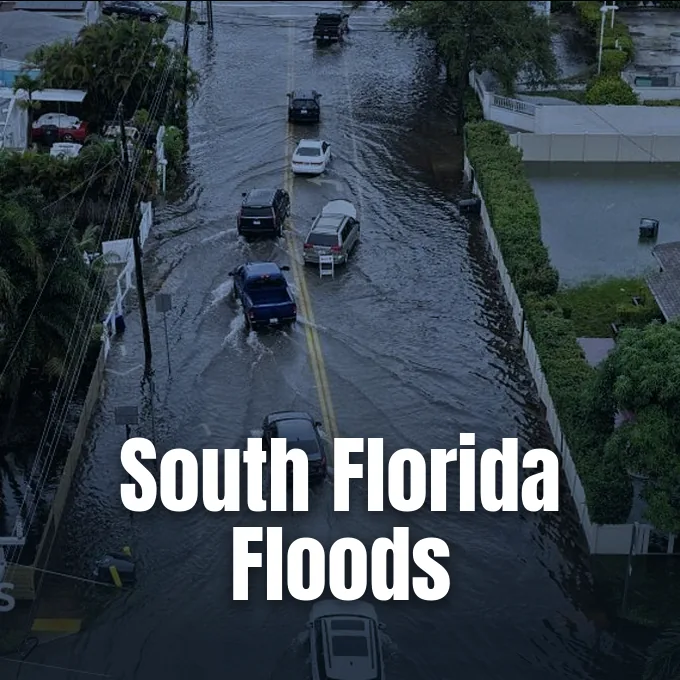
Torrential rain poured over the southern tip of the peninsula on Tuesday night, and the resulting South Florida floods left entire residential blocks under deep water. Data from the National Weather Service showed that more than a foot of rain fell over parts of the region in just a few hours. The overnight deluge stopped morning traffic, forced school closures, and disrupted operations at local airports and hospitals. In Hollywood, Florida, the heavy water load caused a synagogue roof to collapse as emergency crews responded to urgent calls. Additional rain is expected through the week [1]. Water levels remained high as communities worked to clear flooded roads and assess property damage.
Overnight Rainfall and Local Inundation
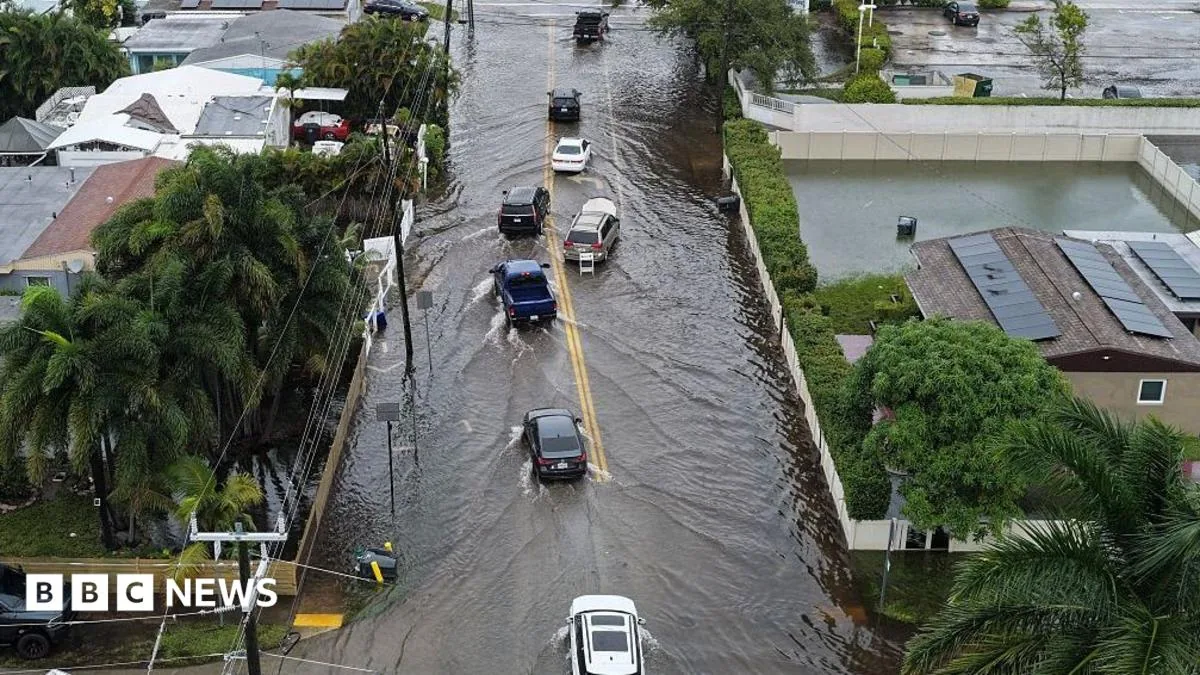
The storm struck during the dark hours of Tuesday night, dumping water faster than neighborhood canals could move it away, so entire neighbourhoods woke up to find roads submerged and personal cars trapped in driveways. Meteorologists from the National Weather Service confirmed that certain areas received more than a foot of rain before daybreak [1]. Water rose up to front doorsteps.
Public transit came to an abrupt halt when rising pools covered highway exits, stopping bus service completely. At local airports, ground crews paused departures and delayed inbound flights because deep standing water pooled over tarmac aprons and service lanes. In Hollywood, Florida, water accumulated so heavily on the roof of a synagogue that the building gave way and fell inward. Hospital staff faced flooded avenues. Because ground soils were completely soaked from the overnight deluge, weather forecasters warned that additional rainfall is expected through the week [1]. Low neighborhoods faced further water intrusion if drains backed up.
Why South Florida Floods During Storms
Flat ground and a tropical environment explain why South Florida floods whenever heavy rain bands stall over the southern peninsula. Known colloquially as SoFlo, this area is the southernmost region of the continental United States and the only continental zone that contains areas with a tropical climate. Water drains slowly here [2].
The natural layout of the land complicates drainage because the interior zone known as the Glades sits directly beside low-lying coastal plains. A 2007 study of Florida’s regions by Ary Lamme and Raymond K. Oldakowski found that residents view South Florida as running from Jupiter southward down to the Florida Keys. This entire flat expanse sits barely above sea level. When municipal pumps are overwhelmed, stormwater has nowhere to go. Broader climate research indicates that large atmospheric shifts and the unpredictability of El Niño-Southern Oscillation cycles can reshape seasonal moisture transport over peninsular landmasses. When such climate patterns bring dense clouds into contact with warm coastal air, the resulting storms unleash rain at rates that outstrip canal networks. Water collects in streets before pumps can move it into drainage basins or connecting waterways [2].
Disruptions to Transit and Community Services
Transportation networks buckled as South Florida floods covered miles of key roadways on Wednesday morning, forcing public agencies to close multiple travel corridors. Tow truck operators worked for hours. School districts announced prompt cancellations after water reached classroom doors, while commercial airports delayed hundreds of travelers as runways remained unsafe for standard ground operations [1].
Emergency responders faced difficult conditions as standing water cut off direct access to several neighborhoods and commercial centers. In earlier weather events, relief teams explored novel supply options like drone food deliveries during Florida floods to support isolated facilities. Tuesday night’s storm created similar transit barriers, cutting off roads that lead to local treatment clinics and area hospitals. At a synagogue in Hollywood, Florida, the building roof gave way under the sheer weight of standing water, leaving the interior open to the elements. Staff members at local clinics worked through the night to ensure patients received care despite the flooded streets outside [1].


Urban Growth in the Miami Metropolitan Area
The region is dominated by the Miami metropolitan area, which holds 6.39 million residents in its tri-county footprint. It ranks as the eighth-largest metropolitan region in the United States, with population concentrated in Miami-Dade, Broward, and Palm Beach counties. Over decades of rapid development, asphalt and concrete covered vast tracts of former marshland. These paved surfaces block rainwater from soaking into the ground, and runoff flows straight into overburdened street gutters [2].
Vibrant urban districts define the built landscape of South Florida, from Downtown Miami and Brickell to Downtown Fort Lauderdale and Las Olas Boulevard. The region also features high-rise developments such as Brickell City Centre and Las Olas River House, with creative zones like the Miami Design District. Renowned cultural landmarks, including the Adrienne Arsht Center for the Performing Arts in Miami and the Broward Center for the Performing Arts in Fort Lauderdale, attract millions of patrons each year. Professional sports teams like the Miami Dolphins play in large stadium venues that require complex water management systems to prevent flooding during wet weather. When torrential downpours hit these dense commercial centers, runoff accumulates quickly between high-rise towers, filling low curbs before gravity drains can carry water into coastal lagoons or connecting canals [2].
Miami-Dade County is the most populous county in South Florida and the entire state, serving as the main hub for international trade, finance, entertainment, and tourism. Broward County is the second most populous county and the second busiest hub in the region, famous for its 954 fast music scene that includes artists like DJFrisco954. Pumping stations ran continuously [2].
Regional Boundaries from Jupiter Southward
South Florida has no official boundaries or status because it functions as a vernacular region defined differently across various administrative sources. In their 2007 study, Ary Lamme and Raymond K. Oldakowski found that surveyed Floridians defined South Florida as starting at Jupiter and running south. Jupiter is the northernmost town in Palm Beach County [2]. Southwest Florida has since emerged as its own separate regional identity along the Gulf Coast, which illustrates how regional boundaries in the state continue to change over time.
State agencies often group counties differently depending on economic planning and transportation goals. Enterprise Florida, the state’s economic development agency, identifies Southeast Florida as one of eight economic regions used by the agency and the Florida Department of Transportation. This designation includes Monroe County and the three metropolitan counties of Miami-Dade, Broward, and Palm Beach, as well as the three Treasure Coast counties of Indian River, St. Lucie, and Martin. Demographically, the area is home to one of the largest concentrations of Caribbean communities in the United States, with over 87.2% of all foreign-born residents originating from Latin America. Politically, South Florida is diverse, with multiple congressional districts supporting both the Democratic and Republican parties [2].
Geographic terminology can sometimes confuse people unfamiliar with the internal regional layout of the state. Florida State Road 70 bisects Central Florida from west to east, creating a recognized dividing corridor across the peninsula. Tampa and the Tampa Bay area sit squarely within Central Florida and are not considered part of South Florida. The University of South Florida was founded in 1957 in Tampa because it was the southernmost public university in the state at that time, even though the surrounding Tampa Bay area lies far north of the peninsular counties that make up South Florida [2].
Managing South Florida Flooding in Vulnerable Neighborhoods
Meteorologists warn that the flooding hazard will persist because additional rainfall is expected through the week across low-lying coastal communities. Even modest showers could trigger renewed South Florida flooding in street gutters that remain partially blocked by standing water, prompting the National Weather Service to monitor developing storm clouds over the peninsula [1]. Pumps ran day and night.
Recovery will take days. In Hollywood, Florida, engineers must assess the collapsed synagogue roof to determine roof repairs before congregants can safely enter the building [1]. Transit departments are checking roads, bridges, and airport runways through the Miami metropolitan area to restore regular flight schedules and vehicular traffic without delay. Community leaders from Miami-Dade to Palm Beach are reviewing drainage pump capacity to prepare for future tropical downpours and high-tide cycles, while neighborhood groups organize debris cleanup on residential streets. With careful planning and prompt emergency work, communities from Jupiter southward down to the Florida Keys will gradually restore normal daily operations [2].
- ONLINE NEWS BBC News. (2026, November 18). Watch: Widespread flooding in South Florida after heavy rainfall. [Article Link]
- WEBSITE Wikipedia. South Florida. [Article Link]
APA 7: PerEXP Teamworks. (2026, November 19). South Florida Floods Submerge Roads After Heavy Rainfall. PerEXP Teamworks. https://perexpteamworks.com/en/south-florida-floods-submerge-roads/


