





Understanding what is cystic fibrosis helps explain how a single genetic defect can alter mucus in vital organs throughout the human body. Cystic fibrosis is an inherited autosomal recessive disease that damages the lungs and gut by producing thick, sticky fluid [10]. Worldwide, an estimated 105,000 people have received a diagnosis across 94 countries, including roughly 40,000 individuals living in the United States [15]. While the illness once proved fatal during early childhood, expanded newborn checks and care teams accredited by the Cystic Fibrosis Foundation in Bethesda, Maryland, now allow most patients to live well into adulthood [1, 18].
What Is Cystic Fibrosis?
Human exocrine glands produce thin fluids that lubricate organ linings, clear debris, and carry gut enzymes. In cystic fibrosis, faulty salt movement dries out the airway liquid, turning normal fluids into thick plugs that block passages in the lungs, pancreas, and intestines [10]. Pathologist Dorothy Andersen first identified the illness as a distinct condition in 1938 at Columbia Presbyterian Hospital, after autopsies of malnourished infants showed fluid cysts and scarring inside the pancreas. Andersen gave the disease its lasting name. Historical records from Europe match this picture as far back as 1595, when folklore warned that a child whose skin tasted salty when kissed would die young [16].
The illness follows an autosomal recessive pattern of inheritance [14]. A child develops the disease only after inheriting two mutated CFTR genes, one from each parent. People with a single mutated gene remain healthy carriers. Such carriers show no symptoms [12].
Carrier parents face fixed genetic odds with each pregnancy. When two carriers conceive, their child has a 25% chance of inheriting the illness, a 50% chance of becoming an unaffected carrier, and a 25% chance of inheriting two normal genes [14]. In the United States, CF occurs in roughly 1 in 3,300 live births among White infants, 1 in 15,300 births among Black infants, and 1 in 32,000 births among Asian American infants. Roughly 1 in 27 White individuals carries a faulty allele [15]. Dr. Patrick A. Flume at the Medical University of South Carolina and Professor Barbara Calhoun at the University of Notre Dame note that carrier screening helps families evaluate these odds through genetic counseling [14].
Genetic Roots on Chromosome 7
Geneticist Lap-Chee Tsui and his research team at the Hospital for Sick Children in Toronto located the cystic fibrosis gene in 1989, publishing their landmark discovery in the journal Science. The gene sits on the long arm of human chromosome 7 at band q31.2, spanning base pairs 116,907,253 to 117,095,955 across 27 distinct coding exons that produce a transport protein made of 1,480 amino acids [12, 17]. Tsui pinpointed the exact molecular defect. Before this discovery, doctors had no way to explain why thick mucus clogged multiple internal organs at the same time [12].
The gene provides blueprints for the cystic fibrosis transmembrane conductance regulator protein, a specialized anion pore that moves chloride and bicarbonate across outer cell membranes [15, 17]. This channel operates along the apical surface of epithelial tissues [15]. In lung airways, rare epithelial cells known as pulmonary ionocytes produce this channel protein at the highest rate [17].
Scientists have cataloged more than 700 to 1,200 disease-causing mutations within the CFTR sequence [12, 14]. The most common defect is ΔF508, also designated F508del, which represents approximately 70% of mutant alleles globally and nearly 85% of cases in the United States [1, 17]. This mutation deletes three base pairs across codons 507 and 508, removing a single phenylalanine amino acid from the mature protein [17]. The misfolded protein is degraded inside the cell. It never reaches the outer cell wall [12].
Six Mutation Classes
Medical researchers divide CFTR variants into six distinct classes based on how each error disrupts channel production, processing, or function [14, 15]. Classes I, II, and III trigger severe disease because epithelial cells fail to deliver working channel proteins to the outer membrane [14]. Class I mutations introduce premature stop signals that halt protein assembly early, Class II mutations like ΔF508 prevent proper molecular folding, and Class III mutations reach the membrane but cannot open their pore to let ions pass through. These severe classes cause early pancreas failure and heavy lung mucus [15, 17].
Classes IV, V, and VI produce milder symptoms because they retain residual channel activity. Class IV mutations alter channel conductance, Class V mutations reduce protein volume, and Class VI mutations destabilize surface channels. Patients with these milder variants frequently keep their pancreas working. Organ testing guides therapy far better than genetic sequencing alone [15].

Evolutionary biologists have long investigated why harmful CFTR mutations remain common among people of European ancestry, with researchers at Johns Hopkins University proposing that a heterozygote advantage protected carriers against deadly intestinal epidemics. Epithelial cells carrying one mutant CFTR allele resist entry by Salmonella typhi, the bacteria responsible for typhoid fever [12, 17]. Mutant cells block bacterial invasion. Furthermore, carrier laboratory models demonstrate marked resistance against life-threatening fluid loss triggered by cholera toxin, explaining why carrier lineages survived historical European epidemics [12, 17].
Airway Infections and Mucus Blockages
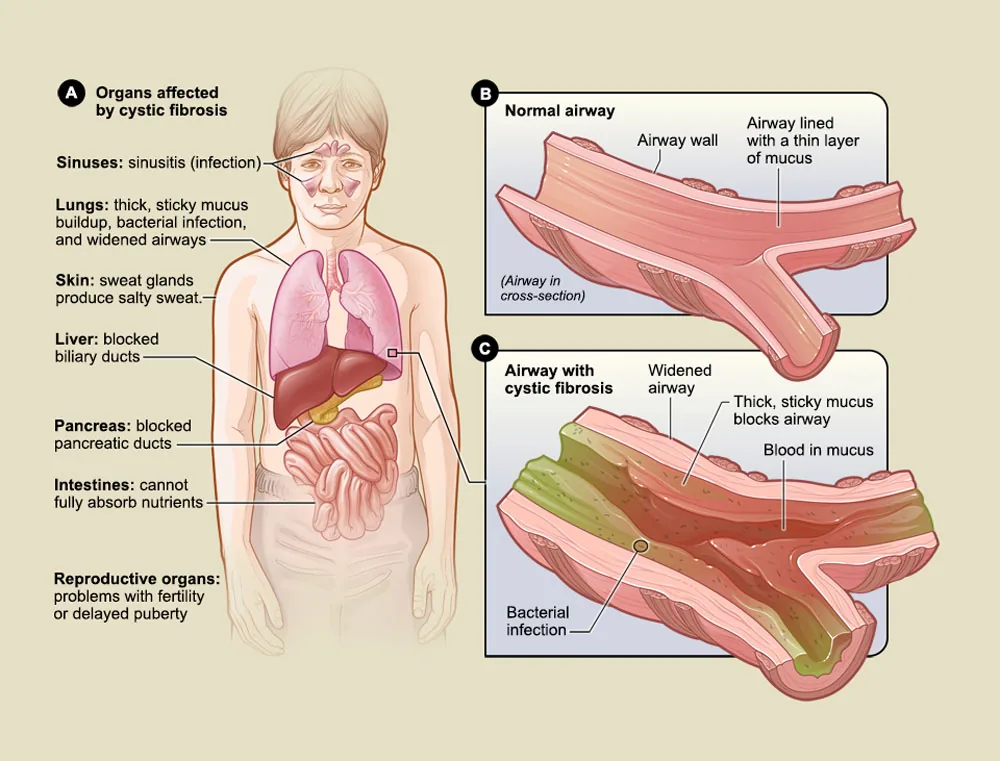
Lung complications cause the majority of deaths in CF, creating a cycle of sticky mucus, chronic infections, and irreversible tissue scarring [10, 16]. In healthy lungs, airway cilia sweep away dust and germs on a thin water layer. In CF, salt channels fail and surface water vanishes, flattening airway cilia under thick mucus plugs [15, 17]. Trapped bacteria multiply rapidly in this dark, low-oxygen environment. Inflammatory white blood cells rush into the airways and release destructive proteases and cytokines, eroding the bronchial walls until patients develop permanent bronchiectasis, high lung blood pressure, and right-sided heart failure known as cor pulmonale [11, 15].
Lung infections follow a predictable timetable as patients grow older. In infants and young children, Staphylococcus aureus and Haemophilus influenzae act as the main culprits. By early adulthood, Pseudomonas aeruginosa takes over, forming thick slimy biofilms that resist standard antibiotics and worsen clinical outlooks [15, 16].
Patients face rising threats from antibiotic-resistant bacteria across specialized care centers. Dr. Patrick A. Flume and colleagues writing in the journal Thorax reported that approximately 25% of American patients harbor methicillin-resistant Staphylococcus aureus (MRSA), which accelerates lung damage [7, 8, 15]. Another 1.2% carry Burkholderia cepacia complex, a microbe linked to sudden clinical decline and cross-patient infection [15, 16]. Nontuberculous mycobacteria like Mycobacterium avium and Mycobacterium abscessus require months of multi-drug treatment. These persistent bugs defy standard antibiotics [8].


Digestive System Complications
Digestive troubles appear right after birth, with 15% to 20% of newborns suffering from a complete bowel blockage known as meconium ileus when thick fluid lodges in the ileum and stops bowel movements for 24 to 48 hours [11, 15, 16]. Affected babies vomit green bile and develop swollen bellies. Many need emergency surgery [11, 15]. Older children experience distal intestinal obstruction syndrome, belly cramps, and rectal prolapse caused by violent coughing fits and bulky stools [15, 16].
Pancreas failure affects roughly 85% of patients with CF. Sticky mucus plugs the tiny ducts of the pancreas, preventing digestive enzymes from reaching the small intestine. Trapped enzymes digest the organ from within, causing inflammation and fibrous tissue replacement [15, 16]. The gut cannot absorb dietary fats or proteins without these essential enzymes [11, 15].
Severe nutrient loss and metabolic disorders multiply as organ damage accumulates over time. Patients pass foul-smelling, fatty stools and fail to absorb fat-soluble vitamins A, D, E, and K, leading to poor bone density and bleeding disorders [11, 16]. Chronic scarring of the pancreas destroys insulin-producing beta cells, causing cystic fibrosis-related diabetes in up to 20% of teenagers and 50% of adults. Obstructed bile ducts produce liver disease in 30% of patients, with 3% to 4% developing cirrhosis. Furthermore, at least 97% of adult men face infertility due to congenital bilateral absence of the vas deferens [12, 15].

Sweat Testing and Infant Screening
Universal newborn screening has revolutionized pediatric diagnosis across the globe, allowing clinical teams to detect the disease weeks before lung symptoms begin [2]. Across all 50 states in the United States, public health labs check dried blood spots collected on filter paper shortly after birth for immunoreactive trypsinogen (IRT), an enzyme precursor that spills into the bloodstream when pancreas ducts are clogged by mucus. High IRT levels trigger immediate reflex testing, including repeat blood assays or DNA tests looking for common CFTR mutations [14]. Early diagnosis allows babies to start pancreas enzyme pills, high-calorie formulas, and chest physical therapy before airway damage takes hold [1].
The quantitative pilocarpine iontophoresis sweat test remains the international gold standard for proving a diagnosis [11, 15]. Sweat chloride readings of 60 mEq/L or higher confirm the illness. Intermediate results between 30 and 59 mEq/L require full CFTR gene sequencing or nasal potential difference measurements to evaluate epithelial ion transport [14].
Specialized clinics rely on objective lab tools to track disease progression across all body systems. Doctors measure stool pancreatic elastase to check digestive enzymes, collect throat swabs to catch bacteria early, and perform spirometry to track forced expiratory volume in children over five years old. High-resolution chest CT scans reveal early bronchial wall thickening before physical symptoms appear [11, 15]. These scans guide timely therapy adjustments [11].
Modern CFTR Modulator Therapies
Drug discovery reached a historic turning point with the arrival of CFTR modulators, small-molecule pills that fix the faulty channel protein instead of merely treating outward symptoms [6, 15]. The potentiator drug ivacaftor, sold as Kalydeco, locks the channel gate open to let chloride flow freely across the cell membrane [15, 18]. Corrector drugs such as lumacaftor, tezacaftor, and elexacaftor bind to misfolded F508del proteins, helping them fold into the correct shape so they can travel to the cell surface [11, 15]. The FDA approved the triple combination Trikafta in just 54 days, offering life-changing therapy to roughly 90% of eligible patients [11, 18]. These daily pills thin mucus, boost lung capacity, and reduce hospital visits [1, 11].
Biotech companies continue to refine these daily pill regimens. Jacob Bell reported in BioPharma Dive that Vertex Pharmaceuticals generated $706 million in third-quarter revenue from its newest triple therapy, Alyftrek. Vertex earned $3.44 billion in quarterly revenue, with over 95% coming from its cystic fibrosis drug lineup [13].

Major philanthropic investments now fuel next-generation genetic cures. In Bethesda, Maryland, the Cystic Fibrosis Foundation provided $5 million to Sionna Therapeutics in 2022 to build alternative modulators. In July 2025, the Foundation announced a $24 million grant to Prime Medicine to develop prime editing tools that repair CFTR mutations directly inside human cells. These gene-editing projects aim to cure the roughly 10% of patients whose rare nonsense mutations produce no protein for current pills to rescue [14, 18].
Long-Term Survival With CF
Daily airway clearance and targeted inhaled medicines remain vital for preserving lung health, even for patients taking modern modulators [11, 15]. Patients spend hours each day doing manual chest percussion, postural drainage, or using high-frequency chest wall oscillation vests to shake loose thick lung mucus. Inhaled hypertonic saline and recombinant human DNase thin mucus, while inhaled bronchodilators help open tight airways [3, 11]. In the PRESIS clinical trial published in the American Journal of Respiratory and Critical Care Medicine, twice-daily inhalation of 6% hypertonic saline in infants under four months improved the lung clearance index and spurred healthy weight gain [5]. Inhaled antibiotics like tobramycin suppress chronic bacterial growth [4, 15].
Patients take oral enzyme capsules with every meal to digest food and absorb nutrients. Infection rules mandate that people with CF stay at least six feet apart to prevent sharing dangerous lung bacteria like Burkholderia cepacia [11, 18]. To build community safely, the Cystic Fibrosis Foundation created virtual events such as BreatheCon and FamilyCon [18].
Intensive daily care and specialized clinics have transformed life expectancy over the last half-century. In the 1950s, few babies with the disease lived long enough to attend elementary school, but today the estimated median survival has risen to 48 to 65 years across the United States, Canada, and the United Kingdom [11, 16]. More than half of all people living with CF in America are now adults [14, 15]. Many graduate from college, build careers, and have children through assisted reproduction [11, 16]. For those with advanced lung failure, bilateral lung transplantation at 115 accredited centers offers a second chance at life [14, 18].
- ACADEMIC JOURNAL Ong, T., & Ramsey, B. W. (2023). Cystic fibrosis: A review. JAMA, 329(21), 1859-1871. [Article Link]
- ACADEMIC JOURNAL Scotet, V., Gutierrez, H., & Farrell, P. M. (2020). Newborn screening for CF across the globe—where is it worthwhile?. International Journal of Neonatal Screening, 6(1), 18. [Article Link]
- ACADEMIC JOURNAL Flume, P. A., O’Sullivan, B. P., Robinson, K. A., Goss, C. H., Mogayzel, P. J., Jr., Willey-Courand, D. B., Bujan, J., Finder, J., Lester, M., Quittell, L., Rosenblatt, R., Vender, R. L., Hazle, L., Sabadosa, K., & Marshall, B. (2007). Cystic fibrosis pulmonary guidelines: Chronic medications for maintenance of lung health. American Journal of Respiratory and Critical Care Medicine, 176(10), 957-969. [Article Link]
- ACADEMIC JOURNAL Mogayzel, P. J., Jr., Naureckas, E. T., Robinson, K. A., Mueller, G., Hadjiliadis, D., Hoag, J. B., Lubsch, L., Hazle, L., Sabadosa, K., & Marshall, B. (2013). Cystic fibrosis pulmonary guidelines: Chronic medications for maintenance of lung health. American Journal of Respiratory and Critical Care Medicine, 187(7), 680-689. [Article Link]
- ACADEMIC JOURNAL Stahl, M., Wielpütz, M. O., Ricklefs, I., Dopfer, C., Barth, S., Schlegtendal, A., Graeber, S. Y., Sommerburg, O., Diekmann, G., Hüsing, J., Koerner-Rettberg, C., Nährlich, L., Dittrich, A. M., Kopp, M. V., & Mall, M. A. (2019). Preventive inhalation of hypertonic saline in infants with cystic fibrosis (PRESIS): A randomized, double-blind, controlled study. American Journal of Respiratory and Critical Care Medicine, 199(10), 1238-1248. [Article Link]
- ACADEMIC JOURNAL Grasemann, H., & Ratjen, F. A. (2023). Cystic fibrosis. New England Journal of Medicine, 389(18), 1693-1707. [Article Link]
- ACADEMIC JOURNAL Jennings, M. T., Riekert, K. A., & Boyle, M. (2014). Update on key emerging challenges in cystic fibrosis. Medical Principles and Practice, 23(5), 393-402. [Article Link]
- ACADEMIC JOURNAL Floto, R. A., Olivier, K. N., Saiman, L. M., Daley, C. L., Herrmann, J., Nick, J. A., Noone, P. G., Bilton, D., Corris, P. A., Gibson, R. L., Hempstead, S. E., Koetz, K., Sabadosa, K. A., Sermet‐Gaudelus, I., Smyth, A. R., Ingen, J. v., Wallace, R. J., Winthrop, K. L., Marshall, B. C., & Haworth, C. S. (2015). US Cystic Fibrosis Foundation and European Cystic Fibrosis Society consensus recommendations for the management of non-tuberculous mycobacteria in individuals with cystic fibrosis. Thorax, 71(Suppl 1), i1-i22. [Article Link]
- ACADEMIC JOURNAL Farrell, P. M., White, T. B., Ren, C. L., Hempstead, S. E., Accurso, F. J., Derichs, N., Howenstine, M. S., McColley, S. A., Rock, M. J., Rosenfeld, M., Sermet‐Gaudelus, I., Southern, K. W., Marshall, B. C., & Sosnay, P. R. (2017). Diagnosis of cystic fibrosis: Consensus guidelines from the Cystic Fibrosis Foundation. The Journal of Pediatrics, 181, S4-S15.e1. [Article Link]
- WEBSITE National Library of Medicine. (1999). Cystic fibrosis. MedlinePlus. [Article Link]
- WEBSITE Schwartz, C. I., Dugdale, D. C., & Conaway, B. (2026). Cystic fibrosis. MedlinePlus Medical Encyclopedia. [Article Link]
- WEBSITE Winikates, K. (2012). Cystic fibrosis transmembrane conductance regulator (CFTR) gene. Embryo Project Encyclopedia, Arizona State University. [Article Link]
- ONLINE NEWS Bell, J. (2026). Vertex, ahead of FDA decision, calms fears surrounding kidney drug. BioPharma Dive. [Article Link]
- WEBSITE Thorne, A., Murphy, B., Calhoun, B., & Flume, P. A. (2025). Cystic fibrosis. National Organization for Rare Disorders. [Article Link]
- WEBSITE Sawicki, G. (2025). Cystic fibrosis. Merck Manual Professional Edition. [Article Link]
- WEBSITE Wikipedia contributors. (2026). Cystic fibrosis. Wikipedia. [Article Link]
- WEBSITE Wikipedia contributors. (2026). Cystic fibrosis transmembrane conductance regulator. Wikipedia. [Article Link]
- WEBSITE Wikipedia contributors. (2026). Cystic Fibrosis Foundation. Wikipedia. [Article Link]


