




Transforming synthetic packaging into food sounds impossible. Could discarded soda bottles eventually nourish astronauts travelling on interplanetary expeditions? Researchers at Southern Illinois University Carbondale are demonstrating that turning plastic waste into food is biologically feasible by programming microorganisms to convert polymer fragments into edible biomass. By combining high-pressure dissolution with engineered yeast, the team produced nutrient-dense cookies dubbed µBites. Their system offers an experimental framework for sustainable nutrition in deep space and terrestrial disaster relief. [3]
From Discarded Bottles to Edible Cookies
Plastic pollution and food scarcity represent two intractable global crises. At Southern Illinois University Carbondale, researchers explored whether one crisis could help resolve the other. The inquiry originated within the NASA Deep Space Food Challenge, an initiative aimed at sustaining astronauts on prolonged lunar and Martian expeditions where resupply missions remain impossible. Associate Professor Lahiru Jayakody noted that plastics and nutrients share an elemental foundation: carbon. That conceptual link shifted the team’s focus toward direct food synthesis. [3]
Microbes drive this transformation. ‘Microbes are very clever,’ Jayakody observed at the American Chemical Society fall meeting. ‘We are using their traits to solve the problems we created.’ [3]
Targeting post-consumer plastic requires tackling polymers. The SIU Carbondale team focused on polyethylene terephthalate (PET, a polyester resin ubiquitous in beverage bottles) because its resilient carbon networks resist conventional mechanical recycling and persist in landfills. Nature uses enzymatic systems to assemble intricate organic molecules. Rather than employing harsh petrochemical reagents, Jayakody chose biological conversion. Engineered microorganisms provide an adaptable metabolic engine capable of handling synthetic inputs. [3]
Turning Plastic Waste Into Food With Yeast
Microorganisms serve as versatile factories. For decades, genetically programmed strains of yeast and bacteria have produced critical pharmaceuticals, most notably recombinant insulin. Graduate student Sandhya Jayasekara and Jayakody expanded that manufacturing paradigm to encompass plastic upcycling. The team reprogrammed common baker’s yeast and specialized strains to metabolize breakdown products derived from plastic and agricultural residues, enabling cellular factories to reconstruct foreign carbon skeletons into functional nutrients. Complete proteins emerge from synthetic inputs. [3]
Nutritional versatility proved essential. Jayasekara engineered distinct yeast lines to deliver specific dietary components rather than a uniform biomass. One engineered baker’s yeast strain converts plant biomass into natural vanilla flavoring, while another strain processes ethylene glycol derived from PET decomposition to synthesize beta carotene, which human metabolism converts into vitamin A. Jayasekara noted that tailoring aroma and nutritional profiles helps create an attractive, consumer-friendly foodstuff. [3]
Living cells need accessible carbon. Intact soda bottles cannot be added directly to fermentation vats, because raw plastics possess inert crystalline structures that defy cellular uptake. Microbes cannot ingest long plastic chains directly. Jayakody and Jayasekara needed a reliable intermediate breakdown stage to convert plastic waste into food ingredients. Without dependable upstream depolymerization, cellular conversion cannot commence. The team avoided toxic petrochemical solvents while liberating clean organic feedstocks. [3]
How Hydrothermal Dissolution Prepares Plastic Chains
Breaking resilient PET bonds demanded chemical engineering. Ken Anderson, a geology professor at Southern Illinois University Carbondale, provided the critical solution through a proprietary process called oxidative hydrothermal dissolution (OHD, a breakdown technique that treats solid materials in pressurized water). The method subjects waste to elevated temperatures and high pressures in the presence of water and dissolved oxygen. Under these hydrothermal conditions, tough synthetic polymers disintegrate rapidly. The reaction fragments complex macromolecules into small, water-soluble organic molecules that microbial enzymes can readily assimilate. [3]
Agricultural residues supplement the plastic stream. Discarded corn stalks, husks, and dried leaves provide cellulosic biomass rich in plant carbohydrates. Co-processing agricultural leftovers with discarded plastic optimizes the nutrient blend fed to downstream microbes, producing an aqueous broth rich in organic acids, solubilized carbon, and essential trace minerals. Instead of relying on purified sugars imported from conventional farming, the bioreactor utilizes waste carbon as its primary growth substrate. Refuse becomes valuable feedstock. [3]
Biotechnologists increasingly turn to living matter. While some efforts explore tiny robots made of living cells that clean up plastic pollution in water, the SIU Carbondale project takes a different approach by funneling synthetic polymers directly into cellular metabolism. Anderson’s hydrothermal reactor performs the difficult structural decomposition that biology cannot accomplish alone. Non-toxic aqueous liquor flows into fermentation vessels. There, yeast cultures devour the dissolved carbon fragments and generate edible biomass. [3]


Inside the 3D-Printed Microbite Recipe
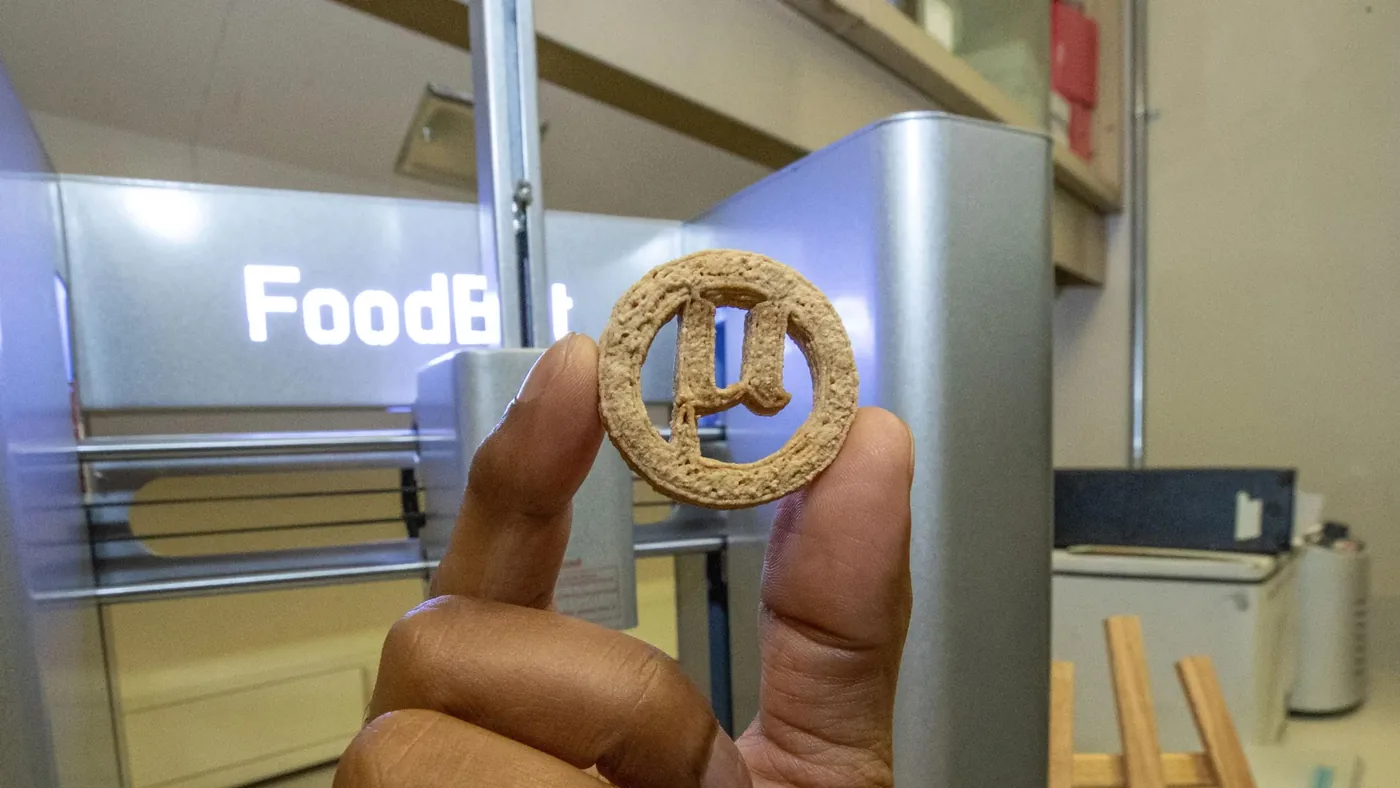
Harvested microbial paste requires careful processing. To transform microbial proteins and lipids into recognizable food, researchers formulated a composite dough. They combined yeast-derived proteins, fats, and synthesized vanilla with dietary fiber, edible starch, and sweetener before loading the blended paste into an automated extrusion printer that fabricates structured, protein-dense cookies called µBites (pronounced ‘microbites’). Layered deposition controls texture, density, and nutrient distribution across each individual ration. [3]
Safety protocols currently govern human testing. Available analytical data indicate that µBites are biochemically safe to eat. Formal human taste tests, however, remain on hold while the team awaits institutional approval. The researchers gathered preliminary sensory feedback by allowing human participants to evaluate the cookies based solely on aroma. Most participants expressed positive reactions to the scent. They indicated a clear willingness to eat µBites in scenarios where standard food supplies were depleted. Flavor chemistry continues advancing steadily. [3]
External additives remain a temporary necessity. Starch, fiber, and sweetening agents must currently be supplied from traditional sources to construct the printable cookie matrix. Jayakody’s ultimate objective is programming specialized microbial strains to manufacture every single ingredient needed when converting plastic waste into food. If yeast can synthesize structural carbohydrates in addition to lipids and proteins, the entire food manufacturing sequence could operate inside a self-contained bioreactor. Pure biosynthesis eliminates outside agricultural binders. [3]
Molten Salt Catalysis Offers a Parallel Path
While biological systems excel at synthesizing complex nutrients from fragmented carbon, chemical engineers are pursuing inorganic upcycling methods for polymers that microbes cannot easily digest. At Oak Ridge National Laboratory (ORNL), a research team led by Sheng Dai and Zhenzhen Yang investigated polyethylene, a commodity plastic found in grocery bags and cutting boards that resists standard biological degradation. Publishing in the Journal of the American Chemical Society, postdoctoral researcher Liqi Qiu and colleagues demonstrated that molten salts containing aluminum chloride can break polyethylene down into liquid fuels at temperatures below 200 degrees Celsius. Unlike conventional pyrolysis, which demands extreme heat exceeding 450 degrees Celsius, this low-temperature liquid-salt medium acts simultaneously as solvent and catalyst, achieving a gasoline yield of approximately 60 percent without requiring noble-metal catalysts, organic solvents, or external hydrogen feeds [1].
Understanding why aluminum-based molten salts work required atomic-scale analysis. Polyethylene consists of durable chains of carbon and hydrogen atoms. To track bond cleavage during the reaction, the researchers substituted deuterium as a chemical tracer. They analyzed the reaction using neutron scattering at ORNL’s Spallation Neutron Source, an instrument ideal for tracking light hydrogen isotopes. Collaborating with Min-Jae Kim and Jinhua Guo at Lawrence Berkeley National Laboratory’s Advanced Light Source, Yang examined aluminum coordination using soft X-rays to establish active catalytic sites. Measurements confirmed that aluminum sites sever polymer backbones into smaller hydrocarbon molecules. [1]
Both platforms encounter distinct operational hurdles. While SIU Carbondale’s bioconversion converts plastic waste into food through cellular metabolism, ORNL’s inorganic process faces a severe moisture vulnerability. Aluminum chloride molten salts readily absorb atmospheric water, which destabilizes the catalytic liquid. Cheap salts make industrial adoption attractive if containment barriers prevent water contamination. Both techniques treat plastic as a valuable chemical feedstock rather than permanent garbage. [2]
Safety Hurdles and Deep Space Diets
Safety remains the foremost question. Discarded polymers often contain additives, colorants, and processing chemicals, which PerEXP Teamworks highlighted in an earlier report on unanticipated toxicity levels in conventional plastic items. Researchers must verify that hazardous chemical residues do not carry over through hydrothermal dissolution into the microbial growth media before regulatory agencies approve any lab-grown food for public distribution. Jayakody emphasized that analytical evaluations have shown no dangerous contaminants in current batches. Independent feeding studies must confirm consumer safety. [3]
Consumer psychology presents another formidable barrier. Convincing the public to consume food derived from reclaimed trash requires overcoming an intuitive disgust response. Even if µBites match commercial cookies in flavor and safety, diner skepticism could suppress market adoption. Sensory refinement remains critical. Jayasekara’s success in synthesizing authentic vanilla and beta carotene demonstrates that microbial products can emulate conventional confectionery. The researchers anticipate that initial deployment will occur in specialized niches where conventional supply chains fail, including military submarines, remote field research stations, and emergency relief operations following natural catastrophes. [3]
Planetary exploration provides the proving ground. On lunar outposts or Mars habitats, every ounce of payload incurs immense launch costs, making resupply from Earth impractical. Jayakody also views turning plastic waste into food as an essential buffer against global hunger. Global food demand is expected to climb between 35 and 56 percent by 2050, putting nearly 30 percent of the world population at risk of malnutrition. Whether engineered microbes can scale quickly enough to feed expanding populations remains an unanswered question, but microbites demonstrate that tomorrow’s meals might originate from yesterday’s waste. [3]
- ACADEMIC JOURNAL Qiu, L., Polo-Garzon, F., Daemen, L. L., Kim, M., Guo, J., Sumpter, B. G., Koehler, M. R., Steren, C. A., Wang, T., Kearney, L. T., Saito, T., Yang, Z., & Dai, S. (2025). Polyethylene upcycling to liquid alkanes in molten salts under neat and external hydrogen source-free conditions. Journal of the American Chemical Society, 147(19), 16207-16216. [Article Link]
- ONLINE NEWS Vincent, L., & Oak Ridge National Laboratory. (2026, September 13). Scientists turn common plastic waste into fuel using heated salts. SciTechDaily. [Article Link]
- ONLINE NEWS ScienceDaily. (2026, September 13). NASA-backed scientists turn plastic waste into edible cookies. ScienceDaily. [Article Link]
- CONFERENCE PAPER Jayakody, L., & Jayasekara, S. (2026, September). Microbial upcycling of plastic and agricultural waste into food components. Presented at the American Chemical Society Fall 2026 Meeting, Undergraduate and Graduate Research in Biochemistry and Chemical Biology Symposium, McCormick Place, Chicago, IL. [Article Link]
- WEBSITE ScienceDaily. (2026, September 13). Plastic cookie [Photograph accompanying research on yeast-based plastic upcycling]. ScienceDaily. [Article Link]
APA 7: TWs Editor. (2026, September 14). Turning Plastic Waste Into Food: How Microbes Make Lab Cookies. PerEXP Teamworks. https://perexpteamworks.com/en/plastic-waste-into-food/


