






In modern space science, learning what are host stars begins with recognizing how these central bodies hold worlds in orbit while steering their climate and long-term path. Every world found outside our solar neighborhood circles a parent star that sends out light, drives space storms, and sets whether liquid water can pool on land. Since Swiss observers detected the first extrasolar world at 51 Pegasi in 1995, space missions have found thousands of alien systems. A planet can’t be understood apart from the sun it circles, because mass, air loss, and orbital paths all reflect the life of the central star [11].
What Are Host Stars?
A host star gravitationally binds planets, comets, and dust into an orbital family [11]. In our solar neighborhood, the Sun fills this anchor role for Earth, Mars, and Jupiter. Deep in space, host stars show broad variety in mass, size, light output, and age. Astronomers calculate planet mass and radius relative to the observed properties of the host star.
In an April 2024 paper on stellar chemistry, Natalie R. Hinkel, Allison A. Youngblood, and Melinda Soares-Furtado cited the common research rule: “to know the star is to know the planet” [1]. Because this paper is a preprint that has not undergone peer review, its models await formal evaluation, yet its astrophysics reflects current thinking across the exoplanet field. The team pointed out that stellar photon flux, particle winds, and internal element mixes steer how a body grows from a young protoplanet into an adult world. Without an exact profile of the host star, observers at NASA Goddard and MIT can easily miscalculate a planet’s physical radius, bulk density, surface gravity, and air depth by significant margins.
Astronomers combine astrometry, photometry, and spectra to chart stellar traits and decode transit dips. Early Doppler surveys found 60 exoplanets before 2002, with yearly discovery tallies climbing to between 30 and 80 worlds over the following decade. Ground networks like SuperWASP and HATNet joined orbital telescopes like CoRoT and Kepler, filling catalogs like the Extrasolar Planets Encyclopaedia and the NASA Exoplanet Archive with more than 4,000 planets around 3,000 host stars [8]. In May 2011, Cambridge University Press published The Exoplanet Handbook by Michael Perryman, cataloging host diversity from pulsar planets to pulsating delta Scuti stars like WASP-33 [2].
Stellar Classes Across the Galaxy
Most known planet-hosting suns are main-sequence dwarf stars belonging to spectral classes F, G, and K [10]. Observers picked these Sun-like targets, including famous hosts like 51 Pegasi, 55 Cancri, and Alpha Centauri Bb, because slow stellar rotation yields crisp absorption lines. Main-sequence dwarfs make up roughly 90% of cataloged hosts, and 95% of known planet hosts have masses within a factor of two of the Sun [8].
Red dwarfs, cataloged as M dwarfs, form the most common stars in the Milky Way, yet finding worlds around them brought steep observational hurdles. Cool surfaces below 4,000 Kelvin yield spectra crowded with molecular bands, complicating metal scans [8]. Even so, NASA’s Kepler mission and TESS showed that small rocky worlds form often around low-mass stars. Kepler proved that occurrence rates for worlds between one and four Earth radii climb steadily around cooler, smaller suns [10]. Meanwhile, sub-stellar brown dwarfs like OTS 44 lack the mass to burn core hydrogen, linking with broader work on how space telescopes uncover odd brown dwarfs and their dust rings.
At the high-mass limit, blazing O-type stars emit harsh ultraviolet beams that sweep away protoplanetary gas before giant worlds can grow, as documented by the Spitzer Space Telescope [10]. When an O-type star ends its life in a supernova blast, massive mass loss unbinds surviving worlds into space, though rare pulsar planets like PSR B1620-26 b can form from fallback debris [2].
Chemical Makeup and the Metallicity Link
A host star’s chemistry gives clues about the raw dust present during planet birth. Astronomers track stellar metallicity—written as [m/H] on a logarithmic scale relative to the Sun—to count iron and other elements heavier than helium [10]. In 2005, Debra Fischer and Jeff Valenti found that the odds of forming a gas giant rise roughly with the square of the star’s iron abundance [8].
Surveys by NASA’s Kepler mission proved that small rocky worlds can grow around stars with varied chemical roots. A 2012 Kepler analysis revealed planets smaller than Neptune around stars with metallicities from −0.6 to +0.5, while gas giants formed almost solely around metal-rich stars. In 2014, researchers sorted exoplanets into three radius bins: rocky worlds below 1.7 Earth radii, gas dwarfs between 1.7 and 3.9 Earth radii, and gas giants above 3.9 Earth radii. Occurrence rates for these groups were 1.72, 2.03, and 9.30 times higher around metal-rich stars than around metal-poor stars [10]. Thin disks can assemble small terrestrial cores, but gas giants demand rich iron inventories to build massive solid cores before protoplanetary gas disperses into space.
In The Planetary Science Journal, J. G. Schulze, J. Wang, J. A. Johnson, B. S. Gaudi, C. T. Unterborn, and W. R. Panero tested if a rocky world’s iron core mass fraction reflects its host star’s iron, magnesium, and silicon mix. Their statistical tests showed that data errors hide small chemical differences unless core fractions diverge by at least 40% to 50% [12].
How Host Stars Shape Planetary Families
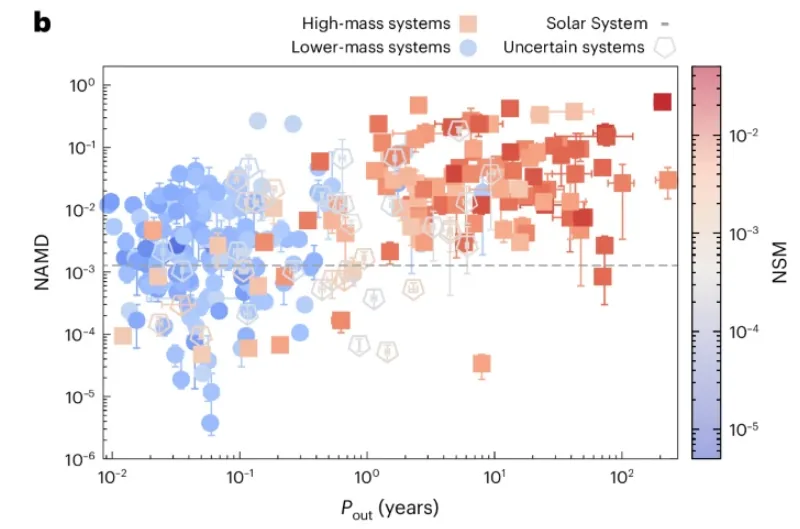
For decades, observers treated our Solar System as the normal mold for all alien systems. That model collapsed when multi-planet systems revealed strange orbital layouts. In 2026, Diego Turrini at the Istituto Nazionale di Astrofisica (INAF) in Italy and Camilla Danielski at the University of Valencia examined 300 multi-planet systems [6]. Their work showed that host stars split planetary systems into two distinct structural families based on stellar mass and disk chemistry.
The lower-mass family forms around suns no heavier than our own. Their inner planets circle in close, regular spacings that follow the peas-in-a-pod pattern, keeping similar sizes and masses among neighbors. Orbital tilts and eccentricities match the mild dynamical state seen in our own Solar System. Turrini and Danielski classified these calm architectures as cold systems, pointing out that gentle planet migration outpaced runaway growth in smaller disks. “The fundamental question we started from was: what determines the characteristics of planetary systems as we see them today?” Turrini said when summarizing the findings [6].
By contrast, the high-mass family grows around metal-rich stars with solar-to-supersolar masses. These worlds arise from disks packing three times more gas and solids, triggering fast growth that sets off strong gravitational scattering. As INAF co-author Danae Polychroni said, planets born in these rich disks grow too large to remain calm, producing eccentric, tilted orbits with high angular momentum deficits [6].


Binary Companions in Close Orbits
Many host stars do not travel through the galactic disk on their own. Multiplicity counts show that roughly 25% of red dwarfs, 45% of Sun-like stars, and 80% of heavy stars belong to binary or multiple systems, including triple systems like 16 Cygni Bb and quadruple systems like Kepler-64 [10]. In 2014, an astronomy group led by Elliott Horch from Southern Connecticut State University studied Kepler Objects of Interest with speckle imaging [7].
Horch’s team spotted companion stars up to 125 times fainter within 100 astronomical units, proving that 40% to 50% of host stars are actually binaries. “It’s interesting and exciting that exoplanet systems with stellar companions turn out to be much more common than was believed even just a few years ago,” Horch said in a press release. Writing in The Astrophysical Journal, co-author Steve B. Howell from NASA Ames Research Center in California said that when a system holds two stars, astronomers often can’t tell which star the planet circles [7]. This stellar confusion distorts transit light dips, creating errors in estimated planet sizes and orbital distances for ambiguous pairs like Kepler-132 and Kepler-296.
Even with strong gravitational tugs, planets manage to orbit either an individual star or both stellar partners at once. Kepler detected circumbinary worlds like Kepler-16b circling near the edge of gravitational stability. Intriguingly, Kepler found zero circumbinary planets around stellar pairs with periods under 7.4 days, even though such close pairs exist in thick disk stars like WASP-21 and low-metallicity systems like WASP-37 [2, 10].
Stellar Winds, Flares, and Atmospheric Noise
A host star acts as a dynamic magnetic motor whose high-energy emissions dictate the fate of planetary atmospheres. In a 2025 book for the Astrophysics and Space Science Library, Jeffrey Linsky showed how stellar winds and high-energy rays control planetary air loss. Strong ultraviolet rays and coronal mass ejections can strip light gas envelopes from young rocky planets, turning humid worlds into dry rock [4].
Stellar magnetic activity also stirs up optical and infrared noise that clouds transit scans. Bright faculae and dark spots rotate across the stellar disk, distorting the spectra astronomers rely on to find atmospheric gases like water vapor [3]. In studies for the American Astronomical Society, Jeffrey Linsky emphasized that stellar noise sets a hard physical limit on measuring exoplanet atmospheres with flagship tools like the James Webb Space Telescope [4]. On active young stars like Epsilon Eridani, spectropolarimetric scans by S. V. Jeffers and T. S. Metcalfe logged shifting magnetic cycles over 3-year and 13-year spans, proving that stellar dynamos warp nearby space weather over brief timeframes [9]. Magnetic fields drive flares that reshape planetary environments.
These stellar outputs prove especially harsh for close-in gas giants, connecting directly to research on hot Jupiters’ occurrence tied to stellar age and orbital decay. Fierce heat from hot host stars triggers steep temperature inversions and splits gas molecules into raw ions [9]. A host star’s magnetic temperament decides whether an exoplanet preserves its atmosphere or turns into a bare core.
Why Astronomers Study Planet-Hosting Stars
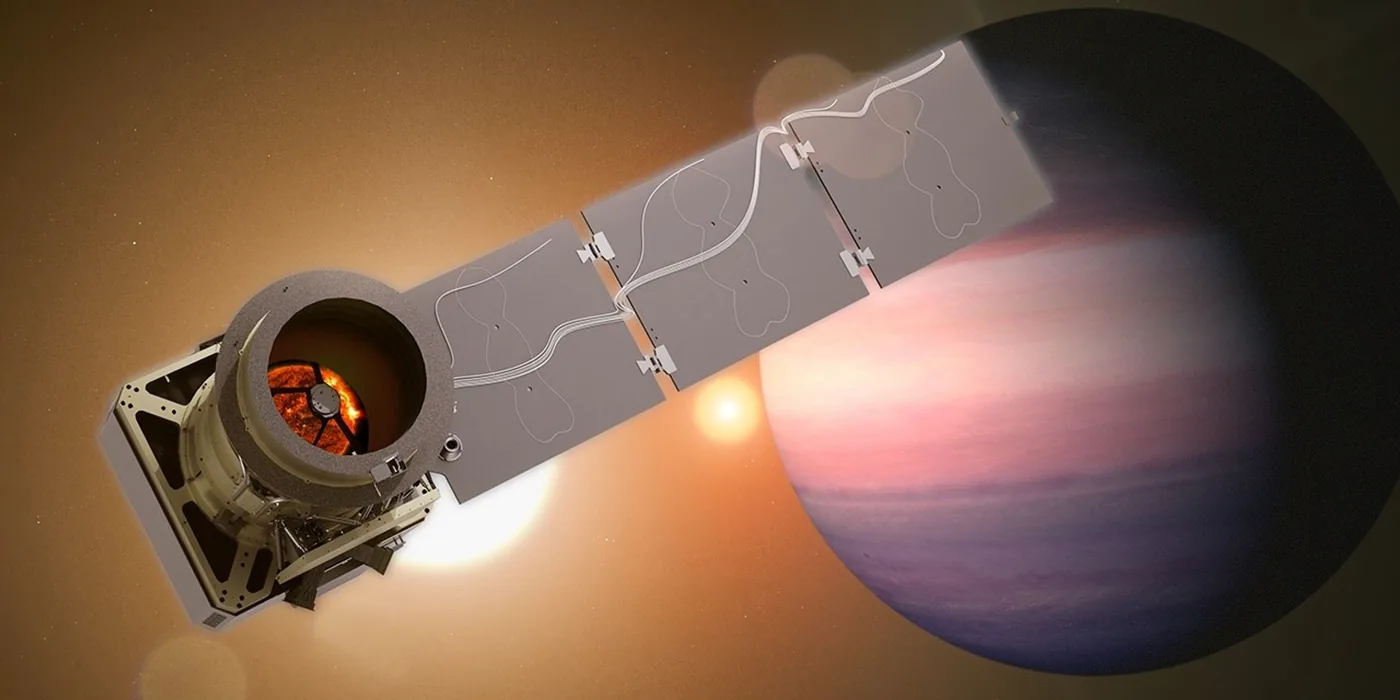
To cut through stellar noise, space agencies build focused missions that study host stars and their orbiting planets. On January 11, 2026, NASA launched Pandora, a SmallSat mission funded by the Astrophysics Pioneers program to track 20 exoplanets and their host stars. Built with an 18-inch aluminum telescope made by Corning Incorporated and Lawrence Livermore National Laboratory in California, Pandora carries a near-infrared sensor originally crafted as a spare for the James Webb Space Telescope [3].
Pandora principal investigator Elisa Quintana at NASA Goddard Space Flight Center in Greenbelt, Maryland, said the spacecraft targets a key gap in exoplanet research. “Pandora’s data will help close a major gap in our knowledge about planets and their host stars because, right now, we can’t be entirely sure how the star’s light affects measurements of what makes up exoplanet atmospheres,” Quintana said. Working with project scientist Knicole Colón, deputy manager Jordan Karburn, and MIT researcher Benjamin Rackham in Cambridge, the team runs 24-hour stares in visible and infrared channels to cleanly untangle starspots from true atmospheric water signals. Mission operations run through the University of Arizona in Tucson, with data hosted at IPAC at Caltech in Pasadena [3].

Stellar astrometry has long anchored host star calculations. In 1997, ESA’s Hipparcos mission published milliarcsecond positions and proper motions for 120,000 stars, later refined by Floor van Leeuwen in 2007 [2]. Today, researchers at the Max Planck Institute for Astronomy in Heidelberg and Uppsala University in Sweden pair Gaia astrometry with infrared spectroscopy to calibrate benchmark dwarf stars for ESA’s upcoming PLATO mission [8, 9].
Can Habitable Zones Remain Stable?
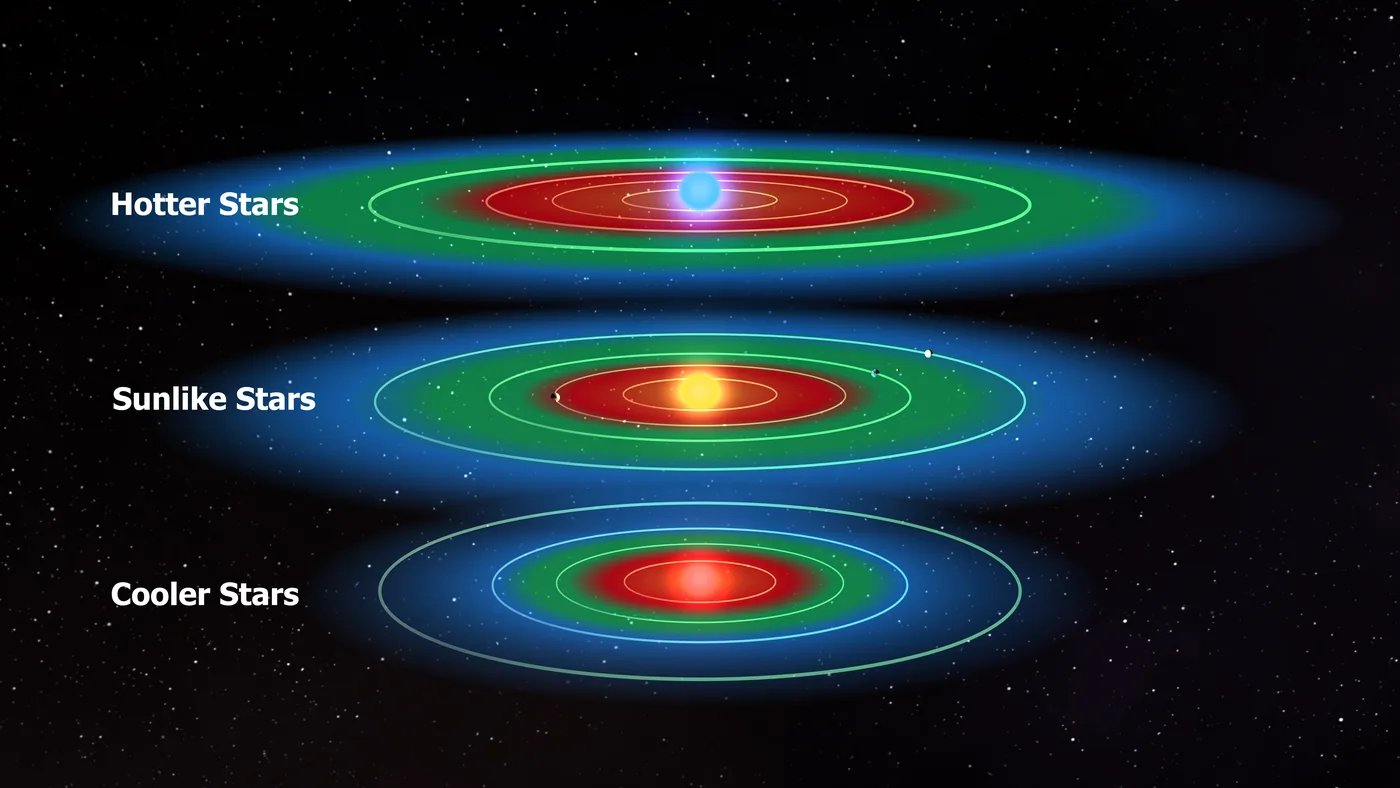
The circumstellar habitable zone marks the orbital ring where a rocky planet can keep liquid surface water under adequate air pressure. The position and width of this zone depend on the host star’s surface temperature and total luminosity [8]. Around bright F-type stars, this temperate belt sits far out, whereas around dim red dwarfs, it hugs the star tightly within a fraction of an astronomical unit.
In 2012, a gravitational microlensing study of observations gathered between 2002 and 2007 led by A. Cassan, D. Kubas, and J.-P. Beaulieu in Nature concluded that “stars are orbited by planets as a rule, rather than the exception”. Analyzing light distortions, Cassan’s team showed that 17% of stars host Jupiter-mass planets, cool Neptunes orbit 52% of stars, and super-Earths circle 62% of Milky Way stars between 0.5 and 10 AU [5]. Furthermore, statistical counts show that 22% of Sun-like stars harbor an Earth-sized world within their temperate zone [10].
Stellar aging ensures that habitable belts shift over cosmological time. As main-sequence stars burn their core hydrogen, they brighten slowly, pushing the inner boundary outward and sparking runaway greenhouse climates on inner worlds [8]. Later, when a host star balloons into a red giant, close-in planets within 0.6 AU are pulled in and swallowed by tidal drag [10].
- PREPRINT Hinkel, N. R., Youngblood, A. A., & Soares-Furtado, M. (2024). Host Stars and How Their Compositions Influence Exoplanets. arXiv. [Article Link]
- BOOK CHAPTER Perryman, M. (2011). Host stars. In The Exoplanet Handbook (pp. 181-208). Cambridge University Press. [Article Link]
- ONLINE NEWS Reddy, F. (2026). NASA’s Pandora Mission Begins Study of Exoplanets, Host Stars. NASA Science. [Article Link]
- BOOK Linsky, J. (2025). Host Stars and their Effects on Exoplanet Atmospheres. Astrophysics and Space Science Library, Springer Cham. [Article Link]
- ACADEMIC JOURNAL Cassan, A., Kubas, D., Beaulieu, J.-P., Dominik, M., Horne, K., Greenhill, J. G., Wambsganss, J., Menzies, J. W., Williams, A. J., Jorgensen, U. G., Udalski, A., & Bennett, D. P. (2012). One or more bound planets per Milky Way star from microlensing observations. Nature, 481(7380), 167-172. [Article Link]
- ONLINE NEWS Gough, E. (2026). Host Stars Shape Their Planetary Systems Into Two Families. Universe Today. [Article Link]
- ONLINE NEWS Hall, S. (2014). One Planet, Two Stars: A System More Common Than Previously Thought. Universe Today. [Article Link]
- WEBSITE Department of Physics and Astronomy. (2026). Exoplanet Host Stars. Uppsala University. [Article Link]
- WEBSITE Max Planck Institute for Astronomy. (2026). Exoplanet Host Stars. MPIA. [Article Link]
- WEBSITE Wikipedia contributors. (2026). Planet-hosting star. Wikipedia, The Free Encyclopedia. [Article Link]
- DICTIONARY ENTRY Goong Dictionary. (2025). Host star Meaning and Astronomical Definition. Goong. [Article Link]
- ACADEMIC JOURNAL Schulze, J. G., Wang, J., Johnson, J. A., Gaudi, B. S., Unterborn, C. T., & Panero, W. R. (2021). On the Probability That a Rocky Planet’s Composition Reflects Its Host Star. The Planetary Science Journal, 2(3), 113. [Article Link]


