



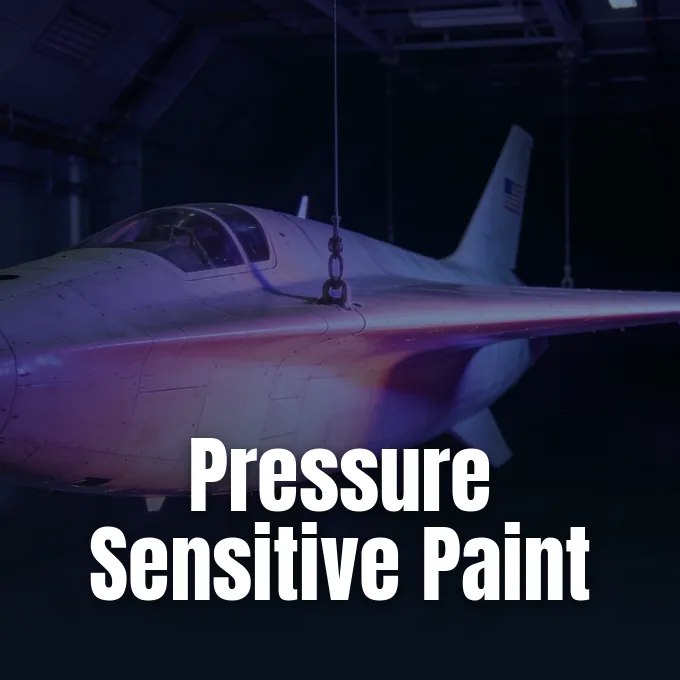
Does luminous surface coating hold the key to understanding complex aerodynamic loading during high-speed transonic flight? NASA aeronautics researchers at the Langley Research Center in Hampton, Virginia, evaluated unsteady Pressure Sensitive Paint across an oscillating wing model inside the specialized Transonic Dynamics Tunnel [1]. High-speed digital cameras recorded continuous optical brightness shifts as turbulent airflow exerted dynamic force across the test article. Sarah Peak photographed the setup [4]. The milestone confirmed that chemical luminescence can successfully map distributed aerodynamic pressure on a freely oscillating structure in a low-oxygen tunnel environment [5].
What Is the NASA Model?
The Benchmark Supercritical Wing serves as a standardized aerodynamic research model designed to validate computational fluid dynamics software rather than representing a specific production aircraft. Wind tunnel engineers rely on this universal Benchmark Supercritical Wing geometry to isolate fundamental transonic flow phenomena without proprietary aircraft geometry constraints. Brandon Ingram reported the milestone. Standardized benchmark models establish repeatable baseline measurements for flight research teams across Langley Research Center. Computational fluid dynamics requires rigorous experimental benchmarks to verify aerodynamic software predictions. Standard models simplify numerical comparisons [1]. Aeronautical research engineers at Langley Research Center continuously calibrate numerical aerodynamic simulations against physical wind tunnel observations to eliminate predictive uncertainties across demanding transonic flight regimes.
Physical models placed in experimental facilities must withstand severe unsteady aerodynamic vibrations while providing unambiguous surface pressure measurements. Diagnostic records display the Left wing unilluminated with the Right wing glowing under ultraviolet exposure photographed by Sarah Peak [4]. Unlike the Webb Space Telescope report examining cosmic dust, this experiment measures atmospheric pressure directly across an aerodynamic model wing. Standardizing model geometries allows aerodynamicists across separate laboratories to compare numerical simulation algorithms directly against shared physical baselines established in the Transonic Dynamics Tunnel [5].
NASA maintains universal wing profiles to ensure consistent numerical benchmarking across multiple aeronautics programs. The wing moved freely [1].
How Pressure Sensitive Paint Works
Pressure Sensitive Paint functions as a distributed optical sensor by converting mechanical surface pressure directly into measurable variations in luminous intensity across the entire aerodynamic model. The chemical formulation incorporates photoluminescent sensor molecules suspended within an oxygen-permeable polymer binder matrix. Ultraviolet lamps illuminate the model. When irradiated by specialized ultraviolet lamps mounted across the tunnel test chamber, these active photoluminescent sensor molecules absorb high-energy photons and continuously emit visible luminescence across the pink-purple electromagnetic spectrum. Ambient oxygen molecules collide with the excited luminophores, quenching the emitted light through non-radiative energy dissipation. Pressure alters luminescence directly [1]. Higher local airflow pressure forces more oxygen molecules into the permeable coating, noticeably reducing fluorescent brightness across the Benchmark Supercritical Wing.
Optical pressure diagnostics require precise photo-physical understanding because temperature variations and coating thickness can alter the luminescent signal. Researchers at Manchester University have examined similar fluorescent molecular responses in aerodynamic testing, demonstrating that precise chemical formulation and camera calibration form crucial links in the experimental measurement chain [5]. Calibrating luminescence against absolute static pressure demands careful laboratory characterization before running high-speed transonic airflow sequences inside the Transonic Dynamics Tunnel. Photometric sensors track these subtle luminosity shifts continuously across the entire wing chord.
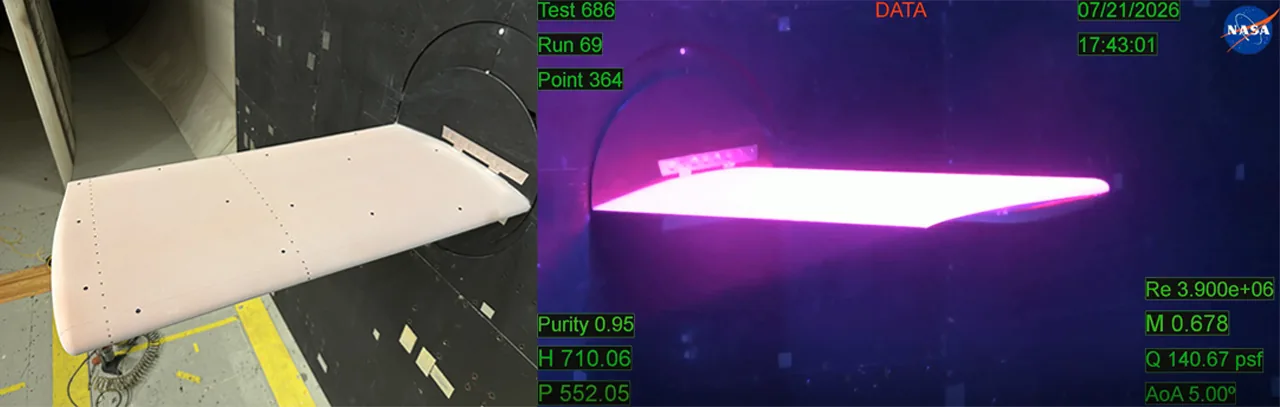
High-speed cameras capture the resulting brightness fluctuations at thousands of frames per second to reconstruct full-field surface pressure distributions. The optical Pressure Sensitive Paint method eliminates the need for hundreds of mechanical pressure taps drilled through model skins. By translating surface aerodynamics into high-resolution visual gradients, the diagnostic approach reveals transient shock waves and localized flow separation that discrete sensors frequently overlook [5].
Unsteady Pressure Sensitive Paint in the Wind Tunnel
Engineers at the Langley Research Center deployed unsteady Pressure Sensitive Paint inside the historic Transonic Dynamics Tunnel to evaluate dynamic aerodynamic responses under realistic transonic speeds [1]. Langley engineers operated the specialized facility in a low-oxygen atmosphere, marking the first time this optical diagnostic technique was executed on a large-scale, freely moving wing model under such environmental conditions [2]. The low-oxygen test chamber provides an ideal medium for evaluating unsteady aerodynamic phenomena and flutter boundaries. Silicon Valley teams assisted Langley. Researchers from the Ames Research Center in California Silicon Valley collaborated closely on the campaign, building upon years of joint efforts to integrate luminescent coatings into wind tunnel workflows for both advanced aircraft and launch vehicles [1].
Operating within the Transonic Dynamic Tunnel requires careful environmental management because the facility’s heavy gas medium alters acoustic velocity and dynamic pressure profiles [1]. Engineers at the Langley Research Center facility have long studied structural aeroelasticity to prevent dangerous aeroelastic flutter in commercial transports. Integrating optical diagnostics with moving models introduces severe vibrations, demanding rigid camera mounts and synchronized illumination strobes [2]. Sarah Peak photographed the wing under both ambient lighting and active ultraviolet excitation, highlighting the visual contrast between the resting model and its glowing operational state [3]. Langley hosts the facility [1].


Optical Data Collection and Camera Calibration
Converting raw video frames into quantitative aerodynamic pressure charts requires sophisticated computational post-processing and radiometric correction. High-speed digital cameras positioned outside the test section record small shifts in pink-purple emission intensity as aerodynamic loads shift dynamically across the Benchmark Supercritical Wing. Because camera pixels measure relative photon counts rather than direct physical pressure units, research teams execute rigorous in-situ calibration procedures before and after every aerodynamic sweep. Image processing algorithms align the oscillating model wing coordinates to eliminate motion-induced artifacts from the pressure maps [5].
Scientific accountability in fluid dynamics instrumentation requires rigorous verification, as demonstrated across instrument-heavy experimental studies published in journals such as Nature. Gemma Lavender highlighted that the initial NASA account represents an instrumentation feasibility milestone rather than a finalized aircraft design or completed flight technology. The published NASA report focused on validating whether the unsteady Pressure Sensitive Paint coating and high-speed optical sensors could reliably record dynamic loads on a moving structure in low-oxygen conditions. Similar challenges in dynamic isolation parallel broader aerospace investigations into spacecraft structural damping, where severe structural vibrations and mechanical resonances must be systematically suppressed during delicate orbital deployment sequences [5].

Pressure-Sensitive Paint Testing on Flexible Wings
Aeronautical engineers at NASA Langley Research Center plan to apply this validated optical Pressure Sensitive Paint technique to evaluate flexible next-generation aircraft wing designs that actively bend and adapt during flight to maximize aerodynamic efficiency. Conventional rigid wings cannot dynamically optimize their aerodynamic profile across disparate flight regimes, prompting modern aerospace programs to explore lightweight, aeroelastically tailored lifting surfaces. As flexible structures deform under aerodynamic loading, their instantaneous shape and surface pressure distributions change concurrently. Tracking coupled aeroelastic deformation demands synchronized spatial instrumentation across the entire wing span [1].
The Aeronautics Research Mission Directorate supports these testing capabilities through the Transformational Tools Technologies project under the Transformative Aeronautics Concepts Program. These research initiatives seek to deliver high-fidelity experimental tools that de-risk advanced wing concepts for commercial aviation. Optical measurement methods provide vital validation data for emerging aerodynamic architectures, including flexible composite structures and novel propulsion airframes akin to dual-mode propulsion systems developed for autonomous space exploration [4]. Validating aeroelastic computer models with full-field data helps aerospace manufacturers minimize structural weight while maintaining flutter safety margins [1].
Flexible wings deform under turbulence. Langley Research Center researchers will use unsteady Pressure Sensitive Paint to document dynamic load shifts during rapid structural flexing [1].
Aerodynamic Modeling Beyond Point Sensors
Traditional wind tunnel testing relies on discrete static pressure taps drilled through aerodynamic models to record localized aerodynamic loads. Sensors record localized loads. While electronic pressure sensors deliver high sampling rates, they provide information only at isolated geometric locations, potentially missing shock oscillations and transient vortices between sensor ports. In contrast, optical Pressure Sensitive Paint luminescent coatings transform the entire aerodynamic lifting surface into a continuous sensing plane. Full-field spatial resolution allows computational aerodynamicists to compare physical pressure gradients against numerical grid predictions with unprecedented fidelity [5].
Future wind tunnel testing at Langley Research Center and Ames Research Center will continue refining unsteady Pressure Sensitive Paint coatings across diverse flow conditions and high dynamic pressures [1]. Although the supplied NASA documentation does not include formal statistical confidence intervals or p-values, the successful demonstration marks a notable technical step forward for wind tunnel diagnostics [5]. By establishing full-field optical surface pressure measurement capabilities on freely moving models inside transonic facilities, aerodynamicists gain a robust empirical foundation to design next-generation transport aircraft with substantially greater aerodynamic efficiency and structural resilience [1].
- PRESS RELEASE Ingram, B. (2026, October 2). NASA Model Wing Lights Up During First Pressure Sensitive Paint Tests. NASA. [Article Link]
- ONLINE NEWS Mirage News. (2026, October 2). NASA Model Wing Lights Up in Pressure-Sensitive Paint Tests. [Article Link]
- ONLINE NEWS La Primera en Línea. (2026, October 2). NASA Model Wing Lights Up During First Pressure Sensitive Paint Tests. [Article Link]
- ONLINE NEWS PressBee. (2026, October 2). NASA Model Wing Lights Up During First Pressure Sensitive Paint Tests.Middle East. [Article Link]
- ACADEMIC JOURNAL Lavender, G. (2026, October 2). NASA Wing Glows Under Ultraviolet Light in Airflow Test. Science.Report. [Article Link]
APA 7: TWs Editor. (2026, October 3). How Pressure Sensitive Paint Maps Dynamic Wing Airflow. PerEXP Teamworks.


