






Could prominent wing markings on an airborne insect deceive an experienced predator mid-strike? While biologists long assumed that conspicuous wing patterns made insects vulnerable sitting ducks, new findings demonstrate that butterfly optical illusions actively disrupt avian flight interception [1]. Exeter University visual ecologist George Hancock and researcher Jolyon Troscianko collaborated with an Essex University research team in England to investigate how dynamic wings deceive predators during high-speed chases [3]. By recording takeoffs at more than 1,000 frames per second, the Exeter University scientists proved that flapping movements generate false directional cues that divert attacks [2]. Nature published the final findings [1].
Do Butterflies Have 2 Sets of Wings?
Butterflies possess two distinct sets of wings—an anterior pair of forewings and a posterior pair of hindwings—that beat independently rather than functioning as a single rigid plane [1]. During flight, these flexible membranous surfaces continuously deform as they clap together on the upstroke and peel apart on the downstroke, causing high-contrast stripes to shift angles relative to pursuing birds [3]. This rhythmic peeling alters the visible orientation of stripes and spots [2]. Because the wings twist during each flapping cycle, surface patterns generate localized vectors that do not match the true trajectory of the insect’s body. Stripes disrupt motion [1]. Exeter University investigator George Hancock documented the pattern [2].
To quantify how wing structure generates false movement, Exeter University visual ecologist George Hancock and Jolyon Troscianko built aerodynamic models representing 757 butterfly forms from 397 European species [2]. High-contrast forewings and conspicuous vertical bands produced the strongest deceptive motion signals across computational flight simulations [1]. Prominent hindwing tails further enhanced this deception by misdirecting visual attention [2]. They tested 397 European species [1]. In many Lepidoptera lineages, two sets of wings provide the mechanical freedom necessary to produce conflicting optical stimuli across the visual field. Popular Science detailed the trials [3].
When an insect relies on camouflage while resting on vegetation, movement immediately shatters the disguise [3]. In the journal Nature, Exeter University researchers reported that wing deformation during flapping flight creates an airborne defense system that operates effectively when resting camouflage fails [1]. The independent motion of the hindwings ensures that even if a predator lunges, the strike frequently lands on non-vital wing margins rather than the central abdomen. ZME Science journalist Tibi Puiu reported the discovery [2].

Why Butterfly Optical Illusions Foil Airborne Attacks
Avian predators rely on specialized motion-detecting neural pathways that rapidly track high-contrast edges across their retinas, allowing raptors and songbirds to intercept small prey traveling through three-dimensional space with remarkable speed and precision [1]. As a bird dives toward a flying target, its visual system estimates speed and flight heading from these retinal signals [2]. Exeter University visual ecologist George Hancock explained that bold markings disrupt targeting by “boosting false motion cues” while disguising the insect’s actual heading [3]. Consequently, butterfly optical illusions actively scramble the predator’s perceptual calculations during high-speed aerial pursuits, causing raptors to misjudge velocity [1].
This sensory disruption proves decisive during the final stage of aerial pursuit, known to ornithologists as the ballistic attack (a sudden strike committed in the final tens of milliseconds). Once an attacking bird commits to its closing lunge, its neuromuscular system lacks time to adjust its flight path through the air. Exeter University investigator George Hancock emphasized that butterfly optical illusions interfere with visual tracking, causing raptors and songbirds to snap their beaks on empty air [3]. A tiny tracking error of merely a few centimeters is enough to ensure survival [2].
Very few avian predators specialize exclusively in hunting butterflies mid-flight. While moths suffer heavy predation from mice, rats, bats, and birds, butterflies navigate open meadows with surprising impunity [3]. Understanding aerodynamic survival strategies in insects mirrors broader research into how winged dinosaurs evolved flight, where physical structures simultaneously served propulsion and environmental interaction [1]. Popular Science science writer Laura Baisas and ZME Science editor Tibi Puiu both noted that dynamic wings explain why vivid colors persisted without fatal predation costs [2].
Barber-Pole Mechanics on Flexible Moving Surfaces
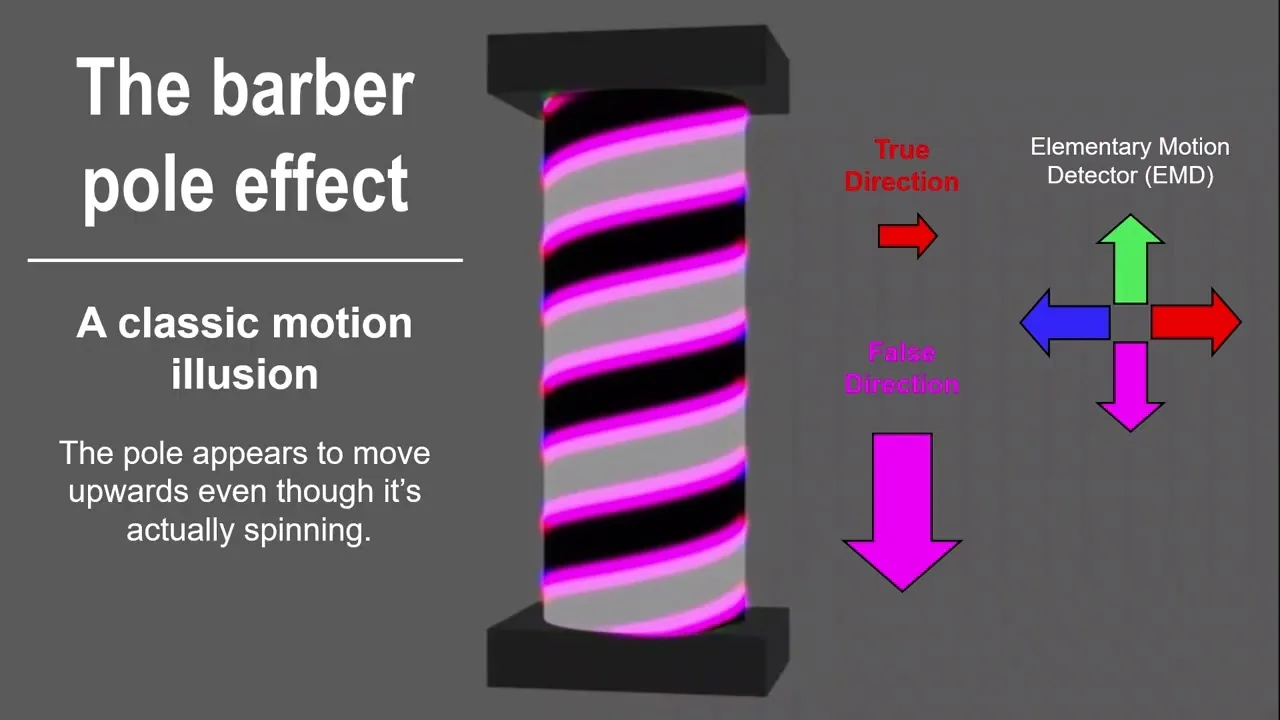
The underlying optical mechanism closely mirrors the classical barber-pole illusion (an optical effect where rotational movement is perceived as upward motion). Outside a traditional barbershop, a cylinder painted with diagonal helical stripes rotates horizontally around a vertical spindle, yet observers perceive the stripes as ascending indefinitely [2]. When butterfly wings flap, high-contrast diagonal bands similarly shift their relative angles across each stroke cycle. Exeter University co-author Jolyon Troscianko emphasized that unpredictable flight paths combine with flapping geometry to produce powerful false directional signals that thoroughly deceive pursuing raptors [3]. Optical illusions confound predators. The eye registers motion along the stripes rather than the true path of the insect [1].
To test this effect computationally, Exeter University researcher Jolyon Troscianko processed slow-motion recordings of flying butterflies through a computer model calibrated to approximate small-bird vision [2]. The simulation produced an unexpected visual output: the model indicated that the butterfly was glowing downwards even as the insect ascended rapidly. Troscianko initially verified the simulation was not “a coding error” swapping directions, recognizing that deceptive motion offered a potent defense. It was no coding error [3]. Instead, the downward-shifting wing patterns were generating butterfly optical illusions that directly contradicted the insect’s physical climb, leading Exeter University scientists to confirm the deceptive mechanism [1].


How Do Butterfly Wings Develop?
Butterfly wings develop their intricate coloration and geometry through evolutionary selective pressures that favor designs capable of confusing predatory motion perception [1]. To examine how these deceptive patterns emerge, Exeter University researchers programmed an evolutionary algorithm to simulate more than 50,000 wing patterns—evaluating 57,600 artificial designs across 20 successive generations. The computer simulation started from entirely random markings and selectively rewarded patterns that generated maximum motion confusion under virtual bird-vision models. Over successive computational cycles, the simulated wings independently developed vertical bands and high-contrast forewings [2]. Nature converged on identical optical solutions [1].
This computational convergence provides compelling evidence that motion confusion represents a primary evolutionary driver shaping wing morphology [3]. Exeter University researcher George Hancock pointed out that very few European butterflies possess chemical toxicity or unpalatable defenses, making visual deception essential for daytime survival [2]. In species lacking aposematism (warning coloration signaling toxicity), visual camouflage and motion disruption represent the primary shields against predators [1]. Exeter University visual ecologist George Hancock observed that diverse markings actively generate “illusions that confuse predators” mid-strike [3]. Butterfly optical illusions thus function as an active airborne shield for palatable insects [1].
While butterflies frequently rest with closed wings to blend into foliage, airborne escape demands an entirely different defensive paradigm [3]. Unlike long-distance endurance seen in butterflies embarking on transoceanic flights, erratic local fluttering produces rapid changes in wing orientation [1]. High-speed recordings of takeoffs at over 1,000 frames per second revealed that natural patterns generated significantly more false motion cues than pattern-stripped controls [2]. The Exeter University and Essex University scientists demonstrated that wing patterns evolved to distort dynamic spatial calculations. Popular Science reporter Laura Baisas documented the findings [3].

Touchscreen Trials with Butterfly Wing Patterns
To evaluate whether digital motion signals genuinely deceive predator targeting systems, researchers conducted extensive touchscreen trials involving human volunteers. One hundred human volunteers acted as surrogate predators, attempting to capture virtual butterflies moving across a high-speed 240-hertz touchscreen display. The participants completed 3,000 trials featuring animated flight sequences modeled directly on real European species. The more a pattern was predicted to distort forward motion, the farther behind the insect people tended to strike [2]. One hundred volunteers participated. Trials confirmed this. Butterfly optical illusions clearly degraded strike accuracy across all test groups [1].
Statistical analysis revealed that between the least confusing and most confusing wing designs, the center of the attack distribution shifted by approximately 38 percent of an average butterfly’s body length. Exeter University visual ecologist Jolyon Troscianko told Reuters that this displacement is likely enough to save butterflies during “the split-second moment” of an attack [2]. For a predator moving at high speed, a 38 percent targeting offset represents the difference between a fatal strike and snapping at empty air [1]. Jolyon Troscianko confirmed the data [2].
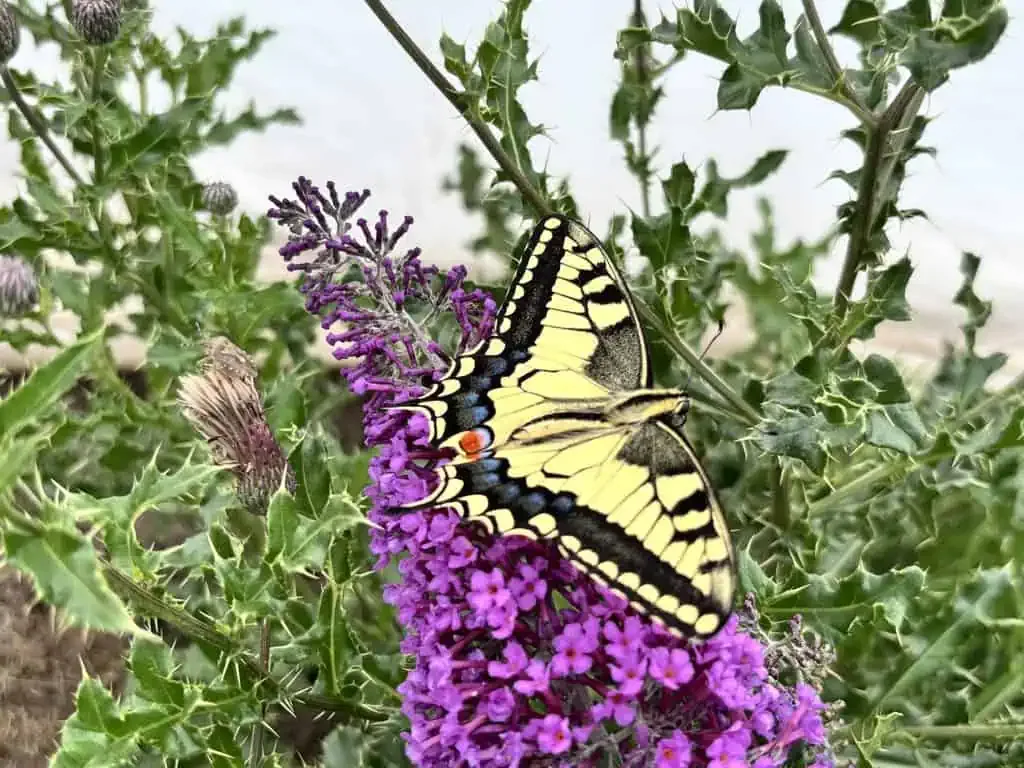
Morphological analysis of 757 butterfly forms from 397 European species showed that single prominent bands, vertical stripes, and hindwing tails exhibited the highest confusion scores [1]. In a study published in PloS ONE, Scott-Samuel showed that high-contrast patterns alter perceived velocity during visual tracking [4]. Species like the European Swallowtail (Papilio machaon) combine high-contrast bands with elongated tails that draw predatory strikes away from vulnerable organs [2]. Exeter University researcher George Hancock noted that beak strikes often clip harmless wing margins, allowing the insect to escape intact [3].
Motion Dazzle Beyond Lepidopteran Flight
The concept of motion dazzle has intrigued visual scientists since early naval camouflage experiments, but biological confirmation in wild animals remained elusive [3]. A foundational 2011 experiment by Scott-Samuel and colleagues demonstrated that high-contrast geometric patterns significantly alter speed perception during tracking tasks [4]. Subsequently, a 2017 study led by Hughes revealed that stripe orientation biases judgments of movement direction [5]. The Nature Study by Exeter University and Essex University advances this science by showing that dynamic surface deformation dramatically amplifies motion distortion beyond what rigid geometric patterns can achieve [1]. Popular Science highlighted the implications [3].
Dragonflies operate with much faster visual processing systems than avian predators. Exeter University researchers noted that these swift insect hunters may not fall for butterfly optical illusions. Dragonflies track targets differently [2].
Exeter University visual ecologist Jolyon Troscianko suggested that motion confusion operates far more broadly across the animal kingdom than previously recognized. Troscianko remarked that motion confusion may prove “far more widespread in nature” than previously realized, extending from bird wings to reptile tails [3]. Popular Science science writer Laura Baisas and ZME Science journalist Tibi Puiu highlighted that these findings open new avenues for animal vision research [2]. Future investigations into vertebrate predator vision promise to illuminate how dynamic patterns shape survival across aerial, aquatic, and terrestrial ecosystems [1].
- ACADEMIC JOURNAL Hancock, G. R. A., Briolat, E. S., Hughes, A. E., Kelley, L. A., & Troscianko, J. (2026). Butterfly wing patterns in flight create powerful illusory motion cues. Nature. [Article Link]
- ONLINE NEWS Puiu, T. (2026, October 1). Butterflies May Use Optical Illusions on Their Wings to Make Birds Miss Them in Midair. ZME Science. [Article Link]
- ONLINE NEWS Baisas, L. (2026, September 30). Butterfly wings create dazzling optical illusions. Popular Science. [Article Link]
- ACADEMIC JOURNAL Scott-Samuel, N. E., Baddeley, R., Palmer, C. E., & Cuthill, I. C. (2011). Dazzle camouflage affects speed perception. PloS one, 6(6), e20233. [Article Link]
- ACADEMIC JOURNAL Hughes, A. E., Jones, C., Joshi, K., & Tolhurst, D. J. (2017). Diverted by dazzle: perceived movement direction is biased by target pattern orientation. Proceedings. Biological sciences, 284(1850). [Article Link]
APA 7: PerEXP Teamworks. (2026, October 2). How Butterfly Optical Illusions Confuse Avian Predators.


