





A vector database is a data store built to hold and search multi-dimensional numeric arrays called vector embeddings. Standard relational databases organize data into rows and tables, but machine learning models turn unstructured text, sounds, and images into numeric coordinates. By placing conceptual meanings into spatial geometry, vector databases let software find items by semantic closeness instead of matching literal keywords [1]. Systems use these tools to power real-time AI search, similarity lookup, and automated reasoning pipelines.
- How Vector Embeddings Represent Unstructured Data
- Distance Metrics for Semantic Similarity
- Why Vector Databases Use Approximate Nearest Neighbor Search
- Common Indexing Techniques
- Dedicated Vector Databases Versus Integrated Engines
- Why Vector Databases Are Critical for RAG Systems
- Real-Time Data and Memory Architectures
- Current Challenges and Future Systems
How Vector Embeddings Represent Unstructured Data
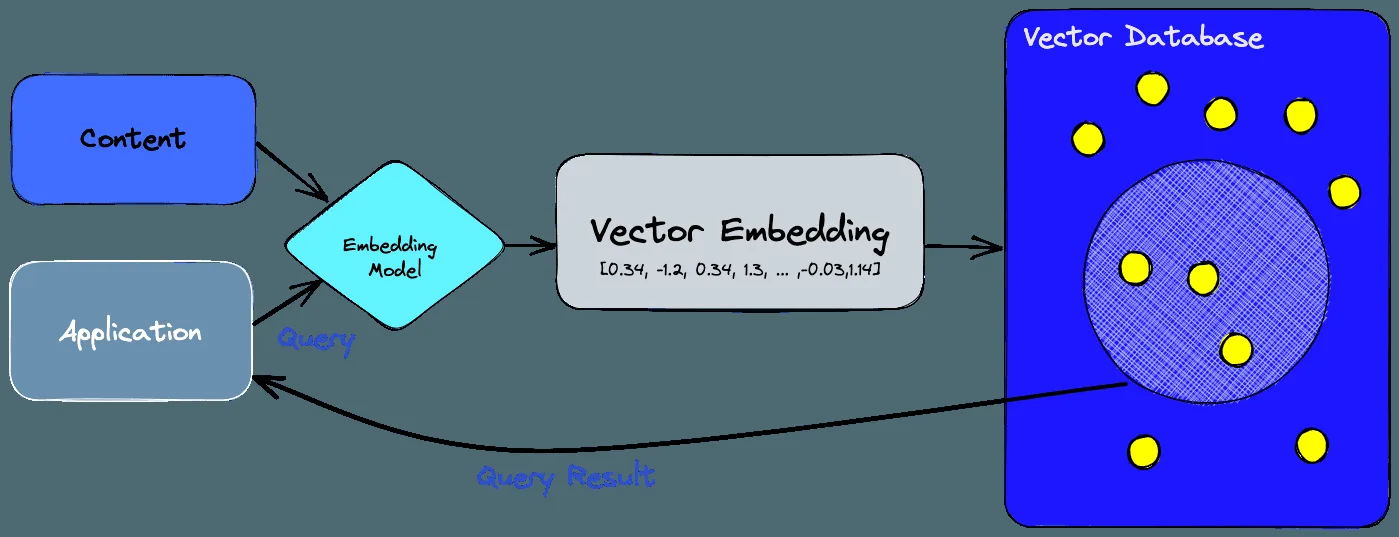
Machine learning models turn raw media files into dense vectors. In these arrays, nearly every slot holds a non-zero floating-point number representing an abstract feature learned by a deep neural net. For example, text models from OpenAI and Azure OpenAI create dense vectors that span 1,536 dimensions. A single word like cat might turn into a list of numbers like 0.135, -0.629, 0.327, and 0.366. Because each model shapes its own coordinate map, vectors from one provider cannot mix with vectors from another. Companies use an API to feed text into models like PaLM, Cohere, or Hugging Face tools, generating vectors that group related items together in numeric space [3].
In a 2013 preprint on arXiv, T. Mikolov, K. Chen, G. Corrado, and J. Dean showed that high-quality word vectors could be trained from 1.6 billion words in less than a day. Their paper was an unreviewed preprint that did not go through journal peer review. Vector math captured word relationships with surprising speed [2].
On the Microsoft .NET Blog, Luis Quintanilla shared an example showing how numeric coordinates place related ideas close to one another. Quintanilla mapped movie plots into a simple two-dimensional space using the Milvus C# client. Family cartoon hits like The Lion King and Toy Story landed right next to each other. In contrast, gritty crime stories like Inception and Pulp Fiction ended up far away. A query for family fun retrieved the animated hits through geometric distance [8].
Distance Metrics for Semantic Similarity
Vector search systems measure how close two points sit in multi-dimensional space by using specific distance formulas. The most common option is Euclidean distance, also known as L2 distance, which measures the straight line between points as if flying through space. Another formula is Manhattan distance, or L1 distance, which sums absolute differences along each axis, like a cab turning street corners on a grid. Chebyshev distance, or Linf, tracks the single biggest gap along any one dimension. For normalized text vectors, engineers often turn to cosine similarity. Cosine similarity checks the angle between vectors, scoring 1 for matching paths and -1 for opposing ones [3].
Dot product is another common metric. When vectors are already normalized, dot product gives the exact same result as cosine similarity, but hardware runs it faster. Binary data uses Hamming distance instead. That metric counts how many bits differ between two binary strings [3].
Complex document search often uses maximum inner product similarity, known as MaxSim, when one item holds multiple vectors. For example, a search tool can break a long article into token-level vectors and compare each query word to the closest passage chunk. This multi-vector approach preserves fine details that single summary vectors might miss, helping search engines rank documents with greater precision [3].
Why Vector Databases Use Approximate Nearest Neighbor Search
Standard relational databases check for exact matches, asking whether an account balance or user ID equals an exact string. In contrast, vector databases solve a geometric problem known as k-nearest neighbor search, where the goal is finding the k closest points to an input query [4]. An exact kNN search scans every single vector in the index. While that flat scan delivers perfect recall, its lookup time climbs linearly as datasets expand, making exhaustive scans far too slow for web-scale catalogs holding tens of millions of records. When latency spikes, interactive applications stall [3].
To keep lookups fast, systems use approximate nearest neighbor (ANN) methods. These algorithms trade a tiny fraction of accuracy for huge jumps in speed. By checking only a promising slice of vectors, ANN tools answer queries in single-digit milliseconds [3].
In a survey published in The VLDB Journal, J. J. Pan, J. Wang, and G. Li detailed five core obstacles facing vector data management. Engineers must tackle vague semantic boundaries, bulky vector sizes, costly distance math, a total lack of natural partitioning grids, and the tricky job of mixing vector distance with standard SQL filters. Annual benchmarks run by SISAP and NeurIPS track how newer engines solve these five roadblocks [1].
Common Indexing Techniques
Engineers arrange vectors into graph structures to speed up similarity lookups. The most popular graph design is Hierarchical Navigable Small World (HNSW), which links vectors across multiple interconnected layers [1]. Upper layers contain fewer nodes with wide, sweeping links that let queries skip rapidly across the dataset, while bottom layers provide tight local connections for fine-grained ranking. Because navigating these layered graphs scales logarithmically, HNSW graph structures routinely outpace brute-force scans in production benchmarks [3]. Inverted file (IVF) indexes offer another route by dividing vector space into separate clusters, guiding searches to scan only nearby cluster buckets [16].
Memory footprint remains a major headache for vector databases. A single 384-dimension vector stored as 32-bit floating-point numbers eats about 1.5 kilobytes of RAM. Adding a vector field to 100 million records can expand index size by seven times [3].
To cut RAM bills, teams rely on quantization to compress high-precision numbers. Scalar quantization turns 32-bit floats into 8-bit integers, shrinking memory use by up to four times while keeping accuracy intact. Binary quantization pushes further by converting values into single bits for up to 32-fold savings [3]. Meanwhile, Microsoft Research built DiskANN for Azure Cosmos DB, keeping vector indexes on solid-state flash drives to serve high-throughput lookups at lower cost [5].



Dedicated Vector Databases Versus Integrated Engines
Software teams choose between two main database models: pure standalone vector stores and general-purpose database systems that add vector indexing to existing relational tables [13]. Pure tools like Pinecone, Milvus, and Chroma were built specifically to store embeddings and light metadata [4, 7, 9]. Algorithmic code libraries like FAISS from Facebook AI Similarity Search offer fast search math, but they lack core database features such as live row updates, user permissions, automated snapshots, and backup tools. Standalone vector databases turn those raw indexing routines into managed platforms [4].
Anton Troynikov and Jeff Huber founded Chroma to give developers a lightweight open-source store. Chroma raised $18 million in seed funding led by Quiet Capital at a $75 million valuation, with backing from Bloomberg Beta and AIX Ventures [9]. Milvus, graduated under LF AI & Data Foundation, introduced version 3.0 in July 2026 with deduplication and Nvidia CUDA acceleration via cuVS and CAGRA [7].
In contrast, relational vendors argue that moving data into outside systems adds cost and breaks ACID safety. MariaDB 11.8 LTS added native vector columns and modified HNSW indexes directly into MariaDB Server. Google launched AlloyDB AI with Vertex AI integration for PostgreSQL workloads, while SingleStore-V and Oracle AI Database 26ai let developers combine vector searches with SQL JOIN queries in one atomic transaction [10, 11, 13, 1]. In ClickHouse, users run cosineDistance functions alongside SQL filters without extra infrastructure [1].
Why Vector Databases Are Critical for RAG Systems
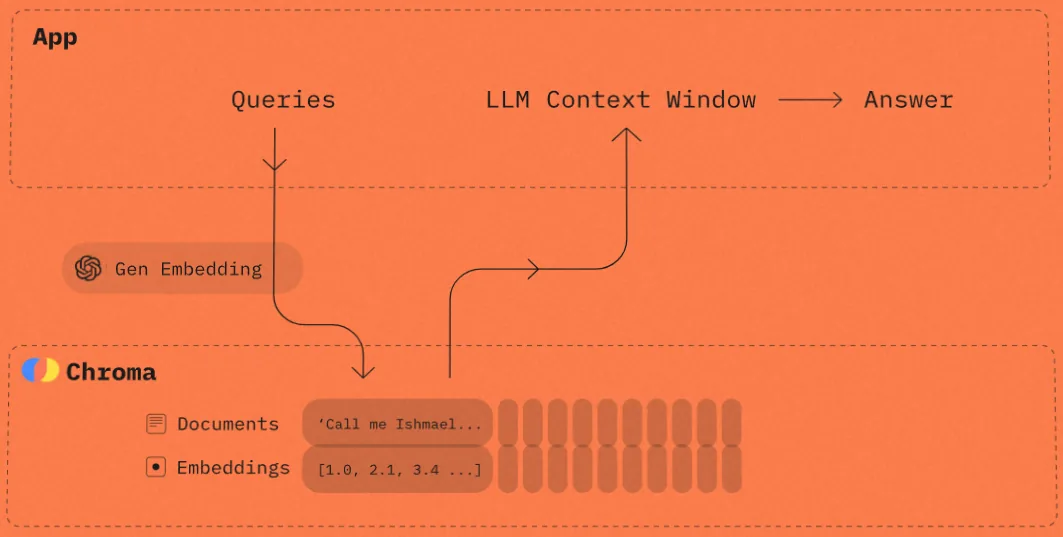
Large language models generate persuasive text, but their knowledge stops at their training cutoff date. When asked about private internal files or breaking news, LLMs can fabricate convincing answers called hallucinations. Retrieval-augmented generation (RAG) solves this flaw by pairing generative AI models with an external memory layer driven by vector databases [3]. Instead of spending huge budgets on retraining models whenever company manuals change, developers store vectorized document fragments in a searchable repository. Systems query this store in real time to feed prompt context to tools like ChatGPT, GPT-3.5, and GPT-4 [5].
When a user asks a question, an embedding model turns that prompt into a vector. The database finds the most similar text chunks and injects them into the prompt. This grounds the answer in real company data, avoiding token limits without costly model fine-tuning [5].
Multi-layer systems show how vector caching sharpens AI precision. In a paper for the Proceedings of the VLDB Endowment, X. Zhao, X. Zhou, and G. Li introduced Chat2Data, an interactive data tool that links LLMs with vector stores. Their platform uses vector indexes to cache intermediate query results, cutting expensive model calls while breaking complex analytical workflows into smaller verified steps [14].
Real-Time Data and Memory Architectures
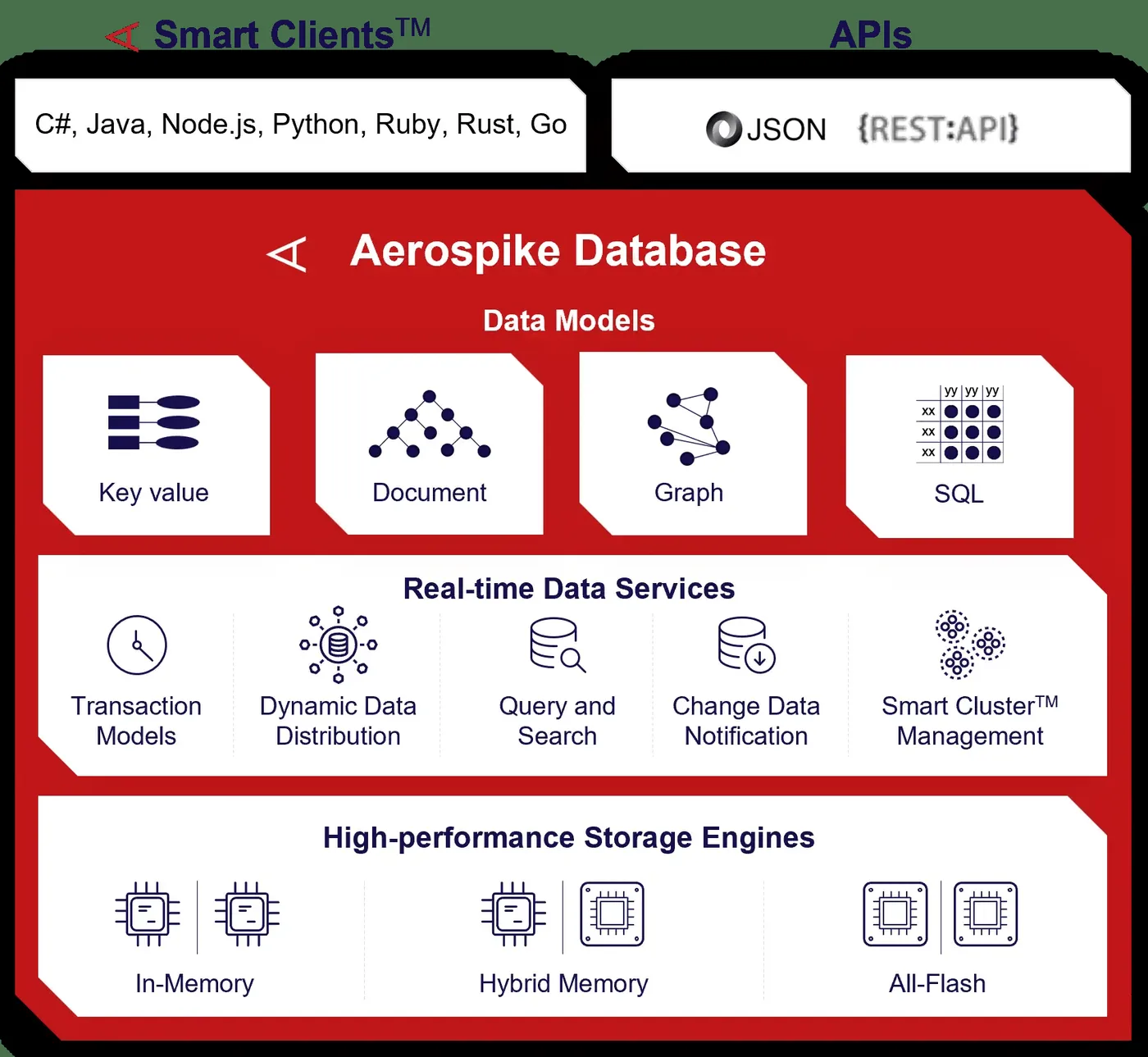
Live fraud detection, financial trading, and adtech platforms need databases to ingest fresh records while answering thousands of concurrent queries. To address these workloads, NoSQL vendor Aerospike raised $109 million in Series E funding led by Sumeru Equity Partners, with backing from Alsop Louie Partners. Aerospike chief executive officer Subbu Iyer noted that pairing graph and vector capabilities lets software use vector search to locate a target document neighborhood, after which graph connections surface related records. Aerospike combines RAM with fast flash storage in a hybrid memory setup, helping enterprise customers like Snap, TransUnion, Airtel, and Yahoo balance query speed with hardware costs [12].
In an unreviewed preprint released on arXiv in 2022, R. Guo and twelve co-authors introduced Manu, an elastic cloud vector database built from feedback across 1,200 industry users. The system relaxed strict DBMS rules, using write-ahead logs and binlogs as core services to decouple writes from read-only searches [6].

Serverless vector stores separate storage tiers from compute clusters. By applying geometric partitioning, systems divide indexes into small pieces, only powering on compute nodes for partitions hit by active queries [4]. In AllegroGraph 8.0, Franz CEO Jans Aasman combined graph databases with vector storage to link LLMs with PubMed records, using disk-backed memory mapping to keep server costs low [3]. A temporary freshness layer acts as a cache for incoming writes, answering queries immediately until background builders finish merging new vectors into long-term partitioned indexes [4].
Current Challenges and Future Systems
Deploying vector search at enterprise scale brings practical hurdles. In a literature review published in Cognitive Systems Research, T. Taipalus highlighted high dimensionality and data sparsity as ongoing challenges for index design and cache tuning [15]. A. KC and D. TL noted that high dimensions cause the curse of dimensionality, where data points grow sparse and equidistant, testing indexing methods like inverted files and product quantization [16]. Meanwhile, research by N. DeCastro-García and co-authors found that vector stores often accumulate redundant entries, requiring graph adjacency matrix checks to filter out duplicate records [1].
Benchmarks show how engine architecture shapes speed. On a test of one million OpenAI vectors from the dbpedia-openai-1000k dataset, MariaDB Vector hit 850 to 1,000 queries per second at 94% recall. It built its index in under 15 minutes, whereas pgvector took up to three hours [10].
Future search pipelines are moving toward multi-staged workflows that pair lexical search with vector similarity. Search engines first run fast approximate nearest neighbor lookups to gather candidate documents, then use cross-encoder models to rerank the top results by deep semantic fit [3]. As AI agents and enterprise chatbots become everyday software tools, vector databases will serve as essential infrastructure linking machine learning models to fresh corporate data [5].
- WEBSITE Wikipedia. (2026). Vector database. Wikipedia. [Article Link]
- PREPRINT Mikolov, T., Chen, K., Corrado, G., & Dean, J. (2013). Efficient estimation of word representations in vector space. arXiv. [Article Link]
- WEBSITE Elastic. (2023). What is a vector database? A comprehensive vector database guide. Elastic. [Article Link]
- WEBSITE Schwaber-Cohen, R. (2023). What is a vector database & how does it work? Use cases + examples. Pinecone. [Article Link]
- WEBSITE Microsoft. (2026). Integrated vector database – Azure Cosmos DB. Microsoft Learn. [Article Link]
- PREPRINT Guo, R., Luan, X., Xiang, L., Yi, X., Luo, J., Cheng, Q., Xu, W., Liu, F., Cao, Z., Qiao, Y., Wang, T., Tang, B., & Xie, C. (2022). Manu: A cloud native vector database management system. arXiv. [Article Link]
- WEBSITE Wikipedia. (2026). Milvus (vector database). Wikipedia. [Article Link]
- WEBSITE Quintanilla, L. (2024). Get started with Milvus vector DB in.NET.NET Blog. [Article Link]
- ONLINE NEWS Palazzolo, S. (2023). Vector database Chroma scored $18 million in seed funding at a $75 million valuation. Business Insider. [Article Link]
- WEBSITE MariaDB Foundation. (2026). MariaDB Vector — native vector search in MariaDB. MariaDB.org. [Article Link]
- ONLINE NEWS Wiggers, K. (2023). Google’s AlloyDB AI transforms databases to power generative AI apps. TechCrunch. [Article Link]
- ONLINE NEWS Lardinois, F. (2024). Aerospike raises $109M for its real-time database platform to capitalize on the AI boom. TechCrunch. [Article Link]
- ACADEMIC JOURNAL Chen, C., Jin, C., Zhang, Y., Podolsky, S., Wu, C., Wang, S., Hanson, E. N., Sun, Z., Walzer, R., & Wang, J. (2024). SingleStore-V: An integrated vector database system in SingleStore. Proceedings of the VLDB Endowment, 17(12), 3772-3785. [Article Link]
- ACADEMIC JOURNAL Zhao, X., Zhou, X., & Li, G. (2024). Chat2Data: An interactive data analysis system with RAG, vector databases and LLMs. Proceedings of the VLDB Endowment, 17(12), 4481-4484. [Article Link]
- ACADEMIC JOURNAL Taipalus, T. (2024). Vector database management systems: Fundamental concepts, use-cases, and current challenges. Cognitive Systems Research, 85, 101216. [Article Link]
- ACADEMIC JOURNAL KC, A., & TL, D. (2024). Vector databases. Open Access Research Journal of Engineering and Technology, 7(1), 096-104. [Article Link]


