






Migratory birds flying over open ocean waters can experience time shifts similar to human travelers crossing multiple time zones on airplanes. Biologists studying the long-distance foraging flights of Manx shearwaters (Puffinus puffinus) from breeding colonies in the United Kingdom found that fast east-west journeys across the Atlantic desynchronize their body clocks from local solar time. This mismatch produces seabird jet lag, which nudges the birds off course by altering their reading of the solar arc. The study appeared on October 29 in the journal Science [1].
How Ocean Flights Trigger Seabird Jet Lag
Long flights that cross lines of longitude alter how an animal’s body clock aligns with the natural day outside. Human travelers recognize jet lag as fatigue and brain fog, but researchers focus on the underlying shift in circadian timing that occurs when an organism moves into a new solar schedule before its cellular rhythms can adjust. Patrick Lewin at the University of Oxford explained that the underlying physiological process in fliers is identical to what humans experience on long flights. “We’ve slightly shied away from using the term jet lag itself, because people associate that with the health impacts of that clock shift, rather than the clock shift itself. But it’s exactly the same process that causes jet lag in people,” said Lewin [3].
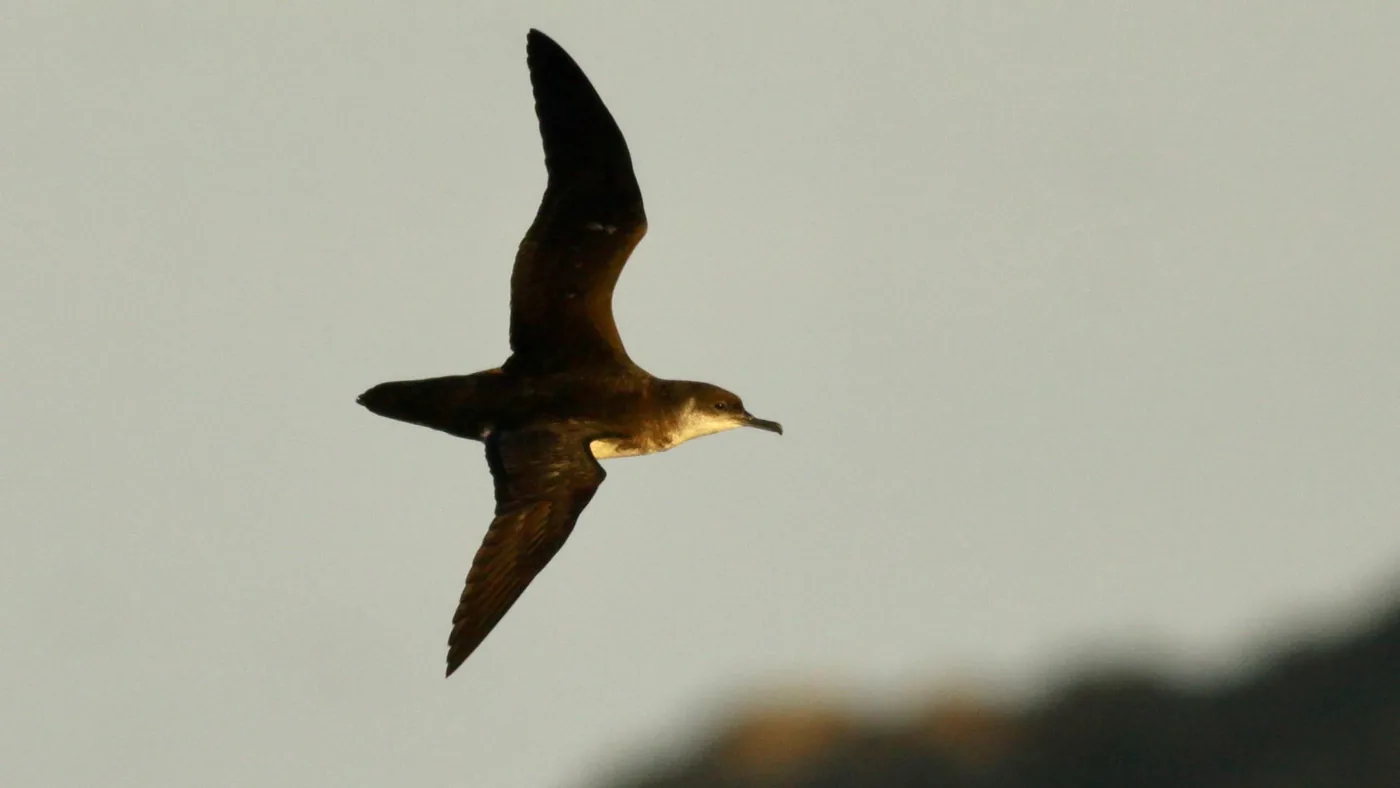
Manx shearwaters breed in island colonies around the United Kingdom and Ireland. While rearing a chick, adult shearwaters fly more than 1,000 kilometers westward into the mid-Atlantic to gather food for their young [3]. As detailed in Science Advances, they glide over Atlantic waves using dynamic soaring to harvest kinetic energy from surface wind gradients [5].
Earth rotates through 15 degrees of longitude every hour, advancing solar time as a traveler moves east. When a Manx shearwater flies eastward at high speed across the Atlantic, local dawn and solar noon arrive sooner than its body clock expects. Because the bird relies on its clock to gauge the sun’s position, this mismatch produces seabird jet lag and nudges the bird off course during long homeward journeys [1].
Tracking Two Decades of Shearwater Foraging Trips
Testing whether wild fliers experience clock shifts required decades of tracking effort over vast oceanic expanses. Over twenty years, Oxford biologist Tim Guilford and his colleagues fitted 1,045 breeding Manx shearwaters with miniature GPS tracking units that recorded high-resolution flight paths during extended ocean journeys [2]. The devices logged flights during nearly 4,000 foraging trips from colonies in the United Kingdom to feeding waters in the western Atlantic [3]. Testing theoretical predictions of compass disruption in free-ranging birds “has seemed impossible until now,” said Guilford [2]. The large dataset provided researchers with a clear opportunity to compare predicted solar navigation errors against actual animal flight tracks recorded under natural marine conditions [1].
The Oxford research team isolated 1,837 continuous homeward flights where adult shearwaters flew straight back toward their nesting burrows in the United Kingdom [2]. Once the birds feed, they head east across the Atlantic in an unbroken line, diverting only to skirt around landmasses like Ireland before reaching colonies [3].
Alternative navigational senses could not account for the observed flight deviations. While many bird species sense Earth’s geomagnetic field, Manx shearwaters do not rely on magnetic compasses. In a study published in Current Biology, Patrick Lewin and Tim Guilford attached small magnets to Manx shearwaters to disrupt geomagnetic reception, but the magnets had no effect on flight paths [4]. “The one thing that best predicted the observed changes in shearwaters’ orientation was always this sun compass effect,” said Lewin [3].
The Mechanics of the Avian Sun Compass
How does a Manx shearwater maintain a steady bearing across thousands of kilometers of open ocean? The answer lies in solar navigation. A sun compass allows an animal to steer by calculating its flight angle relative to the sun, but because the sun sweeps through the sky between dawn and dusk, this guidance system depends entirely on an accurate body clock synchronized to local solar time [2]. In laboratory trials, resetting that clock with artificial light cycles sends birds in the wrong direction. Patrick Lewin pointed out that long Atlantic crossings created a natural experiment where shearwaters altered their own circadian timing by flying eastward faster than their body clocks could reset [3]. The birds navigated using a clock set to dawn at their mid-Atlantic feeding grounds [1].
The geometry of solar navigation explains why fast eastward travel causes predictable clockwise errors. At 6 a.m., a Manx shearwater flying east toward its colony in the United Kingdom must head directly toward the rising sun. By noon, the sun sits due south, meaning an eastward flight path demands traveling at right angles to solar rays. But if the shearwater covers 15 degrees of longitude eastward across the Atlantic during the morning, local solar time reaches 1 p.m. while its body clock still registers noon. Expecting the sun to remain due south, the shearwater miscalculates the solar angle and veers in a clockwise direction [3]. The bird flies south of its intended line [1].


Coastal Landmarks and Predicted Compass Errors
GPS tracking confirmed that eastward-flying Manx shearwaters veered clockwise by as much as 15 degrees from their intended course [2]. This deviation peaked during midday flights over the open Atlantic, when the mathematical difference between local time and circadian expectation reached its widest point [1]. Far from shore, the birds followed their solar compass without visual correction [3].
The most surprising observation occurred when returning shearwaters arrived within sight of land near Ireland and the United Kingdom. Biologists anticipated that visual recognition of coastlines would prompt shearwaters to correct their heading and follow geographical contours. Yet the compass deviations remained visible even when birds flew near familiar shorelines. “But what really surprised us is that the small orientation errors … continue to be visible even when the birds were in sight of presumably familiar land,” said Tim Guilford. When predicted compass errors pointed seaward, shearwaters flew further from the coast; when the calculations pointed inland, the birds drifted closer to cliffs and beaches [2]. The fliers integrated solar cues with coastal landmarks instead of switching entirely to visual navigation [1].
Sangeeta Rani, a chronobiologist at the University of Lucknow in Lucknow, India, interpreted this behavioral tug-of-war as evidence of ecological resilience. Rani said that processing multiple navigation cues protects birds if environmental changes alter familiar landmarks. “After all, if I have marked a path for myself in the woods, my innate ability is not to mindlessly follow the markings,” said Rani [2]. “It is to find out what’s missing and still find my way back.”

Why Seabird Jet Lag Does Not Stop Homing
Despite the measurable orientation shift, the practical cost of seabird jet lag is very small. After a 1,000-kilometer ocean flight, the compass deviation forces a returning shearwater to travel roughly an extra 5 km to reach its breeding burrow in the United Kingdom. For efficient ocean gliders, that extra distance adds negligible energy expenditure [3].
Ken Cheng, a behavioral biologist at Macquarie University in Sydney, pointed to the empirical value of analyzing thousands of real flight tracks collected over decades of field observation. “What is good about the study is that they analyse a lot of tracks, making for robust data to test different models,” said Cheng. Cheng pointed out that typical bird migrations follow north-south pathways between breeding grounds and wintering quarters. Because north-south travel keeps animals within similar longitudes, local solar time changes very little during flight, leaving internal compasses aligned with the sun. Patrick Lewin explained that because the extra flight distance is so small, natural selection never produced a specialized physiological adaptation to eliminate jet lag in Manx shearwaters (Puffinus puffinus) [3].
Chronobiological mechanisms place firm boundaries on animal navigation. Cellular clocks adjust slowly to changing light because molecular feedback loops can’t reset in an afternoon, meaning even wide-ranging seabirds that cross ocean basins at remarkable speeds cannot simply reset their pacemakers at will [1]. Instead of resetting, their bodies maintain an accurate memory of departure coordinates, accepting minor navigational detours as a small trade-off for an otherwise dependable solar compass [2].
Implications for Polar Wildlife and Navigational Models
While temperate birds rarely cross time zones fast enough to experience severe disorientation, polar wildlife faces very different geometric rules. Near the poles, lines of longitude draw closer together, meaning an animal can cross 15 degrees of longitude in a fraction of the distance needed at lower latitudes. Patrick Lewin suggested that Arctic animals traveling on sea ice, such as polar bears and Arctic foxes, might experience noticeable circadian time shifts during routine movements. “Near-polar species may be quite strongly affected,” said Lewin [3].
Testing clock shifts in polar regions must account for unusual daylight patterns. High latitudes experience 24-hour summer sunlight and uninterrupted winter darkness, conditions that alter circadian cycles in many resident species. “Now, it all gets a bit complicated because you have 24-hour daylight and 24-hour darkness in parts of the year, so circadian rhythms break down generally in some species,” said Lewin [3].
The Oxford study opens a new avenue for chronobiology in wild animal populations [1]. Documenting seabird jet lag across thousands of natural foraging flights proves that endogenous circadian clocks shape animal movement in the wild, even when birds fly in plain view of familiar coastlines [2]. As tracking technology improves, researchers can measure how other ocean fliers handle similar time zone discrepancies [3]. For the Manx shearwater, a minor clockwise detour across the Atlantic is simply the price of steering by the sun [1].
- ACADEMIC JOURNAL Lewin, P., Wynn, J., Morford, J., Padget, O., Lancaster-Reeves, L., Siddiqi-Davies, K., Bailey, H., Bond, S., Davis, M., Dean, B., Fayet, A. L., Freeman, R., Gillies, N., Harris, S. M., Jaggers, P., Kirk, H., Maurice, L., Morgan, E., Nisbet, C.,. Guilford, T. (2026). Rapid longitudinal flights cause time shifts and Sun compass error. Science, 394(6823), 520-524. [Article Link]
- ONLINE NEWS Mukhopadhyay, A. (2026, October 29). Seabirds get jet lag, too — and it can throw them a bit off course. Science News. [Article Link]
- ONLINE NEWS Le Page, M. (2026, October 29). Birds can get jet lag on long, fast flights and then fly off course. New Scientist. [Article Link]
- ACADEMIC JOURNAL Lewin, P., Bond, S., Padget, O., Harris, S. M., Lancaster-Reeves, L., de Boer, M., Serafini, P. P., Hughes, G., Wynn, J., Morford, J., & Guilford, T. (2026). Free-ranging Manx shearwaters do not rely on magnetic maps or compasses. Current Biology, 36(19), 5079-5087.e3. [Article Link]
- ACADEMIC JOURNAL Kempton, J. A., Wynn, J., Bond, S., Evry, J., Fayet, A. L., Gillies, N., Guilford, T., Kavelaars, M., Juarez-Martinez, I., Padget, O., Rutz, C., Shoji, A., Syposz, M., & Taylor, G. K. (2022). Optimization of dynamic soaring in a flap-gliding seabird affects its large-scale distribution at sea. Science Advances, 8(22). [Article Link]
APA 7: PerEXP Teamworks. (2026, October 30). Manx Shearwaters Suffer Seabird Jet Lag on Fast Ocean Crossings. PerEXP Teamworks. https://perexpteamworks.com/en/seabird-jet-lag-flight-navigation/


