






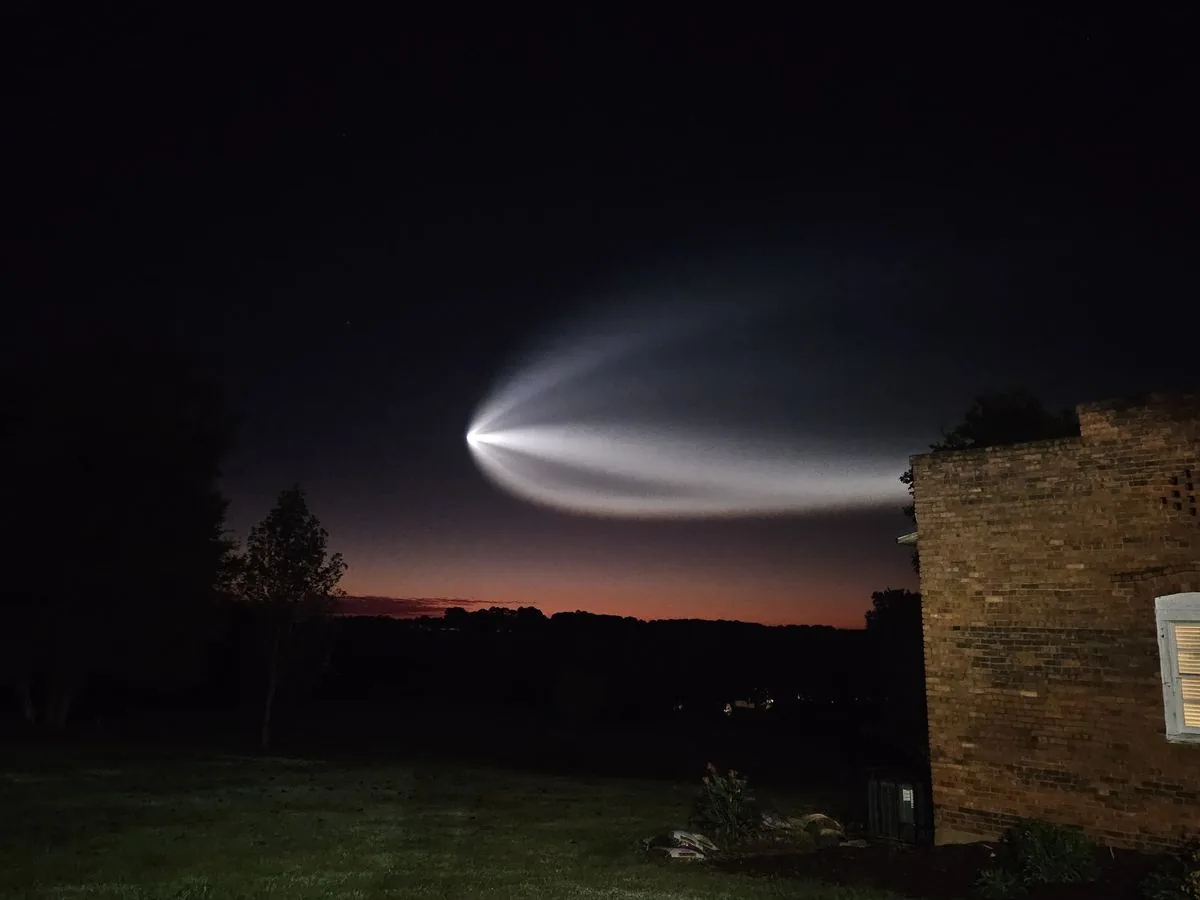
Why did a glowing shape drift over the Atlantic shoreline before sunrise on October 13, 2026? The sight was a Space Jellyfish (an optical twilight effect created by high-altitude rocket exhaust), formed when a SpaceX Falcon 9 rocket lifted off from Space Launch Complex 40 at Cape Canaveral Space Force Station in Florida [1]. Sunlight caught the expanding plume high above Earth while the ground stayed dark. The CRS-35 mission sent an illuminated trail along the eastern coast at 6:35 a.m. EDT [2].
What Is a Space Jellyfish?
A Space Jellyfish is an optical phenomenon that happens when sunlight illuminates rocket exhaust gases in the upper atmosphere while ground observers remain in twilight [4]. The effect needs a specific mix of launch timing and altitude. When a rocket ascends about 40 minutes before sunrise or shortly after sunset, it climbs out of Earth’s shadow into direct sunlight [6].
NASA’s Kennedy Space Center explained the display in a public post after receiving inquiries from observers situated across several coastal states. “Many of you are talking about the ‘space jellyfish’ following this morning’s launch from Space Launch Complex 40 at Cape Canaveral Space Force Station in Florida,” the center said, pointing out that exhaust plumes become luminous when hit by sunlight during dawn or dusk liftoffs [2]. Optical scattering turns the expelled gas into a glowing cloud that looks like a translucent sea creature drifting through space. Although observers often mistake the spectacle for a comet or an exploding aircraft, the glowing cloud consists primarily of water vapor and carbon dioxide catching morning sunlight high above the Atlantic [4].
Early risers across Florida and Georgia watched the cloud expand within minutes of the predawn liftoff. The Weather Channel reported that morning timing made all the difference for skywatchers across the Southeast, where dark skies created clear contrast against the sunlit plume [5]. Similar sightings have accompanied previous dawn flights, yet each display changes shape depending on high-altitude winds [4].
Why Rocket Plumes Expand in Sunlight
The main reason the exhaust plume grows so wide at high altitude comes down to ambient air pressure. Near sea level, heavy atmospheric pressure keeps rocket exhaust confined to a narrow trail behind the engines [4]. As the Falcon 9 climbs into thinner, less dense air at high altitude, surrounding pressure drops close to zero, allowing hot exhaust gas to expand outward in all directions [2].
Without dense air pushing back against the engines, the expelled gas quickly spreads until it becomes hundreds of times wider than the rocket itself [2]. In the upper atmosphere, cold temperatures freeze water vapor produced by rocket combustion into tiny ice crystals. These frozen crystals scatter sunlight through Mie scattering, creating a luminous cone that reflects bright dawn rays while the land beneath remains dark [4]. Samantha Neely reported in Florida Today that this high-altitude reflection allows spectators located hundreds of miles from Cape Canaveral to spot the glowing plume without binoculars [6]. The resulting cloud forms a wide glowing bell behind the vehicle [4].
Timing determines whether observers on the ground can see the glowing cloud. If a rocket launches in full daylight, bright sunlight washes out the faint exhaust glow against the blue sky. If liftoff occurs in the dead of night, no solar rays reach the upper atmosphere to light the expanding gas [7]. Twilight provides the sole lighting condition that makes the cloud visible [4].
Falcon 9 Stage Separation and Booster Return
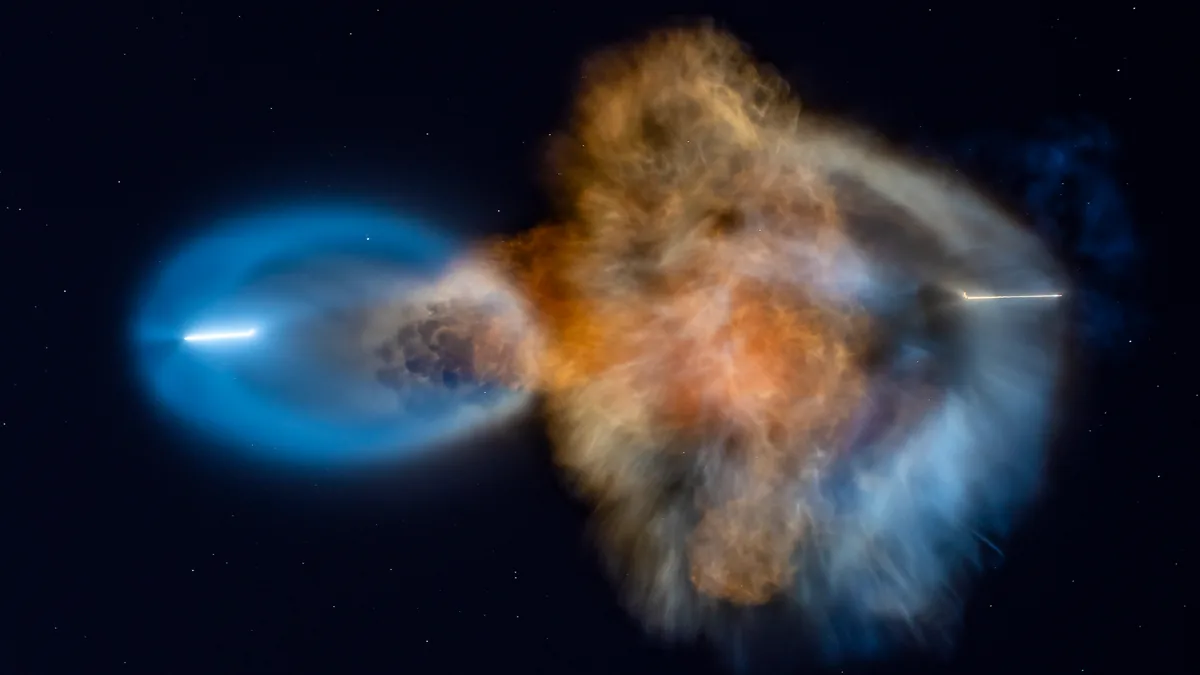
The display reached its brightest point about 2.5 minutes after liftoff, when the Falcon 9 completed its first-stage separation [2]. High above the Atlantic Ocean, the first-stage booster shut down its nine Merlin engines and detached from the second stage [4]. Spectators on the ground saw the single glowing cloud separate into distinct pulses of light as cold-gas thrusters flipped the booster around [2].
In Durham, North Carolina, skywatcher Richard Mack Wilson-Leigh spotted the flight just before the stages separated. “At first, I thought it was a comet,” Wilson-Leigh told Space.com, adding that the sudden flare made him briefly wonder if the rocket had exploded before he recognized the staging burn [2]. The booster then fired its engines to head back toward Cape Canaveral’s Landing Zone 40 [7].
Booster recovery has become a routine feature of SpaceX operations, but watching a rocket stage maneuver under dawn sunlight remains a memorable experience for coastal observers. Unlike expendable rockets that fall into the ocean, the Falcon 9 booster guided itself down to touch down safely at the Cape, allowing technicians to inspect, refurbish, and reuse the flight hardware on future missions [4]. Flight profiles like the First Starship Orbital Flight Set for September 22 Liftoff show how ascent paths and engine burns create distinct visual signs depending on vehicle size [2]. On this morning flight, the booster touched down at Landing Zone 40 while the second stage sped onward [7].


Why the Space Jellyfish Effect Traveled North
The reason the Space Jellyfish effect became visible far outside Florida comes down to orbital mechanics. To rendezvous with the International Space Station, the Falcon 9 did not fly due east into the open ocean. Instead, it followed a northeast trajectory aligned with the space station’s orbital plane, flying parallel to the Atlantic coastline as it gained altitude [2].
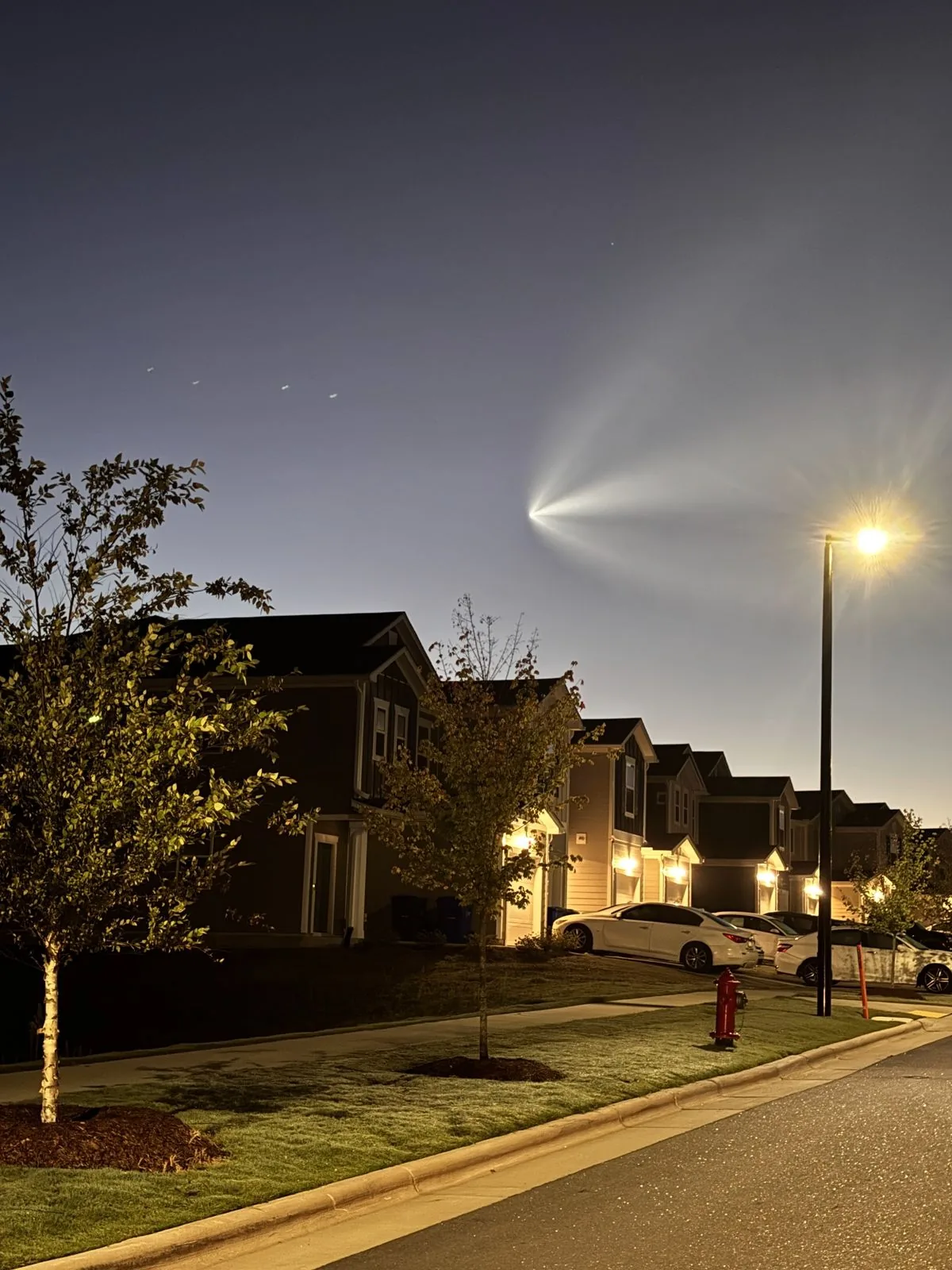
Because the rocket climbed high into direct sunlight while the ground remained in shadow, its illuminated plume rose above the curvature of the Earth, allowing skywatchers across multiple states to view the display [4]. In Colbert, Georgia, resident Ellen Alence photographed the glowing trail from her farm after stepping outside to let her dogs out early in the morning [2]. Near St. Augustine, Florida, storm chaser Aaron Rigsby recorded drone footage of the glowing cloud passing above the historic St. Augustine Lighthouse. Sizable crowds also reported seeing the plume in Knoxville, Tennessee, where photographer Camden Hall documented the trail over the Tennessee River, and as far north as Washington, D.C. [7]. CNN reported that clear autumn skies across the East Coast provided ideal viewing conditions for early risers [3].

Dragon CRS-35 Cargo and Space Station Science
Behind the morning sky display, the flight carried out an essential logistics mission for NASA. The launch marked SpaceX’s 35th commercial resupply run to the orbiting laboratory under its Commercial Resupply Services contract [6]. Inside the Dragon spacecraft, ground crews packed approximately 6,300 pounds (2,860 kilograms) of crew supplies, spare parts, and experimental gear [2].
Florida Today reported that the manifest totaled roughly 6,500 pounds of cargo, including a student science experiment developed at Florida Tech in Melbourne [6]. The new supplies arrived during a crew transition period aboard the station, following the arrival of Crew-13 on October 1, 2026, and the safe Earth return of Crew-12 on October 8 [2]. The hardware supports dozens of scientific studies conducted in microgravity [4].
Dragon spent about two days chasing down the orbital outpost before performing an automated approach and docking sequence. NASA scheduled the capsule to dock at the space-facing port of the Harmony module at approximately 11 a.m. EDT (1500 GMT) on Thursday, October 15, with agency coverage beginning at 9:15 a.m. EDT [2]. While NASA Selects SpaceX Falcon 9 for StarBurst Mission astrophysics payloads under specialized research awards, regular resupply flights like CRS-35 ensure that the station crew receives fresh food, maintenance equipment, and new lab hardware on a predictable schedule [4].
How to Spot a Space Jellyfish Cloud
Catching a Space Jellyfish cloud in person requires tracking launch windows and paying close attention to local weather. The single most important factor is liftoff timing relative to the sun [4]. Because the phenomenon depends entirely on twilight contrast, flights scheduled about 40 minutes before sunrise or around sunset offer the best chances of seeing an illuminated plume [7].
Launch trajectory also determines which coastal communities can witness the display. Cape Canaveral missions that head northeast along the US East Coast remain visible to spectators across Florida, Georgia, and the Carolinas if local skies stay clear of low clouds [4]. Flights heading due east over the ocean or launching into thick cloud cover pass unseen by most land-based observers. Space.com writer Josh Dinner, who has covered Space Coast launches since 2016, noted that tracking morning mission schedules gives skywatchers their best shot at catching these brief optical events [2]. Checking official SpaceX launch updates before dawn helps observers step outside at the right moment [4].
Spectators should look toward the launch site from open areas away from streetlights to get a clear view of the horizon. NASA and local law enforcement remind skywatchers to view flights from designated public spaces rather than stopping along busy highways or trespassing near launch pads. Understanding the mechanics behind the glowing gas turns an unexpected sky sighting into an exciting demonstration of orbital rocketry [4].
- ONLINE NEWS Guardian Staff. (2026, October 14). SpaceX rocket launch creates glowing ‘space jellyfish’ cloud – video. The Guardian. [Article Link]
- ONLINE NEWS Dinner, J. (2026, October 13). SpaceX rocket launch creates incredible ‘space jellyfish’ visible throughout US East Coast. Space.com. [Article Link]
- ONLINE NEWS Balbiyar, W. (2026, October 13). SpaceX launch creates glowing ‘jellyfish’ plume over Florida. CNN. [Article Link]
- ONLINE NEWS Enrico, J. (2026, October 14). SpaceX Falcon 9 launch lights up dawn sky with a glowing ‘space jellyfish’. Tech Times. [Article Link]
- ONLINE NEWS The Weather Channel. (2026, October 13). SpaceX Falcon 9 launch creates jellyfish cloud over southern sky. The Weather Channel. [Article Link]
- ONLINE NEWS Neely, S. (2026, October 13). What was that in the sky? SpaceX pre-dawn launch creates skyward wonder. Florida Today. [Article Link]
- ONLINE NEWS Speck, E. (2026, October 13). Drone video: SpaceX ‘jellyfish’ glows above St. Augustine Lighthouse. Yahoo Tech. [Article Link]
APA 7: TWs Editor. (2026, October 15). SpaceX Falcon 9 launch creates a glowing space jellyfish. PerEXP Teamworks. https://perexpteamworks.com/en/space-jellyfish-spacex-falcon-launch/


