




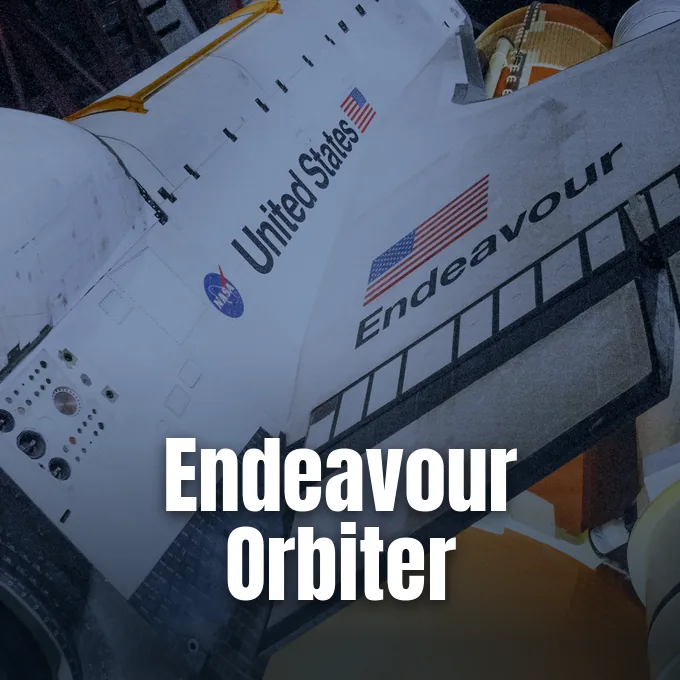
The California Science Center has officially opened the Samuel Oschin Air & Space Center in Los Angeles, giving the public access to its newest building after more than three decades of planning and construction work. Visitors can now view the retired space shuttle Endeavour standing upright in its complete launch configuration, reaching a height of nearly 200 feet (61 meters). Former NASA astronaut Garrett Reisman toured the site during a media preview, reflecting on his own spaceflight career while viewing the orbiter from the newly constructed display platforms. The massive facility welcomes guests free of charge, but online reservations carry small fees during early peak attendance [1].
Opening of the Samuel Oschin Pavilion
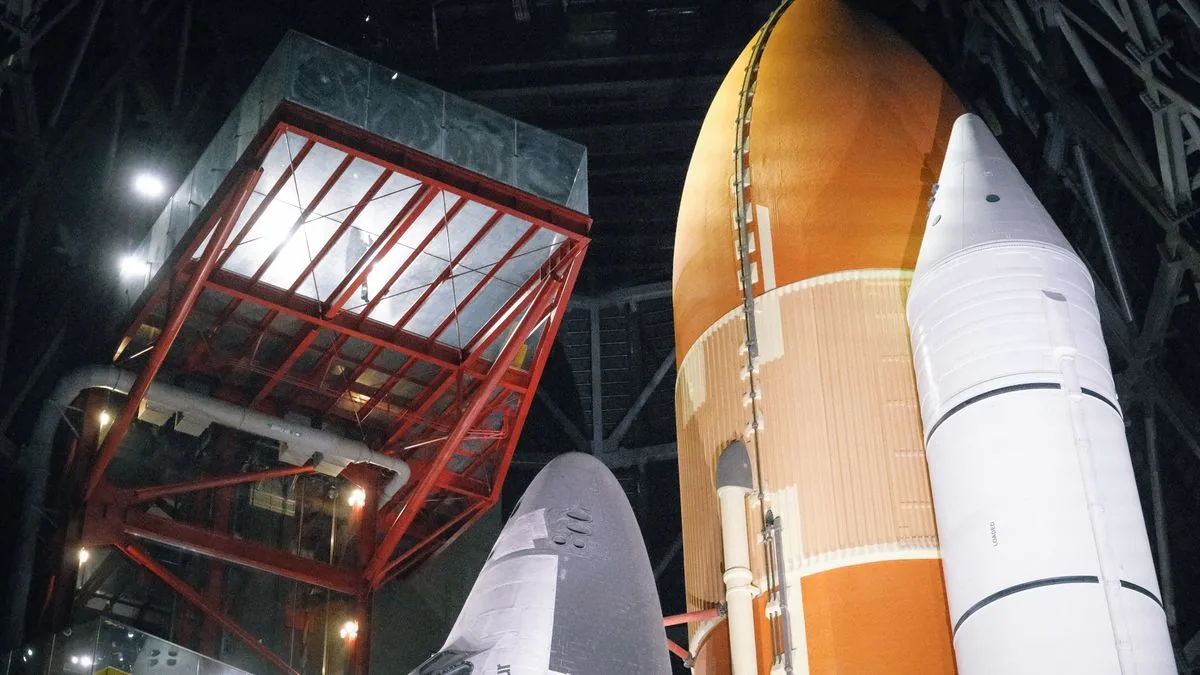
The California Science Center opened the Samuel Oschin Air & Space Center on Nov. 13 after finishing work that required more than 30 years of development. Reporters attended an advance preview on Oct. 28 to view the building before public tours began. The vehicle stands upright on a simulated launchpad [1].
The orbiter rises 61 meters into the air, creating a dramatic viewing space where visitors can walk through multiple floors to inspect the exterior tiles and propulsion systems from different elevations. Garrett Reisman, who flew on two shuttle missions during his NASA career, visited the Los Angeles museum before the official opening to examine the new gallery spaces. He described his immediate reaction upon seeing the massive spacecraft standing in launch posture during a tour with reporters. “It just takes your breath away when you see that reveal and the doors open and you get to look at it for the first time. It’s just — it’s overwhelming,” Reisman said [1].
Reisman explained that the gallery offers guests from around the globe an opportunity to examine genuine spaceflight hardware up close in Southern California. “The exposure it’s going to have is just a force multiplier. There are so many people that can have that opportunity to bring their kids here and show them [the shuttle] and have that experience,” Reisman said [1].
Exhibits Around Space Shuttle Endeavour
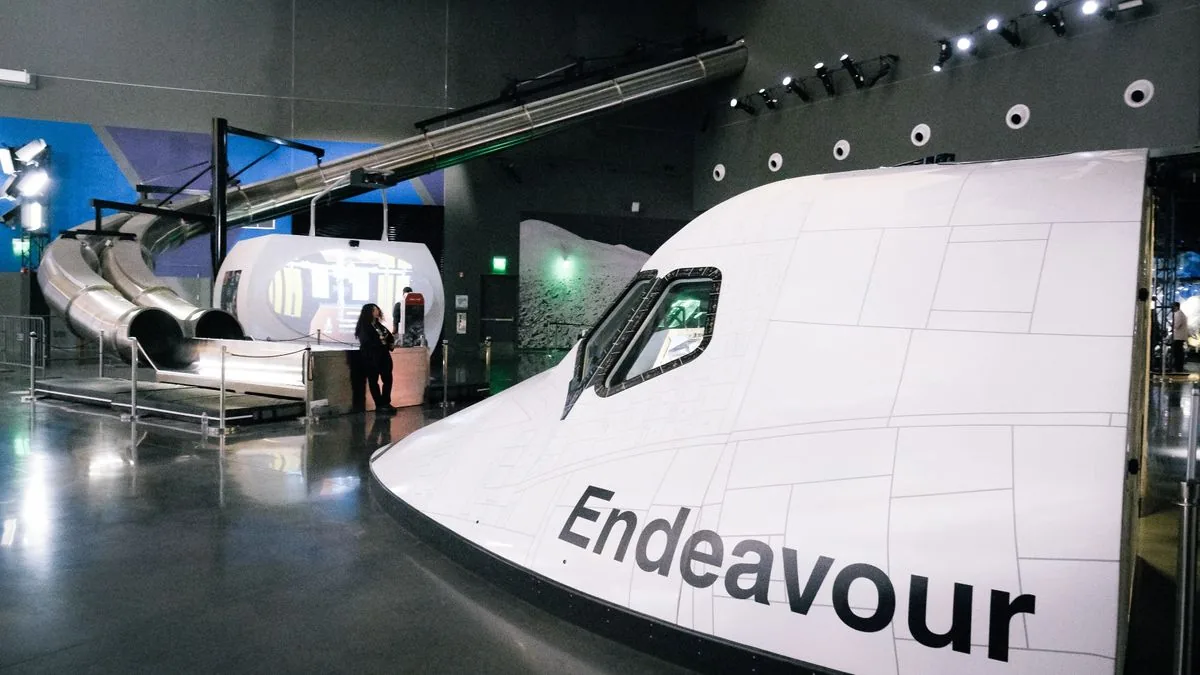
The California Science Center built several interactive stations around the base of the orbiter to help visitors learn about orbital flight mechanics, launch procedures, and spacecraft operations. Guests can descend to the ground floor using an indoor slide, but they can also take stairs or an elevator to explore the surrounding hall. The gallery includes a shuttle landing simulator where people can test their piloting skills, with tires used during flown orbital missions and space hardware gathered from earlier flights. These displays explain the engineering needed to return crews safely through atmospheric entry, giving visitors practical context for each piece of flight hardware. Hands-on stations surround the lower deck [1].
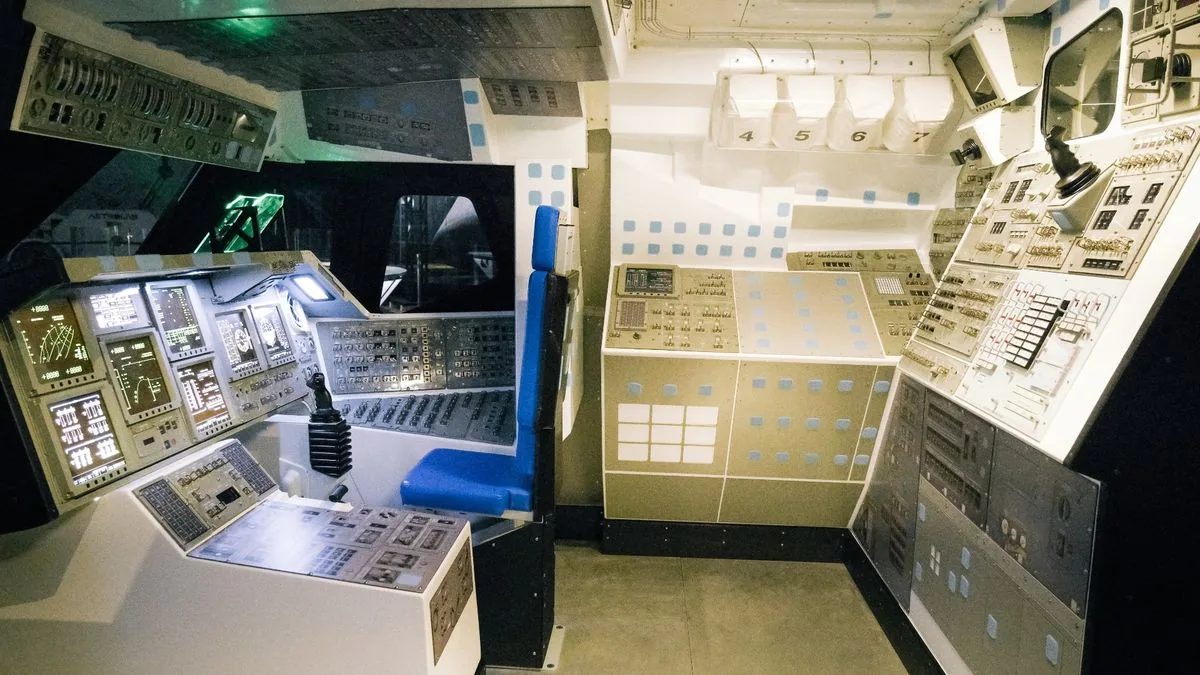
Visitors can also sit inside a detailed replica of a flight deck to see the switches and computer consoles that pilots used. The replica gives guests a close look at the cockpit layout that guided missions into orbit. It reflects early shuttle avionics design [1].
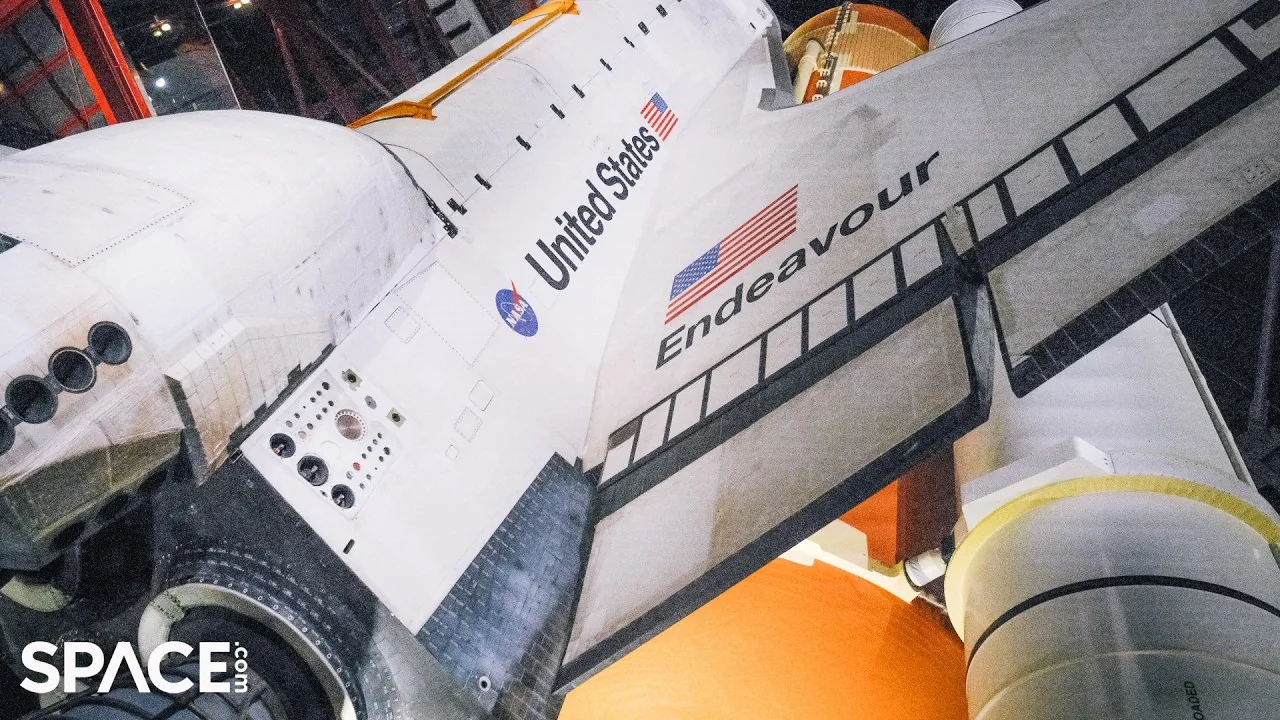
In the center of the hall, the genuine space shuttle Endeavour stands with its payload bay doors opened, allowing people to look inside at the robotic arm packed with handles, straps, and electronic gear. Visitors can walk directly underneath the three main rocket engines to inspect the heat shielding, or take an elevator up the launch tower to come face-to-face with the nose of the orbiter. At the very top of the building, a transparent floor allows guests to look down onto the spacecraft from above. Looking down offers a clear perspective on the full vehicle [1].
Astronaut Spacewalk Memories and Public Access
Walking through the elevated platforms of the launch tower brought back personal memories for Reisman as he examined the exterior hull of the orbiter. He recognized components of the vehicle that he had relied on while working outside the cabin. “I’m looking at handrails that I held onto during a spacewalk,” he said [1].
Reisman had spent months rehearsing his spacewalk movements in simulation pools to prepare for the orbital assignment before flying into orbit aboard Endeavour. “They’re the same handrails. My hand was in the glove, but it was wrapped around those handrails. And I practiced for a long time exactly how I was going to do that, how I was going to root my tether, and all that kind of stuff. And I get to stand [here] now. When you go up the elevator there, you can actually have a direct view of those handrails, and every time I see that, I’m thinking about that spacewalk,” Reisman said [1].
Admission to the California Science Center remains free of charge, and general entry to the Samuel Oschin Air & Space Center carries no admission fee under regular museum schedules. However, high visitor demand during the opening weeks requires people to reserve timed entry passes through an online reservation system. Those advance reservation slots carry small processing fees during the initial opening phase [1].
Flight History of Space Shuttle Endeavour
Before finding a permanent home in Los Angeles, the space shuttle Endeavour served NASA as one of the workhorses of the American spaceflight fleet. The orbiter flew 25 missions to Earth orbit between 1992 and 2011, spending hundreds of days in space to construct the International Space Station and service orbital hardware. It carried dozens of astronauts during those two decades of service, supporting research experiments and satellite deployments across low Earth orbit. Crews carried out critical maintenance tasks on orbit during those journeys. The shuttle completed thousands of orbits around the planet [1].
NASA retired its space shuttle fleet in 2011, ending thirty years of winged orbiter flights and beginning the process of placing the vehicles in museums around the United States. The California Science Center secured Endeavour and planned a dedicated facility to show the spacecraft in an upright launch posture instead of a flat landing stance. The transition took years of planning [1].
Moving the shuttle to Los Angeles and constructing the 200-foot hall took years of engineering work before visitors could finally enter the building. Reisman noted that visitors traveling to Southern California will now see the genuine orbiter from angles that were once accessible only to flight crews and technicians. The vertical exhibit preserves the legacy of the spacecraft while offering educational activities for students and space enthusiasts alike. Looking at the full stack lets students see how rocket components connected to the orbiter during flight. The towering display illustrates the scale of crewed space exploration [1].
British Television and the Morse Legacy
While the orbiter was known for its flights into space, the moniker Endeavour also achieved lasting recognition on British television through a detective drama on ITV. The television series Endeavour served as a prequel to the long-running mystery program Inspector Morse, which originally aired from 1987 to 2000, and its spin-off drama Lewis, which ran from 2006 to 2015 [2].
Actor Shaun Evans starred in the title role as the young Endeavour Morse, depicting the character’s early professional years as a detective constable and later as a detective sergeant. The stories followed Morse as he worked with the Oxford City Police CID, solving complex murder inquiries across the university town. The production spanned a total of nine series set between 1965 and 1972, examining how the young detective developed his deductive skills. In the series narrative, Morse had left Lonsdale College at Oxford University during his third year without finishing his degree, briefly serving in the Royal Corps of Signals as a cipher clerk before joining the police [2].
The television project began with a standalone pilot episode broadcast in 2012, which was set in the year 1965 and introduced viewers to the young constable’s investigative methods. ITV then commissioned a full first series that aired in 2013, continuing the 1965 narrative. Subsequent series advanced the timeline year by year [2].
Detective Morse Narrative in Oxford
In the 2012 pilot story, Morse considered resigning from law enforcement before receiving a transfer to the Cowley Police Station in Oxford to assist with a missing 15-year-old schoolgirl case. At Cowley station, veteran Detective Inspector Fred Thursday, played by actor Roger Allam, recognized the young constable’s investigative talents and chose him as his official aide, or “bagman.” Thursday guided Morse through complicated murder investigations, shielding him from friction with senior officers such as Detective Sergeant Jakes and Chief Superintendent Bright. Morse relied on his knowledge of academic culture and opera to unravel intricate cases that baffled other detectives [2].
Following the pilot, the second series was set in 1966, both the third and fourth series were set in 1967, and a six-episode fifth series took place in 1968. The sixth series picked up eight months later, set in 1969. The chronological progression reflected evolving social settings across Oxford [2].
The drama continued with series seven set in 1970, which screened in February 2020 and aired on Masterpiece Theatre in the United States on August 9 of that year. Series eight was set in 1971, filming between March and June 2021. Filming for the ninth series, set in 1972, began on May 22, 2022, and ended on August 26, 2022. The final three episodes aired on ITV between Feb. 26 and March 12, 2023, concluding the detective drama before broadcasting in the United States on June 18, 2023 [2].
- ONLINE NEWS Gohd, C. (2026). California’s brand-new Air & Space Center, home of the space shuttle Endeavour, opens today. Space.com. [Article Link]
- WEBSITE Wikipedia. (2023). Endeavour (TV series). [Article Link]
APA 7: PerEXP Teamworks. (2026, November 14). Space Shuttle Endeavour Exhibit Opens at California Center. PerEXP Teamworks. https://perexpteamworks.com/en/space-shuttle-endeavour-california-center/


