



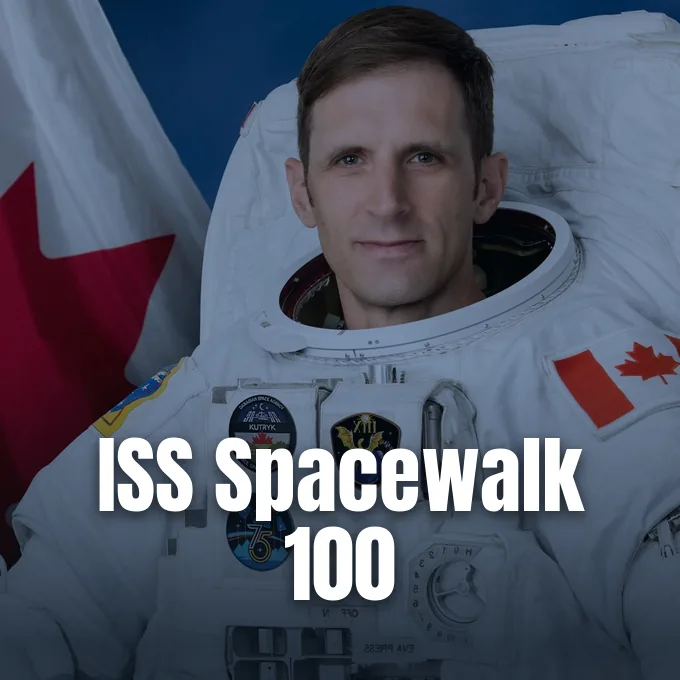
Astronauts Anil Menon and Joshua Kutryk floated out of the Quest airlock on Thursday, October 29, 2026, to attach a new solar wing to the orbiting laboratory. The scheduled six-hour excursion marks the 100th venture conducted from that airlock without a space shuttle docked at the outpost [3]. Moving along the exterior truss roughly 260 miles above Earth, the two astronauts set out to install the seventh roll-out solar array, raising total electrical output for upcoming station research. This ISS spacewalk brings the Canadian Space Agency back into outer station assembly while giving the complex extra energy to run scientific modules until its planned retirement in 2030 [2].
The 100th ISS Spacewalk
The hatch opened around 8 a.m. EDT (1200 GMT) after both crew members completed pre-breathe protocols inside Quest [2]. Live broadcast coverage began 90 minutes earlier through the free NASA+ streaming service and YouTube [4]. The outing stands as the 285th spacewalk in station history and the eighth excursion staged outside the habitat during 2026 [3].
NASA designated the operation as U.S. Spacewalk 100 because it represents the centenary extravehicular outing run from the Quest airlock in the absence of a visiting space shuttle. The station orbits Earth at approximately 17,500 mph, where even tiny specks of micrometeorite debris pose hazards to pressurized suits during long tasks [3]. Menon, 43, is a flight surgeon and an officer in the U.S. Air Force who reached orbit aboard a Roscosmos Soyuz MS-29 spacecraft in mid-July alongside Russian cosmonauts Pyotr Dubrov and Anna Kikina for an eight-month stay [5]. He previously logged three summer outings. Kutryk, 44, a Royal Canadian Air Force colonel who arrived on Crew-13, stepped into the vacuum for his first orbital outing [2].
Nearly two months passed without an excursion before this job began. The previous station walk occurred on September 1, when NASA astronaut Jessica Meir and European Space Agency astronaut Sophie Adenot worked together outside the hull before concluding their orbital expedition and returning home to Earth [5]. Thursday’s ISS spacewalk launched an intensive autumn maintenance campaign aimed at finishing outer power upgrades before winter traffic arrives [6].
New Roll-Out Solar Arrays
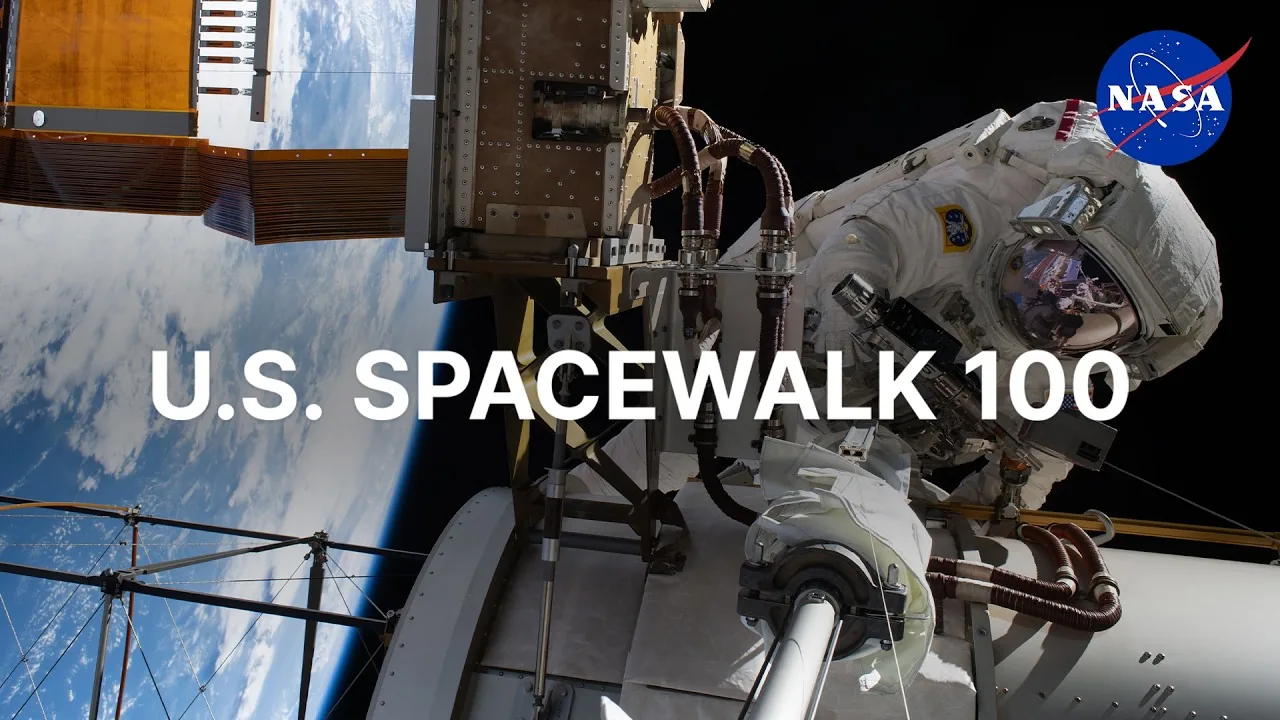
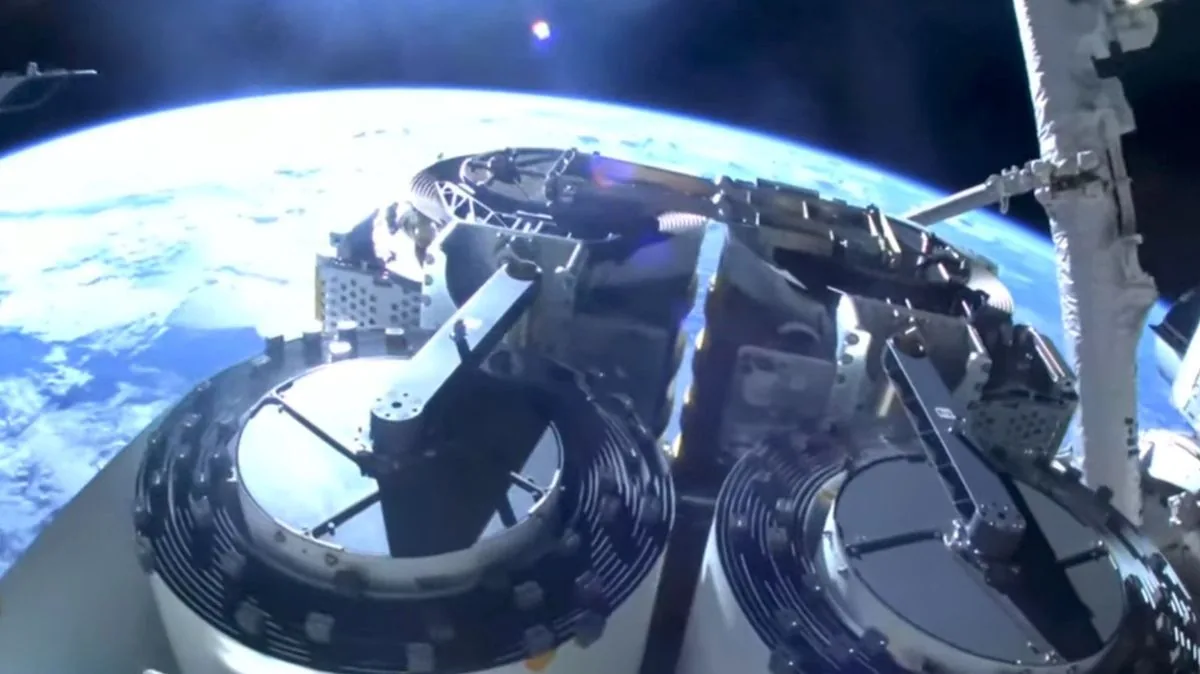
The main goal of the operation involves mounting a new International Space Station Roll-Out Solar Array, known as an iROSA [1]. The orbital complex relies on legacy silicon solar wings that launched in 2000, yet these primary channels have steadily degraded over decades of continuous exposure in space. NASA began installing flexible roll-out panels on top of the older structures in 2021 to restore energy generation. The ongoing campaign to add these panels is detailed in our coverage of how [NASA Spacewalks Will Complete Station Solar Array Upgrades](https://perexpteamworks.com/en/nasa-spacewalks-solar-array-upgrades/) on both sides of the truss. Each rolled-up wing measures 10 feet (3 meters) in length and weighs 750 pounds (340 kilograms) on Earth [2].
Spacewalk flight director Garrett Hehn said NASA regards the hardware as “a lot to handle” due to its mass. The crew relies on modification kits that bolted onto the station truss during earlier excursions. Once unlocked, stored tension allows the carbon-composite structure to roll out over the older solar blanket [2].
“These arrays, I kind of think of them like a snap bracelet,” Hehn said during a pre-flight news briefing. Magnets positioned along the edges supply enough force for the wing to unroll steadily without motor drives. The entire deployment run takes roughly 10 minutes once released. Unfurled, the panel reaches about 20 feet (6 meters) long [2]. NASA operations manager Gaurang Patel confirmed during an October 20 briefing that these additions increase station power generation by up to 30 percent, lifting total electrical output from 160 kilowatts to 215 kilowatts [3].
Moving the Wing with Canadarm2
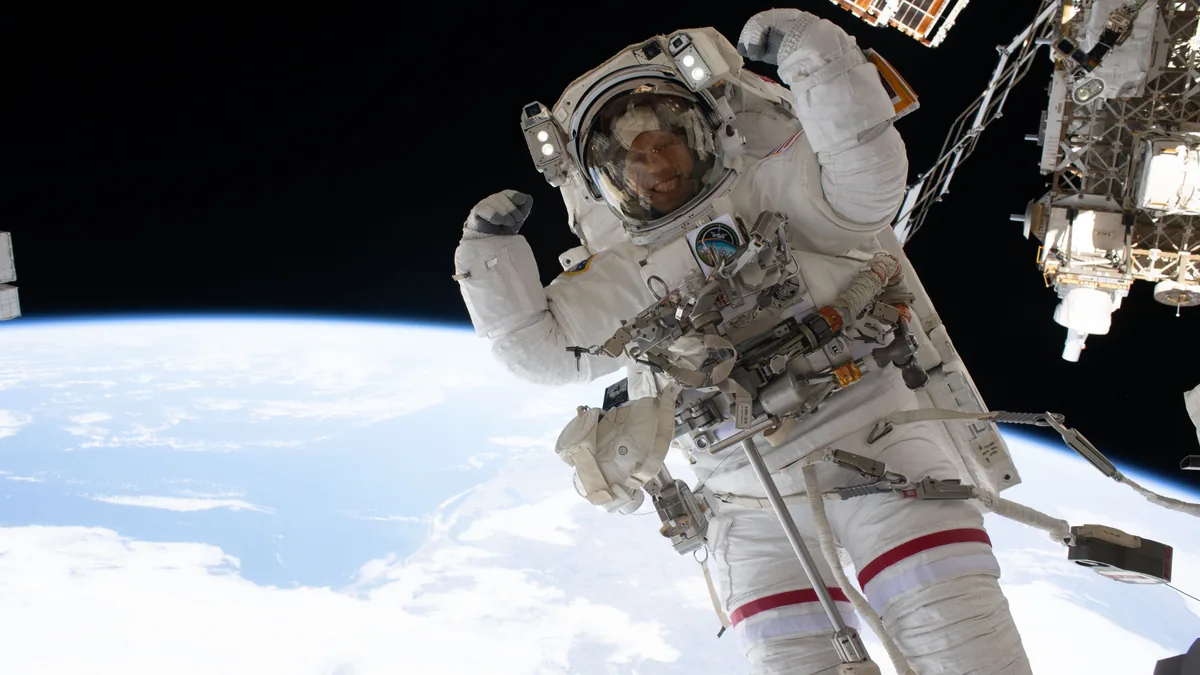
Handling a 750-pound solar wing outside needs close coordination with the Canadian robotic arm, Canadarm2. A SpaceX Dragon cargo capsule delivered two iROSA units to the orbiting outpost earlier in October. Ground flight controllers used the arm to retrieve the wings from the capsule trunk and park them on a mobile transporter rail [2].
Menon praised the robotic team on social platform X, stating that ground operators even used the arm to loosen mounting bolts before the crew stepped outside [2]. Inside the station, NASA flight engineers Jessica Watkins and Luke Delaney took over manual control of Canadarm2 to help the spacewalkers [6]. Menon stepped onto a foot restraint platform mounted on the arm tip, taking the folded solar wing into his hands while Watkins and Delaney pivoted the robotic boom toward the port-side truss. Kutryk moved separately along the handrails to meet him at the 2A power channel worksite [2]. Watkins and Delaney tracked every motion carefully.
Past excursions showed that swinging large payloads can tire astronauts quickly. Hehn said engineers designed “an elegant series of maneuvers” that rotated the array around its own center of mass rather than Menon’s body [2]. This procedural update reduced strain on the lead spacewalker as both crew members positioned the hardware onto the mounting bracket.


Why Night Passes Dictate Cable Work
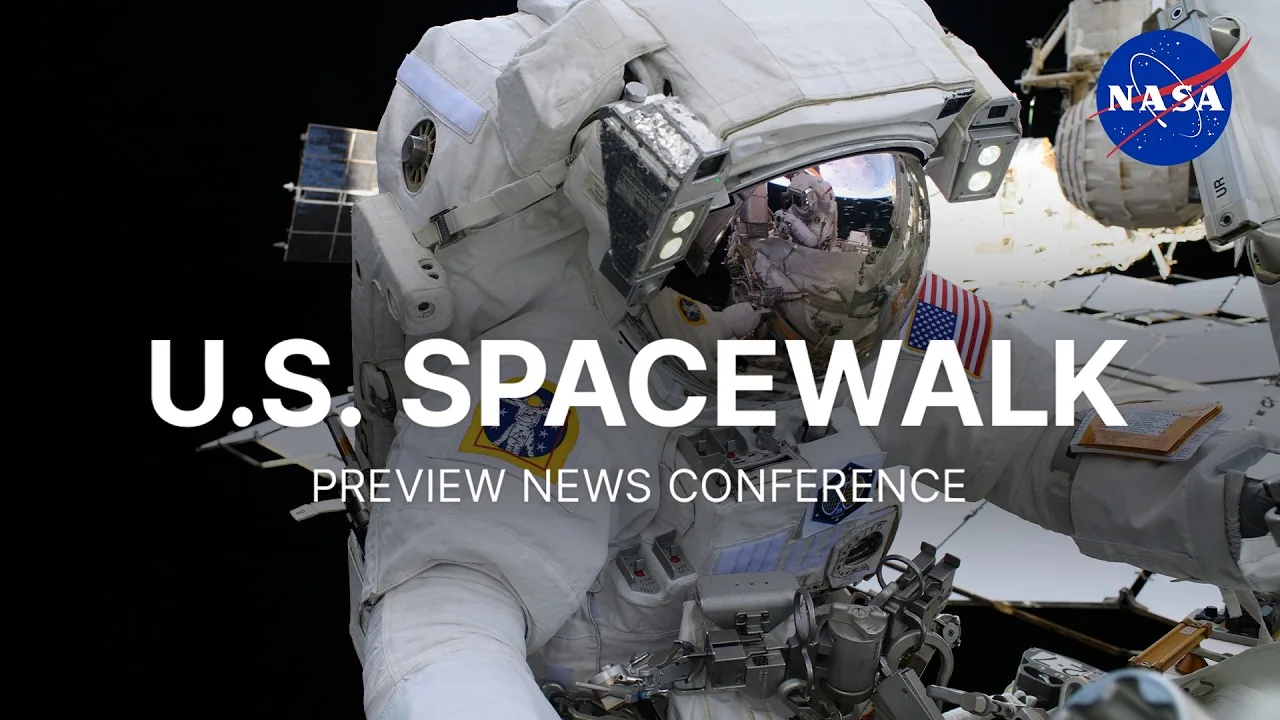
Why do spacewalkers wait for darkness to connect electrical lines? The space station circles Earth every 90 minutes, providing 45 minutes of daylight followed by 45 minutes of orbital night [4]. Solar panels generate high currents whenever sunlight strikes their cells. Touching energized connections poses serious hazards in orbit [2]. Timing is everything during power work.
“We can’t have any sun on the arrays, whenever we’re handling those hot cables,” Hehn explained before the spacewalk. The astronauts used a jumper assembly to combine the output of the legacy array with the new roll-out wing while the orbital lab flew through Earth’s shadow [2]. Working in pressurized spacesuit gloves demands steady exertion, where every hand grip feels like squeezing a stiff exercise spring [4]. The fatigue encountered during microgravity shifts connects with wider scientific investigations into [Astronaut Ageing Research: How Space Could Help Tackle Ageing on Earth](https://perexpteamworks.com/en/astronaut-ageing-research/) among long-duration orbital crews. Helmet lights illuminated their tools during the eclipse.
Once electrical connections were seated and verified, sunlight returned as the station crossed the terminator line. Ground controllers in Houston confirmed good power routing through the 2A channel. The new wing began feeding electricity into the station grid right on schedule [2]. Both spacewalkers paused briefly to check their tether hooks before packing up equipment [4].

Canada Returns to ISS Spacewalk Duties
Kutryk’s presence outside ended a seven-year hiatus for Canadian extravehicular activity. The Canadian Space Agency last conducted an orbital outing on April 8, 2019, when astronaut David Saint-Jacques stepped outside the complex with NASA astronaut Anne McClain during an extensive station maintenance excursion [2]. Kutryk is now the fifth Canadian astronaut to venture into open space [3]. Canada contributes 2.3 percent of the International Space Station partnership, which generally secures a flight opportunity every five or six years [2]. This milestone highlighted Canada’s enduring role during the ISS spacewalk series.
Kutryk originally expected to fly in 2024 aboard Boeing’s Starliner, but setbacks during Starliner’s crewed flight test pushed his flight assignment to Crew-13 in late 2026. His flight follows Jeremy Hansen’s assignment to the Artemis II lunar mission, marking the first time since 2009 that two Canadian astronauts launched within a single year. Back in 2009, Robert Thirsk carried out a long-duration station stay while Julie Payette visited aboard a space shuttle mission. CSA astronaut Jenni Gibbons, serving as capcom in Houston for Kutryk’s spacewalk, has also been selected as lead capcom for the upcoming Artemis III lunar landing test [2].
Canada coupled these crew milestones with new industry investments. The Canadian government pledged 20 million Canadian dollars ($14 million USD) to NordSpace for launch pad access in Newfoundland and Labrador. Another 200 million Canadian dollars ($140 million USD) went to Maritime Launch Services for a commercial launch complex in Nova Scotia [2].
Next Steps for Station Power
Thursday’s excursion represents only half of the autumn upgrade plan. Menon and Kutryk are scheduled to step outside again no earlier than November 5 to install the eighth and final iROSA unit. That second outing will focus on the starboard truss, supporting the station’s 3B electrical-power channel. Because the final installation site sits beyond the reach of Canadarm2, the spacewalkers must execute a coordinated leapfrog maneuver [2]. Kutryk will hold the wing while Menon repositions the platform.
During that future run, Kutryk will translate hand-over-hand to a truss-mounted workstation and take the 750-pound array from Menon’s grasp. Menon will then detach from the robotic arm platform, move the foot restraint to a different station truss socket, and step back on to secure the wing for final mounting. Hehn explained that this sequence is how the crew will “close that final distance that the robotic arm is unable to do on its own” [2]. These procedures build upon earlier station maintenance, such as when [ESA astronaut Sophie Adenot completed her record ISS mission](https://perexpteamworks.com/en/esa-astronaut-sophie-adenot-returns/) with Menon during two communication antenna replacement outings in August [4].
More than 290 spacefarers representing 26 nations have visited the orbital laboratory over its 25-year operational lifespan, including 174 astronauts from the United States who supported station assembly [5]. Completing the full roll-out array assembly guarantees that the laboratory retains adequate electrical margins for continuous scientific research. Once the final ISS spacewalk of this sequence concludes, the outpost will stand fully powered for its remaining years in orbit [3].
- ONLINE NEWS The Guardian. (2026, October 29). Astronauts step out of the ISS for spacewalk – watch live. [Article Link]
- ONLINE NEWS Howell, E. (2026, October 28). ISS astronaut will conduct Canada’s 1st spacewalk in 7 years on Oct. 29: Watch it live. Space.com. [Article Link]
- ONLINE NEWS Anglesey, A., & Leishman, F. (2026, October 29). NASA spacewalk live: Watch as astronauts catch stunning glimpses of Earth on seven hour ISS mission. Daily Mirror. [Article Link]
- WEBSITE Crotzer, R. (2026, July 28). How to Watch a NASA Spacewalk Live: Next Schedule & Streams. Outer Space Trip. [Article Link]
- ONLINE NEWS Lagatta, E. (2026, October 28). 2 astronauts prep for landmark spacewalk at ISS. Here’s what to expect. USA TODAY. [Article Link]
- ONLINE NEWS FOX 35 Digital Team. (2026, October 29). Watch: Astronauts conduct spacewalk at International Space Station. FOX 35 Orlando. [Article Link]
APA 7: PerEXP Teamworks. (2026, October 30). Astronauts Anil Menon and Joshua Kutryk Begin ISS Spacewalk. PerEXP Teamworks. https://perexpteamworks.com/en/iss-spacewalk-roll-out-solar-array/


