




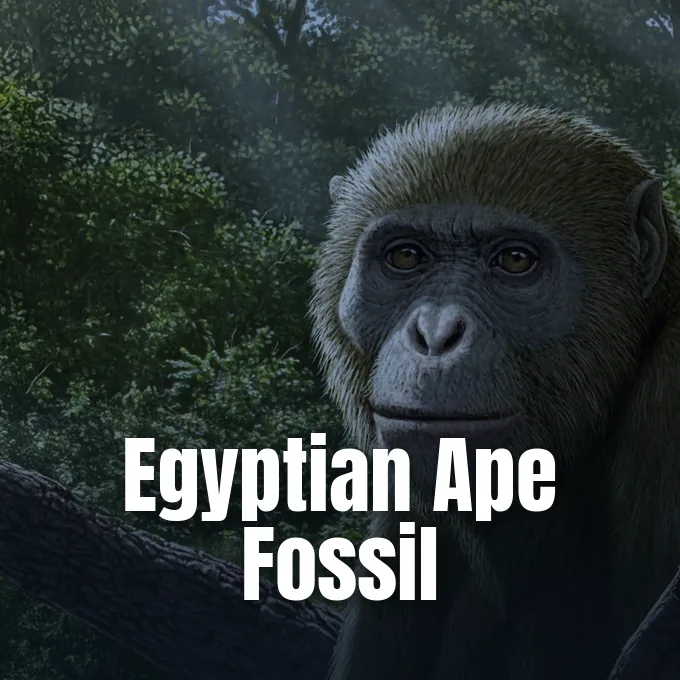
Paleontologists working in northern Egypt have described a new primate species that could reshape scientific thinking about primate evolution and human origins [2]. Fieldwork in northern desert sediments produced an ape fossil Egypt had kept hidden for 17 to 18 million years, offering fresh clues about where the earliest ancestors of living primates first evolved [1]. The find comes from expeditions in 2023 and 2024 by researchers from Mansoura University and the University of Southern California [2]. Their analysis suggests the evolutionary branch that produced modern apes and humans may have emerged in North Africa rather than East Africa [1].
Wadi Moghra Jaw Discovery
Researchers from the Sallam Lab at the Mansoura University Vertebrate Paleontology Center (MUVP) recovered the specimen during desert surveys in Wadi Moghra [2]. For decades, North African Early Miocene deposits had yielded only ancient cercopithecoid monkeys, leading scientists to think early apes lived exclusively in eastern regions [1]. While some Egyptian archaeological discussions examine younger structures like controversial claims surrounding ancient pyramid ages, Wadi Moghra preserves mammal deposits from deep geological time. Field crews returned over five consecutive seasons. Senior author Hesham Sallam said: “We spent five years searching for this kind of fossil because, when we look closely at the early ape family tree, it becomes clear that something is missing — and North Africa holds that missing piece” [2].
Describing a new ape fossil, Egypt and international paleontologists confirmed that northern Africa once supported diverse hominoids. The fossil jaw recovered at Wadi Moghra consists of lower mandibular material and received the scientific name Masripithecus moghraensis. Its genus combines Masr, the Arabic name for Egypt, with píthēkos, the ancient Greek word for ape, while the species designation honors Wadi Moghra itself. Although researchers have not found limb bones or skull fragments, the sturdy lower jaw provides clear anatomical clues about how the animal chewed its food [1]. It is the first definitive fossil ape found in North Africa [2].
Dental Traits and Diet
The lower jaw of Masripithecus has a sturdy build paired with large canine and premolar teeth [1]. Its molars display rounded chewing surfaces covered with pronounced surface textures that differ from those of other Early Miocene apes found in Kenya or Uganda [2]. Paleontologists examine tooth enamel relief to understand what prehistoric primates chewed daily, because wear patterns and tooth shapes reflect diet. The specimen preserves three distinct tooth types [1].
Lead author Shorouq Al-Ashqar said the dental structure helped the animal survive seasonal shifts in northern Africa and Arabia. Fruit served as its main food, but the teeth could crush hard fallback items when trees stopped producing. Al-Ashqar said: “Together, they suggest that Masripithecus was adapted for versatility. The study interprets its chewing anatomy as evidence of a flexible, mainly fruit-based diet, with the ability to process harder foods such as nuts or seeds when needed. This flexibility would have helped Masripithecus to thrive at a time when climatic changes were leading to more pronounced seasonality in northern Africa and Arabia” [2].
Weather patterns became more seasonal during the Early Miocene, creating dry periods when soft forest fruits grew scarce. Animals that relied on a single food source struggled during droughts [1]. Because Masripithecus could crush hard seeds and nuts, it maintained a reliable food supply through changing seasons. Dietary versatility proved useful in shifting habitats [2].

Evolutionary Tree of Masripithecus moghraensis
To determine where Masripithecus fits on the primate family tree, researchers applied advanced statistical models known as Bayesian tip-dating methods. The study, published in Science on March 26, 2026, was co-authored by Shorouq F. Al-Ashqar, Erik R. Seiffert, Sanaa El-Sayed, Belal S. Salem, Abdullah S. Gohar, Hossam El-Saka, Mohamed Amin, and Hesham M. Sallam [1]. These methods compare evolutionary hypotheses by evaluating anatomical measurements with genetic data collected from living primates [2]. The team also calibrated split times using fossil ages [1].
The resulting analysis placed Masripithecus closer to crown hominoids than any fossil ape of similar age found in East Africa [1]. Crown Hominoidea includes the common ancestor of all living apes, as well as gibbons, orangutans, gorillas, chimpanzees, and humans [2]. Questions about ancient human relatives often explore younger epochs, such as what caused Neanderthal extinction during the late Pleistocene, but the roots of living apes reach back into this much earlier Miocene radiation. North African lineages branched toward living apes earlier than expected [1].
Co-author Erik Seiffert studies primate paleontology at the University of Southern California (USC). Seiffert said: “For my entire career, I considered it probable that the common ancestor of all living apes lived in or around East Africa. But this new discovery, and our new and novel analyses of hominoid phylogeny and biogeography, now strongly challenge that idea. And, importantly, the likelihood of this scenario doesn’t depend on Masripithecus — but it is very much consistent with it” [2].


Geographic Crossroads at Afro-Arabia
Geological shifts during the Early Miocene transformed the geography of northern Africa and the Middle East, altering land connections between continents. The African and Arabian tectonic plates were drifting northward to collide with Eurasia, and fluctuating sea levels repeatedly opened and closed narrow land connections between continents. Plate movements drove this faunal interchange [1].
Instead of developing as an isolated corner of the continent, northern Africa served as a junction for evolving mammal groups [1]. Ancient apes living in Wadi Moghra inhabited a landscape close to emerging land routes that later allowed primates to spread into Europe and Asia [2]. Fossil records in Eurasia show apes arriving during the middle Miocene, but earlier African roots remained hard to trace without northern specimens. The species lived between 17 and 18 million years ago [1].
This geographic position explains why the discovery carries broad implications for primate history [1]. Because northeastern Africa sat at the crossroads between two major landmasses, primate populations could disperse or diversify as environments changed [2]. The fossil evidence shows that North Africa was not an evolutionary dead end, but a center where modern ape ancestors established themselves before spreading into Eurasia [1].

Ape Fossil Egypt Evolutionary Significance
Researchers caution that Masripithecus was not necessarily a direct ancestor of humans or modern apes [2]. The species represents an early branch of stem hominoids that reveals where the broader crown group began to differentiate. Through this single ape fossil, Egypt provides vital evidence about where ancestral hominoids flourished before spreading across the globe. Modern humans and living great apes separated much later in evolutionary history, meaning this fossil illuminates a much deeper ancestral chapter [1].
The finding also shows how geographic bias in fossil collection can shape scientific consensus. For over six decades, international expeditions focused heavily on the East African Rift Valley because its exposed sediments produced thousands of well-preserved specimens [2]. The discovery at Wadi Moghra demonstrates that gaps in the fossil record often reflect where scientists search rather than true prehistoric boundaries, as North Africa and the Middle East received far less paleontological fieldwork [1].
Paleontologists from Mansoura University believe that North Africa contains undiscovered fossil beds that could document further stages of early ape diversification [2]. By searching rock formations in northern Egypt, field teams hope to test whether additional hominoid species lived with ancient cercopithecoid monkeys. Without sustained fieldwork in these desert zones, many early primate lineages may remain undetected [1].
What Remains Unknown?
While the lower jaw of Masripithecus offers crucial clues about its teeth and diet, many questions about the animal remain unanswered. How did this ancient primate move through its Early Miocene environment? Because paleontologists have not recovered limb bones, vertebrae, or pelvis fragments, they can’t determine whether the species climbed trees like earlier primates or used different modes of locomotion [2]. Its overall body size, skull shape, and brain volume also remain speculative until further expeditions recover more complete skeletal remains [1].
Expeditions in northern Egypt continue as researchers search for additional fossil fragments in the Miocene sediments of Wadi Moghra. Team members from Mansoura University and the University of Southern California plan further excavations to uncover additional specimens [2]. If future fieldwork uncovers cranial or postcranial fossils, scientists will finally be able to reconstruct the full biology of Masripithecus and clarify how northern Africa shaped the earliest ancestors of modern apes [1].
- ACADEMIC JOURNAL Al-Ashqar, S. F., Seiffert, E. R., El-Sayed, S., Salem, B. S., Gohar, A. S., El-Saka, H., Amin, M., & Sallam, H. M. (2026). An Early Miocene ape from the biogeographic crossroads of African and Eurasian Hominoidea. Science, 391(6792), 1383-1386. [Article Link]
- ONLINE NEWS ScienceDaily. (2026, November 1). Ancient ape fossil in Egypt could rewrite the story of human origins. [Article Link]
APA 7: PerEXP Teamworks. (2026, November 2). Ancient Ape Fossil Egypt Discovery Shifts Primate Family Tree. PerEXP Teamworks. https://perexpteamworks.com/en/ape-fossil-egypt-primate-origins/


