






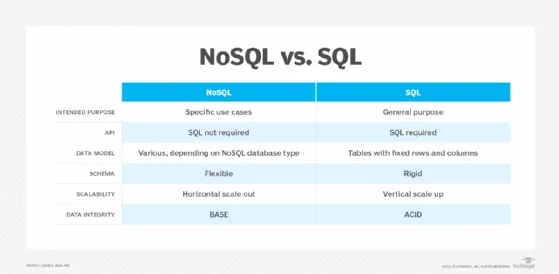
The architectural divide in SQL vs NoSQL systems defines how enterprise applications store and process data. Relational database management systems like MySQL, Oracle Database, and PostgreSQL organize records into structured tables with fixed columns and ACID transaction properties, whereas distributed NoSQL databases like MongoDB, Apache Cassandra, and Redis use flexible data models [1]. Choosing between these systems depends on whether an engineering team needs rigid relational schema enforcement on a single server or horizontal scaling on commodity server clusters [5].
- Origins of the Early NoSQL Movement
- Four Core NoSQL Database Categories
- Schema Flexibility and Entity Aggregation
- Why Can Distributed Clusters Scale Horizontally?
- SQL vs NoSQL Consistency Trade-offs
- Query Joins and Table Scans
- Operational Management in Enterprise Deployments
- SQL vs NoSQL Architectural Decisions
Origins of the Early NoSQL Movement
In 1998, Carlo Strozzi used the name NoSQL for a lightweight relational database running under Unix that stored records in plain ASCII files. Strozzi adopted the operator-stream paradigm, using standard Unix utilities like grep, sort, and awk to filter tabular rows through memory pipes without Structured Query Language [14]. The software was relational in design, but it avoided SQL query parsers. It kept tables scriptable with standard shell tools.
The label returned in San Francisco over a decade later. On June 11, 2009, Johan Oskarsson organized an informal meetup to discuss open-source distributed non-relational data stores. Developers shared early designs from Cassandra, MongoDB, CouchDB, Dynomite, HBase, Hypertable, and Project Voldemort. None of these engines followed Codd’s relational model. They were built for unstructured web data in distributed clusters. The meetup title quickly became an industry banner [6].
Martin Fowler said in his Nosql Definition essay that the label lacks a formal standard or manifesto, describing instead a rapid surge of non-relational tools built for large clusters. While many advocates suggested that NoSQL meant “Not Only SQL,” Fowler argued that treating individual engines as non-relational preserves clarity, reserving the term polyglot persistence for mixed software stacks [6]. Carlo Strozzi said that because distributed engines departed from the relational model, the movement could be called “NoREL” [13]. Early web engineering teams at Google with Bigtable and Amazon with Dynamo proved that explosive internet traffic broke the scalability limits of traditional commercial database engines. These discussions proved that the core divide was not about query syntax, but about whether software ran on relational tables or distributed storage nodes.
Four Core NoSQL Database Categories
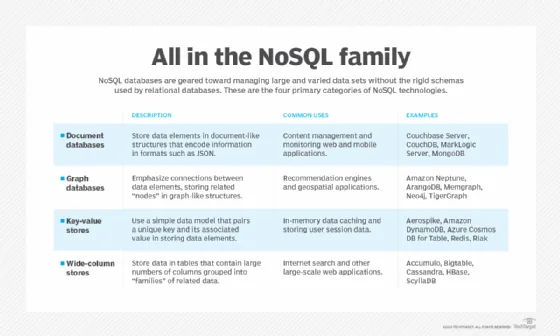
Non-relational data stores divide into four main architectural groups based on how they store and retrieve data [5]. Among these, document stores serve general web systems by encoding information in semi-structured formats like JSON, XML, or BSON. In systems like MongoDB Atlas and CouchDB, each document maintains its own internal fields and nested arrays, allowing developers to add attributes without altering shared table definitions [4].
Key-value stores use the simplest model, pairing a unique key with an arbitrary value payload [5]. Engines like Redis, Riak, and Memcached function as fast distributed hash tables for user sessions and shopping carts. Deployments often keep records in RAM or solid-state drives for low latency [3]. Wide-column systems like Apache Cassandra and Apache HBase organize information into sparse rows where column names, types, and counts vary freely across different entries [5]. Each column family is stored separately on disk.
Graph databases store data as nodes, directed edges, and properties, making them well suited for connected networks. Peter Neubauer said that Neo4j has run in 24/7 production use since 2003, providing ACID-compliant transactions for property graphs without SQL joins [10]. Researchers A. Davoudian, L. Chen, and M. Liu examined how NoSQL systems balance data models, partitioning strategies, and CAP theorem trade-offs [16]. Graph engines excel at traversing multi-hop paths like social ties, access control lists, and fraud rings where relational joins stall [10]. Systems like Neo4j, AllegroGraph, and FlockDB traverse complex multi-hop relationships in memory, avoiding the expensive mathematical set operations typical of traditional RDBMS tables.
Schema Flexibility and Entity Aggregation
Relational databases enforce fixed schemas where column types and lengths must be set before adding data [5]. If a column is an integer, MySQL or PostgreSQL rejects text entries, preserving uniform rules in every row. In contrast, distributed NoSQL systems provide soft schemas that store semi-structured data without fixed table definitions, letting developers adapt data models during rapid software development cycles [1]. Teams can update data models quickly during software release cycles.
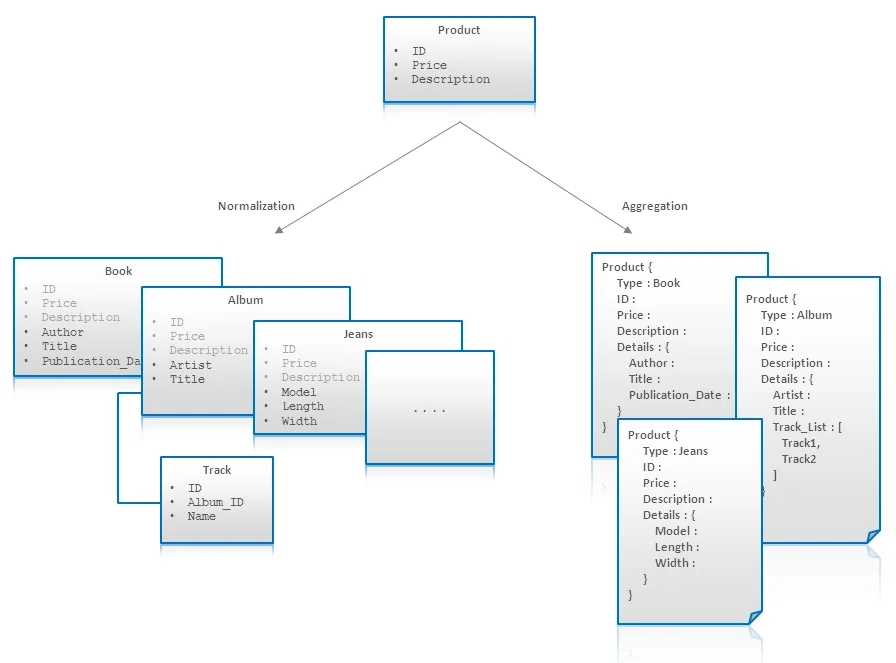
Ilya Katsov described entity aggregation as a pattern where related entities sit in one document or row to avoid join operations. In relational design, a user account, shipping address, and order list split into normalized tables to remove duplicate values. But NoSQL data design follows application access paths rather than relational rules [9]. Nesting child items in a parent record removes read-time joins. Edgar F. Codd wrote in 1970 that relations can contain non-simple domains, confirming that non-atomic values fit theoretical foundations [8].
In 1988, Esther Dyson colorfully described the friction of relational decomposition: “Using tables to store objects is like driving your car home and then disassembling it to put it in the garage. It can be assembled again in the morning, but one eventually asks whether this is the most efficient way to park a car”. Hugh Darwen and C. J. Date said in the NoCOUG Journal that relational theory is purely a logical model rather than a storage format [8]. A database engine can store an object as a single record on disk while still providing an SQL interface. Engineers evaluating sql vs nosql systems recognize that document stores like Couchbase and MongoDB optimize retrieval for nested objects by avoiding artificial table splits.
Why Can Distributed Clusters Scale Horizontally?
Can standard relational databases handle rapid traffic growth without expensive hardware upgrades? Relational database engines scale vertically, meaning that an organization buys larger servers with faster processors, greater memory, and expanded disk arrays to handle higher transaction request rates [5]. But vertical scaling hits hardware cost walls and physical server limits [4]. Distributed NoSQL systems scale horizontally by adding low-cost commodity servers to a cluster [1].
Horizontal scaling breaks datasets into smaller pieces called sharding partitions, distributing records to nodes through hashing [5]. In an unreviewed preprint, A. B. M. Moniruzzaman and Syed Akhter Hossain studied how distributed stores partition data for big data analytics. Their paper has not undergone peer review, but it details how horizontal designs balance read and write loads on clusters [2]. In Oracle NoSQL Database, hashing primary keys spreads records over storage nodes evenly [12]. If traffic grows, administrators add storage nodes to rebalance partitions online [15].
Amazon hit these limits in the 2004 holiday shopping season, when outages occurred after commercial databases were pushed beyond their boundaries. Werner Vogels said Amazon built Dynamo as a key-value store to keep shopping carts online even during server failures. Later, when teams used Amazon SimpleDB, they hit 10 GB domain size limits, forcing manual partitioning. SimpleDB also indexed every attribute automatically, which slowed write speeds. Amazon solved these problems by launching DynamoDB, pairing automated partitioning with solid-state drives for single-digit millisecond latency [7]. Users scale request capacity up or down like turning a dial.


SQL vs NoSQL Consistency Trade-offs
Data reliability marks another core difference between relational and non-relational database models. Relational systems use ACID rules—atomicity, consistency, isolation, and durability—so that every transaction completes in full or rolls back [5]. In contrast, distributed non-relational engines often follow BASE ideas: basically available, soft state, and eventual consistency [10]. In BASE systems, writes commit locally and copy to replica nodes over time [13].
The trade-offs between consistency and uptime are framed by the CAP theorem, which states that a distributed data system can provide only two of three guarantees: consistency, availability, and partition tolerance. Because network drops occur in cloud clusters, partition tolerance is mandatory. Apache HBase chooses consistency, rejecting client queries when a partition occurs. Apache Cassandra chooses availability, accepting writes on active nodes and resolving conflicts later. When assessing sql vs nosql trade-offs, engineers must decide whether stale reads are acceptable during temporary network splits [1].
Researchers M. Diogo, B. Cabral, and J. Bernardino evaluated five NoSQL tools, showing that while Redis, Cassandra, MongoDB, Neo4j, and OrientDB offer eventual consistency, forcing strong consistency lowers availability during network partitions [17]. Relaxed consistency has deep historical roots. Edgar F. Codd wrote in 1970 that checking consistency on every write slows performance, suggesting that systems could log discrepancies and fix them in batches. C. J. Date said that physical server failures create problems for both relational and non-relational engines alike [8]. Date explained that relational theory defines logical structures rather than disaster recovery setups.
Query Joins and Table Scans
Structured Query Language provides standard syntax to combine tables through join operations [5]. Because relational engines normalize entities into tables, coders use joins to connect customer rows, product items, and invoice entries at query time [4]. Distributed NoSQL engines avoid multi-table joins to protect high-speed throughput [1]. When data cannot be nested, applications issue multiple read calls.
Sergey Bushik and engineers at Altoros Systems tested Cassandra, HBase, MongoDB, and Riak using the Yahoo Cloud Serving Benchmark. The benchmark deployed 100 client threads against a table of 100,000,000 records, where each record had 10 fields of 100 bytes on Amazon EC2 instances. In update tests, HBase reached 40K ops/sec with deferred log flush, while Cassandra hit 15K ops/sec by appending writes to commit logs before updating memory Memtables. Both engines kept average update latency under two milliseconds [11].
In read tests with 95% reads and 5% writes, sharded MySQL and memory-mapped MongoDB showed the fastest read speeds. Cassandra matched strong read throughput through its key cache and row cache, avoiding disk seeks on SSTable data files. By 2012, more than 120 alternative storage products entered the market, offering varied trade-offs between write throughput and query breadth [11]. In sql vs nosql workloads, relational systems excel at arbitrary multi-table joins, while non-relational engines optimize primary-key lookups and write ingestion. These benchmark results confirmed that specialized engines gain write speed specifically by removing relational join layers.
Operational Management in Enterprise Deployments
Running distributed database clusters creates operational overhead for engineering teams. Werner Vogels said that although Amazon engineers liked Dynamo’s raw speed and horizontal scale, adoption across the company remained low because running clusters was difficult. Teams found running multi-datacenter clusters and balancing node replicas too complex. Instead, engineers picked managed options like Amazon S3 and SimpleDB, proving that developers prefer operational simplicity over low-level tuning [7].
Photo site SmugMug faced similar friction before moving workloads to cloud storage. SmugMug CEO Don MacAskill said that buying servers and hiring database staff had become a drag on growth. MacAskill said his team wanted to store data and retrieve it reliably without managing hardware clusters [3]. Managed cloud databases like Amazon DynamoDB, MongoDB Atlas, and Microsoft Azure Cosmos DB solve this by automating partition management, cluster replication, and server provisioning behind web APIs [5].

Oracle NoSQL Database shows how enterprise vendors package distributed clusters for high availability [15]. Oracle NoSQL arranges Storage Nodes into shards with an active master node for writes and replica nodes for reads [12]. If a master fails, an automated Paxos election promotes a replica to master without human intervention. Administrators adjust replication factors and add shards online while monitoring health through web consoles or CLI tools [15]. Automated failover cuts downtime during hardware faults. In large corporate setups, managed distributed systems remove daily maintenance work while keeping predictable latency in multi-zone data centers.
SQL vs NoSQL Architectural Decisions
Choosing between SQL and NoSQL engines requires evaluating query access patterns, consistency requirements, and data volume. Relational databases remain a solid choice for applications needing multi-table joins, fixed schemas, and complex financial transactions [1]. Banking platforms, accounting books, and ERP software rely on relational rules to prevent data errors and orphan records [5].
Non-relational databases excel when applications face changing schemas, rapid ingestion, or big datasets split across server clusters [1]. Document stores speed up product catalogs and user profile services, while key-value stores handle shopping cart sessions, user preferences, and high-speed in-memory application caches [5]. Wide-column stores like Cassandra process time-series data and event logs with high write speed [1]. Instead of forcing all application parts into one database, modern software architectures use polyglot persistence [4].
Under a polyglot persistence design, each microservice uses the database engine that fits its specific task. An e-commerce platform can store checkout orders in MySQL, cache carts in Redis, run product catalog searches in MongoDB, and map recommendation links in Neo4j [4]. Jeremiah Wilton, Amazon’s first DBA, said in 2007 that the highest overall system availability comes from designing application software to survive inevitable underlying database server outages [8]. The core choice in sql vs nosql architectures is not about choosing a winner, but about balancing schema rules, consistency models, and horizontal scale [1]. Picking the right tool for each microservice lets engineering teams build fast and dependable platforms.
- WEBSITE NoSQL Database. (2025). NoSQL Databases – From Basics to Enterprise Use. [Article Link]
- PREPRINT Moniruzzaman, A. B. M., & Hossain, S. A. (2013). NoSQL Database: New Era of Databases for Big data Analytics – Classification, Characteristics and Comparison. arXiv. [Article Link]
- ONLINE NEWS Garling, C. (2012). Amazon Goes Back to the Future With ‘NoSQL’ Database. WIRED. [Article Link]
- WEBSITE IBM. (2022). What Is a NoSQL Database? IBM Think. [Article Link]
- ONLINE NEWS Vaughan, J., Yasar, K., & Mullins, C. (2024). What is NoSQL (Not Only SQL database)? TechTarget. [Article Link]
- WEBSITE Fowler, M. (2012). Nosql Definition. Bliki. [Article Link]
- WEBSITE Vogels, W. (2012). Amazon DynamoDB – a Fast and Scalable NoSQL Database Service Designed for Internet Scale Applications. All Things Distributed. [Article Link]
- WEBSITE Fernandez, I. (2013). No! to SQL and No! to NoSQL. So Many Oracle Manuals, So Little Time. [Article Link]
- WEBSITE Katsov, I. (2012). NoSQL Data Modeling Techniques. Highly Scalable Blog. [Article Link]
- ONLINE NEWS Neubauer, P. (2010). Graph Databases, NOSQL and Neo4j. InfoQ. [Article Link]
- ONLINE NEWS Bushik, S. (2012). A vendor-independent comparison of NoSQL databases: Cassandra, HBase, MongoDB, Riak. Network World. [Article Link]
- WEBSITE Oracle Corporation. (n.d.). Introduction to Oracle NoSQL Database. Oracle Documentation. [Article Link]
- WEBSITE Wikipedia. (n.d.). NoSQL. Wikimedia Foundation. [Article Link]
- WEBSITE Wikipedia. (n.d.). Strozzi NoSQL. Wikimedia Foundation. [Article Link]
- WEBSITE Wikipedia. (n.d.). Oracle NoSQL Database. Wikimedia Foundation. [Article Link]
- ACADEMIC JOURNAL Davoudian, A., Chen, L., & Liu, M. (2018). A Survey on NoSQL Stores. ACM Computing Surveys, 51(2), 1-43. [Article Link]
- ACADEMIC JOURNAL Diogo, M., Cabral, B., & Bernardino, J. (2019). Consistency Models of NoSQL Databases. Future Internet, 11(2), 43-43. [Article Link]


