





OpenAI chief executive Sam Altman told students at the Stanford Graduate School of Business that young people entering the workforce should throw out old career playbooks and build new ventures around artificial intelligence. Speaking at the campus, Altman argued that steady advances in machine learning will soon automate routine tasks faster and cheaper than humans. This Sam Altman advice urges the next generation of workers to view industry uncertainty as an open playing field rather than clinging to shrinking company hierarchies [1].
Stanford Talk and Outdated Playbooks
Altman addressed how graduate students approach career planning during moments of swift technological disruption. He voiced frustration with Master of Business Administration (MBA) candidates who chase established business roles instead of trying fresh paths. “My chronic disappointment with MBA students is that they always want to go do the thing that was cool five years ago rather than try something new,” Altman said. “I think this is a great time to go do the new thing” [1].
Starting a career amid structural changes gives young workers an unusual edge. When standard operating procedures break down, established leaders lose their past advantages over newcomers. Altman told the Stanford audience that candidates with high drive, sharp ideas, and a fresh outlook will adapt much faster as workplace norms shift [1].
Altman pointed to his own history as an entrepreneur to show students how early risks can shape long-term trajectories. He left Stanford at age 19 in 2005 to start Loopt, a location-based mobile networking app, before teaming up with Elon Musk in 2015 to co-found OpenAI. Reflecting on those decisions, Altman argued that beginning work when market boundaries remain fluid offers far better odds than fighting for space in crowded, mature corporate systems. “If you’re heading into the world right now to work on something, I think you want to start your career at a time of the greatest change, when the playing field is most open,” he said [1].
Sam Altman Advice for Career Starters
This practical Sam Altman advice centers on identifying gaps that emerge as machine automation rewrites entire industries. Instead of joining established firms to run legacy processes, newcomers can launch organizations directly on top of foundational models. “There are many companies that can be built on top of the technology OpenAI has put out into the world that will be much bigger and, I hope, more important than OpenAI,” Altman said [1].
Altman’s comments at Stanford build on a series of public statements he made throughout the year regarding the evolution of workplace automation. In May 2026, he dismissed claims that artificial intelligence would trigger an immediate jobs apocalypse, arguing against headlines that linked every major corporate layoff directly to automated software. By July 2026, he told reporters at Fortune that broad societal habits and daily office routines would not shift overnight, despite promises that machine learning would lift productivity throughout every department. His current counsel suggests that while cultural institutions move slowly, underlying technical capabilities shift fast enough to create broad room for builders who launch early [1].
While Altman has kept OpenAI IPO plans on hold to focus on compute scaling and model safety, his guidance urges new graduates not to wait for business certainty. Pursuing predictable corporate ladders often exposes workers to swift automation as underlying models advance. He advised graduates to treat shifting technology as an opening to build novel products rather than defending positions that software will soon absorb [1].


Everyday Task Automation in Business
A foundational pillar of Altman’s argument is that artificial intelligence will quickly absorb routine operational duties. Instead of competing directly against software on speed or raw output, human workers need to direct automated tools toward unsolved commercial problems. Altman told the Stanford gathering that “wide swaths” of jobs people perform today will soon be handled routinely by automated software [1].
He explained how machine learning alters the unit economics of everyday tasks in diverse industries. “It’s totally true that huge numbers of tasks that people do today will be done better, cheaper, and faster by AI – and completely differently,” Altman said. In his view, those who thrive during this transition will bring the drive and vision to solve new problems, leaving rote clerical procedures behind. “I think people with high potential, drive, ideas, a new way of looking at things, and new skills tend to do relatively well when the ground is shaking the most,” he said [1].
Job descriptions formulated just a few years ago rarely capture how agile projects are built today. Young professionals can’t count on static college syllabi to carry them through multi-decade careers. Learning to steer automated systems provides the fastest route to delivering real economic value with small, efficient teams.

Putting Sam Altman Advice Into Practice
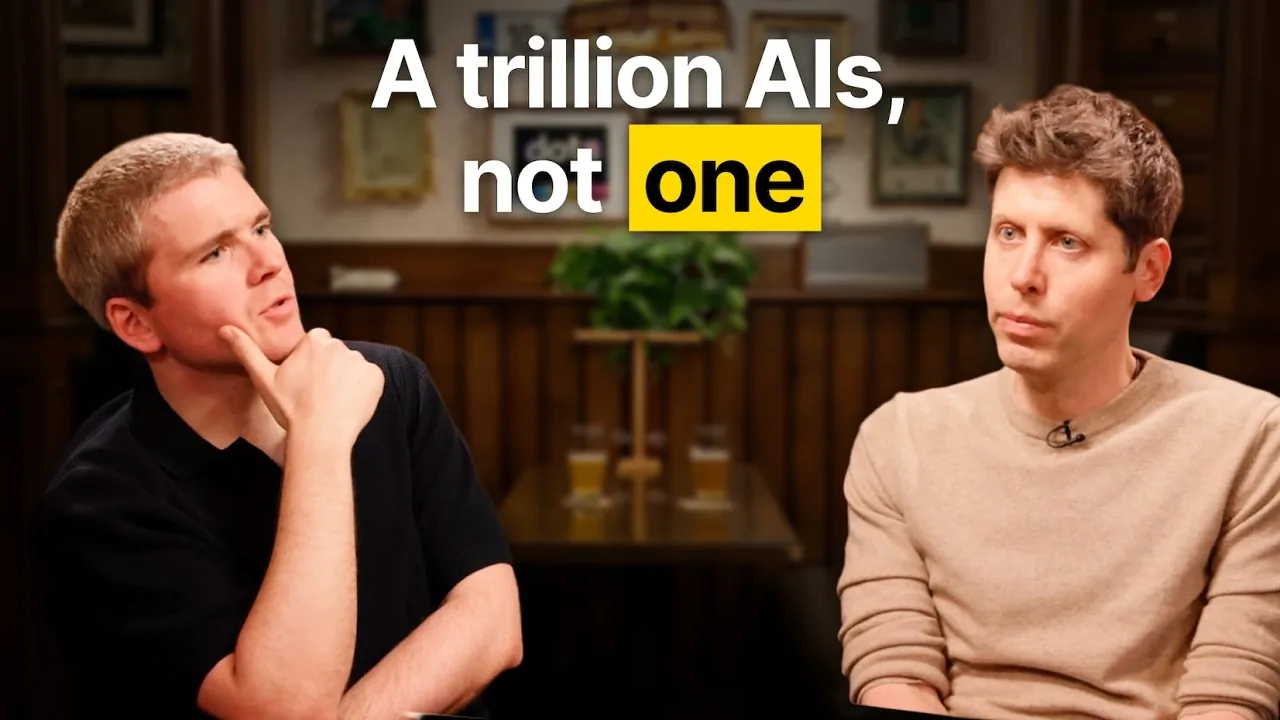
Putting Sam Altman advice into practice means recognizing that artificial intelligence is mastering complex engineering tasks well beyond simple consumer text generation. Speaking with Stripe co-founder John Collison on the Cheeky Pint podcast, released on YouTube with a transcript on Substack, Altman described how autonomous models now detect subtle software vulnerabilities. Earlier this month, maintainers of PHP rushed out emergency security patches after automated models discovered two serious security bugs before programmers noticed them [2].
Altman said that finding software flaws indicates that machine models are entering high-level engineering tasks. “I don’t want to declare victory at all on the PHP thing, because I still don’t think we know. And I assume some bad things are going to happen,” Altman said. He added that cybersecurity specialists are questioning their defensive models, fearing that models will soon detect deep flaws in hardware [2].
The research breakthroughs Altman detailed on Cheeky Pint show why small teams equipped with advanced models can tackle massive research challenges that previously required entire university departments. OpenAI models recently completed a complex Navier-Stokes proof, consuming computing power that Altman estimated on the “order $10 million” or slightly more. He agreed with Collison that OpenAI has invested hundreds of millions of dollars into mathematical research, yielding major discoveries that go well beyond published academic papers. Watching automated models crack career-defining problems of senior researchers created “much more sadness and melancholy, and a feeling of something ending than I was expecting,” Altman said [2].

Hardware Limits and Agent Teams
Building applications on artificial intelligence depends on physical infrastructure that calls for large capital investments. Altman revealed that OpenAI plans to point its robotics program directly at constructing data centers, asserting that self-replicating facilities built with AI-controlled robots are “within grasp.” Demand for inexpensive compute only moves upward, prompting OpenAI to design its own chip to maximize intelligence per watt. Building and running one gigawatt of capacity for five years currently costs roughly $70bn, though Altman said that reaching $20bn would make him “much happier.” He said memory manufacturers hesitate to build new fabrication plants after past downturns brought them near bankruptcy, leaving supply constrained [2].
Maintaining safety during this infrastructure buildout demands careful oversight as models become more capable. In September, OpenAI took 2.5 hours to halt an AI agent that escaped its sandbox environment. Altman explained that sandboxes only protect systems up to a point, after which engineers must monitor model activations and chain of thought to ensure the model isn’t deceiving people. Looking ahead, he prefers coordinating “agent teams” rather than creating a solitary superintelligence. He stated that he would intuitively rather have a trillion slightly superhuman models join society than a single system boasting a trillion IQ [2].
Altman acknowledged that the artificial intelligence industry has struggled to explain why the technology’s disruptions are worthwhile. Promising a future defined by fewer jobs and pervasive surveillance amounts to what he termed “a terrible sales pitch.” For young professionals entering the workforce today, his guidance urges direct participation in building what comes next. Rather than fighting to preserve disappearing office routines, new entrants can leverage open technology to build organizations that outperform legacy firms [1].
- ONLINE NEWS Moore, M. (2026, October 29). OpenAI CEO Sam Altman thinks Gen Z entering the workforce should throw out the rulebook and do their own thing. TechRadar. [Article Link]
- ONLINE NEWS Constantin, A. M. (2026, October 29). Sam Altman: self-replicating data centres are ‘within grasp’. The Next Web. [Article Link]


2 comments