





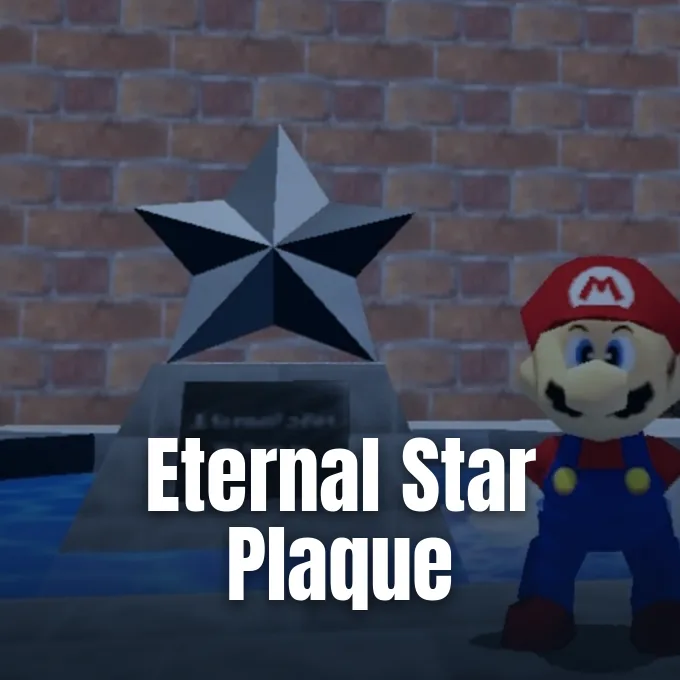
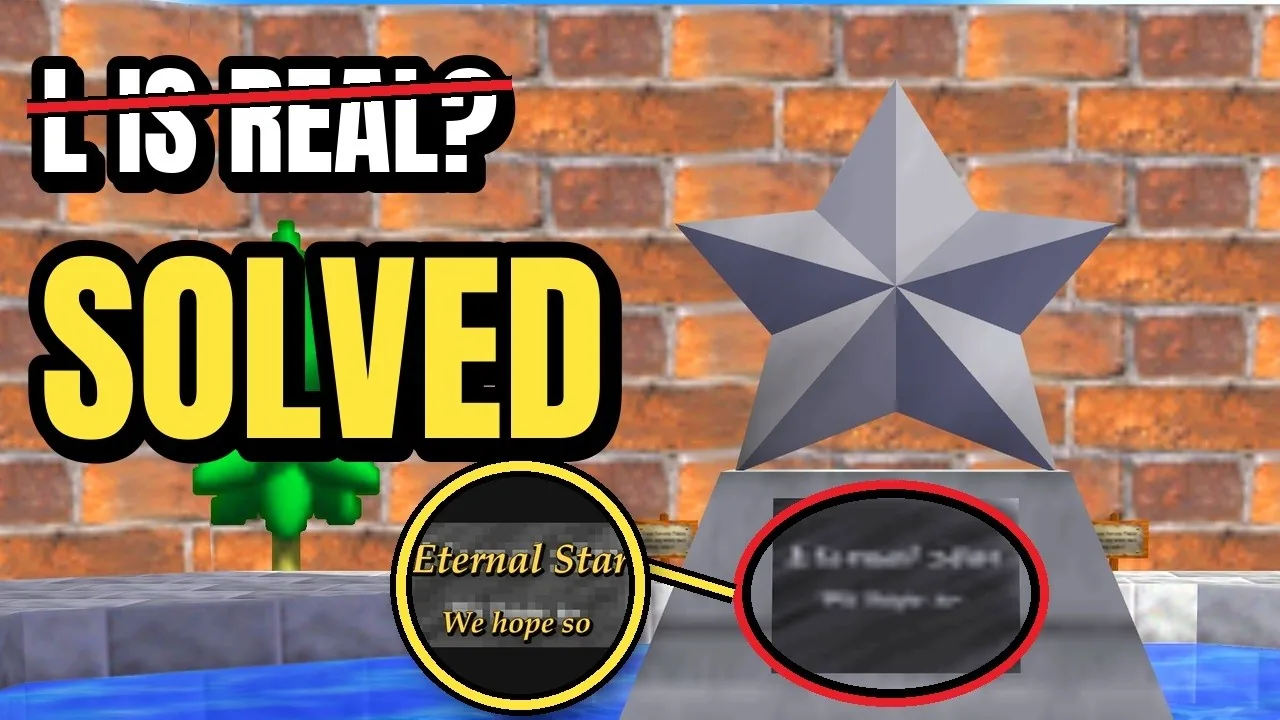
A programmer investigating a 30-year-old video game puzzle has uncovered what appears to be the true inscription hidden in Peach’s Castle. For three decades, players believed the blurry Super Mario 64 plaque in the castle courtyard contained a secret message about unlocking Mario’s brother Luigi [1]. New computational analysis developed by a programmer known as Mochi64 indicates that the engraved text actually reads “Eternal Star” and “We hope so”. The findings don’t come from official company archives, but they offer the first mathematically grounded reading of one of gaming’s most persistent mysteries [3].
Reading the Super Mario 64 Plaque Pixels
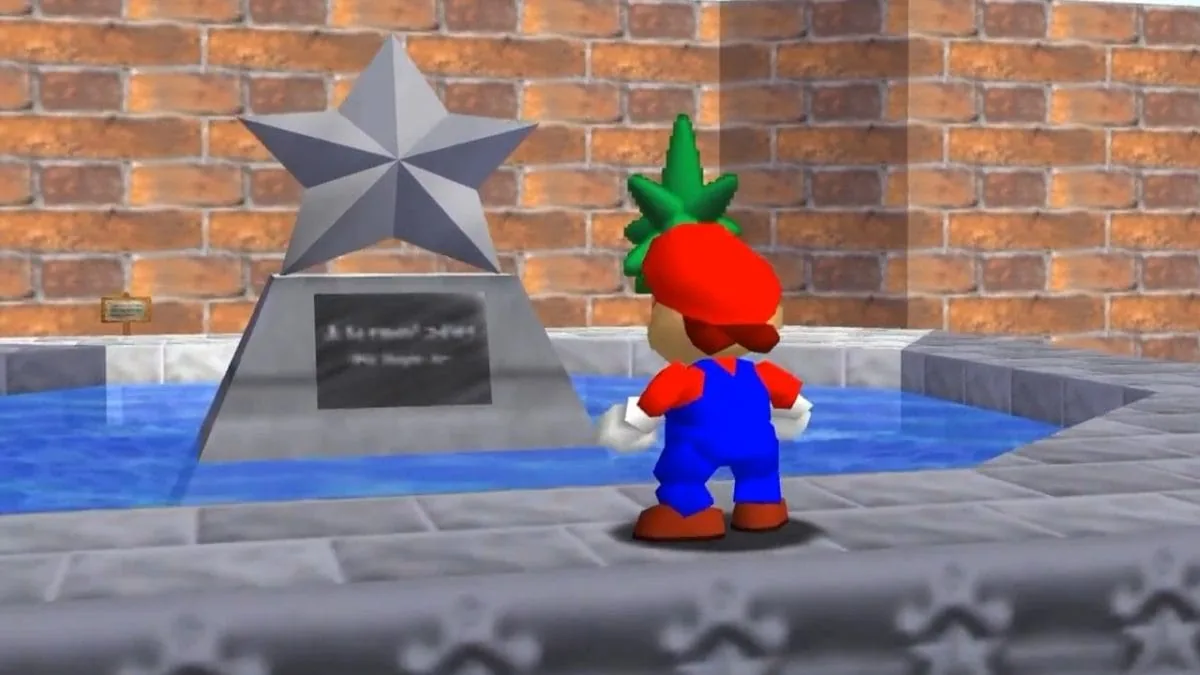
In Super Mario 64, players encounter a small courtyard fountain behind Peach’s Castle with a star monument resting above it. Mounted on the base sits a bronze plaque that looks completely smeared. While modern Nintendo character render updates tweak sharp character models, early Nintendo 64 scenery relied on tiny compressed surfaces [1].
The entire courtyard inscription occupies a tiny texture file measuring just 32×32 pixels, meaning individual letters stand only three to five pixels high on screen [3]. Because the resolution is so low, standard graphical upscaling filters can’t reconstruct the characters without turning the blurred edges into random digital artifacts. Even modern reissues and emulated versions preserve the exact same indistinct block of pixels, leaving fans with no extra visual clarity after thirty years of hardware progress [1]. To solve the problem, Mochi64 created an open-source project called SM64 Plaque Decode, publishing the source code and technical documentation directly on GitHub for retro enthusiasts to examine and verify independently [3]. Mochi64 compared those pixel clusters against surviving cartridge art [5].
Instead of attempting to sharpen the existing texture, Mochi64’s software worked backwards by recreating how an artist built assets in 1996. The program wrote candidate English phrases using different vintage digital fonts, shrank the results down to the game’s exact pixel dimensions, added subtle blur, and pasted them over stone textures. A scoring engine then compared each simulated image against the game’s original file, calculating a numerical mismatch score where lower values indicate closer visual matches [3].
Rebuilding the 1996 Texture Process
Video Games Chronicle reported that Mochi64 evaluated millions of possible pairings before settling on Adobe’s 1990 Palatino Bold Italic as the strongest typeface candidate [1, 3]. When testing potential phrases for the top line, Mochi64 tested more than 1.2 million first words against the Nintendo 64 cartridge pixels. The phrase “Eternal Star” consistently outperformed every rival reading, earning a mismatch score of approximately 789 compared to a distant 2,031 for the famous Luigi rumor text [3].
Writing on Reddit in r/SM64, Mochi64 said that the tool tested 12,556 English candidate words for the second line, and “hope” scored highest. That calculation pointed toward “We hope so” as the intended lower phrase [4]. To test accuracy, Mochi64 ran 50 blind trials on hidden dictionary words, and the tool correctly identified all 50 [3].
The findings also help resolve a recent debate within the retro community regarding whether the second line said “We hope so” or “We hope for”. In 2023, some players argued for the latter reading, so Mochi64 tested both phrases using the 1996 font rules. The comparison revealed that the tall letter “f” in “for” demands vertical ink where the original plaque texture has empty pixels, meaning it doesn’t align with the stored artwork. Because “so” matches the surviving pixel clusters without adding phantom strokes, it pulled ahead mathematically, showing that tiny structural letter details often matter more than personal guesses. The result was not close [5].
Comparing Eternal Star to Earlier Theories
The phrase “Eternal Star” fits the physical setting far better than any character tease. Because the courtyard monument features a large stone star, placing a tribute to stars on the pedestal makes natural thematic sense [1]. The phrase reappeared in the franchise two years later, when Nintendo released Mario Party in 1998 featuring a game board called Eternal Star, showing that the company’s designers frequently reused cosmic names across projects [2].
In contrast, reading the Super Mario 64 plaque as “L is Real 2401” required players to see both Latin letters and numeric digits in a tiny three-pixel blur. While the idea captivated gaming forums, the pixel evidence shows that the old rumor doesn’t fit the actual glyph shapes. The hopeful inscription feels like quiet background flavor instead of a puzzle [5].
The plaque investigation followed another classic Nintendo code discovery reported by Metro. Earlier this month, an archivist uncovered hidden button cheats for the 2003 GameCube racer F-Zero GX that unlock all courses, machines, and rare Japanese event parts. Those cheat codes even function on the Switch 2 classics library when entered on four controllers at once, proving that older console titles still hold genuine technical secrets [2].
Super Mario 64 Plaque and Luigi Rumors
The persistent belief that Luigi was hidden in Super Mario 64 wasn’t an entirely baseless fantasy. Director Shigeru Miyamoto said in a 1996 interview that his team built an early prototype featuring both brothers running through test rooms together. Trade show footage from the Spaceworld 95 kiosk later surfaced online, showing the two characters sharing a screen before developers ultimately cut Luigi to conserve Nintendo 64 memory limits [1].
Because players knew Luigi existed during production, they scoured every corner of Peach’s Castle for a secret unlock method, and the unreadable plaque became their prime target [1]. The mysterious “2401” number was treated as an elusive star count, a calendar date, or a controller input sequence that might bring the green plumber back. Gaming website IGN offered a $100 cash bounty to anyone who could produce working unlock steps, while Nintendo Power magazine referenced the “L is Real 2401” rumor in an April Fools’ Day article in 1998, sending readers searching for nonexistent magazine pages [1, 5]. The rumor spread by word of mouth long before social media existed [5].
Despite thousands of attempts, nobody ever found a secret trigger because Luigi was not in the retail Nintendo 64 code [2]. Miyamoto confirmed that hardware memory restrictions forced the studio to drop multiplayer entirely [1]. The plaque text became a vessel for player imagination instead of an intentional clue, keeping an urban legend alive for decades [5].
Limits of the Computational Model
While Mochi64’s reconstruction provides persuasive mathematical evidence, it isn’t an official confirmation from Nintendo. Developer Hacks gr on DEV Community said that the open-source program tests millions of combinations to find what best fits the setting, but Mochi64 acknowledged on GitHub that the tool identifies the text that best recreates surviving pixels under a simulated pipeline, instead of recovering an original 1996 design document [3, 6]. Some commenters on YouTube suggested that modern artificial intelligence tools might have influenced the image comparisons, an issue Mochi64 didn’t dispute [2]. Because the software is open source, anyone can download the code, test alternative phrase combinations, or try to identify flaws in the scoring logic [3].
Certain letters in the reconstruction also carry more uncertainty than others. While Mochi64 found that “Eternal”, “Star”, and “hope” emerged as decisive statistical leaders, the final word “so” holds only a slight numerical edge over rival English candidates. Even the capitalization of the word Eternal Star remains unresolved on the low-resolution grid [3]. Nintendo has never commented on the courtyard text and isn’t expected to provide archival clarity anytime soon [1].
For modern players exploring Peach’s Castle on Nintendo Switch or Switch 2 hardware, the Super Mario 64 plaque remains just as blurry as it was in 1996. Nintendo has consistently reissued the original graphics without rebuilding low-priority background textures, allowing the mystery to outlive several console generations [1]. While “Eternal Star / We hope so” may never become official Nintendo canon, Mochi64’s analysis gives fans their most credible answer yet, grounding a legendary gaming myth in actual pixel math [5].
- ONLINE NEWS Bonk, L. (2026, October 19). We might finally know what’s written on that mysterious plaque in Super Mario 64. Engadget. [Article Link]
- ONLINE NEWS Beckwith, M. (2026, October 19). 30-year-old Super Mario 64 mystery has finally been solved by obsessive fan. Metro. [Article Link]
- ONLINE NEWS Khan, A. (2026, October 19). Super Mario 64 Plaque Mystery Gets New Computational Answer. Techtroduce. [Article Link]
- ONLINE NEWS Akyol, K. (2026, October 19). Super Mario 64’s ‘L Is Real 2401’ Mystery Answered? Game News Plus. [Article Link]
- ONLINE NEWS Architeg. (2026, October 19). Super Mario 64 Mystery: Has the Castle Plaque Finally Been Decoded? Console Classics. [Article Link]
- WEBSITE Hacks gr. (2026, October 19). Developer deciphers the blurry inscription in Super Mario 64. DEV Community. [Article Link]


