




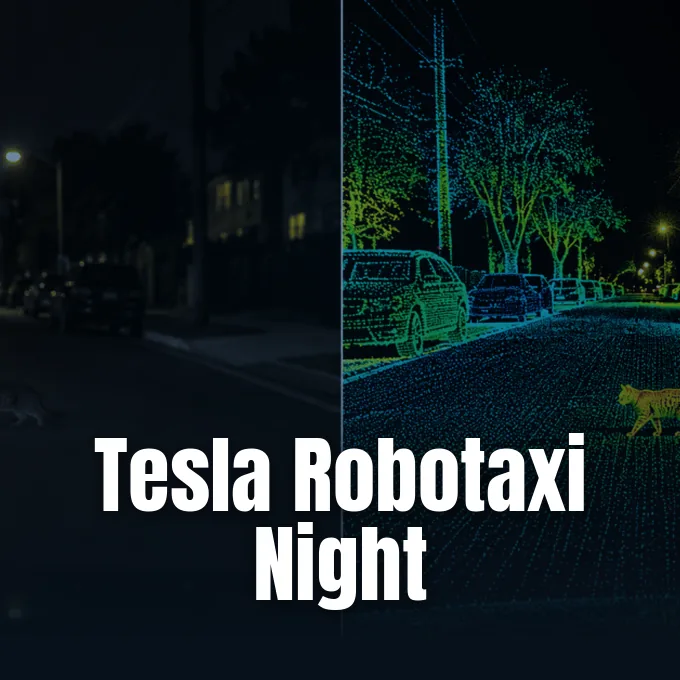
Elon Musk said Tesla robotaxis still struggle to spot pets that blend into the road at night, explaining why the company’s autonomous ride service in Austin recently extended evening operating hours by only one hour. Late Friday night, the Tesla Robotaxi account announced that Austin ride requests would run until 11pm rather than stopping at 10pm [2]. The service first opened in June 2025 with hours stretching from 6am to midnight, but the operating window narrowed over the following fifteen months [1].
Why Do Tesla Robotaxis Close at 11pm?
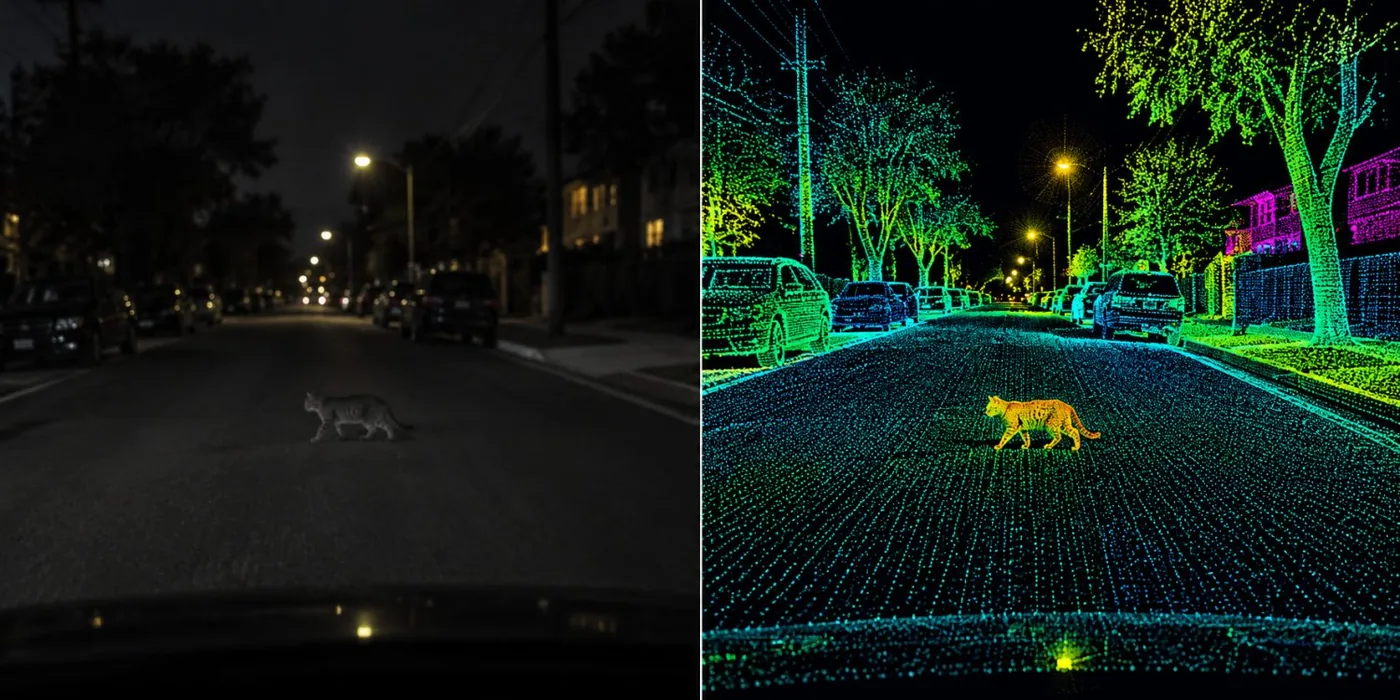
Musk reposted the late-night schedule update and pointed to low-light animal detection as the main barrier keeping vehicles off neighborhood roads. “The main thing we’re trying to solve is making sure that we don’t run over pets when they’re hard to see at night. Literally trying to avoid grey kittens on grey tarmac in the dark,” he wrote on social media. It’s an admission that the company’s autonomous driving system still can’t reliably spot small animals during late trips [2].
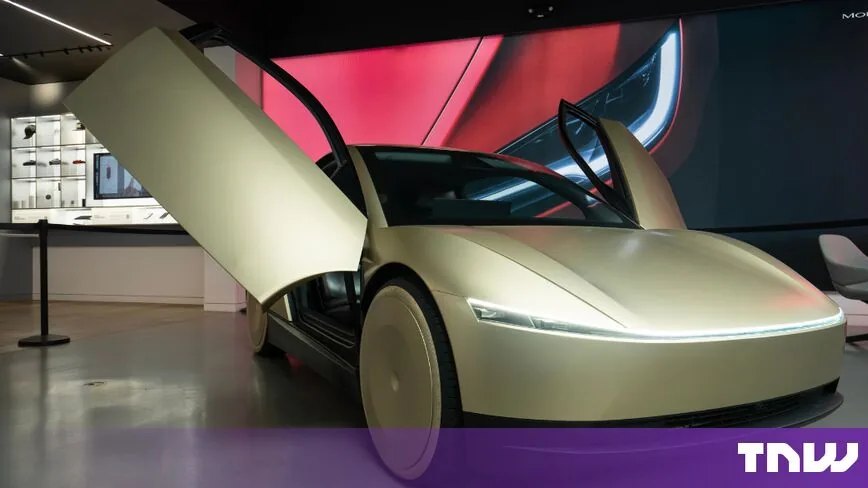
The Austin test fleet hasn’t expanded into an around-the-clock transit system since welcoming its first paying riders in Texas. When Tesla opened the Austin service in June 2025, riders could hail driverless trips during an eighteen-hour daily window that lasted until midnight. Fifteen months later, the cars stop taking passengers an hour earlier than on opening day. Independent tracking in August found the Austin fleet operating without onboard safety monitors, though the active pool had shrunk to about 17 vehicles even after new Cybercab test units joined the trial [1].
Austin’s daily schedule creates an odd contrast between test vehicles and customer cars that share the same city streets. Sunset in Austin happens shortly after 7pm during early autumn, which means Tesla robotaxis already carry passengers in full darkness for several hours before the 11pm cutoff arrives. Why would a driverless car safely navigate streets at 9pm but face safety curfews two hours later? That’s a question local riders often ask, as customer-owned Tesla cars run Full Self-Driving software on identical camera sensors at any hour of the night with no curfew at all [2]. Austin has also served as a test site for other Musk ventures, including Boring Company transit tunnels in Austin, where underground transit plans sought to link city destinations.
Camera Weakness in Low-Contrast Night Driving
The physics of camera vision explains why dark streets present a steep hurdle for Tesla robotaxis and pure vision setups. A camera functions as a passive sensor that relies on whatever light bounces off an obstacle back into its lens. To spot an obstacle, software must find visual contrast between the target and its background [2].
A grey kitten on dark asphalt at night reflects little light and offers minimal color difference, leaving camera sensors with scant raw data to separate the animal from the pavement. Musk selected an adorable example when pointing to kittens, but the underlying sensor challenge applies to many common nighttime hazards (such as discarded tire treads or pedestrians in dark clothing) that blend into the road. While human bodies present taller silhouettes than small pets, road safety can’t rely on assuming obstacles will always be larger than a kitten when autonomous vehicles travel at speed without human backup drivers inside the cabin. Every optical system struggles when photons are scarce, and relying solely on cameras forces software to guess shape boundaries from faint pixels rather than measuring physical distance [2].
Tesla previously suggested that its neural networks had overcome low-light limits through computational image processing. In May of this year, Musk posted a camera-derived image labeled as photon count reconstruction, writing: “This is why Tesla FSD can see so well at night or through extreme glare.” Five months later, avoiding dark objects on unlit roads isn’t an easy task, and Musk describes it as the main problem engineers are trying to solve [2].


How Lidar and Radar Spot Hazards
The limitations of camera hardware explain why rival autonomous vehicle developers rely on active sensing tools. Unlike cameras, lidar doesn’t wait for ambient street lighting or headlight beams to illuminate a target. It fires its own laser pulses and measures the nanoseconds they take to bounce back, calculating an exact distance [2]. It doesn’t depend on headlights, and it doesn’t struggle to separate dark objects from black asphalt.
Lidar operates with equal precision regardless of the hour, spotting an animal or road obstruction by its physical height rather than relying on color differences against the pavement. Radar performs a similar active job using radio waves, adding real-time speed tracking to the vehicle’s computer while cutting through dense fog, dust clouds, and headlight glare that can blind glass lenses [2]. Every company operating autonomous passenger fleets at scale blends cameras, lidar, and radar into a unified sensor suite. Waymo’s sixth-generation robotaxis carry 13 cameras, four lidars, and six radars, contrasting with how Tesla robotaxis navigate Austin streets without any laser or radar sensors [1].
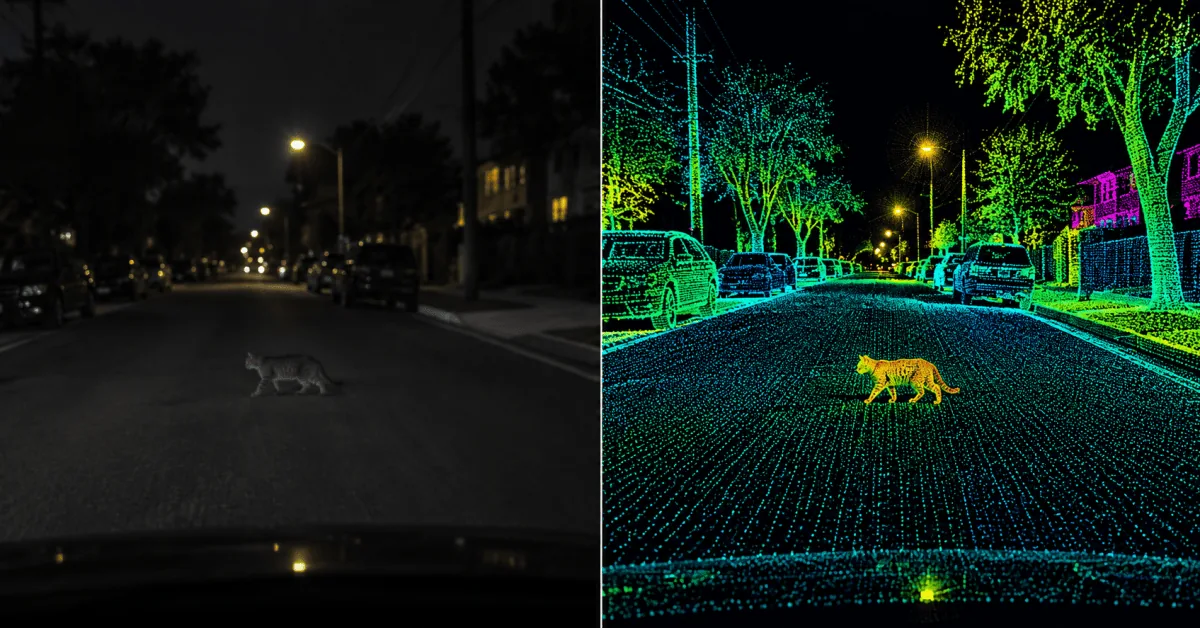
Waymo co-CEO Dmitri Dolgov showed that sensory gap in August by sharing video of children chasing dogs across a pitch-black street. The vehicle’s optical cameras showed little more than dark shadows, but the lidar feed provided a clean, unmistakable outline of every moving shape. No sensor system guarantees zero accidents, as shown last October in San Francisco when a Waymo car ran over a bodega cat that darted under the wheels as the vehicle pulled away. Yet Tesla remains the only developer whose chief executive acknowledges that vehicles struggle to see small animals on dark roads in the first place [2].
Regulators Scrutinize the Tesla Robotaxi Suite
Tesla’s choice to abandon active sensors stems from a philosophical bet Musk championed for years. Tesla removed radar from its production cars in May 2021, eliminated ultrasonic parking sensors in 2022, and never shipped lidar on any vehicle. In April 2019, Musk called lidar “a fool’s errand,” adding that “anyone relying on lidar is doomed” [2].
In February 2022, Musk labeled lidar “a seductive local maximum,” insisting that solving autonomous driving “necessarily will require silicon neural nets & cameras.” Musk pushed that logic further in August 2025 by claiming that lidar and radar reduce vehicle safety through sensor contention, where software gets confused by conflicting sensor inputs. But private conversations reveal he understood the trade-offs of pure vision early on. When Tesla pulled radar units in 2021, Musk told Electrek in direct messages that “vision with high-res radar would be better than pure vision.” That admission now draws scrutiny as the National Highway Traffic Safety Administration investigates 3.2 million Tesla vehicles over crashes in low-visibility conditions, demanding an internal company document titled Radar Saves Us [2].
State legislators are also questioning whether camera-only hardware provides sufficient protection for public roads. In New Jersey, lawmakers introduced a bill that would require autonomous vehicles to carry two sensing modalities beyond standard optical cameras before operating without human drivers [1]. The cost excuse for avoiding extra hardware is fading as well. Electric vehicle maker Rivian said this week that lidar now costs only “a few hundred dollars” per vehicle, showing how mass manufacturing has reduced hardware expenses [2].
Safety Scrutiny and Fatal Crash Investigations
The debate over Tesla’s optical sensor suite faces a formal vote in Europe this week. On 6 October, the European Union’s Technical Committee on Motor Vehicles votes on bloc-wide approval for Tesla’s Full Self-Driving Supervised system [1]. Winning approval needs backing from 55% of member states representing at least 65% of the European Union’s total population.
The software has already secured clearance in six nations through mutual recognition of a permit issued by the Dutch vehicle authority, which approved the system in April after reviewing 18 months of testing and 1.6 million kilometres of European road data. While FSD Supervised remains a driver assistance package (classified as Level 2) where human drivers retain full legal liability, the cars rely on the exact same camera hardware deployed on driverless Tesla robotaxis in Austin. Independent safety researchers have criticized Tesla for presenting safety numbers to Dutch and Swedish officials that they characterized as misleading [1].
Unexplained vehicle stops in the United States have intensified concerns about optical blind spots in low light. Last October, two Model 3 sedans stopped dead in American highway travel lanes and were struck from behind in two separate fatal crashes. Both collisions took place in dark conditions, with one occurring around 9:25pm and the second striking just after 3am. Tesla redacted the software versions and accident narratives as confidential business information, leaving it unresolved which driving aids were running when the cars stopped dead in active traffic lanes [1].
- ONLINE NEWS Popa, D. (2026, October 4). Musk says Tesla’s robotaxis still cannot reliably see pets at night. The Next Web. [Article Link]
- ONLINE NEWS Lambert, F. (2026, October 3). Musk explains why Tesla Robotaxi is not running at night, and lidar is the answer. Electrek. [Article Link]


