



Can a gaming industry generating billions in revenue sustain the creative talent behind its most celebrated titles? Legendary designer Tim Schafer, known for classics such as Psychonauts and Day of the Tentacle, addressed that growing contradiction after parting ways with Microsoft. The high-profile Tim Schafer Xbox separation concluded a seven-year corporate chapter, freeing the San Francisco-based developer Double Fine Productions while prompting its founder to openly challenge persistent industry downsizing. Rather than celebrating autonomy, Schafer warned that four consecutive years of workforce reductions signal deep corporate imbalance across modern game publishing [2].
Double Fine Xbox Partnership and Its Original Mission
Double Fine Productions originally joined Microsoft seven years ago to support the growth of Xbox Game Pass. Schafer explained during an interview with BBC News that the studio aimed to supply the emerging subscription platform with creative variety, ultimately delivering roughly 13 games that spanned both nostalgic catalog entries and original productions. Microsoft acquired the studio in 2019. Throughout that corporate relationship, platform leadership allowed creative leads complete artistic freedom, enabling Double Fine to operate as a larger, fully funded version of itself while reflecting on the early days of the Tim Schafer Xbox collaboration [2].
Retail distribution models provided a unique environment for experimental releases. In traditional retail storefronts, purchasing an unfamiliar title presents a direct financial friction point for curious consumers. Schafer illustrated this dynamic by describing a hypothetical game centered around a walking lighthouse: a shopper encountering such an eccentric concept on a retail shelf at a $70 price point faces an immediate purchasing obstacle [2]. A pre-paid library removes that hesitation by encouraging subscribers to test unusual concepts with minimal personal risk.
Market conditions around subscription services have evolved considerably since that initial seven-year expansion. Platform price adjustments have sparked friction among long-term subscribers, with growing numbers of players cancelling Xbox Game Pass over rising costs as platform owners adjust library fees. Schafer remains supportive of the subscription concept, examining how the Tim Schafer Xbox agreement shaped game discovery. He stressed that lower barrier models remain vital for developers seeking an audience for unorthodox interactive adventures [2].
Why Game Industry Layoffs Broke the Traditional Cycle
Economic realities no longer follow historical precedents. Modern game industry budgeting puzzles veteran designers following four years of contractions [1].
For decades, studio executives relied on a cyclical hiring pattern governed by major production milestones. Publishers traditionally implemented workforce reductions as major multi-year projects concluded, only to confront an immediate talent deficit once greenlighting subsequent release slates across multiple commercial platforms. As Schafer observed, management teams would routinely realize they needed skilled developers to build their upcoming interactive products, leading to a predictable wave of rehiring across independent and internal studios [1]. That historical pendulum has stopped swinging. The industry has remained trapped in a continuous contraction for four consecutive years, defying standard commercial logic as consumer engagement and overall gaming revenues remain at historic highs across global markets, leaving developers questioning why executive leadership continues cutting core talent [2].
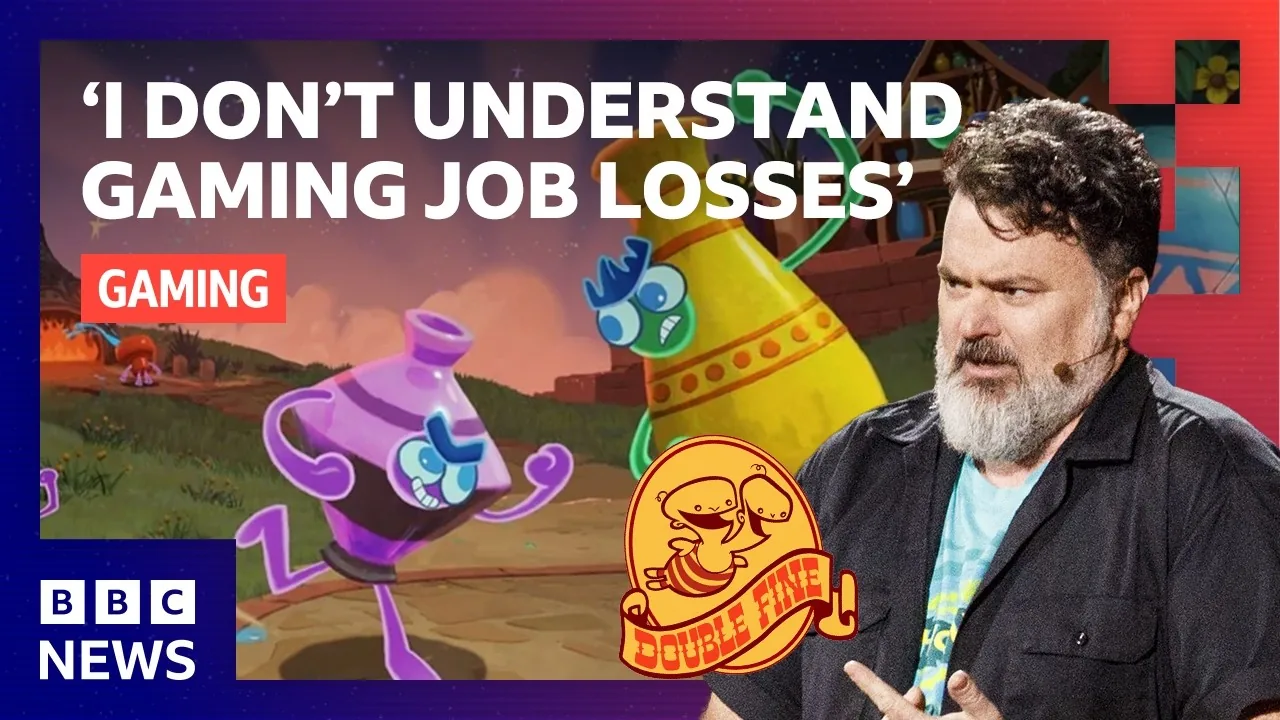
The persistent disconnect between healthy audience spending and continuous studio closures prompted Schafer to question executive motivations directly during his wide-ranging discussion with BBC News. “People are playing games and people are making money, so I don’t know why there’s a big loss of jobs,” Schafer noted, adding, “I just assume it’s like, “someone is being greedy somewhere”” [1]. While expressing genuine hope that commercial equilibrium will eventually return as the Tim Schafer Xbox era drew to a close, he affirmed that Double Fine’s long-term independence and creative survival remain fighting for in an unstable economic landscape [3].


Tim Schafer Xbox Split Reflects Shifting Publisher Priorities
Portfolio realignments within Microsoft catalyzed the separation between the publisher and Double Fine. Schafer explained that platform leadership pivoted toward establishing a curated lineup focused on fewer, massive intellectual properties rather than sustaining a broad assortment of mid-sized titles, highlighting the core driver behind the Tim Schafer Xbox split. Double Fine’s foundational strategy of developing numerous distinct, smaller-scope games ran counter to that corporate consolidation. Because the creative team refused to abandon its multi-project development philosophy, both parties mutually agreed to dissolve their corporate integration [2].
The studio’s departure occurred amid sweeping cutbacks throughout Microsoft’s gaming division. Annual restructuring plans will eliminate 3,200 Xbox positions before the close of the 2027 fiscal year. Compulsion Games and Undead Labs separated. Together with Double Fine, both studios transitioned back into independent entities as Microsoft consolidated operations. Meanwhile, developer Ninja Theory faced potential closure after acquisition negotiations collapsed, while the organizational future of Arkane remains unresolved [1].
Achieving independence brought immediate organizational challenges to Double Fine’s San Francisco headquarters. Without Microsoft’s financial buffer, the newly emancipated studio had to carry out internal workforce reductions of its own to balance operational overhead, facing independent realities after the Tim Schafer Xbox period. Despite those painful cuts, Schafer maintained an uncompromising outlook regarding the studio’s destiny. Confronting the realities of self-funded operations, Schafer declared that no external entity would dictate the studio’s demise, asserting that no one puts Double Fine out of business except for himself [1].
Mounting Pressure Inside Modern AAA Studios
Working conditions inside large-scale commercial game development have deteriorated sharply according to veteran developers. Schafer observed that high-budget AAA environments have become far more hostile toward creative staff after articulating his thoughts during the Tim Schafer Xbox interviews, noting that exceptional creative effort no longer guarantees job stability. Workers frequently find themselves dismissed the moment a major production goes gold. Schafer characterized this dynamic as deeply unrewarding, lamenting that developers who sacrifice years to ship complex interactive worlds face immediate unemployment upon hitting scheduled retail deadlines [1].
Recent industry milestones demonstrate how widespread this post-launch layoff practice has become across prominent publishers. Development teams behind high-profile titles such as Star Wars Zero Company and Gears Of War: E-Day were subjected to staff cuts shortly after finishing their primary software builds. Even critical and commercial triumphs offer little organizational immunity. Electronic Arts celebrated the massive financial performance of Battlefield 6 by awarding EA CEO Andrew Wilson a substantial executive bonus, shortly after dismissing staff members who actually engineered the title [1].
Despite those severe labor critiques, Schafer refused to dismiss large-budget productions outright. He clarified that he is not one of those snobs who claims that AAA studios lack creative ambition, acknowledging that major commercial teams regularly produce remarkable artistic work [2]. His criticism focuses on institutional governance rather than artistic capability. The fundamental friction stems from corporate financial models that prioritize executive bonuses over retaining specialized development teams, generating instability across the entire interactive entertainment sector [1].
Double Fine Returns to Independent Crowdfunding
Navigating post-publisher independence has guided Double Fine back to community-driven production models following the resolution of the Tim Schafer Xbox partnership. Rather than seeking another institutional acquisition, the studio turned to Kickstarter to finance its upcoming small-scale project [1]. Double Fine previously created Broken Age. That groundbreaking 2012 campaign established community backing as a viable development pathway. Returning to crowdfunding allows the team to gauge public demand directly, bypassing corporate gatekeepers while retaining complete ownership over its creative property [2].
Internal creative energy is currently on display through Double Fine’s internal game jam initiative, Amnesia Fortnite. The studio is developing four distinct prototypes, inviting the public to vote on concepts through a dedicated Kickstarter campaign. The projects showcase the developer’s penchant for unorthodox mechanics, featuring a dynamic city builder where urban structures transform into giant robots to battle encroaching monsters. Another prototype, titled Bard Crawl, combines cooperative dungeon exploration with comedic bar crawl multiplayer antics across PC, PlayStation 5, and Xbox Series X/S platforms for players worldwide [2].
Grassroots agility offers a compelling blueprint for studios navigating the ongoing commercial turbulence. While corporate publishers struggle to balance inflated budgets against quarterly performance metrics, independent teams continue to demonstrate that compelling concepts do not require astronomical funding. Schafer remains confident that the gaming medium retains immense creative vibrancy, emphasizing that indie creators will drive future industry rejuvenation [2]. For Double Fine, self-reliance ensures that artistic curiosity continues to guide game design.
- ONLINE NEWS McCrae, S. (2026, September 24). Post-Xbox, Double Fine boss Tim Schafer is baffled by the terrible state of the game industry: “People are making money, so I don’t know why there’s a big loss of jobs”. GamesRadar+. [Article Link]
- ONLINE NEWS Makar, C. (2026, September 24). “I assume someone is being greedy somewhere” – Tim Schafer discusses current game industry woes following Double Fine’s split with Xbox. Eurogamer.net. [Article Link]
- ONLINE NEWS Video Games Chronicle. (2026, September 24). ‘I just assume someone is being greedy’: Double Fine’s Tim Schafer says he doesn’t know why the industry isn’t recovering. Video Games Chronicle. [Article Link]


