





Could Earth’s planetary twin have once possessed a companion of its own? The disappearance of a hypothetical Venusian moon has challenged astronomers for generations. Venus possesses roughly 80 percent of Earth’s mass, yet our neighbor circles the Sun entirely alone. Rather than invoking an exotic cosmic catastrophe, astrophysicist Stephen Kane and his colleagues found that ordinary gravitational forces sealed the satellite’s fate [1, 2]. Under the planet’s slow rotation, the moon was gradually pulled down and swallowed [2].
Why Does Earth’s Sister Planet Orbit Alone?
Venus is frequently described as Earth’s twin because the two rocky worlds share comparable dimensions, structural density, and chemical ingredients. Writing for Nautilus, science journalist Jake Currie notes that Venus retains 80 percent of Earth’s mass and follows an orbit that is 70 percent the size of ours. Despite those deep similarities, the absence of a natural satellite creates an unmistakable division. Our Moon formed roughly 4.5 billion years ago when a rogue planet collided with the early Earth. Cosmic collisions were remarkably frequent throughout the turbulent youth of the inner solar system, making it probable that Venus experienced moon-forming impacts similar to Earth’s early history [3].
For decades, planetary scientists divided their explanations into two competing ideas. Either an immense impact pulverized any satellite that arose, or Venus simply avoided the giant collisions required to form large moons in the first place [2]. Proximity to our host star also complicates satellite retention. Mercury lacks moons because it orbits within the Sun’s deep gravitational well, where solar pull strips fledgling debris away. Venus sits further out, yet its stable gravitational region remains far narrower than Earth’s orbital zone (the gravitational region where a planet’s pull dominates over the Sun). Competing solar and planetary gravitational pulls left very little room for a fledgling satellite to endure. [3]
A fresh investigation offers an alternative to catastrophic collisions. Astrophysicist Stephen Kane from the University of California, Riverside joined researchers from the University of Bordeaux to examine whether orbital mechanics could account for the missing satellite [1, 3]. Their research evaluated how planetary rotation alters gravitational dynamics across billions of years. Early discussions of this work emerged in an unreviewed preprint before formal publication in The Astrophysical Journal [1, 3]. Their numerical simulations suggest that Venus never required a violent catastrophe to strip its sky [2].
How Planetary Rotation Flips Gravitational Tides
Understanding the fate of a natural satellite requires examining how orbital tides exchange angular momentum. Earth rotates rapidly on its axis, completing a full rotation once every 24 hours. Because the planet spins faster than the Moon orbits, tidal bulges stay slightly ahead of our lunar neighbor, transferring rotational energy and nudging the Moon outward. Kane highlights that laser measurements targeting reflectors placed by Apollo 11 astronauts prove the Moon recedes by roughly 4 centimeters per year [2]. Earth constantly propels its satellite into a wider, more distant path.
The physics flips completely around Venus. A single planetary rotation on Venus requires 243 Earth days, making its spin extraordinarily sluggish. Under that exceptionally slow spin, tidal friction operates in reverse. Instead of leading the satellite, the gravitational tidal bulge raised on the planet lags behind the orbiting body [1, 2]. That lag acts as a persistent gravitational drag that steadily siphons away orbital energy. The satellite cannot escape outward. Planetary gravity drags it downward along a relentless inward spiral [2].
Planetary scientists contrast these diverging evolutionary paths when evaluating terrestrial worlds. While Earth preserved its companion, earlier research on doomed ancient Venusian satellites established that inward orbital migration would leave any early moon vulnerable to disruption. Kane explains that the gravity of the planet combined with its rotation rate naturally caused the satellite to collapse directly onto the surface. No catastrophic outside projectile was needed to clear the skies [2].
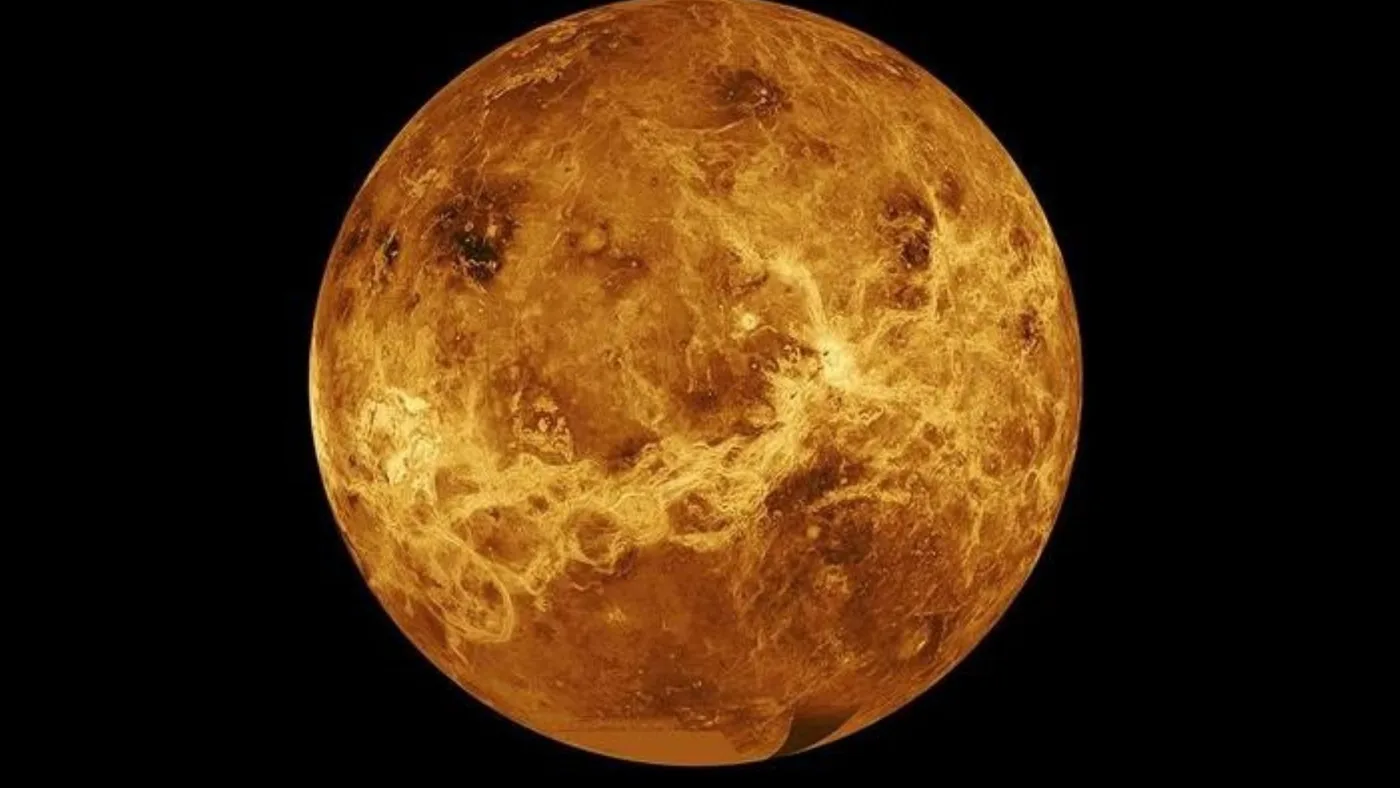
How a Hypothetical Venusian Moon Spiraled Inward
To test whether inward migration was truly inevitable, Stephen Kane constructed comprehensive numerical models tracking gravitational interactions between the host planet and orbiting bodies across cosmic epochs. He first calibrated the simulation against Earth and its Moon to verify that the mathematical model accurately reproduced the outward drift observed today [2]. Once verified, the researchers applied the code to Venus across its 4.5-billion-year history [1, 3]. Kane varied multiple orbital parameters (including rotational velocity, moon mass, and orbital eccentricity) to determine whether any stable niche existed [3]. The team tested hypothetical satellites ranging from half the mass of our Moon up to ten times its mass [2].
The simulations produced remarkably uniform results. Across nearly every scenario, the hypothetical body was pulled inward toward destruction. Kane admitted to being shocked by the uniformity, noting that he had anticipated diverse outcomes across such a wide parameter space. Larger moons experienced even faster orbital decay because greater mass created stronger tidal drag [2]. According to the modeling team, an embryonic moon around Venus would have survived anywhere from 30 million years to 1.7 billion years before ultimately crashing into the planet [3].
Survival proved exceptionally rare in the model. A slow spin guaranteed the satellite’s demise. Venus essentially devoured its companion. [2, 3]

Did a Catastrophic Impact Alter Venusian Climate?
When an inward-spiraling satellite finally collides with a planet, the consequences reverberate across its entire planetary system. A decaying moon dumps an enormous quantity of kinetic energy and angular momentum directly into the crust and mantle upon impact. That immense physical shock can reshape planetary rotation, trigger intense volcanic outgassing, and permanently transform atmospheric structure. Planetary scientists investigating early Venus often wonder whether the planet was once capable of supporting liquid water and stable surface environments. If ancient Venus possessed primordial oceans or moderate conditions, absorbing a massive lunar impact could have disrupted its environmental trajectory, contributing to the runaway greenhouse state seen today. The inward plunge delivered enough raw mechanical energy to alter the planet’s evolutionary path. [2]
Astronomers link these calculations to fundamental questions regarding ancient habitability and surface water. Did ancient Venus resemble our world before its climate collapsed? Observers frequently wonder whether Venus used to be like Earth or whether it once harbored primitive life. Earth’s Moon exerts a stabilizing influence on our axial tilt (the planet’s rotational angle relative to its orbital plane), buffering our climate against extreme variations. Losing a satellite removes that protective anchor. Without a stabilizing companion, a rocky world may experience chaotic shifts in orientation, exposing polar regions to intense solar radiation and accelerating the loss of surface volatiles [2].
Understanding how collisions shaped the terrestrial planets requires comparing these evolutionary timelines. Recent investigations into revised estimates of the Moon’s formation age illustrate how early impact chronology dictated whether satellites survived. If Venus sustained a giant collision comparable to the impact that created Earth’s Moon, the resulting debris had to contend with the planet’s slow spin [1, 2]. The physical outcome was governed by rotational dynamics rather than luck [2].
Searching for Traces Beneath Resurfaced Plains
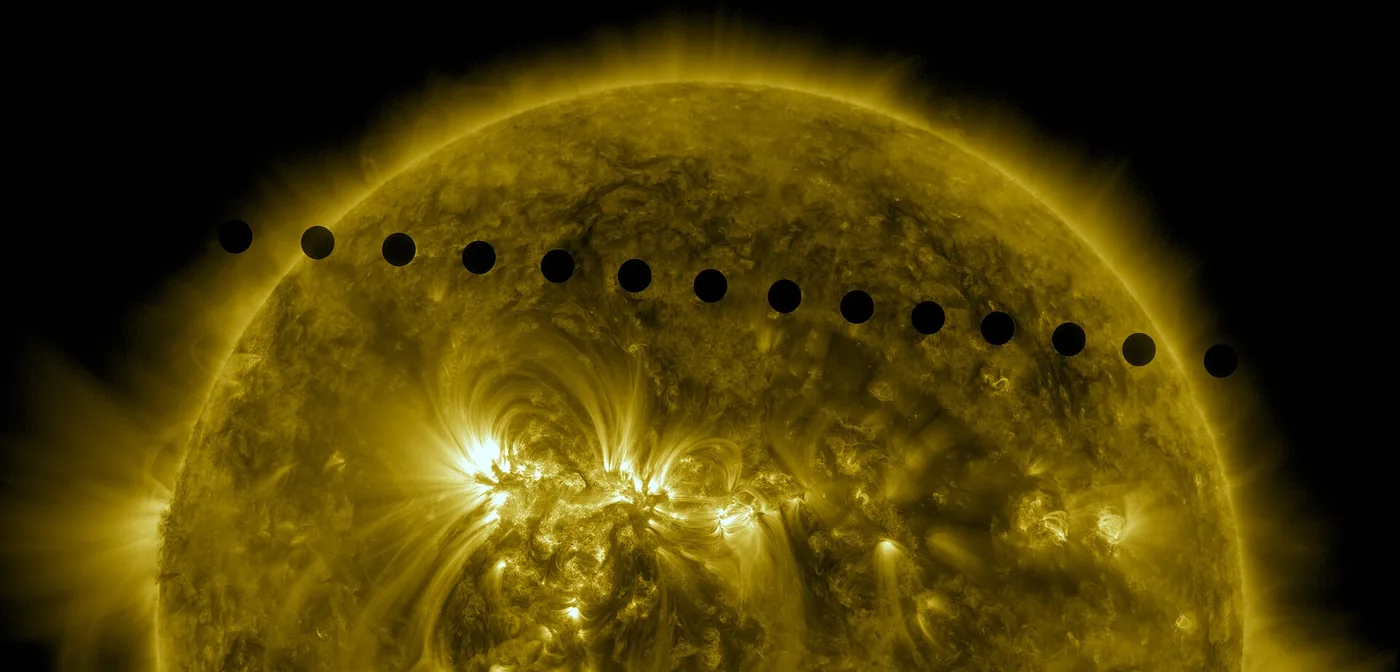
Finding geological proof of a swallowed satellite poses formidable challenges. About 80 percent of Venus’s surface is roughly the same age, having undergone widespread volcanic resurfacing that obliterated ancient impact basins and geological structures across global scales. Lava floods erased the planet’s crust. If a moon crashed into the surface billions of years ago, the resulting crater was almost certainly buried under subsequent basaltic lava flows. Volcanic resurfacing effectively wiped the external visual slate clean. [2]
Planetary geologists look beneath the surface for surviving signatures. On our own world, seismic measurements have revealed anomalous, dense structures nestled deep within the lower mantle. These deep seismic features may represent buried remnants of the ancient impactor that generated our Moon, a possibility explored in research on mantle remnants from the Moon-forming impact. Kane suggests that deep geophysical measurements on Venus could theoretically uncover similar buried material, demonstrating whether our sister planet endured an early moon-forming event [2].
Atmospheric chemistry offers another promising discovery avenue. Several upcoming space missions will explore Venus over the next decade, including NASA’s DAVINCI mission (Deep Atmosphere Venus Investigation of Noble Gases, Chemistry, and Imaging). The DAVINCI architecture includes an orbiter and a descent probe designed to sample chemical composition as it parachutes through the dense atmosphere toward the surface. Researchers hope that measuring isotopic ratios and noble gas abundances will reveal chemical fingerprints left behind by ancient impacts, helping confirm whether a satellite once orbited the planet [3].
Habitability and Missing Moons Across the Galaxy
The implications of Kane’s tidal model extend far beyond the solar system. When astronomers use space telescopes to hunt for potentially habitable exoplanets orbiting other stars, they frequently search for Earth-like twins and evaluate whether those worlds possess moons. In our own system, the Moon stabilizes Earth’s rotational tilt and drives ocean tides, shaping environmental stability in ways scientists are still working to understand. Whether a large natural satellite is strictly required for biological life remains an unresolved debate among astrobiologists. [2]
Kane emphasizes a measured habitability perspective. ‘My feeling is there are benefits to having a moon, but it isn’t required for habitability,’ Kane observed when discussing the broader planetary implications of his study. He noted that while the Moon undeniably altered how Earth evolved, researchers cannot yet quantify how vital that presence was for sustaining biology [2]. A rocky planet might retain liquid water and support life without a satellite, provided its atmospheric greenhouse and orbital geometry remain stable.
The sobering takeaway applies to slow-rotating worlds throughout the cosmos. As Kane noted, astronomers evaluating Earth twins often ask whether a planet has a moon, yet slow rotational speed guarantees that any satellite will eventually crash into the surface. That inward collision drastically redirects planetary climate, geology, and atmospheric survival. Whether Venus once harbored an ancient companion remains an open question, but the physical laws of tidal friction prove that slow-spinning worlds cannot hold onto their satellites across cosmic time [1, 2].
- ACADEMIC JOURNAL Kane, S. R., Selsis, F., Leconte, J., & Raymond, S. N. (2026). Tidal Demise: The Evolution and Fate of a Hypothetical Venus Moon. The Astrophysical Journal, 1009(1), 31. [Article Link]
- ONLINE NEWS Ionescu, A., & Ralls, E. (2026, September 15). Venus may have swallowed its own moon. Earth.com. [Article Link]
- ONLINE NEWS Currie, J. (2026, September 14). Did Venus eat its own moon? Nautilus. [Article Link]
APA 7: PerEXP Teamworks. (2026, September 16). Did a Venusian moon spiral into its host planet? https://perexpteamworks.com/en/venusian-moon-orbital-demise/


