



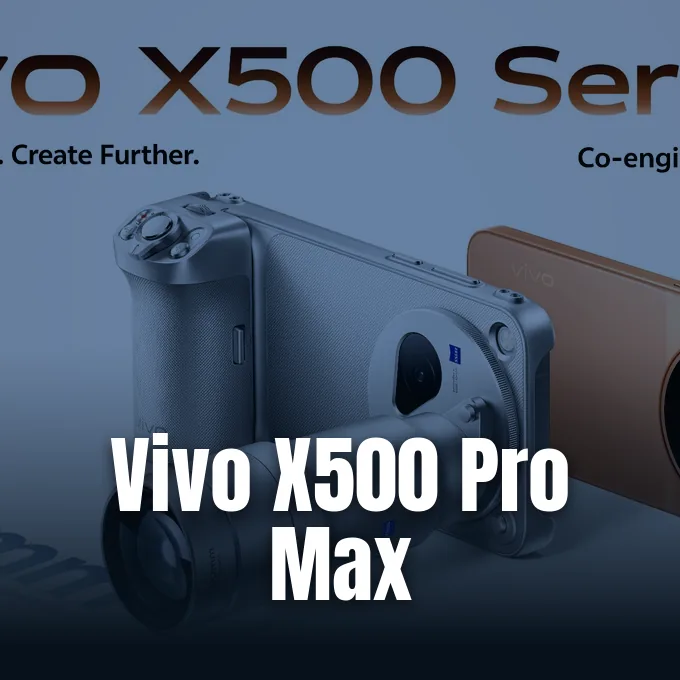
Vivo officially unveiled the Vivo X500 Pro Max during an expansive hardware showcase in Shanghai, China, positioning the handset as its flagship mobile photography benchmark. Succeeding last year’s X300 Ultra at the pinnacle of the manufacturer’s lineup, the device introduces advanced optics engineered with Zeiss and a silicon-carbon 8,000mAh battery cell. Vivo confirmed that domestic retail availability begins this September across China ahead of scheduled international market rollouts [1].
Vivo X500 Pro Max Camera Hardware
Optics define the flagship experience. Hands-on evaluation in Shanghai confirmed that Vivo shifted the primary lens to a traditional 24mm focal length [3].
The optical assembly pairs a 1/1.28-inch 50MP main camera with a 200MP periscope telephoto providing 3.5x optical zoom (an 85mm equivalent focal length favored by portrait photographers) and an additional 50MP ultra-wide sensor. Vivo developed this arrangement under what the company terms the BlueImage Dynamic Imaging Technology Stack, an engineering framework uniting customized sensor hardware from Sony with algorithmic tuning from MediaTek. The imaging system relies on custom V3 and VS1 silicon to accelerate real-time calculation pipelines while preserving delicate textural definition across high-contrast compositions. During high-resolution shooting scenarios, both the ultra-wide module and main camera can output native 50MP files boasting extraordinary resolving power and minimal peripheral distortion [1].
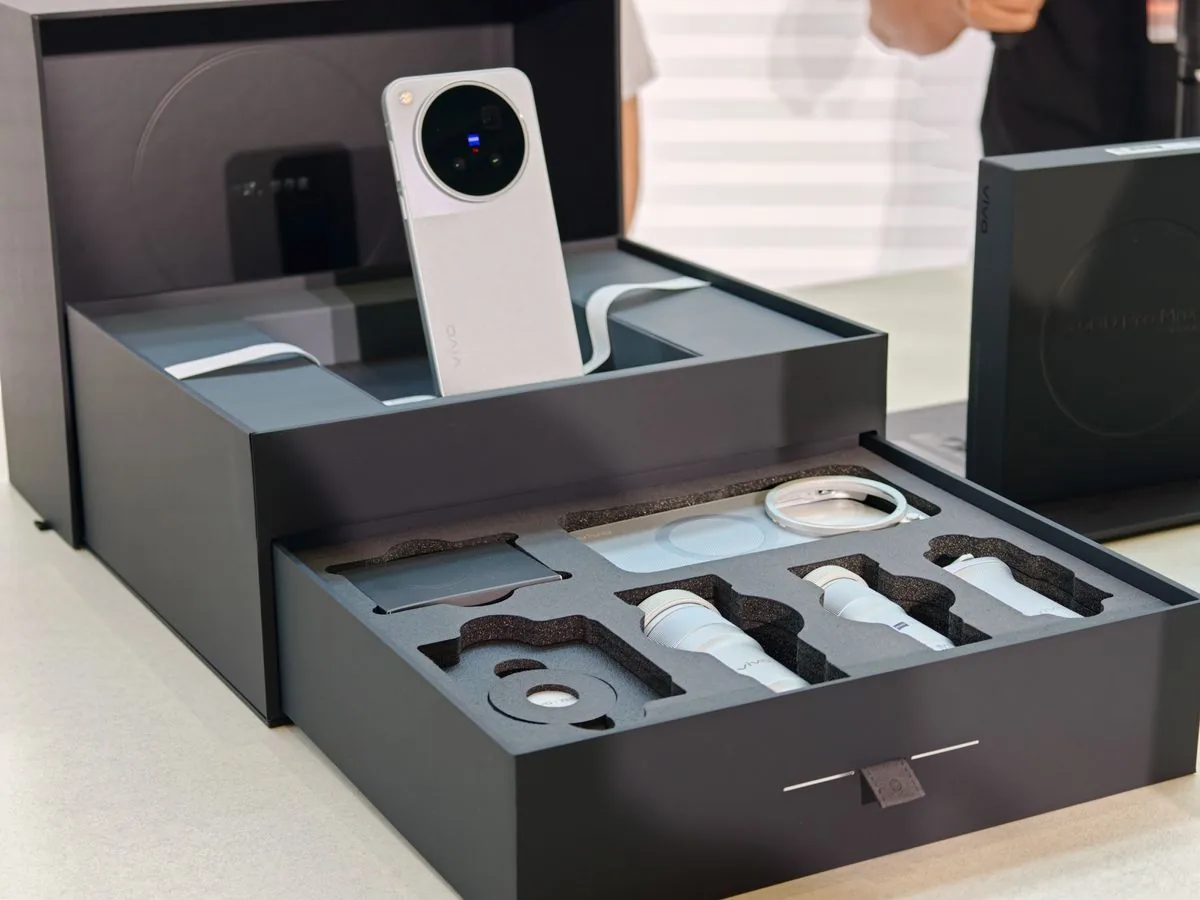
Hardware modularity extends beyond fixed internal components. Dominic Preston from The Verge noted that the 200MP periscope sensor preserves the celebrated optical foundations of the X300 Ultra, maintaining full hardware support for the existing 400mm external teleconverter lens [2]. To complement these telephoto capabilities, Vivo prepared an optional photographer kit housed inside an elegant black presentation box containing dedicated 2.35x and 4.7x conversion glass paired with an ergonomic camera grip and specialized protective cases [3].
Sony Lytia Sensor and Dynamic Range
At the heart of the primary imaging module sits Sony’s new Lytia L910 sensor. The 50-megapixel, 1/1.28-inch component represents Sony’s first mobile deployment of LOFIC (Lateral Overflow Integration Capacitor) architecture designed specifically to prevent severe pixel well saturation under harsh daylight. This circuit design routes excess electrical charge generated during bright exposures into secondary capacitors before highlight information clips into unrecoverable white voids [2].
Vivo claims that this integration delivers true 17 EV ultra-high dynamic range, exceeding the 16.5 stops published for the competing Xiaomi 17 Ultra. How does that translate to real photographic output? Testing conducted in Shanghai by TechRadar editor Tim Coleman demonstrated that the Vivo X500 Pro Max preserves delicate cloud highlights and deep shadow detail in high-contrast monochrome scenes without introducing artificial grain. Coleman also tested the portrait engine, setting the virtual bokeh simulation to an extreme f/0.95 digital aperture across street portraits while confirming that blur intensity remains fully adjustable after saving the image file [3].
Physical stability complements electronic exposure controls. Mechanical stabilization operates through calibrated hardware designed in partnership with Zeiss. The engineering team deployed miniature gimbal-style suspension mounts that actively counterbalance physical hand movement during lengthy handheld exposures. This physical stabilization collaborates directly with the V3 and VS1 co-processors, guaranteeing that low-light street photography and distant telephoto captures on the Vivo X500 Pro Max remain remarkably sharp without blurring intricate architectural details [1].


MediaTek Dimensity Silicon and Video Recording
Processing silicon underwent an equally ambitious generational leap. The internal engine relies on the MediaTek Dimensity 9600 Pro, fabricated using an advanced 2nm semiconductor process. Efficiency gains proved substantial. This dense architectural node yields substantial computational throughput while curbing thermal throttling during sustained workloads like real-time video encoding [1].
Video capture capabilities on the Vivo X500 Pro Max benefit substantially from the customized Dimensity platform and dedicated auxiliary processors. The handset supports cinematic 8K footage along with 4K recording at 240 frames per second (an ultra-fast frame rate for slow motion) that transforms rapid action into smooth, fluid sequences. Professional creators gain further flexibility through 10bit Log recording profiles, unlocking broad exposure latitude when adjusting highlight rolloff and shadow tonality in dedicated grading suites. Vivo also packaged custom cinematic color profiles within OriginOS 7, allowing videographers to capture stylized footage straight from the native camera interface without extensive post-production [2].
Tier differentiation across the series appears in processor distribution between hardware variants. The standard X500 runs on MediaTek’s Dimensity 9600M silicon, while both Pro models rely exclusively on the flagship 2nm Dimensity 9600 Pro platform. Every edition ships with OriginOS 7 built upon Android 17, introducing refreshed system animations and upgraded background memory optimization [1].
Silicon-Carbon Battery and Display Engineering
Screen engineering received noticeable visual enhancements. Dominating the front face is an expansive 6.85-inch AMOLED display operating at a sharp resolution of 3168 x 1440 pixels [1]. Panel clarity remains outstanding. Compared to predecessor panels, this display produces crisper typography and richer tonal transitions across media playback, maintaining effortless legibility under intense outdoor sunlight.
To sustain high-drain optical modules and power-hungry display panels, Vivo transitioned the entire flagship family to high-density silicon-carbon battery chemistry. The flagship Vivo X500 Pro Max incorporates a massive 8,000mAh battery pack, marking the largest energy capacity ever integrated into a Vivo smartphone. For comparison, the compact 6.36-inch Pro houses a 6,510mAh battery, while the standard X500 features a 7,500mAh cell. This industry-wide transition toward energy-dense silicon anodes mirrors similar developments revealed in recent leaked battery profiles for the Galaxy S27 series [2]. Supported by the energy efficiency of 2nm fabrication, Harish Jonnalagadda from Android Central noted that the Vivo X500 Pro Max should easily last three days between charging sessions under normal operation [1].
Accommodating such a substantial power cell and broad screen naturally invites questions regarding ergonomic handling. Can a mobile device carrying an 8,000mAh battery maintain comfortable hand feel? Tim Coleman observed that balanced internal chassis distribution prevents the handset from feeling overly top-heavy during protracted shooting sessions throughout Shanghai [3].
Pricing and Global Release Plans
Domestic pricing structures remain competitive across Chinese retail channels following the Shanghai presentation. The premium Vivo X500 Pro Max enters retail channels starting at CNY 6,999 (approximately $1,045), whereas the smaller Pro model lists for $970 and the entry-level baseline X500 starts at $830 [1]. Domestic shipments start immediately.
These strategic pricing tiers position the flagship directly against established premium alternatives across Asia and Europe. TechRadar highlighted that while rival offerings such as the Oppo Find X9 Ultra and Xiaomi 17 Ultra have expanded into regions like the UK, consumers in the United States rarely receive direct domestic distribution for these specialized camera devices. In overseas markets, prospective buyers evaluating import options frequently measure these specialized features against competing high-end flagships from Apple and Samsung that occupy similar premium price brackets. The inclusion of physical photographic accessories, modular conversion glass, and anti-reflective Zeiss lens coatings on the Vivo X500 Pro Max provides compelling value for dedicated imaging enthusiasts [3].
Vivo confirmed that global distribution will follow in upcoming phases, although specific arrival dates and international pricing schedules remain unannounced [2]. Early reactions suggest that pairing a true 17 EV dynamic range sensor with versatile 4K240 video capture establishes the Vivo X500 Pro Max as a formidable technological benchmark across mobile photography [1].
- ONLINE NEWS Jonnalagadda, H. (2026, September 21). Vivo’s X500 Pro Max just became the camera phone to beat. Android Central. [Article Link]
- ONLINE NEWS Preston, D. (2026, September 21). Vivo’s X500 Pro Max has 17 stops of dynamic range and 4K240 slo-mo. The Verge. [Article Link]
- ONLINE NEWS Coleman, T. (2026, September 21). I tested the flagship Vivo X500 Pro Max in Shanghai, China — here are my favorite photos. TechRadar. [Article Link]


