






Starlink satellites provide broadband web access by circling Earth in low orbital shells instead of distant geostationary perches located tens of thousands of kilometers above the equator. Elon Musk and SpaceX founded the network to deliver internet to remote homes, ships, and planes while funding future journeys to Mars. Older communications satellites introduce substantial latency for ground users. By flying just a few hundred miles above the ground, the SpaceX Falcon launched spacecraft cut data delays down to milliseconds, allowing interactive applications to run smoothly [1]. The network serves millions of active subscribers worldwide.
Orbital Altitude and Latency
Orbital height defines how fast web packets travel through space. Legacy communications platforms park in geostationary orbit far above the equator, taking hundreds of milliseconds to bounce signals between ground stations and user dishes across the globe. SpaceX chose a different path for Starlink satellites, placing them in low Earth orbit at an operational altitude of 340 miles (550 kilometers) to minimize signal travel distance [1]. Flying at this lower height cuts transmission delays down to between 20 and 40 milliseconds, enabling smooth voice calls, real-time gaming, and video meetings for remote communities [10]. The shorter travel distance lets ground terminals send data back and forth without sluggish delays, giving rural homes and remote outposts fast access to everyday web services.
Lower orbits demand far more spacecraft to maintain steady service because a satellite at 550 kilometers moves swiftly across the sky, passing from horizon to horizon in minutes [1]. It cannot linger over one territory. Unlike rival constellations such as OneWeb that fly at higher altitudes, ground dishes must track each passing SpaceX unit and switch electronically to incoming craft as older ones dip out of view.
Musk first announced the venture in January 2015 in Redmond, Washington [3]. The project name was inspired by the novel The Fault in Our Stars. SpaceX filed papers to fly about 4,000 satellites, the Federal Communications Commission (FCC) granted approval for 12,000 craft, and the company filed paperwork to loft up to 30,000 additional spacecraft. Regulators later approved deployment plans for as many as 7,500 second-generation satellites to expand network capacity across multiple low-altitude orbital shells around the globe. By late 2026, tracking by astronomer Jonathan McDowell recorded 11,102 satellites in orbit, with 11,087 working craft providing broadband links [1].
How Starlink Satellites Relay Signals
Connecting to the web through Starlink satellites requires a quick three-step signal loop. A user dish transmits radio waves upward to a passing craft in orbit [4]. The satellite catches the incoming beam and relays it down to a nearby ground station linked directly to terrestrial fiber optic lines and global internet routing hubs. Web servers process the request and return data instantly.
Signals travel over specific microwave frequencies licensed by international regulators. User downlinks run on Ku-band frequencies between 10.7 and 12.7 gigahertz, while feeder links connecting satellites to ground stations rely on higher-frequency Ka-band spectrum to move large volumes of data. In IEEE Transactions on Aerospace and Electronic Systems, researcher T. E. Humphreys and colleagues analyzed the Ku-band signal structure, documenting synchronization sequences embedded within orthogonal frequency division multiplexing transmission frames [7]. The craft manages multiple narrow beams at once. Because each unit flies past rapidly, the network coordinates electronic handoffs every few minutes, allowing an approaching satellite to take over the session without dropping data packets [4].
Service tiers offer different data speeds for customers. Standard residential setups deliver download speeds between 50 and 250 megabits per second, allowing families to stream high-definition video, browse websites, and run online applications smoothly. The higher Starlink Premium tier uses a larger antenna to reach speeds between 150 and 500 megabits per second, supporting storefronts, small offices, and demanding commercial workloads [10]. That faster tier costs $500 each month.
How Ground Gateways Connect to Dishes
User dishes rely on an electronic phased array antenna. Parabolic antennas must physically swivel to track moving orbital targets. In contrast, Starlink terminals use hundreds of tiny internal elements that shift signal timing by microseconds, steering radio beams electronically without mechanical motors to follow spacecraft across the open sky [1]. The dish switches from one satellite to the next in milliseconds. Without moving parts to wear out from friction, the flat electronic array maintains accurate tracking angles across shifting seasons, strong winds, and heavy snowfall on residential roofs. Built-in heating elements melt ice to protect signal reception.
Ground gateways provide the land links that feed web traffic into orbit. These gateway stations look like clusters of white domes housing big tracking antennas. In the Ukrainian conflict, a gateway in neighboring Poland helped keep towns online when local fiber links were cut by military attacks during the defense of Kyiv [4].

Terminal hardware has evolved through multiple editions since public pre-orders opened for a $99 deposit in 2021 [6]. Early circular receivers gave way to lighter rectangular dishes that cut costs. Later, the Starlink mobile expansion announced by T-Mobile CEO Mike Sievert revealed plans to send voice and text signals directly to cell phones using second-generation orbital antennas [9]. Partnering with mobile carriers helps connect standard smartphones during remote emergencies.
Why Are Starlink Satellites Visible in a Line?
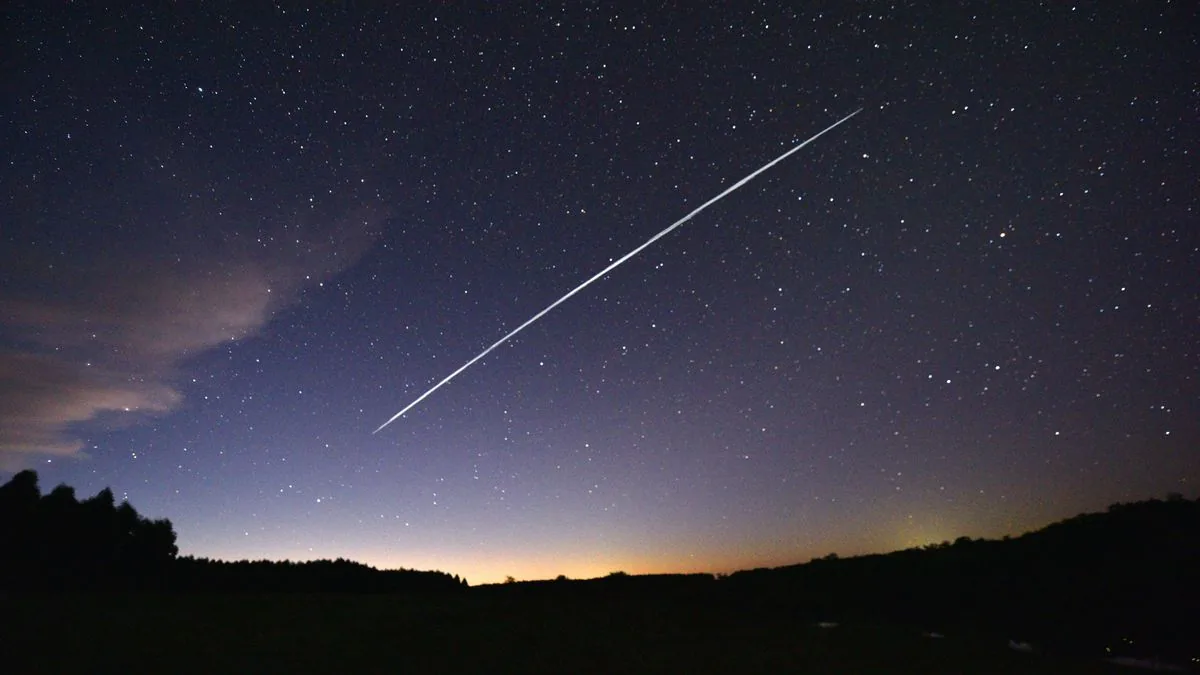
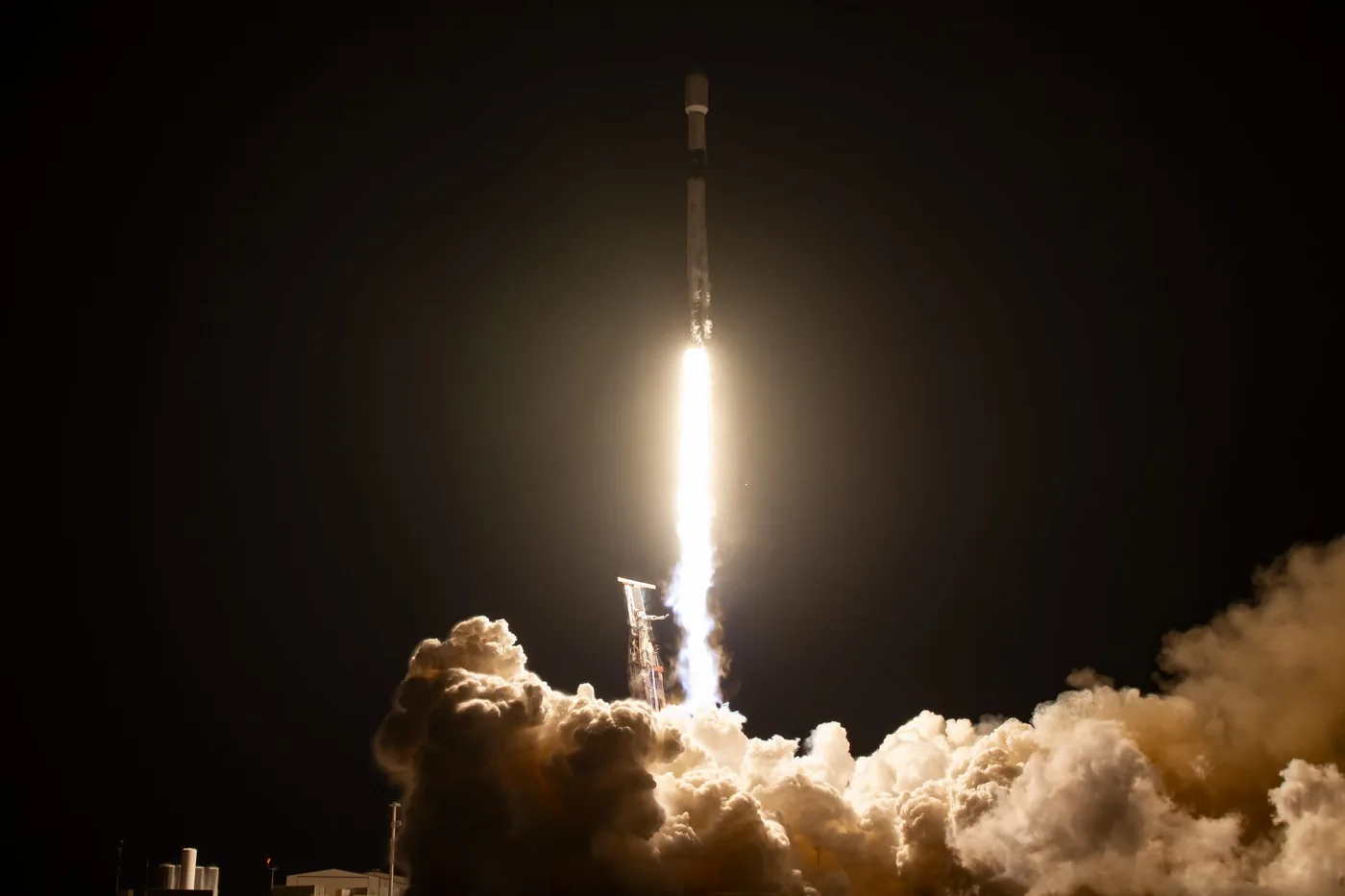
Shortly after launch, skywatchers often see a striking line of lights. Starlink satellites travel close together in a neat file that looks like a moving pearl necklace. This visual spectacle occurs because a SpaceX Falcon 9 rocket deploys a dense stack of 20 to 60 craft into space all at the same time [1]. The newly deployed spacecraft slowly drift apart.
Freshly launched craft look exceptionally bright because they orbit low and catch sunlight. Just after release, the vehicles circle at low altitudes where solar arrays reflect sunlight down to dark ground locations before climbing to their assigned operational slots [1]. Onboard thrusters powered by krypton gas fire every 90 minutes to push the craft toward their final height of 550 kilometers above the planet’s surface [2]. As they climb toward their assigned slots, onboard software adjusts the angle of the solar panels to reflect less sunlight toward observers watching from the ground during clear evening hours. Most operational craft become much fainter over time.
Skywatchers have tracked these trains with great interest. Dutch observer Marco Langbroek famously filmed the first train of 60 craft in May 2019. Amateur skygazers use phone apps to watch them glide. Natural orbital drift and small thruster burns gradually spread the craft out into an evenly spaced orbital shell that circles the globe in regular formation [1].



Laser Intersatellite Links
Early Starlink craft worked like simple transponders reflecting signals back to Earth. This bent-pipe architecture restricted service to regions where a ground station was situated within direct line of sight of both the user and the satellite [4]. Remote ocean expanses and isolated polar regions lacked web coverage. To solve this fundamental limitation, SpaceX developed laser intersatellite links using optical infrared beams that let satellites pass web traffic directly to each other through space [5]. Data hops across multiple craft until reaching an active gateway.
Optical beams route data at the speed of light in space. In IEEE Vehicular Technology Magazine, researchers A. U. Chaudhry and H. Yanıkömeroğlu mapped how craft form permanent links in the same orbital plane and temporary links across intersecting orbital planes [5]. These optical paths create an agile space mesh.
Light travels faster in the vacuum of space than through glass fiber cables laid under oceans, reducing transmission delays on long journeys between distant continental web hubs. By 2023, SpaceX was launching larger V2 mini satellites equipped with lasers [3]. The V2 satellites weigh about 800 kilograms (1,760 lbs) at launch, nearly three times the 260 kilograms (573 lbs) of earlier generation craft built by the company [1]. The heavier satellites carry more capable communications hardware.

Deorbiting to Reduce Space Debris
Flying thousands of craft in low orbits creates worries about debris. With thousands of objects circling the planet, automated collision avoidance is necessary to prevent catastrophic crashes that could scatter fragments across vital orbital corridors [1]. Each vehicle uses onboard guidance software that processes tracking data from the United States military to identify dangerous approaches and steer out of harm’s way [2].
SpaceX agreed to disposal rules enforced by telecom and aerospace regulators. Under older NASA guidelines, satellite operators were allowed up to 25 years to remove defunct spacecraft from low Earth orbit following the conclusion of their missions. In contrast, SpaceX committed to deorbiting its satellites within roughly one year after their five-year operational lifespan ends, propulsively lowering altitude to enter the atmosphere [6]. Using military satellite tracking data helps ensure these disposal burns happen safely without endangering neighboring spacecraft that share similar orbital inclinations. Atmospheric drag naturally pulls failing hardware down within a few years.
Atmospheric entry burns up nearly all hardware before it touches ground. SpaceX built the satellite bus so that at least 95 percent of its components disintegrate completely from intense aerodynamic heating during descent through the upper atmosphere [2]. Still, some scientists question the impact of vaporized metals. Researchers worry that tons of aluminum burning up in the mesosphere could trigger chemical reactions or alter the planet’s ozone layer as mega-constellations expand in coming years [1].
What Starlink Satellites Mean for Astronomy
The growth of Starlink satellites has alarmed professional astronomers. Because the craft orbit low and carry flat reflective panels, they shine brightly in twilight skies, leaving luminous streaks across sensitive telescope photos taken by ground observatories [1]. Writing in The Astrophysical Journal Letters, astronomer Jonathan C. McDowell warned that megaconstellations of 12,000 satellites would clutter low Earth orbit below 600 kilometers with reflective debris tracks [8]. Alice Gorman of Flinders University and Bruce Macintosh of Stanford University said that altering the pristine appearance of the night sky creates challenges for humanity’s view of space [2].
Big survey telescopes suffer the greatest disruption from reflective spacecraft. The Vera C. Rubin Observatory in Chile, formerly known as the Large Synoptic Survey Telescope (LSST), uses a massive 3.2-gigapixel camera that faces spoiled exposures during critical dusk and dawn observing windows. Astronomer Meredith Rawls said that bright satellite trails saturate detector pixels, creating persistent artifacts that obscure faint stars, distant supernovae, and incoming near-Earth asteroids [1].
Radio astronomy faces severe challenges from satellite downlinks. Faint cosmic signals from the early universe risk being drowned out by powerful Ku-band transmissions beamed down from orbiting spacecraft toward ground dishes in populated valleys [1]. Committee on Radio Frequencies chair Liese van Zee and Harvey Liszt of the National Radio Astronomy Observatory said that geographical valleys cannot shield radio dishes from overhead transmitters passing directly above. Astronomer Michael Brown of Monash University also voiced concern about altered night skies. In response, SpaceX worked with the American Astronomical Society to test darker chassis coatings and radio coordination agreements to reduce interference with major scientific observatories [2].
Support During War and Crises
Starlink has become an important communication lifeline during major international emergencies. When natural disasters destroy cellular towers and electrical grids, compact satellite dishes give emergency rescue teams and medical crews instant access to the global internet [1]. The network proved its tactical value after the February 2022 Russian invasion of Ukraine, when cyberattacks crippled Viasat satellite service just hours before ground troops attacked [4].
Ukrainian digital minister Mykhailo Fedorov asked Elon Musk for help on Twitter, and SpaceX shipped truckloads of dishes to Kyiv and surrounding cities within days. On the battlefield, the steerable antennas resisted Russian electronic jamming because their narrow radio beams require an enemy jammer to stand directly in the line of sight of the terminal. Stepan Veselovskyi of Lviv IT Cluster and NetBlocks director Alp Toker said that Ukrainians gathered around dishes to keep basic communications alive when power networks collapsed [4]. The strategic deployment of dual-use satellites during wartime showed how civilian space infrastructure can reshape tactical defense while creating complex legal dilemmas under international law. In June 2023, the Pentagon contracted with SpaceX to sustain Ukrainian service [11].
SpaceX COO Gwynne Shotwell said Starlink was intended for civilian communications. To handle dedicated defense contracts, SpaceX created Starshield, a specialized branch built specifically for government national security missions and defense intelligence operations [3]. The commercial network turned profitable in 2024 with $72.7 million in net income, reaching 13.6 million subscribers by late 2026 as orbital broadband became globally established [13]. The system continues to expand its orbital presence.
- ONLINE NEWS Pultarova, T., Mann, A., & Dobrijevic, D. (2022). Starlink satellites: Facts, tracking and impact on astronomy. Space.com. [Article Link]
- ONLINE NEWS Drake, N. (2019). Will SpaceX’s Starlink satellites harm astronomy? Here’s what we know. National Geographic. [Article Link]
- WEBSITE Wikipedia contributors. (2026). Starlink. Wikipedia, The Free Encyclopedia. [Article Link]
- ONLINE NEWS BBC News. (2022). Elon Musk’s Starlink arrives in Ukraine but what next? BBC News. [Article Link]
- ACADEMIC JOURNAL Chaudhry, A. U., & Yanıkömeroğlu, H. (2021). Laser intersatellite links in a Starlink constellation: A classification and analysis. IEEE Vehicular Technology Magazine, 16(2), 48-56. [Article Link]
- ONLINE NEWS Henry, C. (2018). FCC approves SpaceX constellation, denies waiver for easier deployment deadline. SpaceNews. [Article Link]
- ACADEMIC JOURNAL Humphreys, T. E., Iannucci, P. A., Komodromos, Z. M., & Graff, A. (2023). Signal structure of the Starlink Ku-band downlink. IEEE Transactions on Aerospace and Electronic Systems, 1-16. [Article Link]
- ACADEMIC JOURNAL McDowell, J. C. (2020). The low Earth orbit satellite population and impacts of the SpaceX Starlink constellation. The Astrophysical Journal Letters, 892(2), L36. [Article Link]
- ONLINE NEWS Kolodny, L. (2022). SpaceX and T-Mobile team up to use Starlink satellites to ‘end mobile dead zones’. CNBC. [Article Link]
- ONLINE NEWS Porter, J. (2022). SpaceX’s new Starlink Premium tier promises up to 500Mbps for $500 a month. The Verge. [Article Link]
- ONLINE NEWS Macias, A., & Sheetz, M. (2023). Pentagon awards SpaceX with Ukraine contract for Starlink satellite internet. CNBC. [Article Link]
- ACADEMIC JOURNAL Cakaj, S. (2021). The parameters comparison of the ‘Starlink’ LEO satellites constellation for different orbital shells. Frontiers in Communications and Networks, 2. [Article Link]
- ONLINE NEWS Zafar, R. (2025). SpaceX’s Starlink profit isn’t enough to fund Starship show financial statements. Wccftech. [Article Link]
- ONLINE NEWS Sabbagh, D. (2023). Fury in Ukraine as Elon Musk’s SpaceX limits Starlink use for drones. The Guardian. [Article Link]


1 comment