





People studying military weapons and energetic chemistry often ask what is lead azide and why munitions rely on it despite grave handling risks. Lead azide is an inorganic salt with the formula Pb(N3)2 that functions as a primary explosive in primers and military detonators. Because it contains 71% lead by weight and explodes instantly when struck by fire, impact, or electric sparks, weapons makers use it to trigger main explosive charges inside mortar rounds, artillery shells, and rockets. The dry salt yields a fast shockwave, but its needle crystals turn volatile when liquid baths dry out over decades of storage [7].
What Is Lead Azide?
In civilian and military hardware, pure lead azide appears as a white to buff crystalline powder that sets off secondary high explosives [7]. Chemist Theodor Curtius in 1891 first made the pure salt, discovering a compound far more sensitive than black powder. The salt jumps from burning to full detonation in fractions of a microsecond [12].
The compound consists of divalent lead cations bonded to linear azide anions that release large thermodynamic energy during rapid chemical breakdown. While standard military propellants need tight metal casing to build up destructive force, lead azide detonates whether it is packed inside tiny metal shells or spread loosely across an open table. It contains a high proportion of heavy metal, leading public health agencies to classify the salt as both an acute and chronic poison. The Occupational Safety and Health Administration limits human workplace exposure to airborne lead dust at 0.05 milligrams per cubic meter over an eight-hour shift. Breathing or swallowing loose dust harms human blood cells, kidneys, and the central nervous system [7].
The salt does not dissolve easily in cold water, but it dissolves in weak nitric or acetic acid mixed with sodium nitrate [12]. It also dissolves slightly in hot water and alcohol. Disposal crews use ammonium acetate and sodium dichromate baths to destroy small amounts in glass beakers. Because tiny chemical leftovers still explode, chemists avoid washing dissolved mixtures down copper or brass drains where secondary sensitive salts might form [7].
Chemical Structure of the Salt
The azide group inside the crystal lattice forms a straight, three-nitrogen chain written chemically as N3- with resonance bonds balancing formal electric charges [8]. This anion is isoelectronic with carbon dioxide and nitrous oxide, sharing similar linear electron arrangements between its three nitrogen atoms. In a theoretical study, researcher Z. Li and colleagues modeled alpha-Pb(N3)2 crystals exposed to strong electric fields. Their computer simulations showed that outer electric fields pull on ionic lead-nitrogen bonds far more than covalent nitrogen-nitrogen bonds, creating crystal flaws that can trigger rapid electronic breakdown [6].
Chemical plants make the explosive through a metathesis reaction between liquid sodium azide and lead nitrate. Makers also prepare the salt with lead acetate solutions. Chemists add organic thickeners like dextrin or polyvinyl alcohol during precipitation to control crystal shape, preventing long, fragile needles that would explode under slight friction during factory assembly [7].
When struck, unstable chemical bonds snap apart, releasing huge volumes of hot nitrogen gas and leaving fine metallic lead dust behind [8]. The net chemical reaction splits each molecule into one atom of elemental lead and three molecules of nitrogen gas, written as Pb(N3)2 breaking down into Pb and 3 N2. This swift reaction drives a sharp supersonic shockwave without needing any outside oxygen from ambient air. An environmental life cycle study conducted under ISO 14040 rules by E. B. F. Galante and colleagues in the Journal of Aerospace Technology and Management found that manufacturing the salt consumes large amounts of steam, power, and feed water while creating toxic waste streams that require dedicated treatment tanks [4].
Sensitivity to Shock and Friction
Working with dry lead azide is one of the most hazardous tasks in weapons assembly because tiny amounts of physical energy set off an explosion [12]. In standard sensitivity checks, dropping a steel ball weighing one quarter of an ounce from a height of six inches (150 mm) onto a firing pin triggers the salt. The dry powder explodes when hit by a static electric spark of just 7 millijoules, an energy level people easily build up on clothing during cold, dry weather. Technicians must work on grounded conductive mats to keep static sparks away [7].
To cut electrostatic hazards, chemists design protective coatings that stop charge buildup during factory handling. In a study in Propellants, Explosives, Pyrotechnics, M. Zhou and co-authors tested four surfactants on lead azide and lead styphnate crystals. Their tests showed that adding lauryl dimethylamine betaine cut static buildup without hurting heat stability or lowering detonation limits [3].

Unlike mercury fulminate, soaking lead azide with water does not stop it from exploding when struck [12]. Even though the salt has very low moisture absorption, keeping it submerged in water or alcohol dampens motion and shields crystals from friction while in transit. Furthermore, the salt reacts with copper, zinc, and brass alloys to form secondary metal azides that detonate at the gentlest touch. For this safety reason, munitions plants build detonator cups, scoops, and storage containers solely from non-reactive aluminum or insulated rubber [7].
How Lead Azide Triggers Secondary Charges
In artillery shells and demolition caps, lead azide serves as the prime initiator in an explosive train. Secondary explosives like TNT, RDX, and PETN hold massive energy but safely resist accidental detonation from mild heat or rough handling. A tiny bead of lead azide takes the first firing pin hit or electric match, detonating in an instant to create a sharp shockwave. This sudden punch slams into the secondary booster charge, driving its chemical lattice past the detonation threshold to detonate the main shell [12].
The detonation speed of the salt reaches about 5,180 meters per second, equal to roughly 17,500 feet per second [7]. In a microscale test published in Micromachines, Y. Mu and fellow researchers tracked detonation growth inside narrow steel channels using photon Doppler velocimetry and calibrated polyvinylidene fluoride gauges. Their recorded measurements showed a steady detonation velocity of 4,726 meters per second and an output pressure of 17.12 gigapascals. The full detonation wave formed within just 2.5 millimeters of travel, showing a reaction zone width of 148 micrometers and an ultra-short reaction time of 44 nanoseconds. These lab observations confirmed that lead azide builds full explosive force across tiny distances, making it ideal for compact military fuzes [5].
Scientists have also studied why lead azide sets off secondary explosives better than mercury fulminate. Computer models by B. Khasainov and team members revealed that because lead boils at a much higher heat than mercury, its detonation produces molten lead droplets. These hot liquid metal droplets slam into the secondary explosive, delivering strong shock energy into the acceptor charge [2].


Wartime Military Standards
Armies turned to lead azide on a broad scale after World War I to replace unstable mercury fulminate fuzes. During the 1920s and 1930s, military ordnance boards developed a dextrinated military blend known as (MIL-L-3055) to make powder pressing safer in factories. Bulk industrial production started under contract with DuPont Co beginning in 1932. The standardized powder supplied reliable fuzes for aerial bombs, naval depth charges, and artillery rounds deployed across global combat theaters [7].
World War II created demand for a sharper, more brisant output to detonate heavy armor-piercing munitions. Military chemists met that goal by making RD-1333 lead azide under specification MIL-DTL-46225, adding sodium carboxymethyl cellulose as a settling agent. Decades later during the Vietnam War, high ammunition usage prompted the military to formulate Special Purpose Lead Azide under standard MIL-L-14758. The Department of Defense built massive stockpiles in government depots, but American factories halted regular manufacturing by the early 1990s as military stockpiles proved sufficient [7].
The chemical salt also surfaced in high-profile criminal violence on American soil. On March 30, 1981, John Hinckley Jr. loaded six .22 caliber Devastator bullets into a Röhm RG-14 revolver to carry out an assassination attempt against U.S. President Ronald Reagan. Each bullet contained a lead azide center beneath an aluminum tip designed to explode upon flesh impact. Federal investigators found that the bullet that struck White House press secretary James Brady exploded, whereas the round that wounded President Reagan failed to detonate [7].
Why Do Aging Stockpiles Become Unstable?
To preserve bulk munitions stores safely, military depots keep lead azide submerged in water and ethanol inside sealed drums. The liquid bath shields crystals from friction and stops dry crusts from forming. However, when storage rooms go unmonitored, seasonal heat swings cause the alcohol-water bath to evaporate. Environmental combustion engineer Ron Sahu noted that as liquids dry up, dissolved salt recrystallizes into long, needle-shaped crystals [9].
These needle crystals display extreme sensitivity to vibration, gentle friction, and freezing winter weather [11]. In aging stockpiles, even rolling a drum or twisting a lid creates friction that can set off an unplanned explosion. At the Iowa Army Ammunition Plant (IAAAP) near Middletown, Iowa, inspections revealed that operator American Ordnance LLC, a unit of defense contractor Day & Zimmermann, had skipped required liquid checks since September 2025. By March 2026, depot staff found that stabilizing fluids had dried up across dozens of drums. Independent safety records, including Iowa Army Ammunition Plant safety evaluations, showed that long-stored drums inside concrete magazines had turned too fragile to move safely over public roads [9].
An Army explosive ordnance disposal team inspected the depot on April 28, 2026, finding dangerous recrystallization in 58 of the 68 drums [9]. The U.S. Army Sustainment Command hired MuniRem Environmental in March 2026 to treat the drums chemically, but safety officers cancelled the contract two months later. Opening dried drums to pour in neutralizing agents required close human contact that posed an intolerable blast risk. With winter freezes approaching, the Department of Defense and the Environmental Protection Agency concluded that in-place detonation was the only safe remedy [11].
Controlled Demolition at Iowa Plant
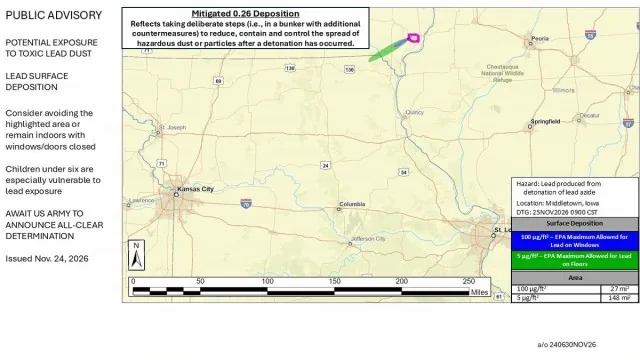
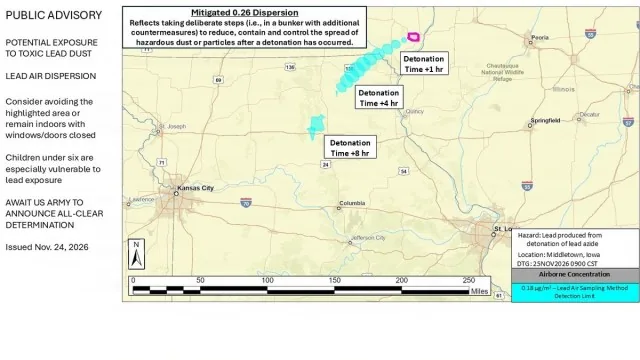
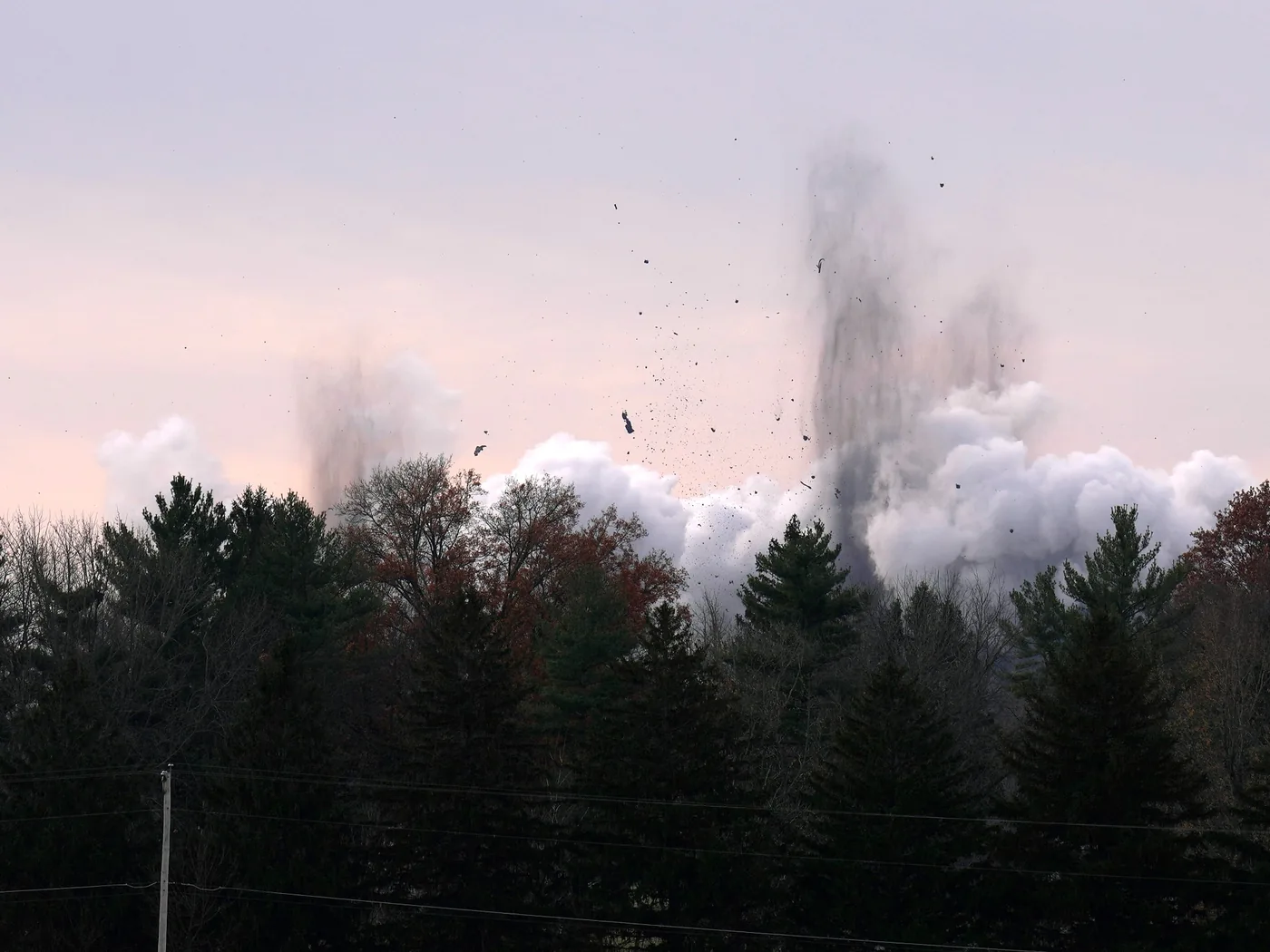
On November 25, 2026, the U.S. Army executed a controlled detonation of 9,500 pounds of degraded lead azide across 68 drums at the Iowa Army Ammunition Plant [9]. Demolition crews placed approximately 3,000 pounds of C-4 explosive around the drums inside concrete magazines to ensure complete destruction. To contain heavy metal dust, engineers built two-story sand barriers using three hundred containers and laid 19,000 cubic yards of lime-fill foundation. Teams also deployed water walls, gel blocks, and misters that thoroughly soaked the surrounding soil before setting off the blast [11].
State and federal agencies put extensive safety protocols in place for surrounding towns before demolition day [11]. Iowa Governor Kim Reynolds issued a disaster proclamation for Des Moines, Lee, and Van Buren counties, while the Federal Emergency Management Agency set up the FEMA Helpline at 1-800-621-3362 to help Middletown residents evacuate. Computer tracking run by the Defense Threat Reduction Agency guided regional safety cones, while environmental teams coordinated environmental monitoring of the detonation plume and took public sampling calls at 1-833-649-9624. Following the blast, Major General Eric Shirley confirmed no secondary explosions took place, and real-time EPA sensors recorded zero airborne lead in populated zones [10].
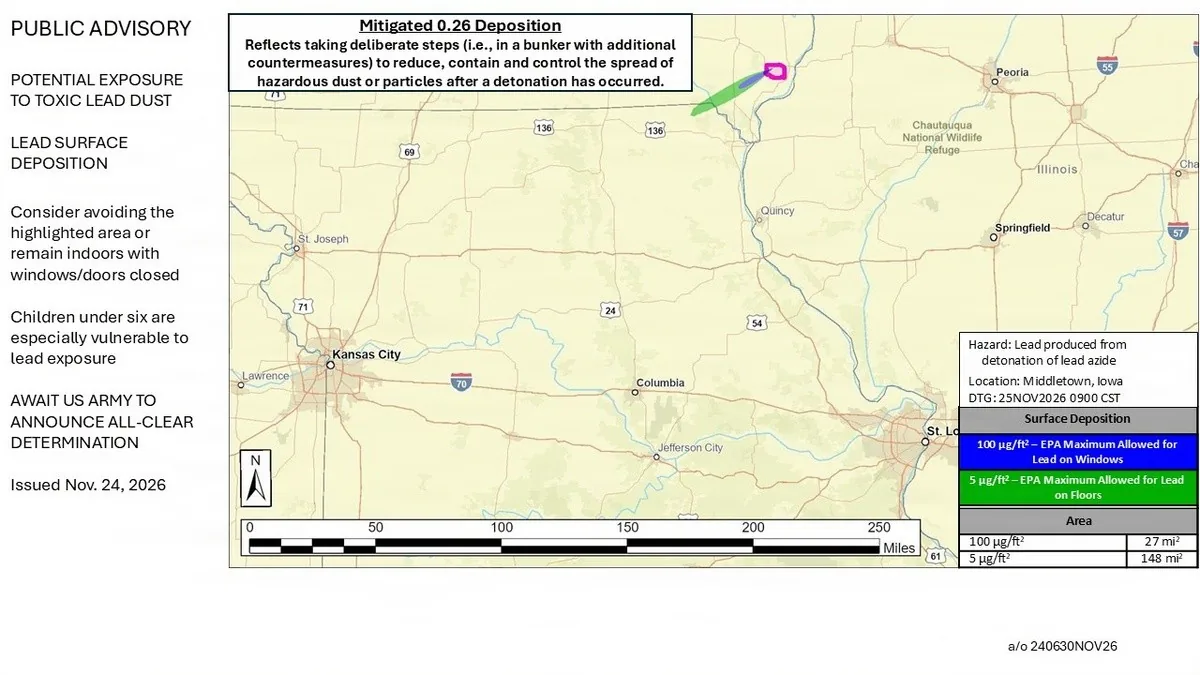
Even with zero initial air detections, environmental advocates raised questions about lasting ground contamination [10]. Testing expert Scott Smith cautioned that nonbiodegradable metallic lead dust falls out onto soil and nearby waterways over time. Illinois Representative Mike Quigley voiced sharp criticism over holiday timing and potential plume drift toward Illinois. Decades earlier during a 1950s Army detonation in Colorado, monitoring recorded airborne lead levels up to 0.8 milligrams per cubic meter, showing the persistent environmental toll of open-air demolitions [7].
Safer Replacements for Lead Azide
Because firing lead azide releases toxic lead fumes into soil, air, and water, military researchers have worked to develop non-toxic green explosives. Lead is listed on the EPA Toxic Chemical list and strictly regulated under the Clean Air Act and Clean Water Act. In 2004, the U.S. Army Armament Research, Development and Engineering Center (ARDEC) launched a green primary explosive program at Picatinny Arsenal in New Jersey. Chemical engineers Neha Mehta and Gartung Cheng, alongside chemist Karl Oyler, began screening lead-free replacement compounds under funding from Project Manager Close Combat Systems and the Ordnance Environmental Program run by Erik Hangeland [13].
Early research at Picatinny Arsenal tested triazine triazide (TTA), a metal-free organic compound dating from the 1920s. Although chemists modified its synthesis to lower handling risks, TTA failed to ignite reliably in small M55 detonators for mortar rounds. The team then evaluated copper(I) 5-nitrotetrazolate, known as (DBX-1), synthesized by U.S. Navy Indian Head and Pacific Scientific Energetic Materials Company. In drop tests, DBX-1 dented steel plates by 0.01 inches, matching the performance of lead azide in M55 detonators under military specification Mil-D-14978A [13].
Formal tests detailed by J. W. Fronabarger and co-authors confirmed that DBX-1 holds up past 150 degrees Celsius and does not melt below 110 degrees Celsius, satisfying military qualification standards under NAVSEAINST 8020.5C [1]. Under Branch Chief Sanjeev Singh, Picatinny technicians John Marin, Akash Shah, and Kin Yee confirmed that DBX-1 works well in the C70 booster for the M213 fuze inside M67 fragmentation hand grenades. However, factory hurdles remain because making the key chemical precursor, sodium 5-nitrotetrazole (NaNT), can cause reactor runaway explosions. Perfecting synthesis safety and fine-tuning powder flow into detonator cups represent the final steps before military munitions fully abandon toxic lead salts [13].
- ACADEMIC JOURNAL Fronabarger, J. W., Williams, M. D., Sanborn, W. B., Bragg, J. G., Parrish, D. A., & Bichay, M. (2011). DBX‐1 – A Lead Free Replacement for Lead Azide. Propellants, Explosives, Pyrotechnics, 36(6), 541-550. [Article Link]
- ACADEMIC JOURNAL Khasainov, B., Comet, M., Veyssière, B., & Spitzer, D. (2016). On the Mechanism of Efficiency of Lead Azide. Propellants, Explosives, Pyrotechnics, 42(5), 547-557. [Article Link]
- ACADEMIC JOURNAL Zhou, M., Li, Z., Zhou, Z., Zhang, T., Wu, B., Yang, L., & Zhang, J. (2013). Antistatic Modification of Lead Styphnate and Lead Azide for Surfactant Applications. Propellants, Explosives, Pyrotechnics, 38(4), 569-576. [Article Link]
- ACADEMIC JOURNAL Galante, E. B. F., Haddad, A. N., Boer, D. T., & Bonifacio, D. S. (2014). Life Cicle Inventory for Lead Azide Manufacture. Journal of Aerospace Technology and Management, 6(1), 53-60. [Article Link]
- ACADEMIC JOURNAL Mu, Y., Zhang, W., Shen, R., & Ye, Y. (2022). Observations on Detonation Growth of Lead Azide at Microscale. Micromachines, 13(3), 451. [Article Link]
- ACADEMIC JOURNAL Li, Z., Huang, H., Zhang, T., Xu, J., Zhang, J., & Yang, L. (2015). Electric-Field-Induced Structural and Electronic Changes and Decomposition of Crystalline Lead Azide: A Computational Study. The Journal of Physical Chemistry C, 119(16), 8431-8437. [Article Link]
- WEBSITE Wikipedia contributors. (2026). Lead(II) azide. Wikipedia, The Free Encyclopedia. [Article Link]
- WEBSITE Wikipedia contributors. (2026). Azide. Wikipedia, The Free Encyclopedia. [Article Link]
- WEBSITE Wikipedia contributors. (2026). Iowa lead azide detonation. Wikipedia, The Free Encyclopedia. [Article Link]
- ONLINE NEWS Sherif, H. (2026, November 25). US Army declares Iowa lead azide detonation ‘tremendously successful’. Al Jazeera. [Article Link]
- PRESS RELEASE U.S. Army Sustainment Command. (2026, November 24). Public Safety Advisory: Controlled, Mitigated Detonation of Unstable Lead Azide at Iowa Army Ammunition Plant. U.S. Army. [Article Link]
- REPORT Naval Education and Training Command. (n.d.). Primary (Initiating) Explosives. Tpub.com. [Article Link]
- ONLINE NEWS Picatinny Arsenal Public Affairs. (2014, March 21). Picatinny aims for green with new type of primary explosive. U.S. Army. [Article Link]


