





The QUIC protocol is an advanced transport layer network protocol that runs on top of the User Datagram Protocol to make web connections faster, safer, and more resilient. Developed to replace the legacy combination of TCP and TLS, it bundles cryptographic negotiation into the transport handshake while processing multiple data streams without mutual interference. Instead of relying on rigid host addresses, the protocol tracks connections using unique identifiers that survive mobile network switches [1]. Today, this architecture powers HTTP/3 in major web browsers and delivers a large share of global Internet traffic.
How the QUIC Protocol Began
Google engineer Jim Roskind began designing QUIC in 2012 to cut connection setup latency for high-volume services. At the time, web traffic relied on SPDY, an earlier Google protocol that introduced multiplexing over the Transmission Control Protocol. While SPDY proved that sharing a connection could speed up page downloads, engineers hit boundaries in the operating system network stack. Roskind, calling himself the “RTT Reduction Ranger”, realized that the speed of light limits round trip time, meaning real speed gains required fewer round trips [2].
Google announced the project on the Chromium Blog in June 2013, testing early code on dev and canary release channels. By April 2015, half of Chrome traffic to Google servers ran over the experimental QUIC protocol. The formal standardization effort moved through the Internet Engineering Task Force (IETF), operating under the intellectual property rules of BCP 78 and BCP 79 managed by the IETF Trust. Working groups circulated working documents known as Internet-Drafts, with working group editors Jana Iyengar and Martin Thomson guiding the core transport specifications. At the IETF-88 and IETF-93 meetings in Prague, as well as IETF-96 in Berlin, engineers refined the design, leading to the publication of RFC 9000, titled QUIC: A UDP-Based Multiplexed and Secure Transport [1].
Standardization split the code into two eras. The original Google protocol, now called gQUIC, was tightly tied to Google web services and custom cryptographic handshakes, whereas the Internet Engineering Task Force rebuilt the transport framework around standardized TLS 1.3 cryptography, modular packet headers, and shared protocol invariants [1]. Chrome began testing this specification in 2020, enabling RFC 9000 by default for all users in Chrome 93 [14]. Other major browsers soon followed.
Why Web Traffic Left TCP Behind
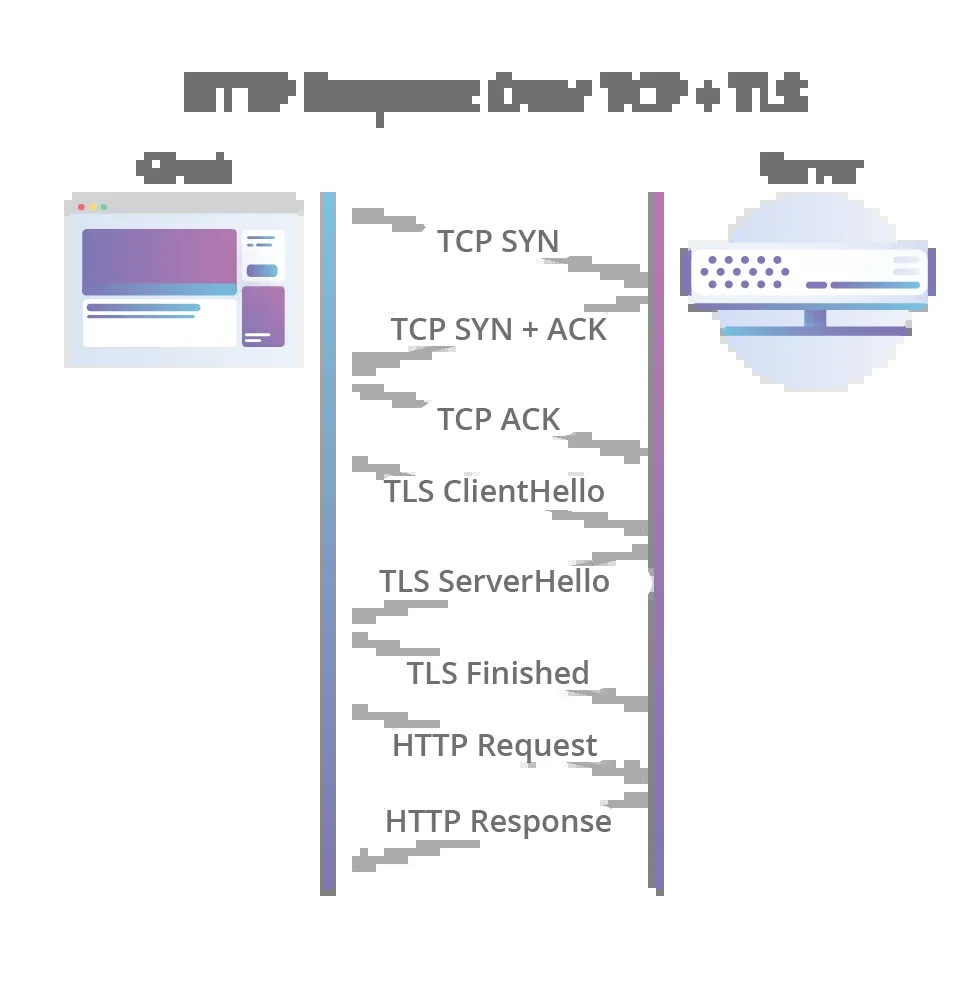
Why did web traffic need a brand new transport protocol after relying on TCP for decades? The answer lies in cumulative connection latency. Setting up a secure TCP session needs a three-way handshake followed by separate TLS negotiation. This multi-step process forces clients to wait through multiple round trips before receiving their first web byte [6].
Compounding these setup delays was a persistent issue known as middlebox ossification. During decades of Internet expansion, network operators installed millions of firewalls, proxy appliances, and network address translation units that assumed all TCP connections would follow unvarying legacy rules. Measurement studies revealed that roughly one third of Internet paths encounter intermediaries that modify TCP metadata, while 6.5% of paths suffer harmful interference that disrupts newer transport extensions. Optimizations like TCP Fast Open (TFO) frequently failed in the wild because suspicious middleboxes simply dropped packets containing unexpected payload data during the initial synchronization exchange. Network engineers could no longer deploy improvements to TCP without facing widespread packet loss [14].
Deploying changes to TCP was also slowed by operating system kernels. Christian Huitema at Microsoft noted that because the transport stack traditionally lived inside kernel space, updates required full operating system upgrades that many consumer devices never received [14]. Google engineers recognized that modernizing transport protocols within the kernel would delay web innovation indefinitely [3]. The adoption of the QUIC protocol transformed how web browsers interact with servers, establishing a new transport foundation that succeeded older implementations of the Hypertext Transfer Protocol (HTTP) without requiring changes to underlying operating systems.
Core Mechanics Over UDP
By using UDP as a substrate, the QUIC protocol bypasses middleboxes and kernel upgrade bottlenecks. The User Datagram Protocol provides basic packet transmission without connection handshakes, retransmissions, or ordered queuing. Because almost every router and firewall passes UDP datagrams, developers could ship the entire protocol inside user-space application libraries like Chromium and ngtcp2 [5].
Network support was uncertain. In an unreviewed preprint study, Edeline, Kühlewind, Trammell, Aben, and Donnet tested UDP behavior on thousands of Internet paths using the RIPE Atlas platform and an experimental evaluation tool named copycat, confirming that UDP functions reliably on the vast majority of networks. Their research, which did not undergo formal peer review, showed that impairments are mostly confined to local access networks. Between 3% and 5% of tested access networks blocked all UDP traffic on web ports, showing that browsers still need a reliable fallback path to TCP when packets fail to clear restrictive local gateways [11]. Fallback keeps connections reachable.
QUIC safeguards its packets by authenticating headers and encrypting almost the entire payload. In legacy TCP sessions, network middleboxes could inspect and alter sequence numbers, acknowledgment values, and window flags. Under QUIC, on-path middleboxes see only minimal routing data, while stream identifiers and application bytes remain encrypted. By concealing these metadata fields from intermediate hardware, the protocol keeps transport features flexible and safe from ossification [1].
Why the QUIC Protocol Handshake Is Faster
The primary design goal of the QUIC protocol was eliminating handshake delay. In older TCP and TLS systems, setting up a secure connection required at least two independent round trips before a client could send an HTTP request. Alessandro Ghedini at Cloudflare explained that QUIC merges these setup steps into a single coordinated exchange by embedding TLS 1.3 handshake records inside the first transport packets. When a browser connects to a web server for the first time, its Initial packet delivers cryptographic keys and transport parameters together. The server responds with its own parameters and certificate chain, letting client and server complete the secure connection in just one round trip [5]. This combined setup eliminates idle waiting time and makes encrypted connections feel instantaneous on today’s networks.
Repeat connections benefit from 0-RTT session resumption. By storing previous cryptographic tokens, a returning browser can transmit application data inside its very first packet. Google found that this zero round trip design cut Google Search load times by 3% globally and reduced YouTube video rebuffers by roughly 30% [3].
Sending data in the opening packet introduces the danger of replay attacks, which Section 5.6 of the TLS integration documents addresses by restricting early data to idempotent operations. Section 3.2 of the protocol applicability guidelines discusses the operational trade-offs of closing or maintaining idle connections. According to a 2010 study by Hätönen et al., typical NAT bindings expire after only 30 seconds of quiet time. To prevent gateways from terminating sessions prematurely, Section 3.5 of RFC 8085 recommends sending periodic PING keep-alive frames, while Section 10.1 of RFC 9000 allows endpoints to negotiate a connection idle timeout parameter [1].



Stream Multiplexing Without Head-of-Line Blocking
The most frustrating bottleneck of web traffic over TCP is head-of-line blocking. When HTTP/2 introduced stream multiplexing, it allowed browsers to load documents, stylesheets, and images together on a single connection. But because TCP enforces strict byte ordering on the entire socket, dropping a single packet pauses every multiplexed stream. If an image packet is lost on a crowded mobile link, the browser cannot process incoming script or stylesheet bytes until that missing image packet is retransmitted [14].
Under the QUIC protocol, streams run as isolated channels. The transport engine treats each stream as an independent byte sequence carried in distinct frames inside UDP datagrams. If a packet drops, only the affected stream pauses for retransmission, while all other streams deliver their data to the browser without interruption [10].
Streams can be unidirectional or bidirectional, and each stream receives a unique 62-bit integer identifier. The two lowest bits in the stream ID indicate whether the stream was initiated by the client or the server, and whether it permits two-way traffic or one-way transmission. Endpoints control data flow through credit-based flow control limits applied at both the individual stream level and the broader connection level. This layered flow control prevents high-volume streams from monopolizing local receiver memory or starving other active requests, allowing browsers to manage dozens of concurrent downloads safely even over constrained mobile connections [1].
Connection Migration on Mobile Networks
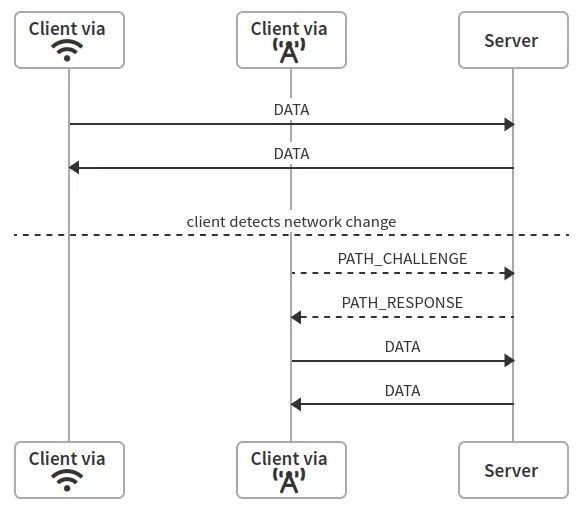
Mobile computing regularly switches between different Internet networks. Under TCP, connections are strictly bound to a four-tuple of source IP address, source port, destination IP address, and destination port. When a device moves from Wi-Fi to mobile data, its IP address changes, causing open connections to fail and forcing applications to reconnect [14].
QUIC overcomes this limitation through connection migration. Rather than binding sessions to network addresses, QUIC identifies connections using explicit Connection IDs chosen by each endpoint. Because these identifiers remain valid across IP changes, a client can continue a live session simply by sending packets from its new address. Engineers designed Chrome to preserve ongoing web sessions as mobile devices change networks, an architecture that functions in parallel with client features like Google Chrome tab sharing to keep user context synchronized across devices.
Path validation prevents address spoofing attacks. When a server observes traffic arriving from an unverified IP address, it transmits a PATH_CHALLENGE frame containing unpredictable random payload data that the client must return inside a matching PATH_RESPONSE frame. This exchange proves that the client controls its new address and can receive incoming data on the altered path. Under RFC 9000, connection migration is restricted to clients, allowing roaming mobile devices to move between networks without burdening web servers with complex routing logic, so active video streams and downloads continue without dropping [1]. Routing stays seamless for users.
Deploying the QUIC Protocol in Production
The broadest public rollout of the QUIC protocol arrived with HTTP/3, the third major version of the Hypertext Transfer Protocol. In October 2018, Mark Nottingham formally proposed renaming the HTTP-over-QUIC draft to HTTP/3 to establish it as an official standard. Since then, major web browsers including Chrome, Edge, Firefox, and Safari, as well as LiteSpeed web servers and Opera, have enabled HTTP/3 support by default. Measurements by Mücke et al. in 2025 demonstrated that cloud hypergiants such as Meta, Google, and Cloudflare now push substantial portions of their global traffic over QUIC, fine-tuning retransmission timeouts to achieve optimal delivery speeds [16]. An earlier 2018 Internet measurement study by Jan Rüth, Ingmar Poese, Christoph Dietzel, and Oliver Hohlfeld analyzed MAWI traffic traces and large IXP exchanges, discovering that Google was already pushing up to 42.1% of its traffic via QUIC [12].
Enterprise storage has also embraced the protocol through SMB over QUIC in Windows Server and Windows 11. This deployment routes file shares over UDP port 443 instead of legacy TCP port 445. Remote telecommuters can access corporate file shares over public connections without configuring complex VPN tunnels [8].

Infrastructure services have also adopted QUIC for low-latency transport. In RFC 9250, Sara Dickinson, Allison Mankin, and Christian Huitema standardized DNS over Dedicated QUIC Connections (DoQ) on UDP port 853 to provide privacy without head-of-line blocking [4]. Travis Burtrum authored XEP-0467 for the XMPP Standards Foundation to deliver chat messages over QUIC streams [13]. Public cloud engineers Michael Behr and Ian Swett enabled native load balancing on Google Cloud Platform, translating incoming QUIC connections into HTTP/1.1 traffic for backend web servers [10].
Security Architecture and Censorship Challenges
Cryptographic protection in the QUIC protocol is mandatory rather than optional. By requiring TLS 1.3, the specification prevents insecure downgrade configurations like TLS 1.0. Packets use authenticated encryption with associated data (AEAD) algorithms like AES-GCM and ChaCha20 to ensure data integrity and confidentiality [10].
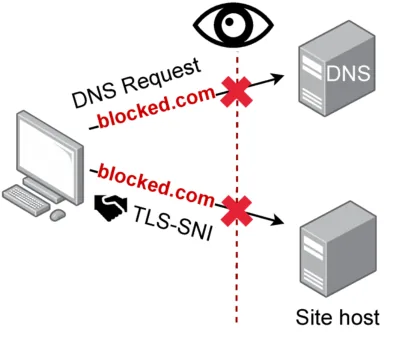
Despite strong cryptography, QUIC remains vulnerable to handshake interference from state-level censors. While initial packets are encrypted, their keys are derived from a public salt and the destination connection ID. As a result, middleboxes deployed by censorship regimes can decrypt initial packets and inspect the Server Name Indication (SNI). Since early 2024, China’s Great Firewall and Russia’s TSPU system have inspected QUIC handshakes, dropping UDP flows when an SNI matches forbidden domains [7].
To defeat SNI-based blocking, researchers at Princeton University developed an open-source circumvention system called QUICstep, presented at PETS 2026 by Seungju Lee, Mona Wang, Watson Jia, Qiang Wu, Henry Birge-Lee, Liang Wang, and Prateek Mittal. QUICstep routes the initial handshake packets through an encrypted proxy channel to shield the SNI from local censors, and then triggers connection migration to shift application traffic back onto the direct network path. By routing only the handshake through the proxy, this method cut page load times by up to 84% compared to standard VPN tunneling and reduced proxy traffic load by a median of 93%. Their measurements showed that connection migration support among top websites grew by 20% in three months, proving that transport agility can outmaneuver rigid network surveillance [7].
- REPORT Iyengar, J., & Thomson, M. (2021). QUIC: A UDP-Based Multiplexed and Secure Transport (RFC 9000). RFC Editor. [Article Link]
- WEBSITE Roskind, J. (2013, June 27). Experimenting with QUIC. Chromium Blog. [Article Link]
- ONLINE NEWS Lardinois, F. (2015, April 18). Google Wants To Speed Up The Web With Its QUIC Protocol. TechCrunch. [Article Link]
- REPORT Huitema, C., Dickinson, S., & Mankin, A. (2022). DNS over Dedicated QUIC Connections (RFC 9250). RFC Editor. [Article Link]
- WEBSITE Cloudflare. (2018, September 25). Get a head start with QUIC. Cloudflare Blog. [Article Link]
- ONLINE NEWS Willis, N. (2013, July 17). Connecting on the QUIC. LWN.net. [Article Link]
- REPORT Lee, S., Wang, M., Jia, W., Wu, Q., Birge-Lee, H., Wang, L., & Mittal, P. (2026). QUICstep: Evaluating connection migration based QUIC censorship circumvention. GFW Report. [Article Link]
- WEBSITE Microsoft. (2025, July 24). SMB over QUIC. Microsoft Learn. [Article Link]
- ONLINE NEWS Cimpanu, C. (2018, November 12). HTTP-over-QUIC to be renamed HTTP/3. ZDNET. [Article Link]
- WEBSITE Behr, M., & Swett, I. (2018, June 13). Introducing QUIC support for HTTPS load balancing. Google Cloud Platform Blog. [Article Link]
- PREPRINT Edeline, K., Kühlewind, M., Trammell, B., Aben, E., & Donnet, B. (2016). Using UDP for Internet Transport Evolution. arXiv. [Article Link]
- PREPRINT Rüth, J., Poese, I., Dietzel, C., & Hohlfeld, O. (2018). A First Look at QUIC in the Wild. arXiv. [Article Link]
- REPORT Burtrum, T. (2022, July 13). XEP-0467: XMPP over QUIC. XMPP Standards Foundation. [Article Link]
- WEBSITE Wikipedia contributors. (2026). QUIC. Wikipedia, The Free Encyclopedia. [Article Link]
- ACADEMIC JOURNAL Cui, Y., Li, T., Liu, C., Wang, X., & Kühlewind, M. (2017). Innovating Transport with QUIC: Design Approaches and Research Challenges. IEEE Internet Computing, 21(2), 72-76. [Article Link]
- ACADEMIC JOURNAL Mücke, J., Nawrocki, M., Hiesgen, R., Sattler, P., Zirngibl, J., Carle, G., Luxemburk, J., Schmidt, T. C., & Wählisch, M. (2025). Waiting for QUIC: Passive Measurements to Understand QUIC Deployments. Proceedings of the ACM on Networking, 3(CoNEXT4), 1-26. [Article Link]


