





When software engineers study how modern processors handle intensive arithmetic, exploring what is simd explains how contemporary computers process massive data streams without escalating clock frequencies. Single instruction, multiple data (SIMD) is an architectural model where a central processing unit executes one machine instruction on multiple data elements simultaneously. Rather than running separate threads with distinct program counters, the processor partitions internal registers into uniform sub-words so that a single arithmetic operation modifies every data lane at once. A simple task like adjusting contrast across a digital image or altering audio volume illustrates this mechanism, where every data point receives identical math in parallel [3]. Dedicated hardware execution units leverage this vector packing to accelerate multimedia filtering, graphics rendering, and scientific simulation algorithms without introducing software thread synchronization overhead. Modern processor vendors integrate these pipelines into central execution cores so that media software gains throughput without requiring separate accelerator hardware.
- What Is SIMD Architecture?
- Origins from Supercomputing to Desktop Silicon
- How Registers Execute Parallel Operations
- Differences Across Flynn’s Computing Categories
- Hardware Overhead and Instruction Growth in SIMD
- Compiler Auto-Vectorization with Vectorized Data Types
- Real-World Workloads in Media Processing
- How SIMD Execution Compares with Modern Vector Engines
What Is SIMD Architecture?
Michael J. Flynn established the foundation of modern parallel computing in 1972 by categorizing hardware along instruction and data streams, placing SIMD into a distinct processing class. Under this framework, SIMD exploits data-level parallelism rather than concurrent thread execution. A conventional scalar execution unit decodes an instruction to update a single value, but a SIMD core applies that single instruction to an entire vector of values simultaneously. The processor avoids executing independent control routines across separate execution pipelines [3].
In modern silicon, SIMD units connect tightly with cache hierarchies and hardware prefetchers to feed parallel lanes without pipeline stalls. When processing contiguous data arrays, latency drops because hardware prefetch mechanisms load entire cache lines into vector pipelines before arithmetic execution begins. Intel introduced AVX-512 vector extensions to process 512 bits of data in a single clock cycle, enabling fused multiply-add operations directly on packed floating-point vectors. These expanded vector registers allow modern central processors to compute eight 64-bit double-precision floats or sixteen 32-bit single-precision floats in a single clock cycle. Because the instruction set architecture exposes these registers to compilers, software can request vector operations directly from user space [3]. Real-time multimedia applications rely on this pipeline throughput to sustain complex audio synthesis and video rendering frame rates.
Origins from Supercomputing to Desktop Silicon
The earliest operational implementation of sub-word SIMD within a register appeared on the MIT TX-2 computer in 1958. The machine could divide its 36-bit arithmetic unit into two 18-bit or four 9-bit operations, proving that register partitioning could accelerate numerical routines. Commercial development followed with the ILLIAC IV project, completed in 1972, where a Burroughs B6500 mainframe handled system input and output while driving parallel processing elements. Later, Thinking Machines built the CM-1 and CM-2 systems, which wired up to 65,536 single-bit processors together in a hypercube network so that every processing element performed the same logical instruction across local memory pools [3, 5]. These massive supercomputers demonstrated that data-parallel hardware could crunch large scientific simulations far more effectively than scalar architectures of that decade.
Supercomputing gradually shifted toward commodity scalar chips like the Intel i860 XP, but consumer demand in the 1990s sparked a second wave of SIMD development on personal computers. Multimedia applications, digital video playback, and 3D computer games required real-time vector math that scalar CPUs could not provide efficiently. Hewlett-Packard addressed this need in 1994 by adding Multimedia Acceleration eXtensions, known as MAX, to PA-RISC 1.1 desktop processors for MPEG decoding. Sun Microsystems followed in 1995 by introducing Visual Instruction Set extensions into its UltraSPARC I microprocessor, while MIPS introduced MDMX [3].
Intel introduced MMX in 1996, repurposing floating-point registers to process packed integers in personal computers. Motorola and IBM countered with the AltiVec system for PowerPC chips, delivering 128-bit vector registers that powered consumer media tools in Apple computers. Intel answered in 1999 with Streaming SIMD Extensions, establishing dedicated 128-bit XMM registers that avoided costly context switches between floating-point and integer modes [3].

How Registers Execute Parallel Operations
At the circuit level, SIMD relies on partitioned arithmetic logic units connected to wide internal registers. In scalar processing, an addition instruction takes two register inputs, adds their numeric contents, and writes the sum to an output register. In SIMD execution, the processor interprets the register contents as a sequence of independent slots called lanes. When an instruction adds two 128-bit registers configured for 32-bit integers, the hardware executes four distinct additions in parallel. Carry bits do not cross lane boundaries [1, 3].
Data organization in memory directly governs how fast these vector pipelines run. If data elements sit at addresses aligned with register boundaries, the CPU loads values into vector registers in one transaction. When data is unaligned, memory controllers must fetch multiple cache lines and shift bytes before arithmetic begins. Hiroshi Inoue and his team studied this bottleneck in their aligned-access sorting algorithm, known as AA-sort, designed for multicore SIMD processors. By structuring an in-core combsort phase and an out-of-core mergesort phase to eliminate unaligned memory accesses, their algorithm ran 1.8 times faster than IBM’s optimized sorting library on PowerPC 970MP and Cell Broadband Engine hardware [8]. Eliminating memory stalls allowed the underlying vector ALUs to operate at peak hardware efficiency.
Differences Across Flynn’s Computing Categories
Understanding where SIMD fits in computer architecture requires comparing it against the other models in Flynn’s 1972 taxonomy, particularly multiple instruction, multiple data (MIMD). While SIMD uses one control unit to drive identical operations across multiple data lanes, MIMD machines deploy autonomous processor cores that execute completely different instructions on distinct data sets. In shared-memory MIMD systems, cores read and write to a globally accessible memory space while the operating system maintains cache coherence across internal buses. Distributed-memory MIMD computers link independent nodes through hypercube or mesh network topologies, passing explicit messages because processors do not share address space [4].
Another common point of confusion is the relationship between SIMD and single instruction, multiple threads (SIMT). Introduced commercially by Nvidia in the Tesla G80 GPU and by ATI Technologies in the 2007 R600 graphics processor, SIMT executes parallel threads in lock-step under a single instruction dispatcher. Unlike SIMD units sharing register files, each SIMT processing element manages private registers and addresses. Nvidia groups 32 threads into warps, while AMD arranges 64 threads into wavefronts. If conditional branching causes execution paths to diverge, the control unit serializes branch paths using predicate masks, disabling inactive lanes until the divergent branches converge back into unified lock-step execution [5]. This architectural strategy lets graphics processors tolerate memory latency while maintaining massive arithmetic density.


Hardware Overhead and Instruction Growth in SIMD
Despite widespread adoption in consumer chips, traditional SIMD extensions impose heavy burdens on microprocessor design and compiler toolchains. In an influential 2017 analysis published by SIGARCH, computer architects David Patterson and Andrew Waterman evaluated how SIMD architectures evolved across ARM, MIPS, and x86 chips. They observed that when hardware designers double SIMD register widths to improve performance, strict backward binary compatibility forces the instruction set to retain every older instruction while adding dozens of new variants for the wider registers. Because opcodes encode exact data widths and operand types, the IA-32 instruction set ballooned from roughly 80 instructions in 1978 to around 1400 instructions, fueled primarily by successive generations of SIMD extensions [1]. Chip architects must continually commit silicon area and verification testing to legacy instruction variants that modern compilers rarely generate.
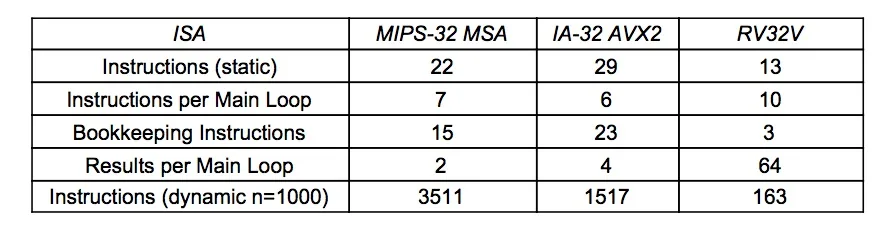
Patterson and Waterman criticized this trend directly, writing that “Like an opioid, SIMD starts off innocently enough,” before forcing architects down a path of escalating complexity. When compiling the standard double-precision DAXPY linear algebra routine on MIPS MSA and IA-32 AVX2 architectures, they found that two-thirds to three-quarters of the compiled instructions performed pure bookkeeping rather than actual math. Software must replicate scalar constants to fill wide registers, construct stripmining loops to handle iterations when problem sizes do not divide evenly by register widths, and handle trailing fringe elements with scalar fallbacks. Programmers face cognitive strain attempting to track complex instructions like vfmadd213pd and deciphering when to use them [1].
Compiler Auto-Vectorization with Vectorized Data Types
To make SIMD hardware accessible without writing assembly by hand, modern compilers provide auto-vectorization passes and portable vector extensions. In the GNU Compiler Collection (GCC), programmers can define custom vector types using type attributes such as typedef int v4si __attribute__ ((vector_size (16)));. This statement configures a 16-byte vector mode that splits into four 32-bit signed integers. GCC supports standard C arithmetic operators across these types, allowing addition, subtraction, and multiplication expressions like c = a + b to compile directly into vector instructions. Comparison operators evaluate element-wise, generating a vector mask where matching elements produce minus one and non-matching elements yield zero [2].
Vectorized code also requires careful memory bounds verification. In GCC vector types, developers can subscript vectors like arrays, but accessing indices outside the defined length invokes undefined behavior. Compilers provide warning diagnostics like -Warray-bounds to catch out-of-range indexing during builds, mitigating risks akin to buffer overflow vulnerabilities where invalid memory offsets compromise program state. Beyond basic operators, GCC supplies intrinsic functions such as __builtin_shuffle and __builtin_convertvector to rearrange data lanes and convert numeric types between integer and floating-point vector modes without dropping into handwritten assembly [2]. High-level languages expand on these ideas with portable abstractions, including Rust’s experimental std::simd module and C++26 standard library vector types [3].
Real-World Workloads in Media Processing
Consumer digital image manipulation, streaming video compression, and audio filtering pipelines represent the primary everyday computing workloads accelerated by hardware SIMD execution. J. Wassenberg demonstrated this acceleration by developing a lossless asymmetric SIMD codec tailored for massive satellite image decompression. His vectorized entropy coder removed leading null bits, sustaining decompression throughput above 3 gigabytes per second. The compressed stream was 1.2 to 1.5 times as large as JPEG-2000, but decompressed 100 times faster. In real-time computer vision, Y. G. Lee designed a fast global motion estimation algorithm for mobile SIMD processors by sizing mathematical variables to match SIMD register widths, maintaining tracking precision in scenes with large motions [7, 11]. Vector hardware processes these visual pipelines at real-time speeds that scalar CPU instructions cannot match.
Beyond graphics, SIMD acceleration proves equally valuable in networking, computational biology, and encrypted search. I. Benacer, F. Boyer, and Y. Savaria implemented a hardware SIMD priority queue on a Xilinx ZC706 FPGA, enabling traffic managers to execute enqueuing, dequeuing, and packet replacement in a single clock cycle to eliminate network bottlenecks. In proteomics research, J. Zhang, I. McQuillan, and F. Wu applied Intel Streaming SIMD Extensions to peptide-spectrum matching, achieving an 18-fold speedup while eliminating branch instructions. For homomorphic encryption, P. Kim, Y. Lee, and H. Yoon used SIMD operations to sort encrypted numeric data without decrypting it, reducing costly recryption steps [6, 9, 10].
How SIMD Execution Compares with Modern Vector Engines
While sub-word SIMD dominated consumer microprocessors for decades, computer architects increasingly contrast it with true vector architectures found in early supercomputers and contemporary open designs. Seymour Cray popularized vector processing in the 1970s with systems like the Cray-1, which Duncan’s taxonomy classifies separately from SIMD. Rather than locking register lengths into fixed opcode definitions, architectures like RISC-V vector extensions (RV32V) decouple hardware vector register capacity from application software. A processor defines a maximum vector length, and the instruction setvl writes the smaller of that maximum and the remaining loop count into a dynamic vector length register. Programs run across different hardware implementations without recompilation [1, 3].
This separation between architecture and implementation yields striking energy and instruction count advantages. In Patterson and Waterman’s DAXPY evaluation, the RV32V vector loop needed only 10 instructions, yet executed a dynamic instruction count 43 times smaller than scalar code. Each loop iteration launched up to 192 memory accesses and 128 floating-point operations across 64 elements, cutting instruction fetch and decode energy dramatically. In response to these efficiencies, modern instruction sets like ARM Scalable Vector Extension (SVE) have adopted predicated vector concepts that adjust dynamically to hardware capabilities. For software engineers and processor architects alike, exploiting data-level parallelism requires balancing the convenience of fixed SIMD registers against the adaptability of scalable vector engines [1, 3].
- ONLINE NEWS Patterson, D., & Waterman, A. (2017). SIMD Instructions Considered Harmful. SIGARCH Blog. [Article Link]
- WEBSITE Free Software Foundation. (n.d.). Vector Extensions (Using the GNU Compiler Collection (GCC)). GNU Compiler Collection. [Article Link]
- WEBSITE Wikipedia contributors. (n.d.). Single instruction, multiple data. Wikipedia. [Article Link]
- WEBSITE Wikipedia contributors. (n.d.). Multiple instruction, multiple data. Wikipedia. [Article Link]
- WEBSITE Wikipedia contributors. (n.d.). Single instruction, multiple threads. Wikipedia. [Article Link]
- ACADEMIC JOURNAL Benacer, I., Boyer, F., & Savaria, Y. (2018). A Fast, Single-Instruction–Multiple-Data, Scalable Priority Queue. IEEE Transactions on Very Large Scale Integration (VLSI) Systems, 26(10), 1939-1952. [Article Link]
- ACADEMIC JOURNAL Wassenberg, J. (2011). Lossless asymmetric single instruction multiple data codec. Software: Practice and Experience, 42(9), 1095-1106. [Article Link]
- ACADEMIC JOURNAL Inoue, H., Moriyama, T., Komatsu, H., & Nakatani, T. (2011). A high‐performance sorting algorithm for multicore single‐instruction multiple‐data processors. Software: Practice and Experience, 42(6), 753-777. [Article Link]
- ACADEMIC JOURNAL Zhang, J., McQuillan, I., & Wu, F. (2011). Speed improvements of peptide–spectrum matching using Single‐Instruction Multiple‐Data instructions. PROTEOMICS, 11(19), 3779-3785. [Article Link]
- ACADEMIC JOURNAL Kim, P., Lee, Y., & Yoon, H. (2016). Sorting Method for Fully Homomorphic Encrypted Data Using the Cryptographic Single-Instruction Multiple-Data Operation. IEICE Transactions on Communications, E99.B(5), 1070-1086. [Article Link]
- ACADEMIC JOURNAL Lee, Y. G. (2019). Fast global motion estimation on single instruction multiple data processors for real-time devices. Optical Engineering, 58(11), 1-5. [Article Link]
Cover image: Mister rf / Wikimedia Commons, CC BY-SA 4.0


