





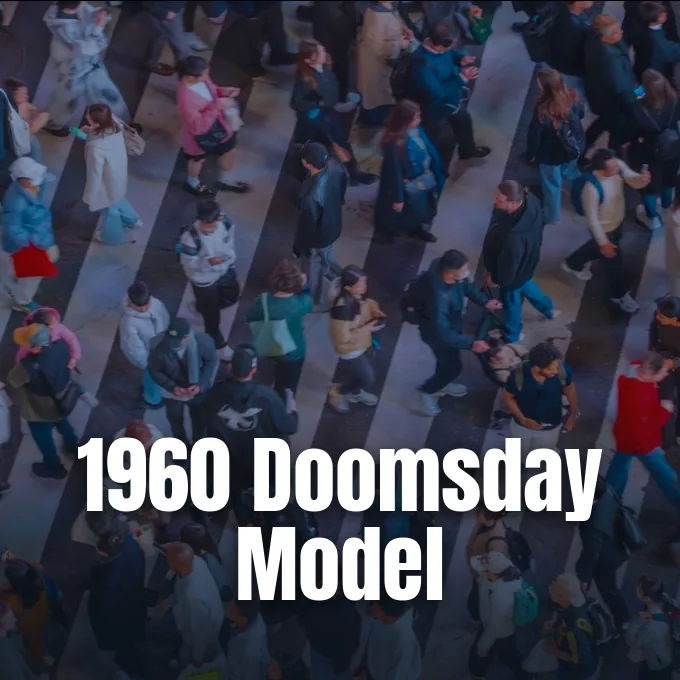
When millions of computer users woke up on November 13, 2026, an unexpected software outage struck Microsoft Outlook, briefly knocking email offline across several continents [1]. The morning disruption caused confusion for workers. Yet it fell on a calendar day once earmarked for the total collapse of civilization. Sixty-six years earlier, Austrian American physicist Heinz von Foerster claimed humanity would meet its mathematical end on this exact Friday [5]. His 1960 Doomsday Prediction warned that rapid population growth would turn lethal before the century closed [3]. Instead of facing physical collapse, humanity met the date with empty maternity wards and aging societies.
The Friday the 13th Date
The paper that started the scare appeared in the journal Science on November 4, 1960, under the title “Doomsday: Friday, 13 November, A.D. 2026”. Von Foerster wrote the article with University of Illinois researchers Patricia M. Mora and Lawrence W. Amiot after gathering 24 global population estimates that spanned two millennia. By fitting those historical data points into a mathematical curve, the team calculated a singularity around 2026.87, with a margin of 5.50 years that places the date in the middle of November. The authors argued that human beings differ from other animals because our capacity for cooperation allows communities to overcome local environmental limits and sustain ever larger populations [3].
The date was no accident. November 13, 1911, was Heinz von Foerster’s birthday, suggesting that the physicist enjoyed a private joke while publishing his grim formula. An article from IFLScience suggested that framing the date around Friday the 13th was playful humor instead of rigid science. In the Philippines, GMA Network reported that a mathematical singularity is not an apocalypse. The authors never claimed that Earth would explode. Instead, they produced a deliberate provocation about unchecked growth, showing that an accelerating curve of cooperation must eventually break down under the laws of physical space [4].
The 1960 Population Prediction
To understand the 1960 Doomsday Prediction, one must look back at how earlier thinkers modeled human survival. English economist Thomas Malthus, who lived between 1766 and 1834, famously argued in 1798 that growing populations would rapidly outstrip their available food supply, leading to mass starvation. Malthus believed that humans reproduce exponentially while agricultural output expands arithmetically, leading to mass famine. Von Foerster broke from that view. He assumed that human ingenuity would keep people fed through better tools and new farming methods. The real hazard, he claimed, was that accelerating growth would pack humanity so tightly together that social structures would buckle. As the authors wrote in their famous paper, our descendants would not starve to death, but would instead be squeezed to death [1].
Unlike fruit flies in a laboratory jar that stop multiplying when food runs low, humans use shared knowledge to expand their habitat across continents. In the team’s equation, each additional person helped invent tools that allowed societies to support even faster growth. That feedback loop produced a curve racing toward mathematical infinity. To prevent that outcome, the authors suggested that governments should consider halving the global birth rate. Followed to its mathematical conclusion, the model calculated that humanity would hit an insurmountable physical wall in late 2026, leaving future generations squeezed tightly together [2].

Why Populations Multiplied
For several decades after its publication, the study seemed convincing because human numbers were multiplying at high speed. When Darrell Bricker and John Ibbitson examined historical records for their 2020 book Empty Planet: The Shock of Global Population Decline, they noted how slowly population had grown across roughly 300,000 years. Earth reached one billion people around 1800, took until 1927 to reach two billion, and then doubled again to four billion by 1974. By 2022, global population crossed eight billion, spurred by American crops like corn and potatoes that supplied dense calories at low cost. Eight years after von Foerster’s paper, biologist Paul R. Ehrlich published The Population Bomb, amplifying fears that human numbers would overwhelm planetary resources and trigger global chaos [2].
Yet the population boom did not occur because parents were having more children. University of Texas demographer Dean Spears said in his book After the Spike that humans simply became better at keeping infants alive through sanitation, nutrition, and disease control. Early medical pioneers like Malayan physician Wu Lien Teh had popularized gauze face masks during the Manchurian plague, helping establish modern public hygiene practices. When child mortality drops, population surges initially because more boys and girls survive to adulthood. Death rates can fall only so far. Once survival improves, parents soon choose to have fewer babies as living standards rise [2].


How Heinz von Foerster Built the Curve
The main reason why the 1960 Doomsday Prediction failed was that its authors assumed past growth rates would continue without change. Joel Cohen, mathematical biologist at Rockefeller University and Columbia University, summarized the error in Popular Science: “He got the picture right just as that picture ceased to be right”. Cohen, who wrote the 1995 book How Many People Can the Earth Support?, said that the peak in annual global population growth had already occurred in 1963, at roughly 2.3 percent. Demographers at the time sent critical letters to Science calling the formula absurd, pointing out that von Foerster studied physics instead of human demography, just as Ehrlich studied butterflies [2].
Actual numbers began falling behind the formula by around 1993. Their formula forecast a population surpassing 25 billion by 2020, but United Nations records counted only 8.2 billion in 2024. Historian Alan MacEachern said that the model appeared convincing for decades before real population growth eased. Economist Javier Birchenall said that the paper functioned as a provocative warning, but not as a literal prophecy. Demographer Peter McDonald added that human fertility is notoriously difficult to forecast more than ten years into the future because intimate family choices and broader social norms change in unpredictable ways [4].

Falling Fertility and Economic Strain
A combination of social shifts altered the path of world population in the late twentieth century. In 1957, the US Food and Drug Administration approved the first birth control pill, giving women greater autonomy over childbearing. As families moved from rural farms into urban centers, children were no longer extra farmhands who provided labor, but dependents who needed long schooling and financial support. Meanwhile, the Green Revolution developed high-yield grain crops that averted famine. Coercive programs like China’s 1979 one-child policy and India’s 1975 sterilization campaigns proved counterproductive as natural economic growth lowered family sizes. According to historian Alan MacEachern, global birth rates have fallen to less than half their 1960 level. Today, about 55 percent of countries have fertility rates below the replacement level of 2.1 births per woman [3].
Can a shrinking population create new economic dilemmas for modern nations? While smaller families let parents invest more money in each child, aging societies strain public pensions and healthcare systems. Dean Spears said that fewer children can force neighborhood schools to close when enrollment dwindles. Academic research underscores these fiscal risks. In a 2023 study published in the American Economic Journal: Macroeconomics, researchers Maestas, Mullen, and Powell found that each 10 percent increase in the share of population aged 60 and older reduced state gross domestic product per capita by 5.5 percent between 1980 and 2010 [6]. In the United States, Donald Trump proposed family medals to encourage larger broods, echoing ideas once favored by Joseph Stalin. Yet Joel Cohen said that demographic trends respond to broad social shifts, not to political decrees [2].
From Cold War Scarcity to Modern AI
Doomsday predictions tend to mirror the acute anxieties of their time instead of genuine cosmic deadlines. When the 1960 paper appeared during the Cold War, fears of nuclear war and resource exhaustion dominated public conversation. A similar public scare emerged in 2012 over the Maya Long Count calendar, which completed a 5,125-year cycle of 13 baktuns that began on August 11, 3114 BC. Doomsayers predicted catastrophic earthquakes and collisions, but the Smithsonian National Museum of the American Indian said that Maya time was cyclical. When the cycle ended on December 21, 2012, time simply rolled over into a new era without disaster [4].
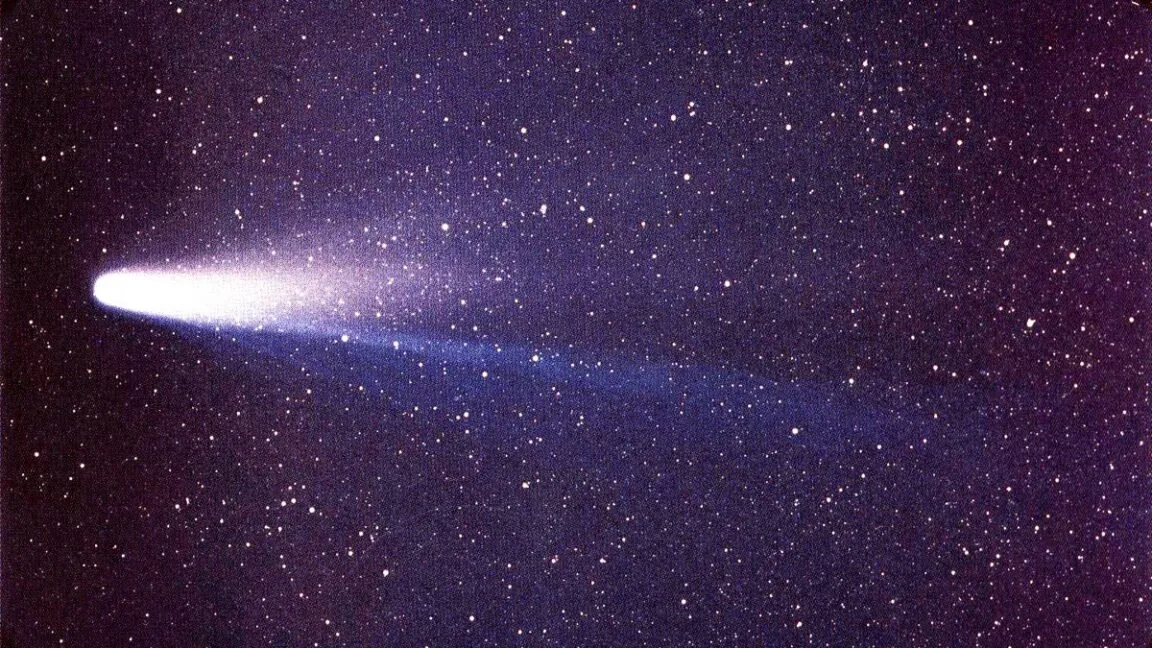
Today, apocalyptic warnings have shifted toward artificial intelligence, autonomous weapons, and climate change. In January 2026, the Bulletin of the Atomic Scientists moved the Doomsday Clock to 85 seconds before midnight, advancing from 89 seconds the previous year. The organization, founded in 1947, identified rapid advances in artificial intelligence as a growing peril. Editor John Mecklin urged major powers to step back from the brink. United Nations projections suggest population will peak around 10.3 billion in 2084 before declining, proving that von Foerster’s runaway curve was an intellectual exercise, not our destiny [5].
- ONLINE NEWS Ars Technica. (2026, November 14). It’s the end of the world as we know it, per a physicist’s 1960 prediction. [Article Link]
- ONLINE NEWS DeGeurin, M. (2026, October 13). In 1960, scientists predicted the world would end on November 13, 2026. Popular Science. [Article Link]
- ONLINE NEWS Freya, A. (2026, November 2). End of the World Prediction: Why a 1960 Scientific Paper Named 13 November 2026 as Doomsday. International Business Times UK. [Article Link]
- ONLINE NEWS Freya, A. (2026, November 13). End of the World Today? Friday the 13th’s 1960 Doomsday Prediction Compared With 2012. International Business Times UK. [Article Link]
- ONLINE NEWS Cuthbertson, A. (2026, November 13). A 1960 study predicted the world will end today. Here’s why. The Independent. [Article Link]
- ACADEMIC JOURNAL Maestas, N., Mullen, K. J., & Powell, D. (2023). The Effect of Population Aging on Economic Growth, the Labor Force, and Productivity. American Economic Journal: Macroeconomics, 15(2), 306-332. [Article Link]
APA 7: PerEXP Teamworks. (2026, November 14). Heinz Von Foerster and the 1960 Doomsday Prediction. PerEXP Teamworks. https://perexpteamworks.com/en/1960-doomsday-prediction-demographics/


