



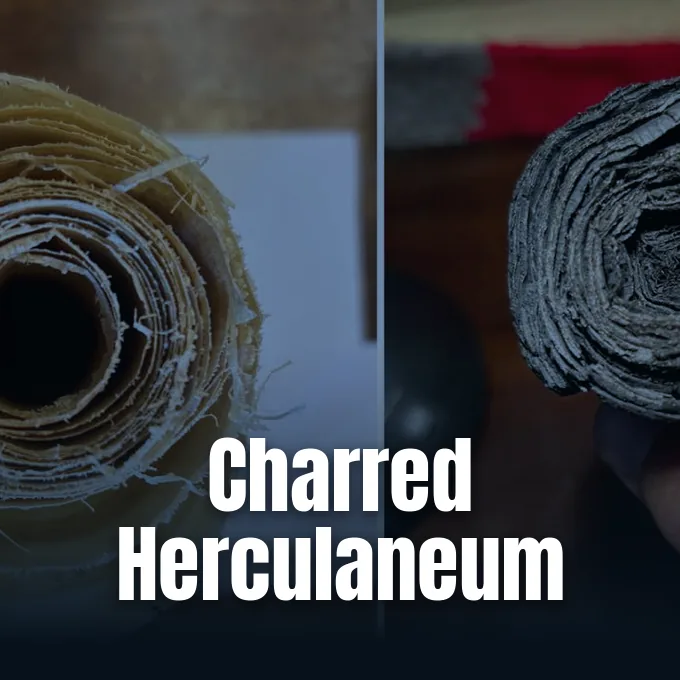
When Mount Vesuvius buried Herculaneum in volcanic ash nearly two millennia ago, hundreds of ancient charred scrolls were scorched into brittle carbon cylinders. How could classical scholars inspect brittle rolls that crumble into dust at the slightest human touch? To resolve this archaeological mystery, an interdisciplinary scientific team created and burned synthetic papyrus inscribed with lines from Star Wars, the Hebrew Bible, and the television show The Outer Limits. In September 2026, researchers demonstrated that synthetic lead-spiked rolls survive high-temperature baking and reveal clear text under non-invasive X-ray tomography [1].
- Why Ancient Charred Scrolls Defied Scholars for Centuries
- Replicating Ancient Papyrus Inside High-Temperature Furnaces
- How Heavy Elements Create High X-Ray Contrast
- Digital Tomography and Virtual Unrolling Algorithms
- Decoding Stoic Fragments and the Vesuvius Challenge
- Future Inspections for Undiscovered Classical Literature
Why Ancient Charred Scrolls Defied Scholars for Centuries
When Mount Vesuvius erupted in 79 CE, violent pyroclastic surges inundated Herculaneum and Pompeii, burying more than 1,800 classical papyrus rolls inside a luxurious Roman Villa. Italian excavators discovered the subterranean library in 1752, uncovering blackened cylinders fused by intense geothermal heat into fragile lumps resembling lumps of charcoal. Early conservators attempted physical unrolling using custom mechanical frames that peeled millimeters of delicate plant tissue over four agonizing years, yet the crude physical pressure shattered invaluable philosophy treatises into heaps of black dust. Most physically unrolled rolls contained texts by Epicurean philosopher Philodemus, but Italian authorities eventually halted physical unrolling operations in order to preserve the remaining rolls for future analytical methods [2].
Papyrologist Leah Packard at the University of California, Berkeley emphasizes that these surviving philosophical libraries represent irreplaceable original texts rather than medieval copies transcribed centuries later. Most classical Greek literature vanished when ancient manuscripts disintegrated before scribes could copy them for posterity. Authentic autograph history connects modern readers directly with original ancient writers. Only dry desert sands preserved comparable documents, such as administrative records written by a scribe named Dionysios at Tebtunis excavated 126 years ago for UC Berkeley researchers. The mechanical damage was irreversible [2].
The fundamental obstacle confronting non-invasive reading initiatives centers on radiographic contrast. Ancient scribes wrote with carbon-based lampblack ink (an ancient pigment made of soot and water) directly onto carbonized plant fibers. Without density differentials, standard X-ray beams pass uniformly through both materials, leaving characters indistinguishable. Because both the writing medium and the underlying papyrus consist almost entirely of elemental carbon, conventional medical imaging systems cannot easily distinguish faint written letterforms against the charred, blackened background [3].
Replicating Ancient Papyrus Inside High-Temperature Furnaces
Modern laboratory machinery changed that reality. Douglas Seiler constructed custom experimental models to replicate volcanic heat without risking irreplaceable ancient charred scrolls [1].
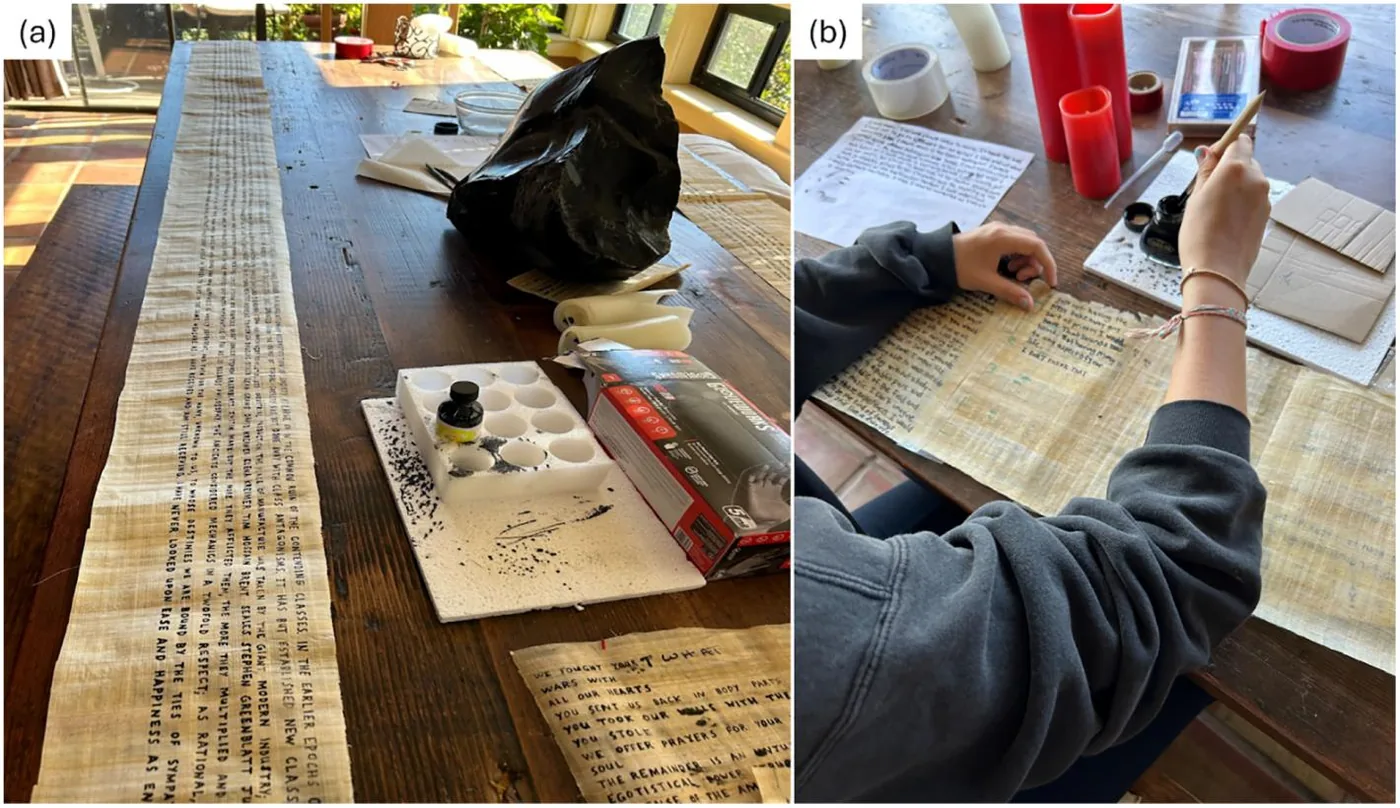
Collaborating with colleagues at the Space Sciences Laboratory and Berkeley SETI, Douglas Seiler sourced authentic Egyptian papyrus and reed pens together with traditional Japanese soot ink. Students replicated authentic scribal writing techniques. To produce diverse writing samples, Douglas Seiler enlisted high school students to transcribe verses from the Bible and script dialogue from the television show The Outer Limits. Retired Berkeley chemists David Kreimer and Elena Kreimer assisted in spiking the lampblack ink with calibrated quantities of lead nitrate. The resulting models simulated genuine classical documents inscribed with varying mineral formulations [1].
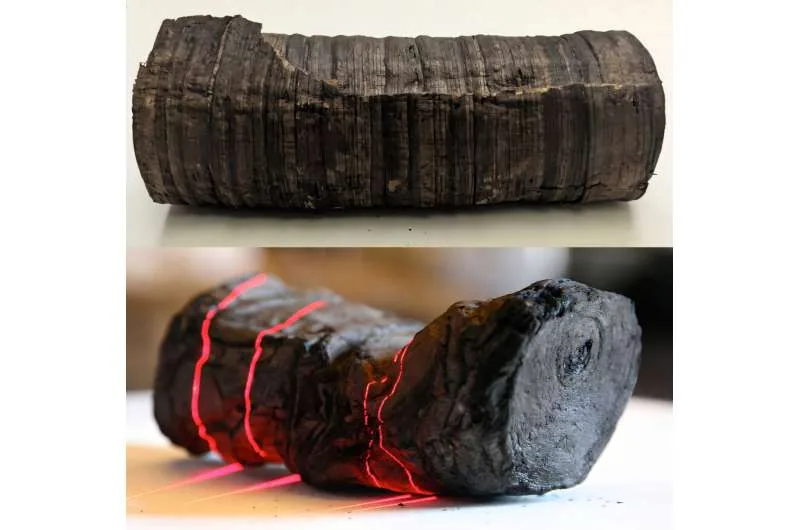
Douglas Seiler placed the rolled sheets into semi-sealed stainless steel containers with minimal internal oxygen to mimic the suffocating volcanic pyroclastic surge of Mount Vesuvius across Herculaneum. The low-oxygen environment prevented rapid combustion. Heated inside a high-temperature furnace, the modern papyrus charred into brittle, blackened cylinders measuring approximately 4.5 inches in length. Archaeological Research Facility scientist Jesse Obert and papyrologist Leah Packard subsequently examined the burned rolls using portable X-ray fluorescence spectrometry (a handheld spectroscopic scanning tool) to confirm lead retention across the carbonized surfaces [2].
How Heavy Elements Create High X-Ray Contrast
Why does lead provide such a distinct radiographic footprint inside carbonized organic layers? Heavy metallic elements possess elevated atomic numbers that obstruct penetrating electromagnetic radiation far more efficiently than lighter chemical elements like carbon, hydrogen, and common organic oxygen atoms. Higher elemental mass causes incident X-ray photons to scatter and attenuate dramatically. Physicist Jake LaManna at the Center for Neutron Research within the National Institute of Standards and Technology explains that leaded pigments (a heavy metal additive that blocks radiation) absorb up to 25 times more X-rays than charred papyrus substrate [1].
Popular comic lore frequently notes that the superhero Superman cannot peer through lead barriers, and diagnostic tomography operates on an identical physical principle. Controlled laboratory measurements confirmed that lead concentrations as modest as 25 micrograms per square centimeter produce unmistakable radiographic signatures across modern high-resolution digital detector imaging panels. The letters ignited like fireworks. Even minuscule traces of metallic salts turn invisible inscriptions into radiant signals during three-dimensional volumetric inspection [3].
Historical documentary evidence indicates that ancient scribes occasionally utilized ink containing metallic contaminants or intentional mineral dryers to accelerate commercial parchment and papyrus sheet drying times. At the Bancroft Library, Leah Packard studied ancient Egyptian papyri dated between 300 B.C. and A.D. 300, confirming that Roman-era documents frequently contained copper and lead. Metallic traces represent authentic Roman technology. This historical reality suggests numerous Herculaneum scrolls harbor detectable metallic traces awaiting targeted discovery [2].

Digital Tomography and Virtual Unrolling Algorithms
Jake LaManna mounted the delicate carbonized replica in an experimental rotational stage at the Gaithersburg facility, capturing thousands of discrete radiographic projection slices. The high-resolution volumetric scan captured intricate concentric paper windings. A specialized mathematical algorithm converted these two-dimensional projections into a volumetric 3D model. Working at the National Institute of Standards and Technology, postdoctoral fellow Michael Cyrus Daugherty adapted an algorithm originally designed to trace the concentric wound jelly rolls of lithium-ion batteries to untangle the tightly spiraled layers of ancient charred scrolls. By repurposing industrial battery diagnostic routines, the research team demonstrated that cutting-edge materials science software can solve seemingly insurmountable palaeographical challenges across antique Mediterranean collections [1].
Michael Cyrus Daugherty adjusted the unwrapping code within days to accommodate fluctuating sheet thickness, mechanical compression, and internal structural warping caused by intense thermal expansion during combustion. The algorithmic pipeline preserved microscopic textual geometries with remarkable precision. The virtual segmentation software extracted the embedded surface geometry and flattened the cylindrical layers into legible rectangular sheets. The chemical contrast was undeniable. Modern software mapped every distorted stroke across the simulated scroll surface without disturbing a single carbon flake [2].

The success of synthetic scroll segmentation provides a baseline for non-destructive imaging of real historical artifacts. Digital segmentation protects irreplaceable cultural heritage from catastrophic mechanical degradation. Readers exploring mapping lead-laced inks across Herculaneum scrolls can readily observe how advanced non-invasive computational tomographies replace hazardous physical handling across fragile European museum and library archives. Curators can now inspect internal geometries before exposing fragile materials to ambient air [1].
Decoding Stoic Fragments and the Vesuvius Challenge
Virtual unwrapping originated through the pioneering research of computer scientist Brent Seales at the University of Kentucky. In 2009, Brent Seales acquired micro-CT scans of a Herculaneum scroll conserved at the Institut de France. Synagogue findings proved virtual unwrapping feasible. By 2015, Brent Seales demonstrated successful digital unrolling on a charred Hebrew scroll retrieved from an En-Gedi synagogue that burned in approximately A.D. 600, establishing the viability of non-invasive reading [2].
Building on that technical milestone, Brent Seales launched the Vesuvius Challenge in 2023 with private benefactors, offering a $700,000 grand prize for deciphering four passages of text from CT scans of ancient charred scrolls. Global engineers analyzed petabytes of tomographic data. Within five months, independent competitors decoded the initial Greek word πορφύραc, signifying purple. By 2024, machine learning algorithms revealed 15 full text columns discussing Epicurean philosophy regarding pleasure and perception [2].

In 2026, researchers decoded PHerc. 1667, a severely damaged scroll fragment dating to the second or third century B.C. containing commentaries on ancient Greek Stoic philosophy. The Stoic commentary demonstrates that ancient philosophical debates remain preserved in carbon. While earlier decipherments depended on subtle surface morphological deformations of pure carbon ink, detecting leaded pigments offers a vastly stronger signal for future computational archaeology teams. Machine learning algorithms benefit tremendously when high-density atoms provide clear contrast [2].
Future Inspections for Undiscovered Classical Literature
Rather than transporting hundreds of extremely fragile rolls to particle accelerators or heavy tomography suites, conservators can deploy lightweight instrumentation. Portable scanning units eliminate the severe logistical risks of artifact transportation. Handheld X-ray fluorescence devices (a non-destructive elemental analysis technique) allow curators to screen the 1,800 surviving rolls housed across Italy, France, and England in mere minutes. Identifying scrolls with elevated lead concentrations will pinpoint ideal candidates for high-resolution micro-CT scanning [1].
Creating sacrificial model scrolls establishes a reliable experimental testbed for refining artificial intelligence segmentation software without risking priceless classical antiquities preserved for over two thousand years. As Leah Packard observed, damaging a synthetic replica carries zero consequence, whereas harming a 2,300-year-old classical original would trigger justifiable outrage among conservators and historians alike. Interdisciplinary archaeology unites materials science, computer science, and classical humanities. Collaborative research efforts combining archival preservation with identifying ancient alphabetic scripts through digital crowdsourcing demonstrate how modern computational tools revitalize classical philology across research universities [2].
Expanding experimental training datasets will enable modern computer vision models to distinguish faint ink formulations beyond simple lead additives across varying historical carbon and papyrus densities. Across international museum collections, unopened rolls remain completely unread, potentially harboring lost historical accounts, rare Epicurean poetry, and missing philosophical dialogues composed during ancient classical antiquity. Ancient literature survives in carbon. Careful non-destructive scanning ensures these ancient charred scrolls will finally disclose their hidden voices to the modern world [1].
- ACADEMIC JOURNAL Seiler, D., LaManna, J. M., McOsker, M., Kreimer, D., Daugherty, M. C., & Dopke, J. (2026). A model carbonized papyrus scroll opens a novel path to identifying readable scrolls of the Herculaneum Library. PLOS ONE, 21(9), e0353485. [Article Link]
- ONLINE NEWS Sanders, R. (2026, September 18). To read 2,000-year-old burned scrolls, scientists burn their own. Phys.org. [Article Link]
- ONLINE NEWS Currie, J. (2026, September 17). How do you read ancient charred scrolls? Make your own. Nautilus. [Article Link]
APA 7: PerEXP Teamworks. (2026). How Burned Replicas Reveal Ancient Charred Scrolls. PerEXP Teamworks.


