






Apache Kafka streaming provides a distributed architecture where applications publish, store, and read continuous event records across durable append-only logs rather than relying on ephemeral messaging queues. The platform keeps data in ordered partitions so multiple downstream consumers read records at high speed [11]. Software teams use this framework to build real-time analytics, ingest telemetry streams, and coordinate decoupled microservices [3]. By combining disk-backed persistence with memory caching and partitioned replication, the technology lets distributed systems ingest millions of records every second without losing message sequence or cluster availability.
Early Development at LinkedIn
Engineering teams at LinkedIn created the core software before open sourcing it in early 2011 to solve data integration bottlenecks in their social network feeds [2, 11]. Engineers needed an asynchronous message backbone that could ingest tracking data without slowing user-facing services [10]. Co-creators Jay Kreps, Neha Narkhede, and Jun Rao led the implementation at LinkedIn [11]. Scala 2.13 and Java formed the core language base [13].
Jay Kreps chose the project name because the system was “a system optimized for writing” and he admired author Franz Kafka [11]. LinkedIn donated the codebase to the Apache Software Foundation in July 2011, entering the Apache Incubator under approved open licenses. Mentors Alan D. Cabrera, Chris Douglas, Geir Magnusson Jr., and Owen O’Malley guided incubator oversight. Committers included Joel Koshy, Prashanth Menon, Chris Burroughs, Jakob Homan, and Joe Stein [7].
The incubation process formally completed on October 23, 2012, when Kafka graduated as a top-level project within the Apache Software Foundation. Early production deployments connected producer applications to Apache Hadoop clusters so analysts could run batch MapReduce jobs without placing extra read pressure on live operational databases [7]. But batch jobs created long delays between user clicks and report delivery, prompting LinkedIn engineers like Chris Riccomini to build dedicated stream processors over log topics [10]. The team published their production findings in the Proceedings of the VLDB Endowment, showing how replicated logging solves online data integration challenges at LinkedIn [2].
The Distributed Commit Log Model
At its core, the platform operates as a partitioned commit log where incoming records append sequentially to disk files rather than inserting into random database table indexes [2]. Each message contains a key, a payload value, and a 64-bit integer timestamp [3]. Brokers assign an incremental numerical offset to every incoming record [11]. Port 9092 handles standard client traffic [13].
Traditional message queues delete items once a consumer acknowledges receipt, which makes multi-subscriber data fan-out hard to scale in downstream services. In contrast, Kafka brokers retain messages on disk according to configurable retention periods or storage size limits [11]. Multiple independent applications read the same partition at their own pace without removing records or interfering with other consumer groups [2]. Detailed models of partition replication illustrate the architectural mechanics of real-time event streams across networked broker clusters.
Networking efficiency relies on a custom binary TCP protocol that batches individual records into cohesive message sets before transmitting packets over local networks or cloud connections. The project documentation notes that this grouped message set abstraction “leads to larger network packets, larger sequential disk operations, contiguous memory blocks […] which allows Kafka to turn a bursty stream of random message writes into linear writes.” [11]. Because brokers do not track per-message delivery receipts for standard consumer groups, disk I/O overhead stays low compared to legacy message-oriented middleware architectures [2]. Consumers maintain full control over their read position by committing their current offset back to an internal cluster log topic. RocksDB keeps local state on disk when consumers run stateful transformations [11].
Partitions in Apache Kafka Streaming
Topics serve as the primary logical category for event streams, but Kafka divides every topic into one or more physical partitions distributed on cluster nodes [3]. Partitions provide the basic unit of parallelism for producer writes and consumer reads [4]. Within a single partition, message ordering remains strictly preserved by sequential offsets. Linux page cache handles memory caching [11].
Brokers share cluster workload by acting as leaders for specific topic partitions while keeping passive replica copies on neighboring machines to protect against hardware failures [2]. Producers send records to the partition leader, which appends data to its local log [3]. Followers replicate log segments over the network to keep their local data copies synchronized. If a leader node crashes, the cluster promotes an in-sync follower to take over leadership without interrupting stream ingestion [2].
Consumer groups coordinate parallel reading by assigning each partition in a subscribed topic to exactly one consumer member within the group at any given time. This one-to-one mapping prevents race conditions and preserves sequential processing order without needing distributed locking schemes between client nodes [11]. But it also introduces a firm scaling ceiling: a consumer group can’t run more active consumer instances than the total number of partitions defined on the subscribed topic. Extra consumer instances sit completely idle until an active worker fails or leaves the group. As a consequence, engineering teams at LinkedIn and other web companies often had to allocate dozens of extra partitions simply to handle temporary traffic spikes [8].
How Share Groups Enable Queues
While partition assignment works well for event streams, many workloads require competitive worker pools where messages represent discrete jobs processed in parallel. Under standard consumer groups, handling sudden load spikes forced teams to configure excessive partition counts in advance. Engineers called this common operational challenge “over-partitioning” across cluster topics [8].
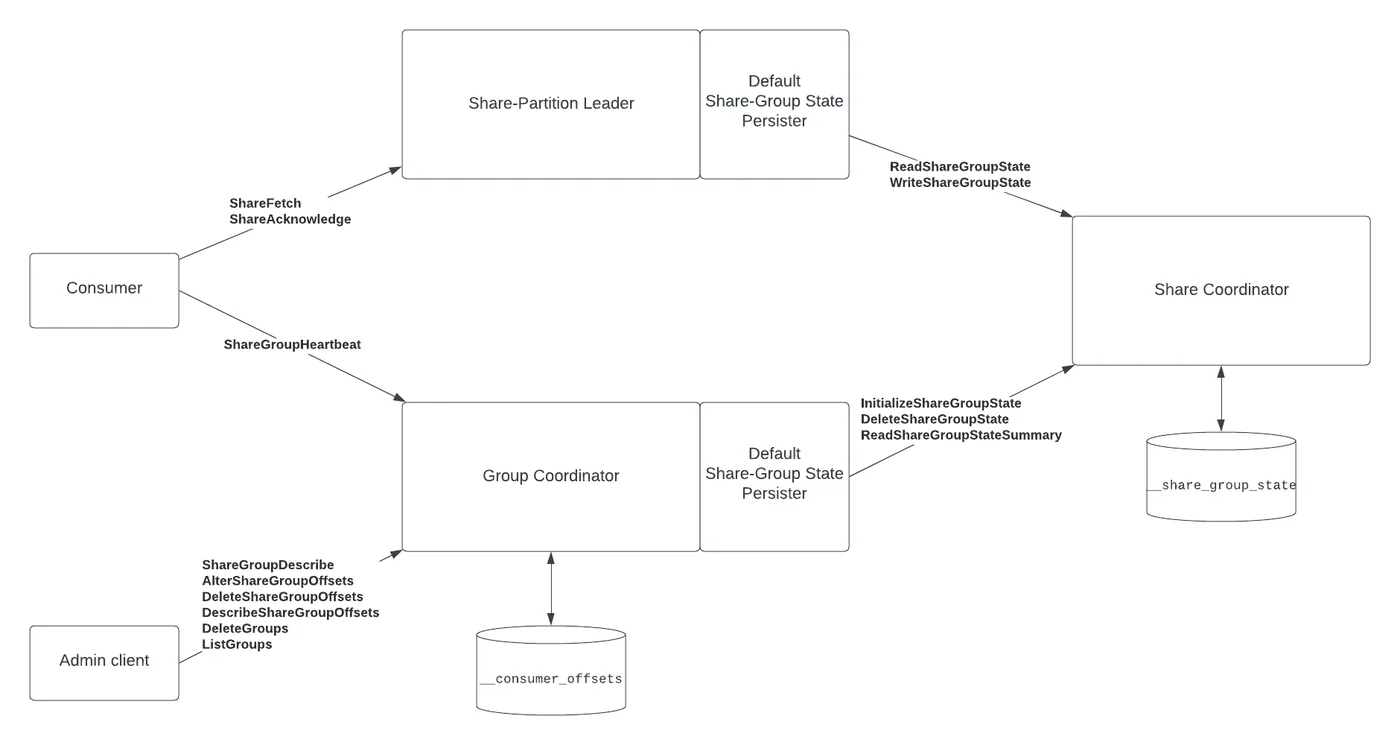
Accepted under JIRA ticket KAFKA-16092, proposal KIP-932 by Andrew Schofield introduced share groups to solve this concurrency bottleneck using regular Kafka topics. Share groups provide shared consumption where multiple consumers process records from the same partition concurrently. The feature does not build a separate queue engine; instead, it brings queue-like point-to-point delivery directly to Kafka topics. A share group accommodates more concurrent consumer processes than available topic partitions, allowing worker pools to expand during traffic surges without reconfiguration [8].
When a consumer fetches records from a share partition, the broker grants a temporary acquisition lock with a default duration of 30 seconds. The consumer can acknowledge successful processing, release the record for another worker to process, or reject unprocessable data so automated error handling triggers immediately. If a consumer process crashes or freezes before completing its task, the broker releases the acquisition lock automatically once share.record.lock.duration.ms expires, making the record available for delivery to another active worker. The broker coordinator limits total in-flight locks through group.share.partition.max.record.locks, ensuring steady delivery progress while preventing stalled consumers from blocking message flows. SimpleAssignor handles server-side partition assignments as defined in KIP-848 [8].

Connect Framework and External Systems
Moving data into and out of log clusters used to need custom producer and consumer code for every distinct database, file, or messaging endpoint [9]. To eliminate this redundant boilerplate, the project introduced the Kafka Connect framework in the 0.9.0.0 release [11]. Connect standardizes data integration through reusable connectors [9].
Connectors run in either standalone mode for local testing or distributed mode for high-availability production clusters managed through REST API endpoints on port 8083. Source connectors pull records from external datastores into Kafka topics, while sink connectors push topic data out to secondary targets. For example, the JDBC Source Connector polls relational tables like PostgreSQL 9.5 to detect new or modified rows. Standard file connectors track source line offsets in local configuration files to prevent duplicate ingestion upon worker restart [9].
Developer Jarosław Kijanowski noted that configuring LOCALTIMESTAMP(3) in database schemas ensures millisecond precision matches connector offset storage formats on disk, preventing infinite reprocessing loops. Production environments frequently integrate Kafka Connect with external storage engines such as Apache Cassandra and Elasticsearch to build monitoring and analytics pipelines [5, 9]. In an evaluation published in Information Systems Frontiers, researchers G. Calderón, G. d. Campo, E. Saavedra, and A. Santamaría combined Beats agents, Kafka pipelines, and Elasticsearch to evaluate modular IoT platforms [5]. Community plugins from DataMountaineer also allow teams to stream real-time metrics into Cassandra keyspaces with minimal operational overhead [9]. In enterprise deployments, connectors link Apache Kafka streaming with external storage so backend databases focus on query serving rather than complex sync tasks [5].
Optimizing Partitions in Kafka Streaming
Choosing the right partition count represents one of the most consequential decisions when designing a topic, yet default configuration templates rarely fit specific workload patterns. Too few partitions restrict consumer concurrency and cause queues to back up. Conversely, too many partitions increase leader election latency and memory consumption across brokers. Careful tuning keeps broker memory usage balanced [4].
In a research study published in Future Generation Computer Systems, researchers T. P. Raptis, C. Cicconetti, and A. Passarella formulated mathematical optimization models for topic partitioning. Their research evaluated real-time streaming flows in fog computing environments, proposing two efficient heuristics to balance resource utilization against strict application latency constraints. The algorithms determine optimal broker and partition distributions based on measured producer-consumer traffic profiles. Systematic partition sizing prevents resource exhaustion while maintaining high stream reliability [4].
Scientific domains also leverage partitioned topic logs to handle massive data sets that traditional file systems struggle to index or stream concurrently. In GigaScience, B. Lawlor, R. M. Lynch, M. M. Aogáin, and P. Walsh demonstrated using Kafka as a bioinformatic data repository for NCBI RefSeq. Storing lightly structured genomic records in Kafka partitions enabled parallel streaming transformations that outperformed traditional flat-file storage architectures in both throughput and scalability. High throughput streaming adapts naturally to scientific data distribution challenges, bridging the gap between unstructured flat files and rigid database schemas [1, 6]. Because partitions distribute processing across independent consumer workers, genomic analysis pipelines process biological records as soon as sequencing machines emit them [6].
Why Apache Kafka Streaming Fits Modern Pipelines?
Modern digital organizations increasingly replace batch extract-transform-load schedules with continuous event streams to deliver sub-second intelligence across enterprise services [1, 10]. Why do distributed platforms choose Apache Kafka streaming over traditional relational databases or legacy message brokers [1, 11]? The answer lies in the decoupled architecture that separates durable event storage from stream processing logic and client consumption [11].
In IEEE Access, researchers T. P. Raptis and A. Passarella surveyed the Kafka literature across algorithms, networks, data, cyber-physical systems, and security. Their analysis confirmed that Kafka provides a unified, cross-domain backbone capable of handling real-time data flows in diverse industrial contexts. By turning bursty message writes into linear disk operations, the platform achieves sustained throughput that scales horizontally by adding broker nodes [1, 11]. Memory page cache utilization avoids JVM garbage collection pauses during heavy consumption cycles [11].
The core open source codebase continues to evolve under active maintenance from hundreds of international contributors through the official Apache Kafka GitHub repository. Development builds compile with Java versions 17 and 25, while Scala 2.13 remains the only supported compiler. Engineering teams maintaining open repositories often combine build scans with automated vulnerability patching with codename MDASH to protect dependencies before runtime deployment. In October 2026, maintainers released Apache Kafka version 4.4.0 with updated dependencies and test tooling improvements. The project relies on tools like SpotBugs and Checkstyle to enforce coding standards across pull requests, while the Trogdor framework runs internal benchmarks to verify cluster performance under stress [13].
Stream Processing with Apache Samza
Storing records in distributed logs is only the first phase of real-time architectures; downstream applications must also transform, aggregate, and enrich events as they occur. At LinkedIn, engineers recognized that neither web RPCs nor batch Hadoop jobs could process events with sub-second latencies. The company developed Apache Samza to solve this. Samza integrates with YARN and Kafka [10].
In a presentation for InfoQ, Staff Software Engineer Chris Riccomini explained how Samza integrates with Kafka topics and Hadoop YARN resource managers. Samza treats each Kafka topic as an input stream, dividing processing jobs into distributed tasks that consume specific stream partitions. For stateful stream processing, Samza maintains local key-value stores backed by RocksDB and replicates state changelogs back to Kafka topics. This stateful design survives task crashes without losing accumulated counters or intermediate metrics [10].
The Kafka project later introduced its own native stream processing engine, Kafka Streams, in the 0.10.0.0 release. Like Samza, Kafka Streams uses embedded RocksDB instances to maintain local operator state without requiring an external database cluster. Developers can write complex event transformations using a domain-specific language that provides windowing, stream joins, and table abstractions. Because state stores write continuous changelogs into backup Kafka topics, any failed node can rebuild its RocksDB cache simply by replaying the changelog from the beginning. Apache Samza and Kafka Streams together demonstrate how Apache Kafka streaming provides the durable log foundation for modern asynchronous data processing systems [10, 11, 12].
- ACADEMIC JOURNAL Raptis, T. P., & Passarella, A. (2023). A Survey on Networked Data Streaming With Apache Kafka. IEEE Access, 11, 85333-85350. [Article Link]
- ACADEMIC JOURNAL Wang, G., Koshy, J., Subramanian, S., Paramasivam, K., Zadeh, M., Narkhede, N., Rao, J., Kreps, J., & Stein, J. (2015). Building a replicated logging system with Apache Kafka. Proceedings of the VLDB Endowment, 8(12), 1654-1655. [Article Link]
- ACADEMIC JOURNAL Shaheen, J. A. (2017). Apache Kafka: Real Time Implementation with Kafka Architecture Review. International Journal of Advanced Science and Technology, 109, 35-42. [Article Link]
- ACADEMIC JOURNAL Raptis, T. P., Cicconetti, C., & Passarella, A. (2024). Efficient topic partitioning of Apache Kafka for high-reliability real-time data streaming applications. Future Generation Computer Systems, 154, 173-188. [Article Link]
- ACADEMIC JOURNAL Calderón, G., Campo, G. d., Saavedra, E., & Santamaría, A. (2023). Monitoring Framework for the Performance Evaluation of an IoT Platform with Elasticsearch and Apache Kafka. Information Systems Frontiers, 26(6), 2373-2389. [Article Link]
- ACADEMIC JOURNAL Lawlor, B., Lynch, R. M., Aogáin, M. M., & Walsh, P. (2018). Field of genes: using Apache Kafka as a bioinformatic data repository. GigaScience, 7(4), giy036. [Article Link]
- WEBSITE Apache Software Foundation. (2012). Kafka Incubation Status. Apache Incubator. [Article Link]
- WEBSITE Schofield, A. (2024). KIP-932: Queues for Kafka. Apache Kafka Confluence. [Article Link]
- WEBSITE Kijanowski, J. (2016). Kafka Connect – Import Export for Apache Kafka. SoftwareMill. [Article Link]
- WEBSITE Shenoy, R., & Riccomini, C. (2014). How LinkedIn Uses Apache Samza. InfoQ. [Article Link]
- WEBSITE Wikipedia contributors. (2026). Apache Kafka. Wikipedia, The Free Encyclopedia. [Article Link]
- WEBSITE Wikipedia contributors. (2026). Apache Samza. Wikipedia, The Free Encyclopedia. [Article Link]
- WEBSITE Apache Software Foundation. (2026). Apache Kafka – A Distributed Event Streaming Platform. GitHub. [Article Link]
Cover image: graysky. / Wikimedia Commons, CC BY 2.0


