






In a software defined radio (SDR), physical layer tasks like filtering, mixing, and decoding move from fixed analog parts into code running on digital chips [1]. Instead of relying on hardwired circuits for each radio format, an antenna and a flexible RF front end capture raw waves, while an Analog-to-Digital Converter (ADC) turns them into numeric data [2]. Digital Signal Processors (DSPs), field-programmable gate arrays (FPGAs), or personal computers then process the signal stream, letting one radio tune widely varied wireless modes without changing internal wiring.
Basic Principles of SDR
Older radio gear relied on fixed circuits built for specific tasks. A shortwave receiver tuned HF bands, while an airband scanner tracked VHF voice channels [10]. Can one radio monitor both bands without solder work? A software defined radio delivers that versatility because code sets its behavior [1]. The radio front end grabs RF signals, converts them to digits, and hands them to a PC.
As engineers noted in IEEE reports, moving demodulation into software lets a rig alter bandwidth, coding rate, and modulation during live runs [1]. Modern SDRs rely on Digital Signal Processors (DSPs), FPGAs, or general-purpose computers to run fast mathematical transforms [16]. If a radio standard shifts from analog FM voice to digital packets, the user simply starts a new software program. Aging hardware stays useful longer because code updates replace physical repairs [12].
Analog radios use tuned LC tanks, quartz crystals, and diode detectors to isolate single stations [3]. These parts use little processing power, but they cannot adapt when transmission rules change. In contrast, software radios shift the hard work onto fast chips to process millions of numeric samples each second [2]. The hardware stays simple, while code handles signal math.

The Analog Front End
Every radio begins at the antenna, which picks up faint voltages from passing radio waves [4]. Distant space links or weak amateur signals often deliver less than a microvolt of power to the input terminal. A low-noise amplifier (LNA) must boost these tiny signals before any digital conversion starts. However, strong local FM or cellular towers can overload the amplifier and cause bad cross-modulation. Tuner designers place switched band-pass filters right behind the antenna jack to keep strong out-of-band energy from blinding the input stage [6].
Analog superheterodyne tuners use intermediate frequency stages. In a typical setup, common IF values include 455 kHz for AM broadcasts and 10.7 MHz for FM stations, where an analog mixer multiplies the antenna feed against a local oscillator tone. This step lowers high frequencies before analog detection occurs [3]. While some software receivers keep this mixing stage to lower radio waves before conversion, modern direct-sampling designs bypass analog mixers entirely [6].
The analog front end dictates the sensitivity and dynamic range of the whole receiver chain [4]. When stray radio signals hit an unshielded preamp, they compete with desired calls and ruin audio quality [6]. Radio builders add common mode chokes and ferrite rings on input leads to block stray computer hash [9]. Careful RF shielding remains vital for clean reception.
How Digital Converters Sample Waves
How do radio waves become numbers? An analog-to-digital converter (ADC) samples incoming antenna voltages at rapid clock intervals, turning continuous analog waveforms into a stream of numerical I/Q data [4]. Direct sampling needs no analog mixer [6]. A converter’s sample rate dictates total bandwidth, while bit depth sets dynamic range, allowing sixteen-bit converters like the LTC2208 to resolve faint calls beside local transmitters that blind cheap eight-bit chips [9].
Most receivers split incoming signals into two separate paths called in-phase and quadrature data to track amplitude and phase shifts without losing data [4]. Digital down converters multiply incoming IF samples by digital sine and cosine waves, shifting the target signal down to complex baseband without creating mirror images or false carrier spikes [3]. This math generates I and Q data streams that let software tell positive frequency shifts from negative offsets [9]. In tuners with split analog mixers, small phase errors between lines cause a center spike called DC offset, but digital routines cancel that error mathematically. The software balances signal levels across both channels before handing data to decoding modules [3]. Digital filters adjust bandwidth smoothly in software to reject unwanted adjacent channels without introducing analog phase lag [4]. Clean math replaces heavy coils [3].
In radio transmitters, the signal path runs in reverse order [3]. A host CPU creates baseband I/Q data representing a chosen mode, such as QPSK, QAM, or OFDM [4]. A digital up converter shifts these numbers to IF, and a digital-to-analog converter (DAC) produces smooth analog voltages. Analog mixers and power amplifiers then send the RF waveform to the antenna [3].
Signal Processing in SDR Software
Once radio waves become digital baseband samples, DSP code replaces heavy coils, variable capacitors, and quartz crystal filters. Software finite impulse response (FIR) filters isolate single voice channels with sharp cutoff skirts that analog circuits cannot match [4]. An amateur radio operator can narrow receiver passband from 2.4 kHz for single sideband (SSB) down to 100 Hz for CW Morse code with a simple mouse click [8]. The radio shape shifts instantly.
Software demodulators recover sound or raw data by applying math directly to I/Q samples [4]. A single software defined radio can decode AM, FM, phase-shift modes, and modern digital weak-signal protocols like FT8 without any soldering. Popular open-source tools like GNU Radio, SDR#, HDSDR, and GQRX run on Windows and Linux PCs, giving users modular signal blocks [1]. These applications provide live waterfall displays that map spectrum activity visually in real time. Operators spot faint calls immediately as bright lines across the screen, turning radio tuning into visual discovery [10].
High-rate signal math demands serious processing power when monitoring wide bands of spectrum [2]. Many advanced rigs split tasks between FPGAs and host computers. Matt Ettus led the team that created the Universal Software Radio Peripheral (USRP) family at Ettus Research, now part of National Instruments. The USRP uses onboard FPGAs to decimate high-speed converter samples down to manageable rates before streaming data to a PC over Gigabit Ethernet or USB 3.0 links [11]. This hardware split prevents data bottlenecks.


Origins of Software Defined Radio
The roots of programmable radio reach back to military labs in the nineteen-seventies, where engineers created digital baseband receivers like the TRW Midas tool [6]. In 1982, while working under a Department of Defense contract at RCA, Ulrich L. Rohde led the team that built an early software radio receiver using the eight-bit COSMAC CDP1802 microprocessor. Rohde presented these results in London in 1984, explaining how microprocessors sample HF radio signals [7]. Teams at E-Systems soon created digital baseband setups with multiple array processors [6].
The field matured in 1991 when Joe Mitola published architectural rules for software transceivers, later earning praise as the godfather of the technology. Mitola’s vision guided the military SpeakEasy project, managed by DARPA and Rome Air Development Center between 1990 and 1995, where Wayne Bonser, Alan Margulies, and Beth Kaspar built a reconfigurable radio. SpeakEasy demonstrated that a single modular system operating between 2 MHz and 2000 MHz could emulate Army SINCGARS, Air Force VHF AM, and Navy HF gear using Texas Instruments C40 DSP chips. In May 1995, Mitola edited a special issue of IEEE Communications Magazine that focused world attention on software defined radio designs. The issue proved that software control could unite fragmented defense radios into a shared digital platform [6].
Amateur radio builders soon embraced the concept. In 2002, Gerald Youngblood published a seminal series titled “A Software Defined Radio for the Masses” in QEX, launching the FlexRadio SDR-1000 transceiver. The SDR-1000 paired radio hardware with a PC sound card and the DttSP processing core written by Frank Brickle and Bob McGwier. Tony Parks later designed the SoftRock kit line in 2005, shipping over 15,000 low-cost sound-card radio kits to hobbyists in sixty countries [8].

The Rise of Cheap Dongles
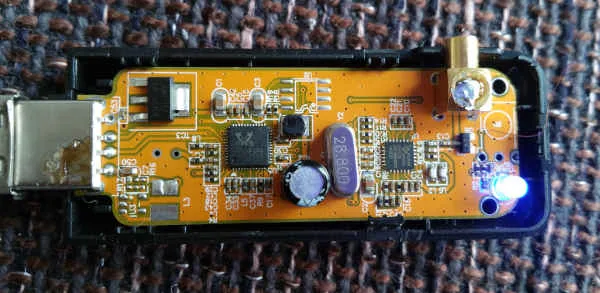
For years, software radio remained limited to sound card kits or expensive lab gear. That barrier fell in 2010 when developer Eric Fry noticed an undocumented raw data mode inside USB digital television tuners powered by the Realtek RTL2832U chip. In 2011, Linux programmer Antti Palosaari proved that these twenty-dollar DVB-T dongles could capture wide swaths of raw radio spectrum in quadrature. Instead of decoding television broadcasts, the USB stick streamed raw eight-bit I/Q samples into computer memory for software processing [9]. A mass-market consumer gadget became a versatile wideband scanner overnight.
The cheap RTL-SDR dongle gave hobbyists instant access to radio waves from 24 MHz up to 1700 MHz when paired with tuners like the Elonics E4000 or Rafael Micro R820T [9]. Free software decoders quickly appeared to track passenger airliners via ADS-B beacons broadcast on 1090 MHz, turning home PCs into live radar displays. Operators erected small antennas to capture live weather photos from polar-orbiting NOAA satellites, decode marine AIS ship beacons, and read municipal pager alerts. Enthusiasts no longer tuned dials blindly [10]. They watched full VHF and UHF bands on screen, decoding several digital transmissions simultaneously on affordable setups [9]. A single USB tuner replaced shelves of dedicated desktop scanners for thousands of curious listeners worldwide. Real-time spectrum waterfalls revealed hidden signals instantly [10].
Basic television dongles have clear limits. Their eight-bit converters lack dynamic range, their crystal clocks drift with heat, and they cannot tune HF bands below 24 MHz without extra parts. Builders solved this by injecting HF signals directly into unused ADC pins or adding upconverters like the Ham It Up board [9]. Higher-grade receivers from Airspy and SDRplay offer cleaner oscillators and better front-end filters [10]. The twenty-dollar dongle democratized radio exploration forever.
From Satellites to Defense
Beyond the hobby desk, software defined radio drives modern wireless infrastructure [4]. Commercial cellular base stations for 4G LTE and 5G New Radio rely on programmable transceiver arrays to handle shifting user traffic and switch bandwidth on the fly [3]. Public safety agencies deploy reconfigurable tactical radios to connect police, fire, and ambulance crews operating on disparate legacy bands. By loading common software waveforms, first responders talk directly across agency lines without hauling multiple heavy handheld radios [12]. The network adapts through code.
Armed forces around the globe rely on the Software Communications Architecture (SCA) promoted by the Joint Tactical Networking Center (JTNC) and the Wireless Innovation Forum (WInnF) to ensure software reuse across tactical radios [12]. Software-defined radar systems use digital up converters, digital down converters, and active phased array antennas to steer radar beams electronically while generating agile pulse patterns [13]. In electronic warfare, reconfigurable transceivers intercept hostile emissions in milliseconds, measuring pulse width and arrival angle to launch targeted defenses. Code updates keep military systems ready as electronic threats evolve [12].
In scientific laboratories, software radio methods replace older frequency counters and analog mixers in atomic clock metrology. Researchers writing in the Review of Scientific Instruments reported that commercial SDR platforms achieve sub-femtosecond timing stability when comparing optical clocks against microwave standards [5]. Space scientists also use software receivers to track navigation signals from GPS, GLONASS, Galileo, and BeiDou on ordinary multicore processors. Storing raw satellite samples to disk lets researchers replay identical orbital passes to verify advanced signal filtering code [14]. Testing needs no repeat flights.
Hardware Overload and Noise
Software processing offers immense freedom, but physical analog limits still govern receiver performance. Budget tuners often overload when operated near powerful FM broadcast towers or paging transmitters [10]. Because basic eight-bit ADCs offer narrow dynamic range, a single strong local signal raises the entire noise floor, burying weak distant stations across adjacent channels. Radio operators cure this by placing passive band-stop notch filters between the antenna and receiver input [9]. Hardware preselection protects digital processing.
The host PC itself creates intense electrical noise. Switching power supplies, fast processor buses, and unshielded computer monitors radiate radio frequency hash that enters nearby receivers through USB cables and antenna feed lines unless builders take strict precautions. Experienced radio builders install shielded cables and attach ferrite chokes near connectors. Adding forty-seven microfarad capacitors in parallel with small ceramic units across the five-volt direct current power rail stabilizes power delivery to sensitive tuner chips [9]. External loop antennas placed far from residential wiring help isolate faint signals from household electronics [10]. Without good shielding, computer hash swamps weak stations across high-frequency bands. Ferrite beads block stray common mode currents effectively [9].
Moving radio functions into code also introduces network security risks. Researchers studying cognitive radio networks warn that programmable transceivers face rogue threats, including unauthorized firmware updates and spoofed transmissions on licensed spectrum. Regulatory bodies require cryptographic code signing to stop modified equipment from disrupting aviation or emergency frequencies. Securing software radio has become as critical as writing DSP code [15].
- ACADEMIC JOURNAL Reis, A. L. G., Barros, A. F., Lenzi, K. G., Meloni, L. G. P., & Barbin, S. E. (2012). Introduction to the Software-defined Radio Approach. IEEE Latin America Transactions, 10(1), 1156-1161. [Article Link]
- ACADEMIC JOURNAL Machado, R. G., & Wyglinski, A. M. (2015). Software-Defined Radio: Bridging the Analog–Digital Divide. Proceedings of the IEEE, 103(3), 409-423. [Article Link]
- WEBSITE RF Wireless World. (2023). SDR Architecture: Understanding Software Defined Radio. [Article Link]
- WEBSITE ICO Optics. (2026). Software-Defined Radio (SDR) Principles and Applications Explained. [Article Link]
- ACADEMIC JOURNAL Sherman, J. A., & Jördens, R. (2016). Oscillator metrology with software defined radio. Review of Scientific Instruments, 87(5), 054711. [Article Link]
- WEBSITE Wikipedia contributors. (2026). Software-defined radio. Wikipedia, The Free Encyclopedia. [Article Link]
- ONLINE NEWS American Radio Relay League. (2017). Ulrich Rohde, N1UL, Recognized for Pioneering Work on SDR. [Article Link]
- ONLINE NEWS Lindquist, R. (2005). FlexRadio Systems SDR-1000 HF+VHF Software Defined Radio Redux. Redorbit. [Article Link]
- WEBSITE Collier, P. G. (2024). RTL-SDR Software Defined Radio. AB9IL. [Article Link]
- ONLINE NEWS Blythe, R. (2026). What Is Software Defined Radio (SDR)? Real World Examples. Radio Hobbyist. [Article Link]
- WEBSITE Wikipedia contributors. (2026). Universal Software Radio Peripheral. Wikipedia, The Free Encyclopedia. [Article Link]
- WEBSITE VIAVI Solutions Inc. (2026). What is Software Defined Radio (SDR)? [Article Link]
- WEBSITE RF Wireless World. (2026). Software Defined Radar (SDR) Explained. [Article Link]
- WEBSITE Wikipedia contributors. (2026). GNSS software-defined receiver. Wikipedia, The Free Encyclopedia. [Article Link]
- ACADEMIC JOURNAL Baldini, G., Sturman, T. A., Biswas, A. R., Leschhorn, R., Gódor, G., & Street, M. D. (2011). Security Aspects in Software Defined Radio and Cognitive Radio Networks: A Survey and A Way Ahead. IEEE Communications Surveys & Tutorials, 14(2), 355-379. [Article Link]
- WEBSITE Ham Radio FAQ. (2023). What is software-defined radio (SDR)? [Article Link]


