






The joint BepiColombo mission entered orbit around Mercury on Saturday after completing an eight-year flight through the inner solar system to study the scorched world, while flight controllers at ESOC confirmed orbital capture from Darmstadt, Germany [1]. Telemetry arrived from 94 million miles (152 million kilometers) away after the probe completed a 37-minute thruster firing to allow Mercury’s weak gravity to capture it [3]. Humanity has now returned for the first time in over a decade to Mercury: The Planet Closest to the Sun, an extreme planetary world where surface temperatures swing from blistering heat to deep cold [2].
Arrival After an Eight-Year Cruise
Visiting the innermost planet requires shedding immense orbital energy while fighting the Sun’s gravitational pull, making Mercury harder to reach than distant Pluto, as Azul Pinochet-Barros from ESA explained during mission operations [2]. Launched in 2018 from French Guiana, the spacecraft kept thruster brakes engaged to avoid falling toward the Sun [3]. No probe had orbited Mercury since NASA’s MESSENGER mission operated from 2011 to 2015, following the three flybys conducted by NASA’s Mariner 10 during the mid-1970s. Voyager 2 visited Uranus and Neptune in the 1980s [1].
To shed velocity without unmanageable propellant loads, ESOC navigators routed BepiColombo through nine planetary flybys [2]. During this inward spiral, BepiColombo looped by Earth once, flew past Venus twice, and performed six close approaches to Mercury to lose momentum. Those gravity-assist passes added 6 billion miles (10 billion kilometers) to the journey [1]. The $2 billion project, funded jointly with 1.7 billion euros by ESA and JAXA, overcame notable engineering hurdles during cruise, including a 2024 propulsion malfunction that forced ESOC controllers to alter the trajectory and postpone arrival at Mercury from December 2025 to November 2026 [2].
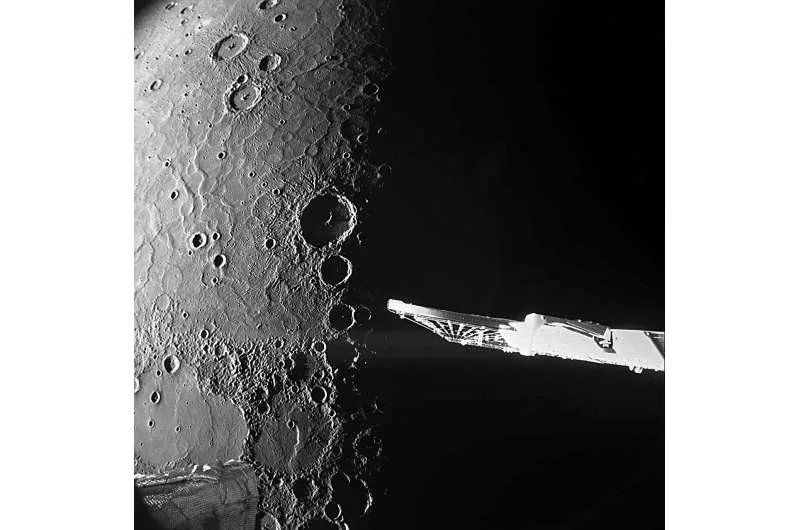
The final orbital insertion relied on a 37-minute engine burn that slowed the spacecraft enough for Mercury’s gravity to capture it, ending several anxious hours for flight controllers in Darmstadt, Germany. Public interest surged after an outreach initiative where ESA invites the public to witness BepiColombo Mercury arrival events to track the orbital maneuvers. Lead project scientist Geraint Jones said ESA and JAXA teams are eager for data to begin streaming down in the spring [1].
BepiColombo Mission Carries Two Orbiters
ESA and JAXA built the BepiColombo mission around two distinct scientific orbiters: the European Mercury Planetary Orbiter and the Japanese Mercury Magnetospheric Orbiter, known as Mio. Both probes traveled attached to the Mercury Transfer Module, which supplied electrical propulsion and solar shielding throughout the eight-year interplanetary cruise [2].
On September 3, the Mercury Transfer Module separated from the science stack, allowing MPO and Mio to complete the final approach together. Flight controllers at ESOC plan to separate the pair between December 9 and December 10, when each craft will fire thrusters into its dedicated polar orbit [2]. Jessica Marshall, an Airbus systems engineer who worked on BepiColombo in Britain, said that the spring mechanism must release gently despite harsh thermal swings and intense solar radiation, while also twisting slightly to start the Japanese spacecraft spinning for rotational stability. Airbus built the spacecraft structure in Britain [3].
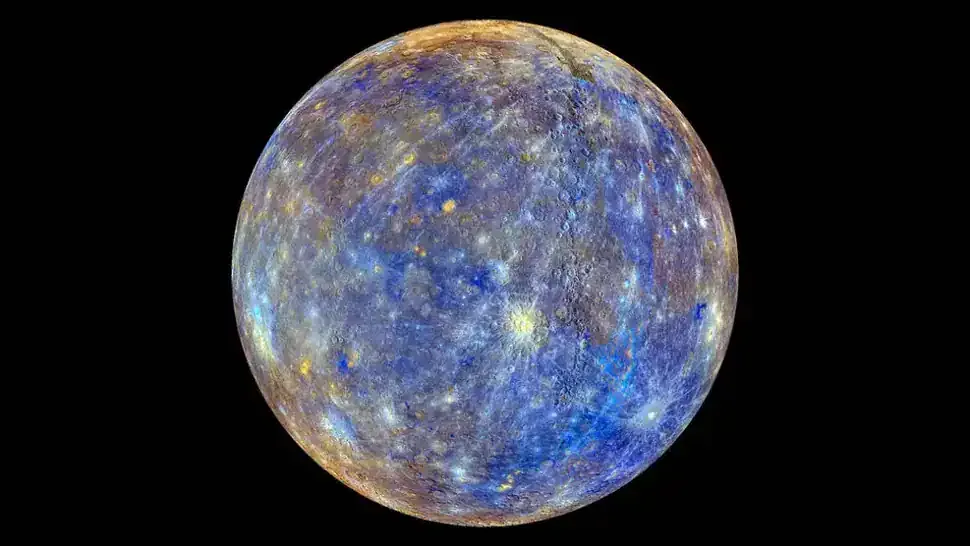
Deploying two orbiters during the BepiColombo mission gives ESA and JAXA simultaneous observations from two distinct altitudes around Mercury [1]. The European MPO will circle close to map surface minerals, while JAXA’s Mio monitors the surrounding plasma environment from higher altitude [2]. Flight controllers in Germany monitored telemetry streaming back from both probes after capture. Lead scientist Geraint Jones said the mission will provide the ability to compare “unprecedented measurements taken by two spacecraft at the planet at the same time” [1].
Surface Scars and Mysterious Hollows
Sunlit plains reach 800 degrees Fahrenheit (427 degrees Celsius) while shadowed basins plunge to -180 degrees Celsius, yet NASA’s earlier MESSENGER probe detected water ice shielded inside dark polar craters where temperatures remain permanently frozen [3]. The European Space Agency’s MPO carries imaging spectrometers to analyze the mineral composition of these frozen deposits [2]. MPO also carries a laser altimeter designed to record topography across volcanic plains, cliffs, and mountain peaks that rise 3 miles (4 1/2 kilometers) into the sky [1]. Surface temperatures climb above 427 degrees Celsius under direct sunlight [3].
Planetary researchers at ESA and NASA also want to solve the origin of hollows, which are shallow, steep-sided depressions found in tight clusters across Mercury’s terrain. These hollows are roughly 100,000 years old, indicating that they formed relatively recently in planetary history. Scientists know they are not standard impact craters left by colliding space rocks, suggesting volatile minerals may be vaporizing under intense solar heat [3]. High-resolution cameras on ESA’s MPO will examine these sunken features from close range to determine whether they remain actively developing today [2].


Why Mercury Has a Massive Core
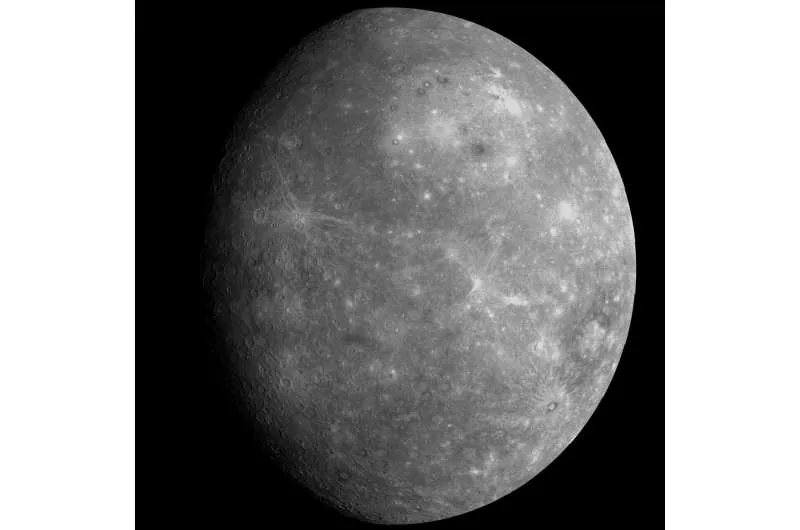
A dense metallic core occupies an enormous share of Mercury’s interior volume, posing an enduring puzzle for planetary geologists. Prof Emma Bunce, a principal investigator on the mission from Leicester University in Britain, said that Mercury might have started much larger before a catastrophic impact stripped away its outer mantle, or weathered a prolonged series of smaller cosmic collisions that battered away its rocky crust over time. Alternatively, the planet may have formed inside an iron-heavy region near the young Sun where lighter rocky silicates were less abundant [3].
To test these competing impact models, ESA equipped MPO with a radio science experiment, an accelerometer, and a gravitometer. These instruments will track minute gravitational perturbations as MPO orbits, revealing the exact diameter and density distribution of the iron core. The radio science experiment will determine the precise size of the planet’s core [2]. Ground teams from ESA and Airbus tested this hardware using a structural model now displayed at the Science Museum in London. Airbus built the test model in Britain [3].
MPO will map gravity variations across Mercury [2].

How the BepiColombo Mission Studies Space Plasma
A core scientific objective of the BepiColombo mission involves examining Mercury’s unexpected magnetic field and surrounding plasma environment, since the tiny planet maintains an active global field that continues to puzzle geophysicists at JAXA and ESA [1]. Measurements from Mariner 10 and NASA’s MESSENGER revealed that this magnetic field is strangely displaced from the geographic core and tilted away from the planetary equator. The internal dynamo mechanism lacks an obvious explanation today [2].
The Japanese spacecraft Mio will monitor how Mercury’s magnetic shield responds to intense solar wind bombardment near the Sun, where ferocious coronal streams blast the planet’s thin exosphere with high-energy radiation and charged ions [3]. JAXA equipped Mio with plasma wave detectors and magnetometers to track particle leakage into the exosphere. Santa Martinez, ESA mission manager for BepiColombo, said that putting two spacecraft into orbit around this mysterious world will deliver unprecedented views of Mercury and open a fresh chapter in planetary exploration [2].
Thermal management presents an acute engineering challenge because solar radiation heats exterior surfaces to more than 427 degrees Celsius, threatening sensitive scientific instrumentation during each close orbital pass. Geraint Jones said that keeping the spacecraft and its instruments cool represents a major hurdle in itself [1]. Multi-layered insulation blankets and specialized radiators designed by Airbus in Britain must continuously dump excess thermal energy into deep space to preserve internal electronics. Radiators discard excess heat into space [2].
Timeline for Science Operations
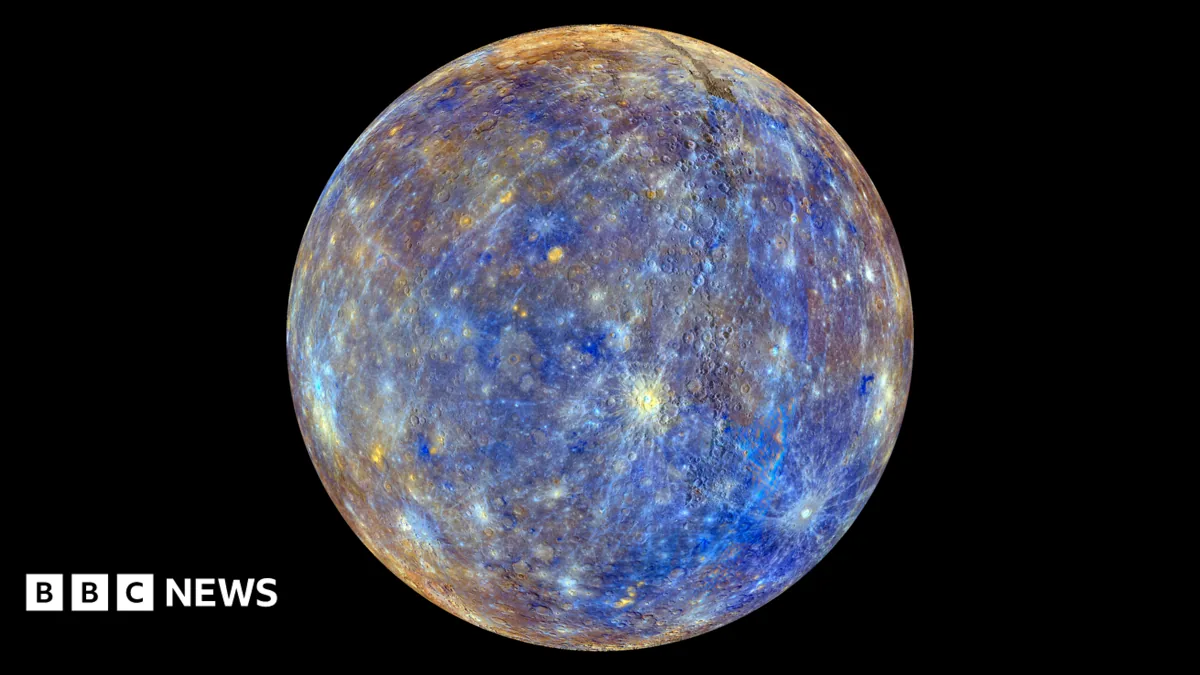
Although BepiColombo has entered Mercury orbit, MPO and Mio must spend several weeks completing operational checkouts before flight controllers at ESOC initiate their planned physical separation between December 9 and December 10. Each orbiter will then adjust altitude and deploy science antennas [2]. Full scientific observations will officially commence in April 2027 once both probes enter their dedicated polar orbits, running for at least one Earth year, which equals four full Mercury years [1]. A day on Mercury lasts 59 Earth days, while a full orbital year takes only 88 Earth days [3].
ESA and JAXA planned an extended mission through 2029 [2]. The joint mission honors Italian mathematician Giuseppe Colombo, whose orbital calculations enabled NASA’s Mariner 10 to execute the first Mercury flybys in 1973 by using Venusian gravitational assists to shed velocity [1]. Santa Martinez said the mission will provide unprecedented insights into planetary evolution as data from the BepiColombo mission explains how our solar system’s innermost world formed in the solar furnace [2].
- ONLINE NEWS Dunn, M. (2026, November 22). Mercury gets its first visitor in years as a pair of spacecraft loop into orbit. Phys.org. [Article Link]
- ONLINE NEWS Cartier, K. M. S. (2026, November 22). After 8 Years in Space, a Spacecraft Has Finally Reached Mercury. ZME Science. [Article Link]
- ONLINE NEWS Morelle, R., Francis, A., & Jolliffe, T. (2026, November 20). BepiColombo spacecraft arrives at Mercury after eight years. BBC News. [Article Link]
APA 7: PerEXP Teamworks. (2026, November 23). BepiColombo Mission Enters Mercury Orbit After Eight Years. PerEXP Teamworks. https://perexpteamworks.com/en/bepicolombo-mission-enters-mercury-orbit/


