




Microsoft senior business strategy manager Brandon Stirrup deleted his X account on October 19, 2026, less than 24 hours after publishing posts on X saying that game makers who refuse artificial intelligence shouldn’t stay in business. Stirrup insisted that studios without AI tools are planning for a fake future, but heavy online backlash quickly pushed him off X [1].
Brandon Stirrup Defends Vibe Coding
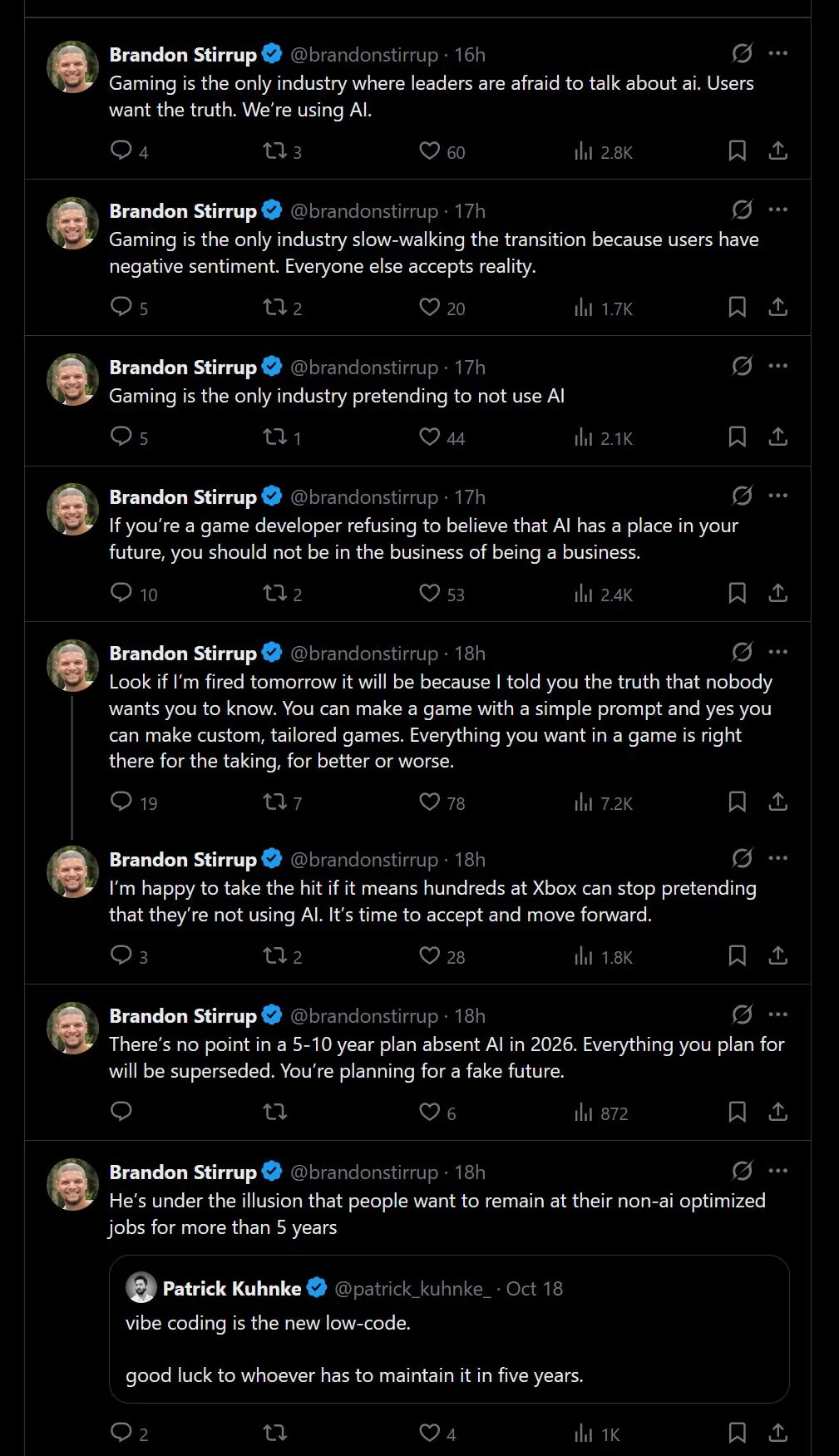
The social media sequence began when Brandon Stirrup posted a thread on October 18 explaining that he had vibe coded a playable software demo over two days. He wrote that he spent only about three hours actively working on the project, relying on simple text prompts with a chatbot to produce playable game code. Stirrup stated that his short test convinced him that anyone can construct a working game without coding training. In his opening posts, Stirrup argued that five-year and ten-year studio plans that exclude AI tools are completely unrealistic in 2026 because machine learning tools will supersede older design practices [1].
Stirrup then warned working game creators with a direct warning about their relevance. He wrote, “If you’re a game developer refusing to believe that AI has a place in your future, you should not be in the business of being a business.” He added that anyone can now prompt custom games, saying that tailored playable projects are ready for the taking [2].
Stirrup also claimed he was fully prepared to accept personal career fallout if his remarks provoked anger from Microsoft leaders or gamers. He posted that if he got fired the next morning, it would happen because he told what he described as truths that nobody wants revealed. He wrote, “I’m happy to take the hit if it means hundreds at Xbox can stop pretending that they’re not using AI.” Stirrup maintained that his core goal was helping Microsoft move past public secrecy, arguing that all major tech firms already rely on machine help in 2026 [1].
A Soccer Prototype and Vibe Coding Claims
To back up his argument, Brandon Stirrup shared a short video clip showing the demo he built through prompt inputs on X. The footage showed a basic soccer simulation featuring elementary player models and rudimentary physics on a plain field. He admitted that he had never attempted to make a video game before. Stirrup claimed that prompt-driven vibe coding lets anyone build playable titles without learning game engines or writing code by hand [2].
Writing for GamesRadar+, gaming journalist Anthony McGlynn observed that the soccer project looked exactly like a basic test produced during three hours of casual chatbot prompts. The demo lacked refined controls, responsive physics, or deep gameplay mechanics that retail sports releases need to keep players engaged over long sessions. McGlynn pointed out that assembling a simple tech demo with a chatbot isn’t the same as designing a complete video game, especially when commercial projects demand deep testing, balance passes, and code optimization to run reliably on consumer consoles. Generating basic assets through scripts does not resolve the hard artistic and coding hurdles that studios solve daily [2].
McGlynn also challenged Stirrup’s claim that game creators can’t succeed without generative tools, pointing to hit releases like Palworld, Wardogs, and Slay the Spire 2. Those hit games showed that studios can achieve massive player reach without relying on automated text prompts. In McGlynn’s view, asserting that businesses without machine learning are doomed ignored how creative teams actually build beloved games [2].

Unverified Claims About In-House Studio Work
Beyond his personal coding test, Brandon Stirrup made broad claims about daily production habits among Xbox teams. He asserted that hundreds of Xbox employees use AI tools, arguing that gaming is the only field where leaders remain afraid to discuss machine learning openly. Stirrup framed his thread as an effort to break that silence, urging Xbox peers to stop pretending that machine tools aren’t part of standard office work. However, his statements about broad in-house adoption remain unverified, as Microsoft leaders haven’t published official data detailing employee access to generative tools or confirmed whether teams use machine code in retail releases [1].
GamesRadar+ could not verify how many coders at Xbox use AI help or whether studios mandate machine learning in live production pipelines. While publisher EA reportedly made chatbots mandatory for staff last year, audience reception to machine-made game assets stays negative. That friction aligns with earlier reporting on the Xbox Activision Bethesda crackdown on viral AI games, where platform administrators set clear limits on unvetted AI assets [2].
This episode wasn’t Stirrup’s first public effort to push workers to adopt AI tools during challenging career transitions. Last month, he counselled departing staff to use Microsoft Copilot to catalog their skills and job achievements after rounds of Xbox layoffs amid studio consolidation across Microsoft teams. His previous advice showed a consistent belief that automated assistants offer practical career benefits, even as thousands of industry workers face restructuring. Yet for many developers navigating studio closures and job cuts, manager enthusiasm for AI tools feels disconnected from the difficult realities of studio employment [1].
Why Brandon Stirrup Deleted His Account
The sharp online reaction prompted Brandon Stirrup to delete his X account less than a day after posting his thread. Creators and players on X posted thousands of critical replies, pushing back against the claim that writing prompt instructions replaces foundational programming and design skills. The account vanished within a day [1].
While online observers speculated that Microsoft management ordered Stirrup to remove his posts, reporting from PC Gamer revealed a different explanation. Reporter Andy Chalk cited an internal source at Xbox who confirmed that Stirrup chose to deactivate the account on his own initiative due to the heavy volume of replies filling his inbox. Stirrup had declared in his thread that he was willing to take the hit for his public stance on machine learning, but the sheer scale of pushback made keeping the profile active untenable. The account removal ended the immediate exchange, leaving his assertions without follow-up commentary [1].

The episode showed how contentious discussions surrounding automated game creation remain among developers. Stirrup presented vibe coding as an inevitable future that creators must accept, but the backlash proved that working developers reject being told their hard-earned skills are obsolete. When tech managers declare that traditional development is disappearing, creators push back firmly against that narrative [2].
Industry Moves to AI Automation
Despite public pushback against Stirrup’s remarks, several prominent industry leaders continue investing heavily in automated technologies. Epic Games chief executive Tim Sweeney recently said that his company was “moving developers around to retool for maximum AI acceleration,” signaling an executive push for machine help. The Epic Games Store sparked its own major controversy after staff stated that they had vibe coded their latest store launcher, prompting sharp criticism from developers who felt the phrasing diminished professional programming work. Sweeney defended the technological shift, arguing that automated tools will expand what small development groups can accomplish over time [1].
Xbox itself hasn’t abandoned machine learning initiatives, even as managers avoid further social media disputes. Under a former AI leader, Xbox launched Xbox Labs to explore emerging technologies, including machine-assisted workflows. That initiative shows Microsoft stays committed to testing automation, even while rank-and-file developers express skepticism about its impact on game quality [1].
The push for machine-generated code is also reshaping governance rules in the tech world. The Linux project recently dropped its rule requiring contributors to disclose when they use AI tools to write code submissions, removing formal barriers to automated contributions in its code tree. As Linux and major platforms normalize machine help, the divide between corporate proponents and frontline game creators shows no signs of closing. While business strategists argue that automation is inevitable, working developers insist that compelling games still depend on human craft, genuine artistic vision, and deliberate design choices [1].
- ONLINE NEWS Chalk, A. (2026, October 19). Xbox biz guy deletes his X account less than 24 hours after saying game devs who don’t embrace AI ‘should not be in the business of being a business’. PC Gamer. [Article Link]
- ONLINE NEWS McGlynn, A. (2026, October 19). Xbox business manager says devs not using AI shouldn’t ‘be in the business of being a business’ – because he ‘vibe coded a bad but improvable game in 2 days’. GamesRadar+. [Article Link]


