




Longitudinal data from long-running household surveys reveals that growing up poor leaves a lasting mark on future earnings. In Australia, recent findings show that childhood poverty multiplies the odds of economic hardship in early adulthood by more than five times compared to middle-income peers. Researchers Esperanza Vera-Toscano and Roger Wilkins tracked thousands of participants from childhood into their thirties to measure how family income affects adult security. Their analysis shows that young people who grew up below the poverty line face a 27 percent poverty rate between ages 24 and 35, compared to just 5 percent for peers from median-income homes [2].
Measuring Childhood Poverty Across Generations
The investigation drew its evidence from the Household, Income and Labour Dynamics in Australia Survey, known as HILDA, which has followed families annually since 2001. Researchers focused on a sample of 2,205 people whose childhood household finances were observed across at least three years. The team tracked these participants until age 24 to record how early deprivation altered their adult income streams [1].
Australia lacks an official statutory poverty line, so researchers used a relative income measure based on disposable household funds adjusted for family size. Under this framework, the benchmark sat near A$72,000 for a couple with two children and roughly $55,000 for a single parent raising two kids. To evaluate comparative outcomes, the authors set a reference benchmark of families earning between 150 percent and 200 percent of the poverty threshold, which represents the median national income of about $144,000 for a four-person household. Children who grew up below the poverty line faced an early-adulthood poverty rate that was 22.4 percentage points higher than that of the reference cohort [1].
Near-poverty also created a lasting disadvantage for growing children. Households earning between 100 percent and 150 percent of the line, or roughly $72,000 to $108,000, saw an 8.7 percentage point increase in early adult poverty. These gaps carry broad consequences, as data from the Australian Council of Social Service and UNSW Sydney showed that about 757,000 Australian children under age 15 lived in poverty in 2022–23. That aggregate exceeded the combined populations of Geelong, Newcastle, and Wollongong [2].
Educational Milestones and Early Career Obstacles
Disparities in formal schooling form one of the clearest paths linking childhood poverty to adult disadvantage. In the United States, research published by the Urban Institute showed that children who spent at least half their childhood in poverty graduated from high school at lower rates. By age 20, only 62 percent of these children obtained a diploma, compared to 90 percent of peers who never experienced poverty during their upbringing [3].
The divide widened in higher education, where family savings often dictate whether students can manage tuition and living costs without leaving school. According to the Urban Institute’s figures, only 23 percent of young adults from persistently poor backgrounds enrolled in higher education by age 25, while 70 percent of non-poor peers enrolled. Completion rates showed an even steeper barrier, with just 3 percent of those raised in chronic poverty finishing a college degree by age 25, in contrast to 37 percent of their economically secure classmates. These educational hurdles directly altered their employment stability as young adults. Overall, researchers discovered that only 16 percent of children who spent half their childhood in poverty were consistently working or studying and largely free of poverty by their late twenties [3].
Compounding Pressures in Sole-Parent Homes
Children raised in single-parent households encounter compounding hurdles that make early hardship especially persistent. Australia counts roughly 1.2 million single-parent families, and their children experience disproportionate economic exposure. Research by the Australian Council of Social Service and UNSW Sydney determined that 37 percent of children in sole-parent households lived in poverty in 2022–23, compared with 11 percent of children living in partnered households [2].
Because a solitary parent must manage all unpaid childcare, household duties, and wage-earning responsibilities alone, balancing basic living expenses becomes far harder over time. This dual strain was documented in an August 2025 investigation led by Swinburne University researchers, who surveyed 2,590 Australian single parents, most of whom were women. The study found that 78 percent of single mothers spent “a lot” or “almost all” of their daily hours worrying about or planning for their family’s economic survival. One survey participant described the relentless pressure simply: “I need more money. The financial stress feels untenable” [2].
In a related report on single mothers, researchers Kay Cook, Ashlea Byrt, and Terese Edwards found that time-poor and resource-poor mothers must balance survival demands while managing trauma recovery and care. These daily pressures leave fewer reserves to buffer children against future shocks. When family resources remain depleted for years, children miss out on enriching extracurricular activities, tutoring, and stable housing conditions that foster long-term resilience [2].


Health Hazards and Toxic Stress
Physical environments in low-income neighborhoods often introduce hazards that affect health long before children enter the workforce. According to a 2016 report from the American Academy of Pediatrics, childhood poverty raises accident mortality fivefold. The academy reported that low-income homes often lack functional smoke detectors and expose young residents to open fires, unprotected windows, and unsafe stairs. Beyond acute injuries, children facing poverty suffer from higher rates of chronic conditions such as asthma, obesity, and diabetes, which are compounded by greater exposure to secondhand tobacco smoke and fewer chances for safe recreation [3].
The neurological toll of early hardship can be even more enduring. Dr. Benard Dreyer, a former president of the American Academy of Pediatrics, told FRONTLINE that persistent economic deprivation generates toxic stress that alters early brain development. “There are definite impacts on physical health,” Dreyer said, adding that unbuffered stress in the first years of life permanently alters neural circuits governing memory and mood control. Constant surges of stress hormones produce a wear-and-tear effect on internal organs and the central nervous system. Dreyer observed that toxic stress impairs basic coping: “It doesn’t doom all children, but on the average, it causes a very significant problem in their ability to react to other stress, their ability to behave, to pay attention and to learn cognitively” [3].
Racial Disparities in Childhood Poverty Persistence
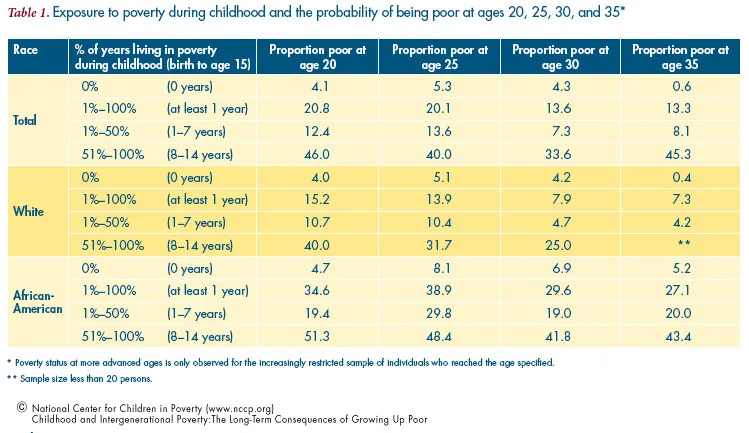
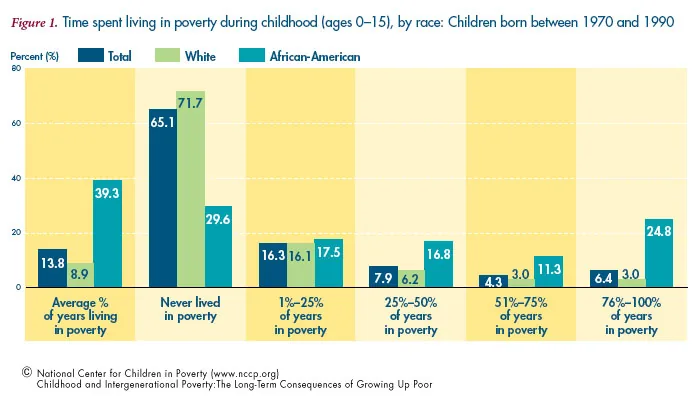
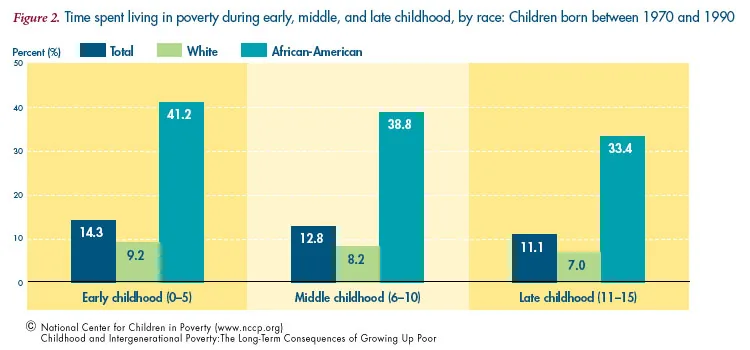
The duration of childhood poverty plays a direct role in whether hardship follows individuals into later life. In an analysis of the Panel Study of Income Dynamics from the University of Michigan, researchers Robert Wagmiller and Robert Adelman examined long-term trajectories for Americans born between 1970 and 1990. Using benchmark indicators developed by Lloyd Grieger, Sheldon Danziger, and Robert Schoeni, the authors found that 35 percent of children experienced poverty before turning 15 [4].
While 69 percent of those affected spent less than half of their childhood in low-income conditions, 10 percent endured persistent deprivation for half or more of their youth, and 6.4 percent were poor for over three-quarters of those years. These duration patterns diverge along racial lines. The data revealed that 72 percent of white children never lived in poverty, compared to only 30 percent of African-American children. Furthermore, 41 percent of African-American children spent more than half their childhood in poverty, a condition experienced by just 6 percent of white peers [4].
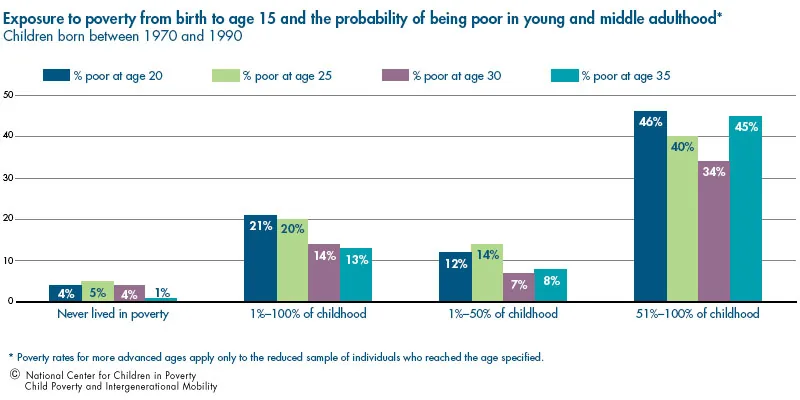
When these cohorts reached adulthood, the penalties remained uneven across racial backgrounds. Among adults who spent more than half their youth in poverty, 42 percent of African-Americans were poor at age 30, compared to 25 percent of whites. In related mobility research, Tom Hertz calculated that 42 percent of African-Americans born in the bottom income bracket between 1942 and 1972 remained there as adults, compared to 17 percent of whites, while Bhashkar Mazumder estimated the parent-child earnings correlation at 0.6 [5].
Two-Generation Strategies for Policy Reform
The economic toll of childhood disadvantage extends beyond individual families to the wider economy. In the United States, research cited by the National Center for Children in Poverty showed that childhood poverty costs society roughly $500 billion each year in lost productivity, health expenditures, and criminal justice operations. In Australia, recent legislative updates have targeted this issue by adjusting payment thresholds for single carers. The Albanese government reformed the Parenting Payment (Single) program by raising the eligibility age cut-off until the youngest child turns 14, an adjustment that assisted at least 57,000 single parents, 91 percent of whom were women. Researchers continue to push for targeted increases to Family Tax Benefit Part A payments to shield vulnerable households from chronic debt [2].
Addressing these long-term disparities requires what researchers term a two-generation strategy, combining immediate cash relief with early developmental investments. The National Center for Children in Poverty recommended establishing Children’s Development Accounts while expanding access to high-quality early education and pediatric mental health care. Maintaining robust longitudinal surveys helps economists measure whether policy adjustments help families escape poverty over multiple decades. As Vera-Toscano and Wilkins stated in their report in the Economic Record, early economic support gives children a better foundation for adulthood, offering a practical path to reduce disadvantage across future generations [1].
- ACADEMIC JOURNAL Vera‐Toscano, E., & Wilkins, R. (2026). The Persistence of Poverty from Childhood to Early Adulthood in Australia. Economic Record. [Article Link]
- ONLINE NEWS Vera-Toscano, E., & Wilkins, R. (2026). Children who grow up in poverty are 5 times more likely to be poor young adults: new study. The Conversation. [Article Link]
- ONLINE NEWS Boghani, P. (2017). How Poverty Can Follow Children Into Adulthood. FRONTLINE, PBS. [Article Link]
- REPORT Wagmiller, R. L., & Adelman, R. M. (2009). Childhood and Intergenerational Poverty: The Long-Term Consequences of Growing Up Poor. National Center for Children in Poverty. [Article Link]
- REPORT National Center for Children in Poverty. (2009). Child Poverty and Intergenerational Mobility. National Center for Children in Poverty. [Article Link]
APA 7: PerEXP Teamworks. (2026, November 2). Childhood Poverty Multiplies Long-Term Hardship Fivefold. PerEXP Teamworks. https://perexpteamworks.com/en/childhood-poverty-adult-hardship-risk/


